
Gunnar Gunnarsson, Novelist and boy from the colonies, left Denmark (the colonial heartland) in 1939 to build a farm on Iceland (the colony) that would provide in a physical form the cultural direction of his novels. His friend the North German architect Fritz Höger, who volunteered to design Gunnar’s farmstead, had in mind something like this …
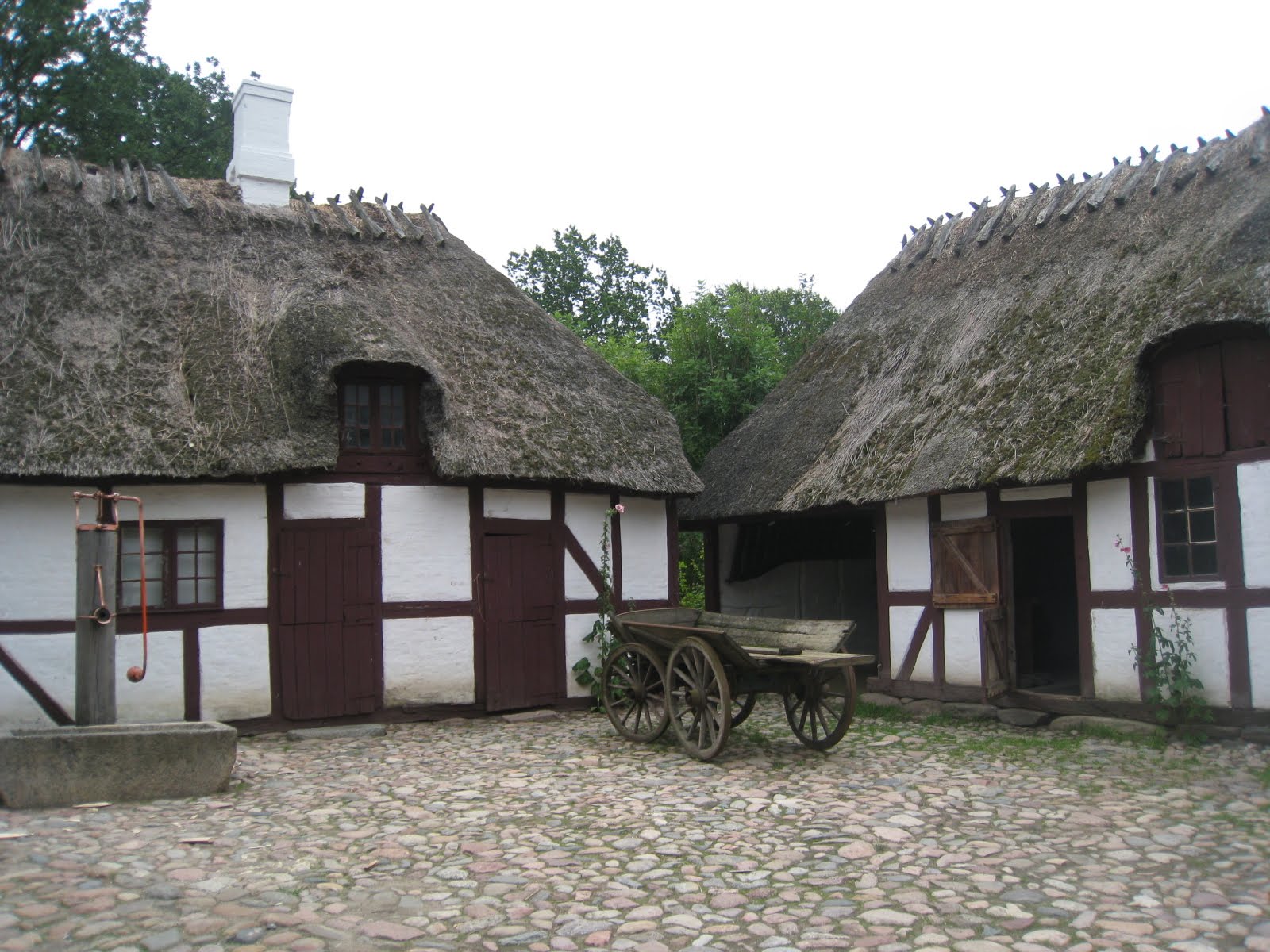 Half-Timbered Danish Farmhouse
Den Fynske Landsby, Fyn, Danmark. The working courtyard in front follows the ancient Norse (and thereafter Icelandic) architectural model of a tun, an open air working room between buildings. Gunnar’s farmstead was to have a large an open tun between buildings, which was abandoned when the additional buildings were never constructed.
A German architect building a Danish-style building on Scandinavian soil for a man who lived his life between the German and Danish worlds would be a way of making peace with the Prussian takeover of Schleswig Holstein (Höger’s area of Germany) from the Danes. It was, of course, the time of an ascendent Nazi Germany, so the idea of a country house built by a German architect would contain some notions of German country houses, and in this case, a Tyrolian one (dominant at the time, with the annexation of Hitler’s Austria fresh in everyone’s minds, and all) …
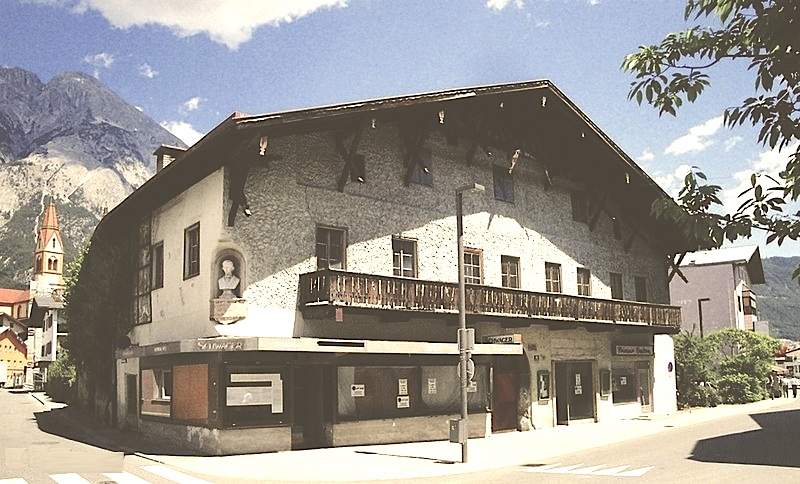 Telfs, Austria
Note the balcony. It provides a commanding viewpoint. A central part of Höger’s design was to build a large terrace in a roman or Italian extension of this model. An absolutely key part of German culture is that Germans like to live outside. Their terraces are their summer homes. It’s not quite like that for Canadians, like myself, or Icelanders, who lives in countries a bit less amenable to lounging around in the cold. Still, what was done was done. What Gunnar had in mind was a totally different idea of living outside, much like this …
 Landhus Farm Barn, Fljótsðalur
This is a variation on the icelandic version of the previous two architectural methods: build the house out of the materials of the earth itself; your whole life is lived within and on the land. In such a situation, a terrace is rather redundant. Gunnar was committed to the idea of human habitation fitting into the land as if it were not even there, or as if it were an extension of it, like this…
 The Foundation Walls of a Former Turf House
Overlooking the Lagarfljót
What he got is more like that than other houses in Iceland …
 Gunnar’s House Seen from Down the Hill
True to Gunnar’s vision, it changes colour with the seasons. True to Fritz’s, it is made out of cemented, rather than stacked stones. Fritz had in mind cut, square blocks of good German rock. There is no such rock in Iceland. The local boys settled on round stones from the river. Score: Germany 1; Iceland 1. A draw.
Thing is, Gunnar’s whole idea was that architecture, and especially how it fit into a landscape, determined the soul of a people and their ways of thinking. He was dead set against putting non-Icelandic architecture within Iceland, as it would, he felt, damage the people and their ability to survive. Now, one reason his farming venture failed is that there was war (started by his readers, the Germans), and a resulting invasion of Iceland by the British and the Americans, who paid so well for labourers to build their infrastructure that there were no surplus young men to care for animals like this …

Icelandic Ewe Demonstrating Ancestral House Roof Clambering Technique on a Hay Bale
Go, girl!
… and in this way the war ripped out the economic underpinning of Gunnar’s farm. What’s more, the rough and ready construction methods the young men learned on the American and British bases had a kind of effect that eventually led to this…

Definitely Not Gunnar-Approved Architecture
Thrown together for reasons of utility and nothing else. That is what farms look like throughout Iceland. There doesn’t appear to be the money on many to build anything better and, besides, it works. This kind of raw utilitarianism would not have appealed to Gunnar, and he would have feared that it would have led to sloppiness. He might have seen this, for example, as a consequence …
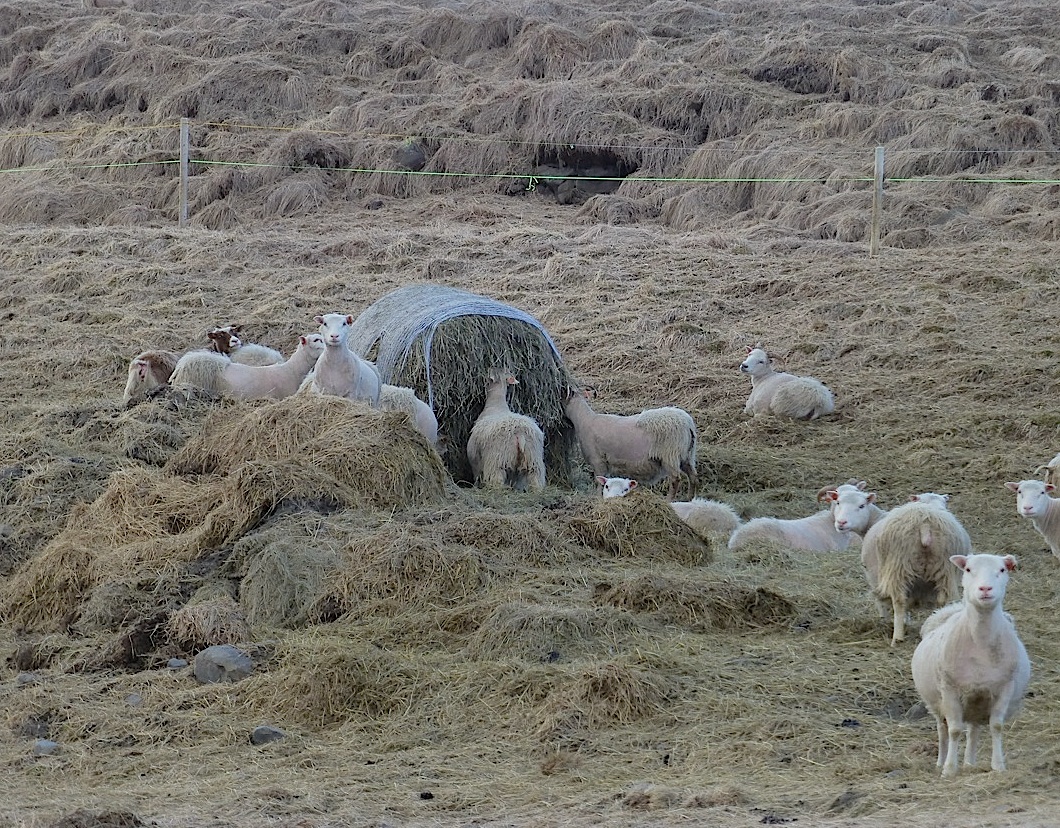 Sheep Pigging Out on a Haybale
But what Gunnar did not foresee was a permanent divorce of Icelanders from their land. A tiny fraction of the original rural population now has to grow more sheep, cows and horses than ever before … something has to give. The solution has been German, rather than Icelandic, industrial farming methods, capitalized on American industrial farming models. Has all this led to the wealth and security Gunnar was trying to create with his tun-based farmstead that would bring German agricultural models to the land and separate Iceland from colonial overlordship by teaching farmers how to get more wealth from their land, and keep it rather than giving it away to colonial capital managers?
 Not quite yet. There’s more than one way to lose your sovereignity. Perhaps the process of decolonization is not complete and something can still be learned from Gunnar’s attempt. Heck, it could have been him holding that protest sign. Perhaps Gunnar’s time has come.
 A Farm in Iceland