Monthly Archives: March 2013

Painting with Ice

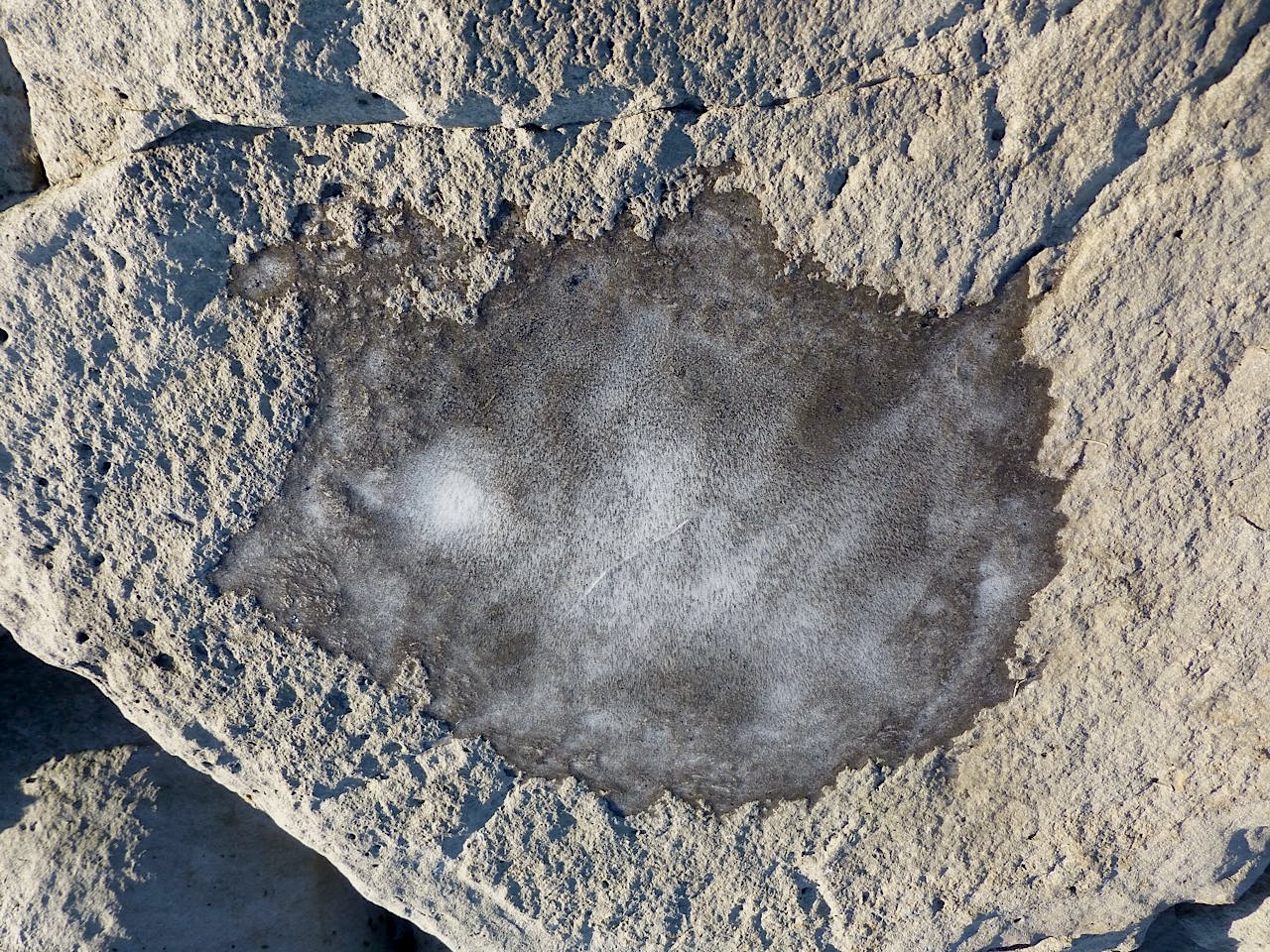
The Icelandic artist Páll Guðmundsson of Húsafell does a lot of work with rock. Sometimes he makes faces on boulders and scatters them in streams, where they look a lot like the boulders with natural faces that are already scattered there. It is like adding extra cards to a deck, and makes life a worthwhile adventure. On December 1st, 2008, however, the Church of Reykholt, Iceland, put on a display of prints of St. Cecilia, which Páll created by painting ice with images with pigments made of ground local stone, then allowing the ice to print them onto paper as it melted. They are inscribed with poems by Thor Vilhjálmsson. Here is one…  

cecilia

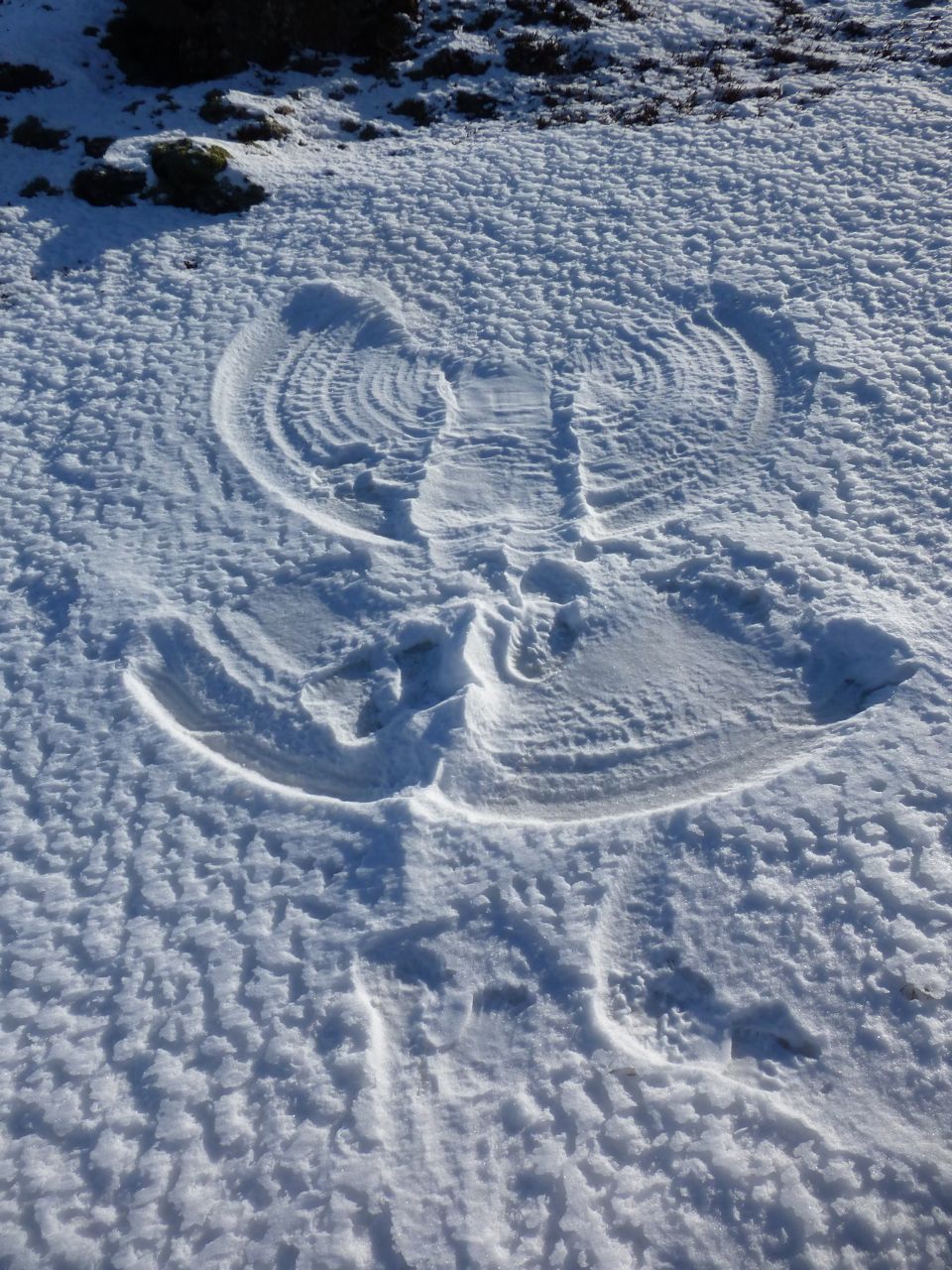
What an inspiring transformation of the art of lithography! Páll is not the only artist in Iceland playing around with the interface between faith, ice and stone. Here’s a spontaneous piece of folk art I found at the sheep fold on the cinder cone, Grabrok …P1280259The angels are among us. Good to know.

Next: snow meets the sea at Sauðarkrokur.

The Language of ice

Gunnar Gunnarsson’s published a fascinating ghost story called Vikivaki in 1932. Iceland is still writing them. Take a look…

P1260997

Ghosts, Öxarárfoss, Iceland

What’s a ghost? Why, something that’s neither dead nor alive and which brings a message from deep within your story.

As for people, they’re writing something else. Here’s what visitors to Iceland write upon the body of the land when they visit:

P1260717Troll People, Þingvellir

They just have to leave a record of themselves, it seems, using whatever is at hand.

For people who live within a landscape, language comes from the land, the water, the light and the air. Here’s a piece of just such a language from Iceland:

P1270050

Language Beginning, Öxarárfoss, Iceland

Forget about cuneiform and Linear B and language starting with bird tracks in sand. There is another way. Forget about writing for purely human audience and deferring the environmental costs of turning from the earth until the future. That future is now.

P1270135

Language Beginning as Art, Öxarárfoss, Iceland

Compare that to the lines in this stained glass window from the church in Reykholt, West Iceland:

window

Mary, The Christ Child, and Three Angels

Reykholt

Iceland is a country in which Christianity is uniquely bound to the soil. Unsurprisingly, Gunnar’s ghosts are a surprisingly devout bunch, called forth in a moment of nationalist zeal. This is one lesson I’m going to happily take home to Canada in 6 weeks. Sometimes the hidden people of a country can be the people themselves.

Next: I will explore these ideas further by discussing an Icelandic artist who paints with ice.

Rebirth in the Trees

Every Western church has a window much like this …

P1270834

Christ Risen

This is a window painted with the art of the mind. Reykholt Church Altar, Iceland

Not many churches, though, have this for a view while you’re sitting in a pew …

P1270831
Church Window, Reykholt, Iceland

The other cross.

Imagine if a people had cut down all their trees to stay warm in the cold, until the poets came along and started planting trees again, until memory was a live and growing year by year, and you could walk through it. Imagine a people who found their liberty in this way, rather than by war or revolution: by planting trees. Well, it’s the kind of country that might build a road like this…

P1270659

If You’re Going to Go Through All the Trouble of Building a Road …

… you might has well have it lead somewhere.

Putting towns at the ends of roads is so expensive. There are other places people need to go. Even Gunnar Gunnarsson found his way home.

Gunnar’s Warning to the Germans

Look at the riddle Gunnar Gunnarsson told the Germans in 1940, just a few weeks before the invasion of Denmark and Norway and the resulting invasion of Iceland by the British and then the Americans:

It is far better for a man to recognize true inner human nature without touching it than through the words and behaviours people dress it in. Such a view into truth is far more vital than casual thought would have it. And certainly it’s no great sacrifice to hold to good taste and respect in all things. And since the talk is about sacrifice, our land has at least fully earned that, and our joy at its beauty will never be complete until these issues are ordered in such a way that gives no more ground for reprimand.

The text it is from a speech called “Our Land.” It can be read many ways. Here’s one:

fold

Turf Sheepfold, Reyðarfjörður

Here’s another, referencing each sentence of the passage quoted above to the argument Gunnar built up in the pages preceding it:

1. It is far better for a man to recognize true inner human nature without touching it than through the words and behaviours people dress it in.

Translation: Iceland has no history, except nature. Elsewhere (Germany included), nature is interpreted through the habits and clothing of people — in other words, through the changeability of time. In Iceland, however, nature is naked, and so are people: they are dressed in nothing, except each other. They do not exist in time — only in place. When one builds a bridge in Iceland (it is an example that Gunnar uses), one has to build it out of Iceland and not out of imported ideas, which sit within foreign customs and gardens rather than within nature itself, no matter how successful they were in other places. In Iceland, they won’t work. The land is not forgiving of any departure from its forms.

P1190151

Workers’ Housing, Aluminum Smelter, Reyðarfjörður

Gunnar would not have liked this.

2.  Such a view into truth is far more vital than such casual thought would have it.

Translation: Truth is untouched nature. It can be approached (and dismissed) casually, but it is not in itself dismissable. Nature is not the contemporary idea of “all things green”, nor the idea of “landscape art”, nor the notion of a goddess of nature called Natura. It is God: wordless, idea-less, unrepresentable and uncontainable. God is Iceland is Nature — or they would be, except God and Iceland and Nature have no names, and no words or ideas can be given to them, only drawn from them.

P1010427Streambed Near Njardhvik

3. And certainly it’s no great sacrifice to hold to good taste and respect in all things.

Translation: Just as with the sacrifice of Christ, good taste and respect (based on an underlying devotion to God) are not sacrifices but a practical good in their own right. Life flows in patterns. On earth (that is to say on “Our Land”), one lives within them. Land is this shore of life, which other people call a planet, and which yet others call countries. “Our Land” is a changeable idea. It really means, “Who we are.” That’s not a modern idea.

stream2

Ryolite Streambed Near Njardhvik

4. And since the talk is about sacrifice, our land has at least fully earned that, and our joy at its beauty will never be complete until these issues are ordered in such a way that gives no more ground for reprimand.

Translation: Iceland has earned the sacrifice of human desire to its eternal forms; all those wishing to speak of sacrifice must learn to do so in a way consistent with the forms of the shore, in the way water finds its path through the grasses yet still moves with great power. Societies can be repurposed. Land cannot. Any attempts to do so will destroy the society of humans on earth. The joy of Icelanders at the beauty of those forms will not be complete until human temporal constructions are ordered in a way no longer out of touch with the streambeds of nature. The bonds between humans and God — a bond called “Our Land” — must be respected, not with words or ideas or customs, but with bodies and with rock. Only the people of a place can build there. All else will fail.bird

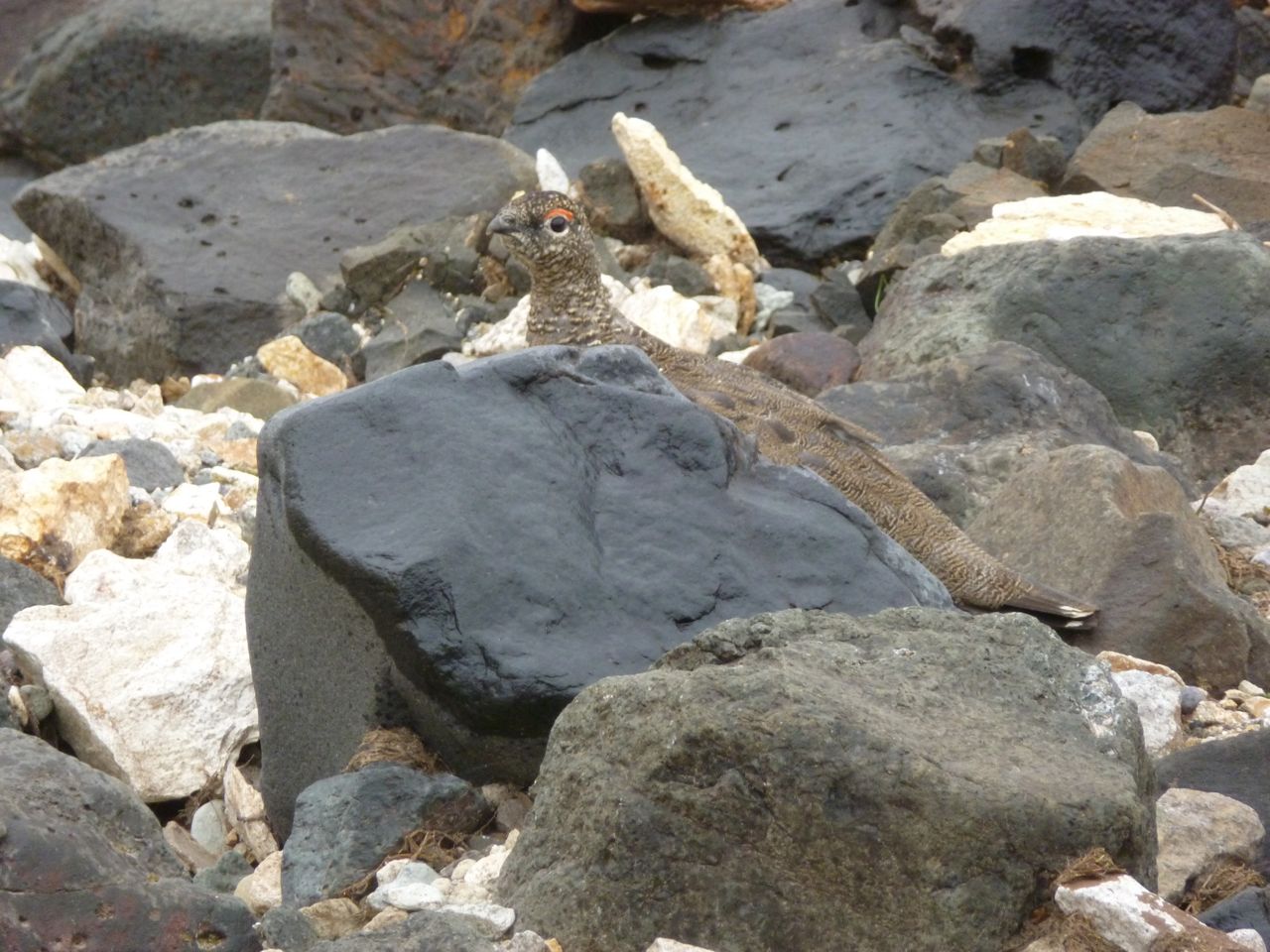
Ptarmigan Waiting for Me to Go Away

It’s a remarkable thing to say, especially to a country in the throes of praise for the sacrifice of thousands of its young men in capturing Poland to provide, in the language of the times, land for nordic people, especially when Finland is falling and talk of Scandinavia’s strategic importance is in the air. Invasion plans have already been drawn up, by both the British and the Germans. It’s an especially remarkable thing from a man like Gunnar, who spent decades advocating for a pan-Scandinavian state and who earned his income writing Scandinavian books for a German audience enamoured with the idea of becoming Scandinavian rather than Mediterranean. It’s an especially pointed statement to a Germany that has just united with Italy, on the Mediterranean, especially when Italy, Norway and Iceland are the three poles of the world given in Gunnar’s speech. Did I say ‘speech’? I meant sermon.

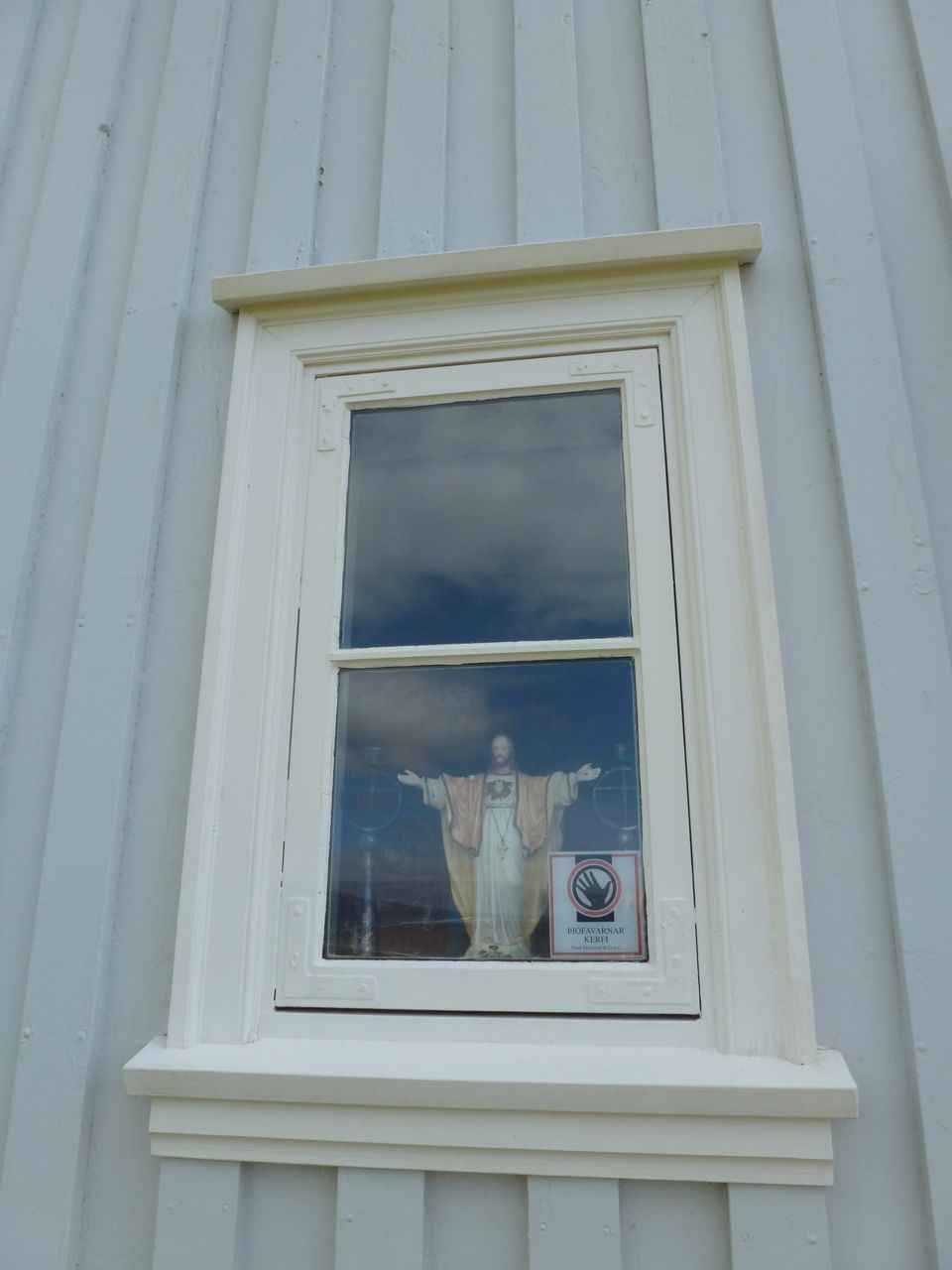
christ

Two Security Systems Hard at Work and Ready to Embrace You. Strandakirkja

Choose the one that works for you.

Next: Gunnarsson as a Lutheran.

Elves, German Nationalism, and Gunnar Gunnarsson

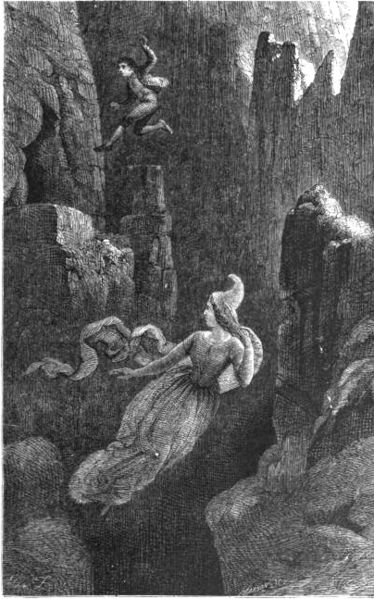
Before Darwin, European culture had many ways of understanding the relationship between humans, land, and evolution. Scientifically, they withered under the evidence of Darwin’s theories, but culturally many of them have remained potent. One of them is the Huldafólk, or Other People, of Icelandic folk culture. The English translation is “elves”, but these aren’t Tolkein’s elves, nor are they the fairies of Irish folklore. These are human-sized people, just more beautiful than the humans themselves.

374px-Jumping_after_Hildur
Jumping After Hildur
A man jumping after an elf (English Engraving, 1864)
Another set of alternate people are the dwarves of Norse (and occasionally Icelandic) legend…
P1020278Dvergasteinn, Seyðisfjörður

The dwarves, it is said, rowed this dwelling (rock) across the fjord, when the humans moved their church to this site, because they missed their company on Sundays. Eventually, the humans moved away and took their church with them. The stone (and its dwarves) is left.

Another alternate human is the Green Man, and his relative, the Old Man of the Woods. These people were said to be the original humans, who had risen from the earth and the trees.

greenThe Green Man, Görlitz, Germany

With his leafy beard, hair, and moustache.

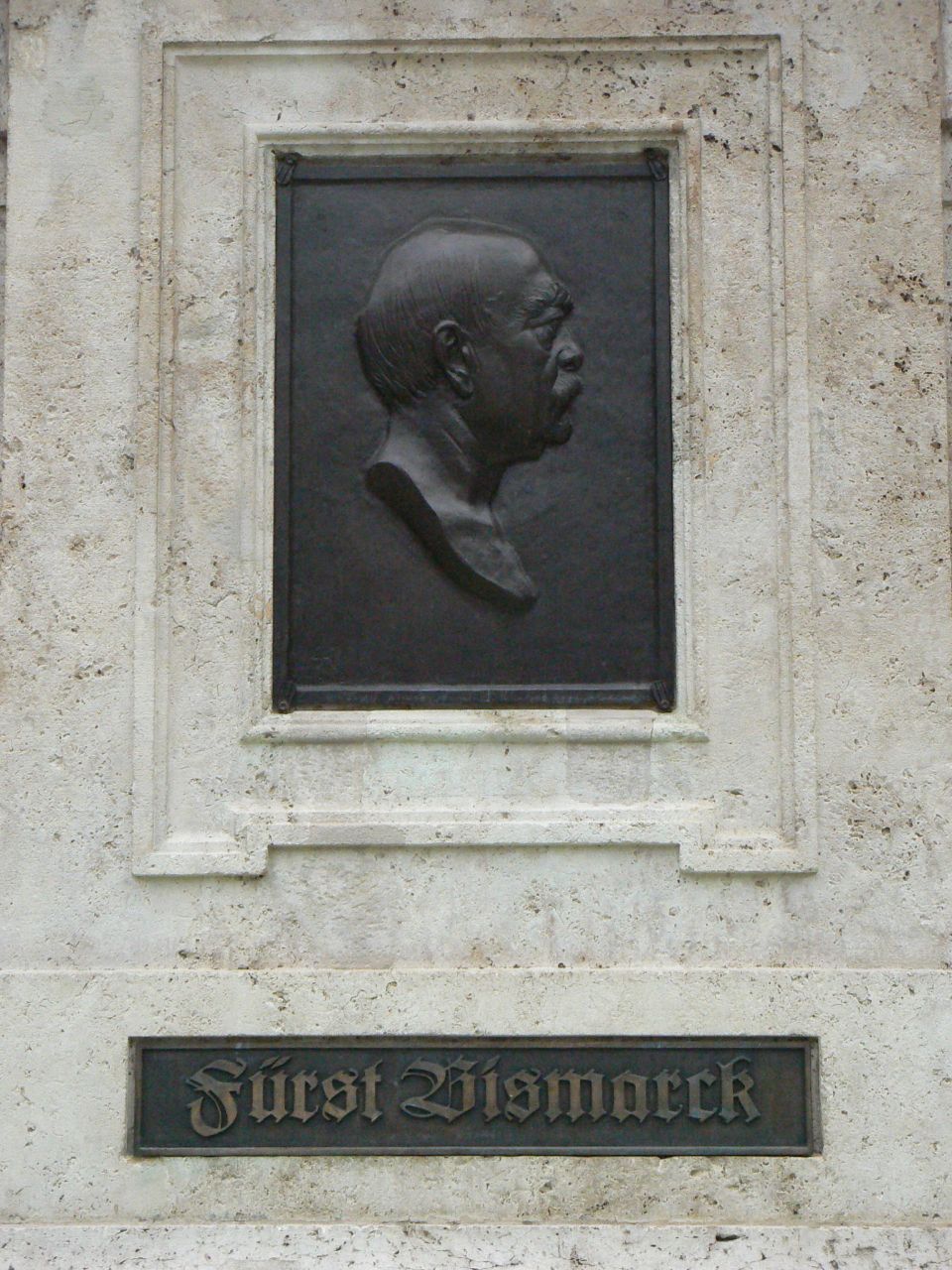
The Green Man was an important nationalist symbol in the German struggle for independence in the mid-19th century. He was often said to be a representation of the first Christian, Judaic and Islamic human, Adam. Here those ideas kind of come together in one of the contemporary centres of German ultra-nationalism:

bismarckBismarck, the Iron Chancellor, Jena, Germany

The father of Germany, with his bushy Green Man Moustache. Now a fountain.

Here is an older image of these men coming together in one spot:

barbarossaBarbarossa, or Holy Roman Emperor Friedrich I, Kyffhäuser Monument, Germany

Friedrich’s Crusade to recapture the Holy Land came to an end on June 10, 1190, when he drowned in Northern Lebanon. The monument was erected to commemorate the founding of the modern German State.

Few of Barbarossa’s (Red Beard’s) 100,000 men made it home. Legend, though, has him return to the country as an old pilgrim dressed in grey, inspecting his kingdom, which had lapsed from true observance of Christianity and was a shambles, much like this figure…

wodin

Wodin, from the lost Hall of Sagas, in Silesia

Odin of Norse Belief, or Gandalf in the modern version, or Barbarossa, take your pick. Old legends just don’t die out. Barbarossa was the code name for Hitler’s Invasion of Russia in 1941.

Depressed at it all, Barbarossa retreated to the castle on Kyffhäuser Mountain, where he lived inside the mountain with his knights, served by the dwarves of the mountain. He drank a lot of beer with them and fell asleep, only to wake a century later, ask if it was time to wake up, and then drink another beer and fall asleep once more. His beard kept growing.

P1160220One of Barbarossa’s Dwarves

Dwarves show up continually in German folklore. Luther, the translator of the Bible and unwilling founder of Protestant Christianity, was raised in such legends, in the mountains east of Frankfurt, where his father was a coal miner and descended among them daily. Their power haunted their simple forest house.

Luther’s dwarves were the subconscious mind of the German people. They lived inside what was known as “the living rock”, or the deep rock of the mountains. Gunnar Gunnarsson, son of Iceland, descendent of men of Odin, born to a country of turf houses buried in the earth, also came from this story. So did this man:

DeeJohn Dee, 1527-1609

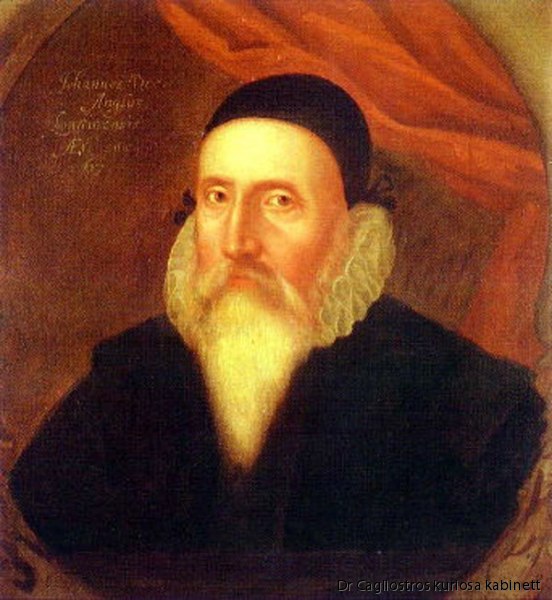
Dee was an Englishman who served as Court Astrologer to Queen Elizabeth of England, created the navigational instruments used by early European explorers in the North, and spent many years writing down his conversations with the angels. He believed that if he could learn their language, and speak it correctly, he would be able to conjure up the spirits of the earth and the air, as God did in the Book of Genesis, restart Creation, heal all war and disease, and return earth to Eden. Legend has it that when the Spanish Armada, the most powerful state in the world, attacked England, John Dee wove a magic spell around the Island and conjured up a storm, which wrecked the Spanish fleet. This act formed the basis of Shakespeare’s play, The Tempest.

prosperoProspero, Duke of the Island, Banishing the Half-Human Creature Caliban

The tree spirit Caliban is not unlike the Green Man.

Return Earth to Eden? Cast a spell around an island alive with spirits of earth and air? Banish the half-humans? Retreat to a mountain stronghold (an old monastery)? Found a country? Invasion from the most powerful country in the world? The old gods walking the roads in disguise? This is the context in which Gunnar Gunnarsson was operating — the old European, pre-Darwin context, that was still very much alive in his time and is still alive today. In my next post, I’ll show how these ideas illuminate parts of the speech he gave while on tour in Germany in the spring of 1940.

Trolls and House Building: A Field Guide

Well, not trolls exactly. And not exactly a house. It’s a bit of a riddle, but poets love riddles. Why, you could even say that on the northern shores of the world, poetry developed out of riddles, or that skaldic poetry did, at any rate. Here’s a famous Icelandic skald:

Egil Skallagrímsson, Skald

Ready to do battle with, what’s that, a rusty sword? More like a cleaver, I think. I have used things like that to pick cabbages. Poet farmers unite! (17th Century Manuscript from the Árni Magnússon Institute).

A scaldic poem is a ceremonial poem, given as a gift by a poet (a skald) to his patron, written in praise (or at times rousing criticism — very scalding, very scolding criticism). Scaldic poetry was worked through in intricate design and was intended as a verbal form of the intertwined patterning on a shield — a kind of protective magic. (The contemporary equivalent might be depleted uranium.) At times, skaldic poems were even recited before battle. They were part of the battle. An important part, too, that preceded the bloodiness.

374px-Öl1,_karlevi

The Karlevi Stone, Vickleby, Sweden

Photo by Berig.

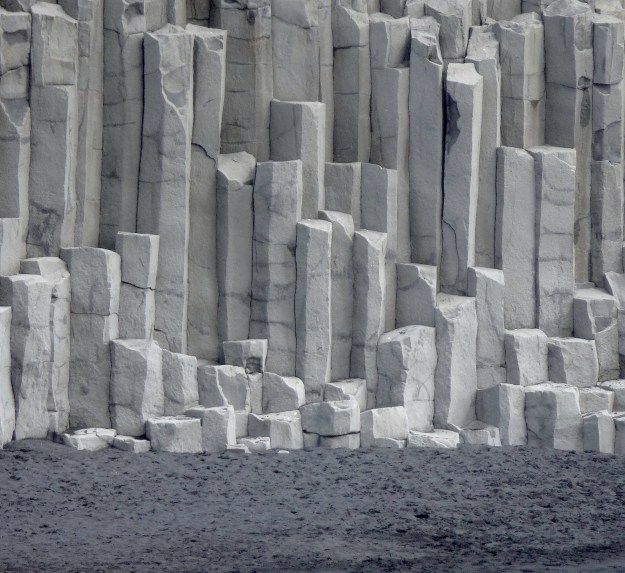
Note the vertical columns of the scaldic poem above. As Gunnar Gunnarsson pointed out in Unser Land (the speech he read from during his 1940 literary tour of Germany), they are not much different than this:
pillars1

Basalt Columns, Vík í Mýrdal

A tightly-linked protective shield poem against the encroaching sea, written in the land itself. (Note: studies from Hawaii have shown that black basalt beaches like this form in hours, not centuries.)

Isn’t that cool? A poem that is the land? That is the riddle Gunnarsson was speaking from: his house is Iceland; Iceland is his house. If that sounds a little unusual, do recall: he’s a poet; he’s not really thinking in metaphor. Mostly, metaphor is for people who are not poets. It’s a useful way, for sure, of describing the work of poets, but it does do so without really accepting the poem as the reality of the world, which is the poet’s way. In the case of Gunnarsson’s house and island, that work is performed in skaldic poetry, which makes his house a shield as well — and not just a shield, but an ornament, too, like this, maybe:

h2_1992.59.1

Viking Broach, Sweden

Men might have wanted shields, to protect their bodies in battle, but, perhaps, just perhaps, women wanted something to hold their garments together at the shoulder, something that was as protective as a shield, something with an island in the centre and the four points of the compass around them, something that would set them at the middle of the world. In Sweden’s case, that would have been North for the Trail to the North (Nor’way), South for Denmark and the trails down the Rhine, East for Finland, and West for the Orkneys — and if you just kept going, going, going, going (whew) … aha! In the middle of the ocean… Iceland.

Once people arrived in the middle of the North Atlantic, the compass shifted. Iceland was now at the centre of the world. The other points of the compass were adjusted accordingly, to reference it. Since all directions led to water, however, Iceland became the entire earth, floating in the universe  (which was a big, cold sea). The country is still roughly divided into these quadrants.

icerecoloured

Iceland, the Compass Version

The shield and compass pattern extends beyond maps. For example, if you really wanted to get into the whole magical side of things, and weren’t squeamish about a little darkness in your life, you could play around with something like the following (You could even write it in your own blood):

2000px-Vegvisir.svg

Vegvisir

An Icelandic magical stave. Staves come in many shapes and were drawn for many different purposes.This one is a compass written in magical symbols, and was used to find one’s way in bad weather.

For such a stave to work (if it did), such navigation would not be done by the physical properties of the land, but by spiritual ones — and we’re not talking Christian-spiritual. In the high days of the Christian Church in Iceland, the possession of such staves could have had you condemned as a witch and beheaded at Þingvellir. That might have been awfully un-Christian, too, but, still, even today, this kind of magic is not advisable. When the Germans tried this kind of thing in the 1930s, for one thing, they invented the 1940s, which turned out to be a really bad idea.

6a00d83452a98069e200e54f76d8928833-640wi

Dresden, February 1944

Among the 20,000 people killed in the Allied bombing of Dresden and the millions of German refugees who streamed through it shortly afterwards on their way south and west from the Baltic, were untold numbers of readers of Gunnar Gunnarsson’s books about Iceland.

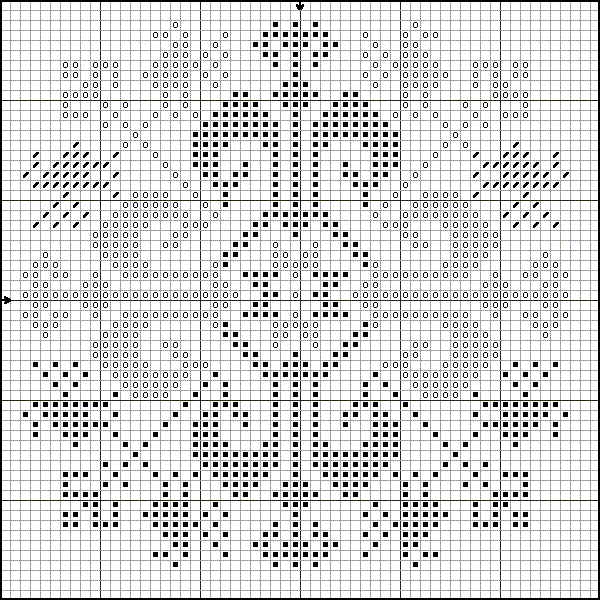
The pattern of land-as-compass-as-shield continues further, into practical applications of gentler spiritual principles. This time, they are placed in the interests of nationalism, where it’s not black magicians in the West Fjords or Ancient Viking ancestors or ultra-Nationalist Germans trained in the killing fields of The Chemins des Dames who are leading the way to a nation, but young women, quietly fitting their minds to the old patterns, to create a little beauty and order out of the blank, snow-white flaxen cloth woven out of the country’s fields. Think of these as self portraits…

icesymbl

Icelandic Needlepoint Pattern

Flowers, yes, but also a hand-held mirror lifted from a dressing table, as well as the old compass, the old shield, the old broach, and the old skaldic poetry, too. Not to mention Gunnarsson’s house. Yes, the house.  Such a pretty thing. Such devotion.

If you think I’m stretching this, consider that five centuries ago in the cloister below Gunnarsson’s house at Skriðuklaustur illiterate young women would have made embroidery of the flowers of the fields. It was a form of prayer, practiced between caring for the sick. Such devotion was the unique Icelandic contribution to prayerful attention and worship, in the way that the repetitive painting of icons of saints was an essential contribution to worship in Russia.
christ-icon-cc-phool-4-XC

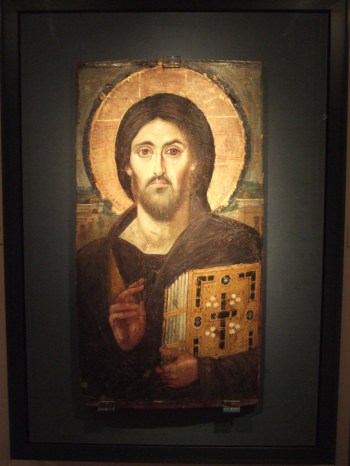
Christ Pantokrator

6th century encaustic icon from Saint Catherine’s Monastery, Mount Sinai. The power comes from about fifty coats of paint and the deliberately non-representational nature of the image. God, after all, can’t be reproduced in an image, so trying would be arrogance. Accordingly, such images aren’t representations of God. They are God’s presence, revealed when people devote themselves to old patterns.

The repetition and patterning were key. For example, just down the valley from Gunnarsson’s house at Skriðuklaustur, the old girls’ school at Hallormsstaður trained girls in Icelandic embroidery, as one part of a project to create a culture in Iceland independent from Danish influence. If the home was the heart of the country, and women were at the heart of the home, and the country was its children, then Icelandifying young women would, it seems, pay future dividends. Politification (My, aren’t I inventing words today) of national identity could follow at its own pace.

hallormsstadur

Icelandic Nationalist Embroidery, 1930s, Hallormsstaður.

The doors of the rooms in the school dormitory bear the names of trees, instead of numbers, and are set within a somewhat overgrown botanical garden. Such gardens were decorative in mainland Europe. In Iceland, they are a more practical magic. 

The embroidery above is much like a map of Iceland. When you get down to ground level, after all, and experience the map that is Iceland on a human scale rather than an international or global one of contours, nation states, trade patterns, colonies, weather isobars and even corporate banking, Iceland does look like this:

p1190188

Iceland at Ground Level, Neskaupstaður

The embroidery of summer!

This beautiful meadow, may I remind you, is still our shield and still our skaldic poem. It’s also Gunnarsson’s house, his novels, and the workings of his subconscious and conscious minds. Skaldic poems are full of doubling like that. We’re back to this:

His house is Iceland.

Iceland is his house.

Very skaldic, indeed. Of course, in physical terms, when this skaldic play comes to Gunnarsson’s house, the whole thing does look awfully German.

P1020160

Skriðuklaustur

The German architect, the Icelandic stone, the grass roof…why, it’s an island itself. An island in itself. An island. Itself. German….German? That’s the riddle within the riddle. 

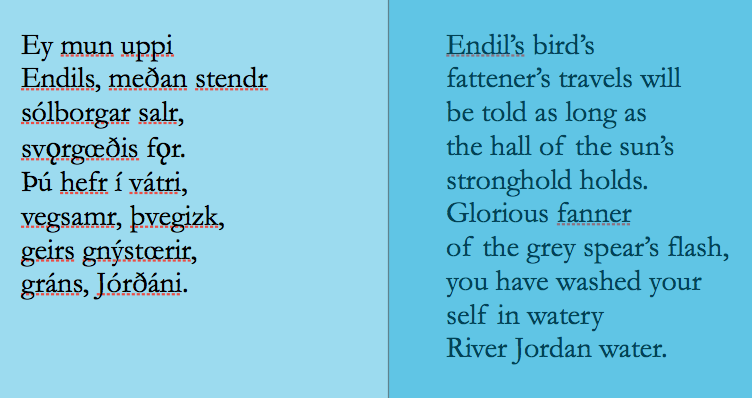
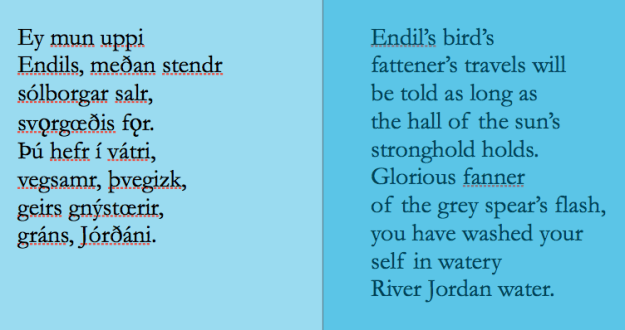
The poems are our key. The first form of doubling in a skaldic poem is a kenning. Kennings are natural word forms inherent in Germanic languages (Frisian, Icelandic, Norse, English, Danish, and so on). Speakers of these languages use words like that all the time. Some English examples are: butternut, windowsill, firefly, and doublespeak. In kennings, this tendency is made artful. Each kenning is a miniature poem in itself. Take the land, for instance, such as that forming Iceland. Take a look at the series of kenning’s below. The earth is cleverly hidden with them, or perhaps cleverly revealed. The delight in recognition is part of the magic of the poem. Can you find the earth there, in its sea? (The translation [mine] is loose, to try to catch some of the music, but it’s not wildly off track, or at least not enough to hide the earth any more than it already is.)
endil2

Skaldic Poem Made Out of Kennings

The earth is “The sun’s stronghold”. The others? Well, hey, it’s a riddle, right? Source.

So, that’s the first doubling: words are given multiple meanings by being joined together. In the example above, the earth is both rock and stone as well as “The sun’s stronghold” (as opposed, seemingly, to the darkness of death, underground, and the land of the salmon, or water).  The other doubling comes about because the rhyme schemes of these poems were so intricate that the poem often had to be split in two columns, one representing each of its two speakers. Two speakers? Yes, that is another old Nordic style of poetry. Here’s what it looked like in its Finnish variant…
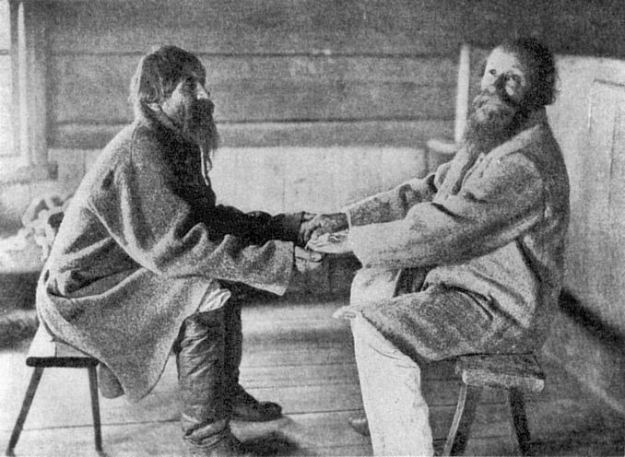
These two Finns are singing the Kalevala, the national epic of Finland

Finnish Folk Singers, Telling a Song Together

Each singer pulls the other towards himself to speak, then follows the other to listen, to pull again. It’s like rowing, or weaving.

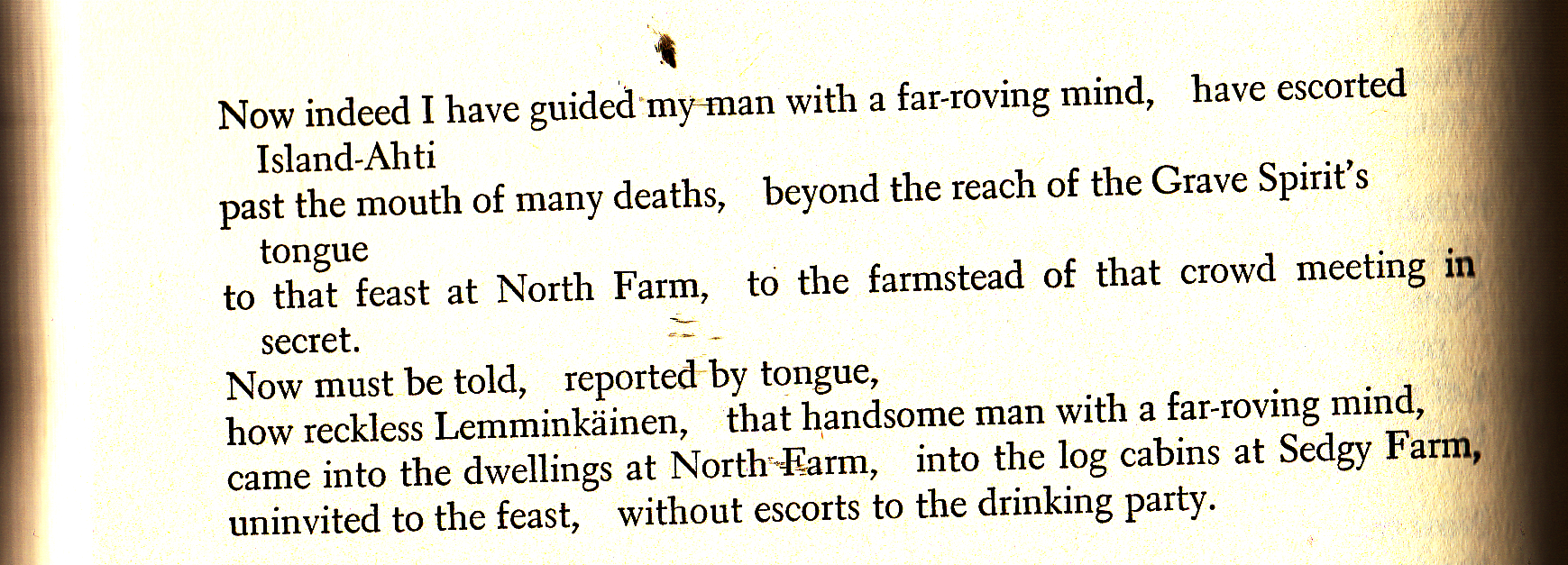
Such poems looked like this, sometimes (the first line in each rhyming pair was given by one speaker; the second by the other… a pleasant game, for sure):

kalevala1

The Kalevala, Canto 27 (Opening)

Finnish is related to Pictish (and nothing else), the language of Scotland before the Vikings took the place for their own.

Here it is again, in English from the time of Gunnarsson’s youth. This time, the rhyming pairs are bound on single lines (to draw parallels with Homer, by the sounds of it):

27The Kalevala, Canto 27 (Opening)

Finnish folk poetry, compiled and massaged into a narrative by Elias Lönnrot. Translated by Frances Peabody Magoun, Jr. Homer was extensively read in literary circles at the time.

Two speakers. That’s the key here. But who are they? Ah, they are many things, many of which I have already hinted at here: Iceland and Germany, Gunnarsson and Denmark, Elves and the Church, earth and language, men and women, peace and war, individual and state, man and God. It looks like many things, but that’s just a linguistic convention. It’s really all part of the same conversation — if those words could be brought together into one tightly compressed thing, we would have Gunnarsson’s house. Let’s not forget that Gunnarsson was an Icelander. For a man like him, the word ‘thing’ has special significance, and looks like this:

P1190592

þingvellir, the Thing Place

Iceland’s first thing, or speaking (In Icelandic, Alþingi. In Norman English parliament), took place here in the Mid-Atlantic Rift in 930. In 1000, the country chose Christianity here, for practical reasons to do with unity, self-determination and self defense.

Below the Icelandic flag above, there is a church, and a curious collection of houses…

P1190582

þingvellir Church, 1850

The earliest church on this site dates from the early 11th century. The row of five houses to the right of the church represent the Icelandic state. Each time the constitution has been rebuilt from the ground up, a new house has been added to the row. The one house that is not represented here, is the one in Fljotsðalur to the North East. That’s right: Gunnarsson’s. Hey, no one said he was particularly modest. The volcano, Thor’s Shield, rises faintly in the background, from the earth’s core.

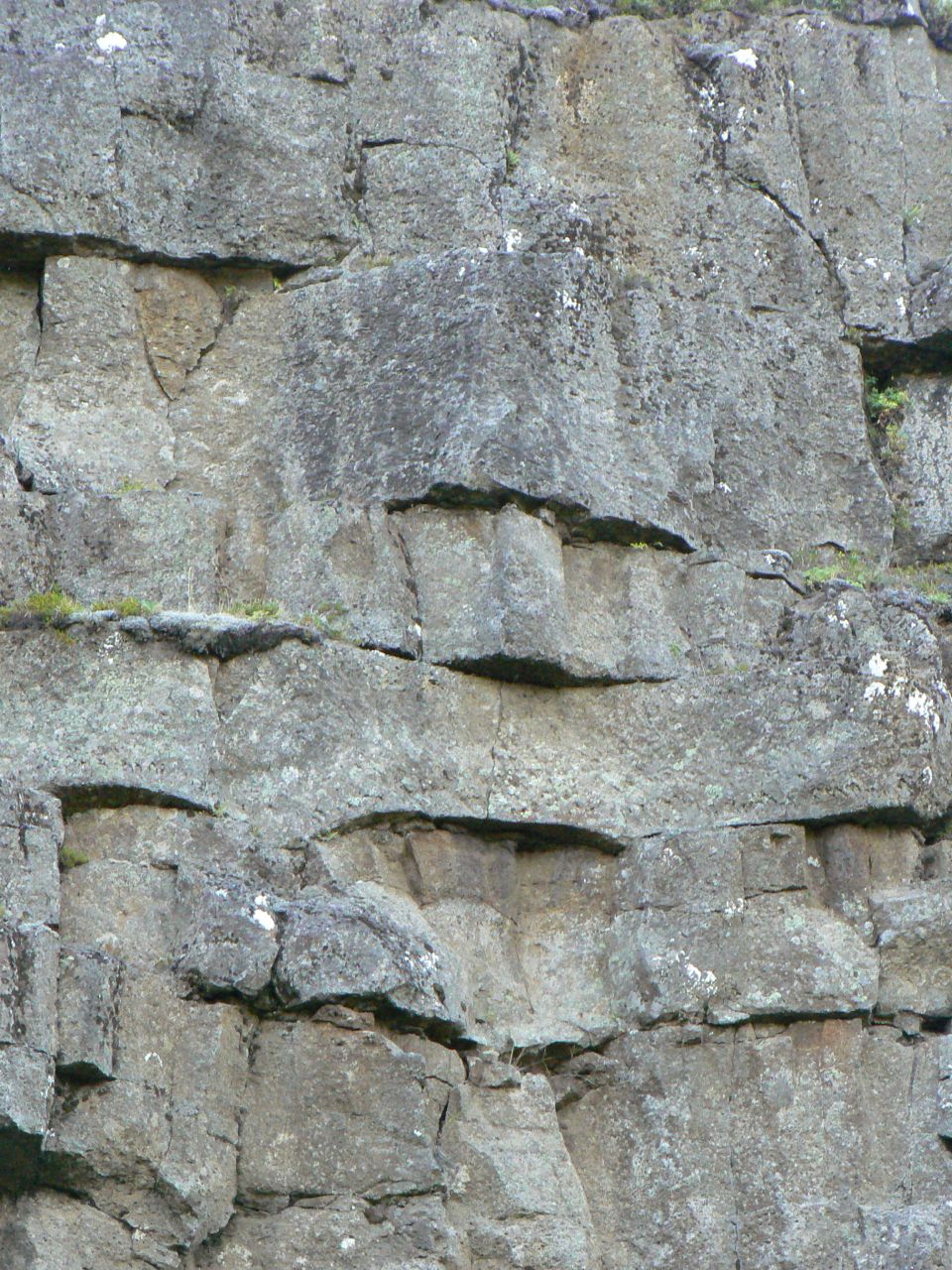
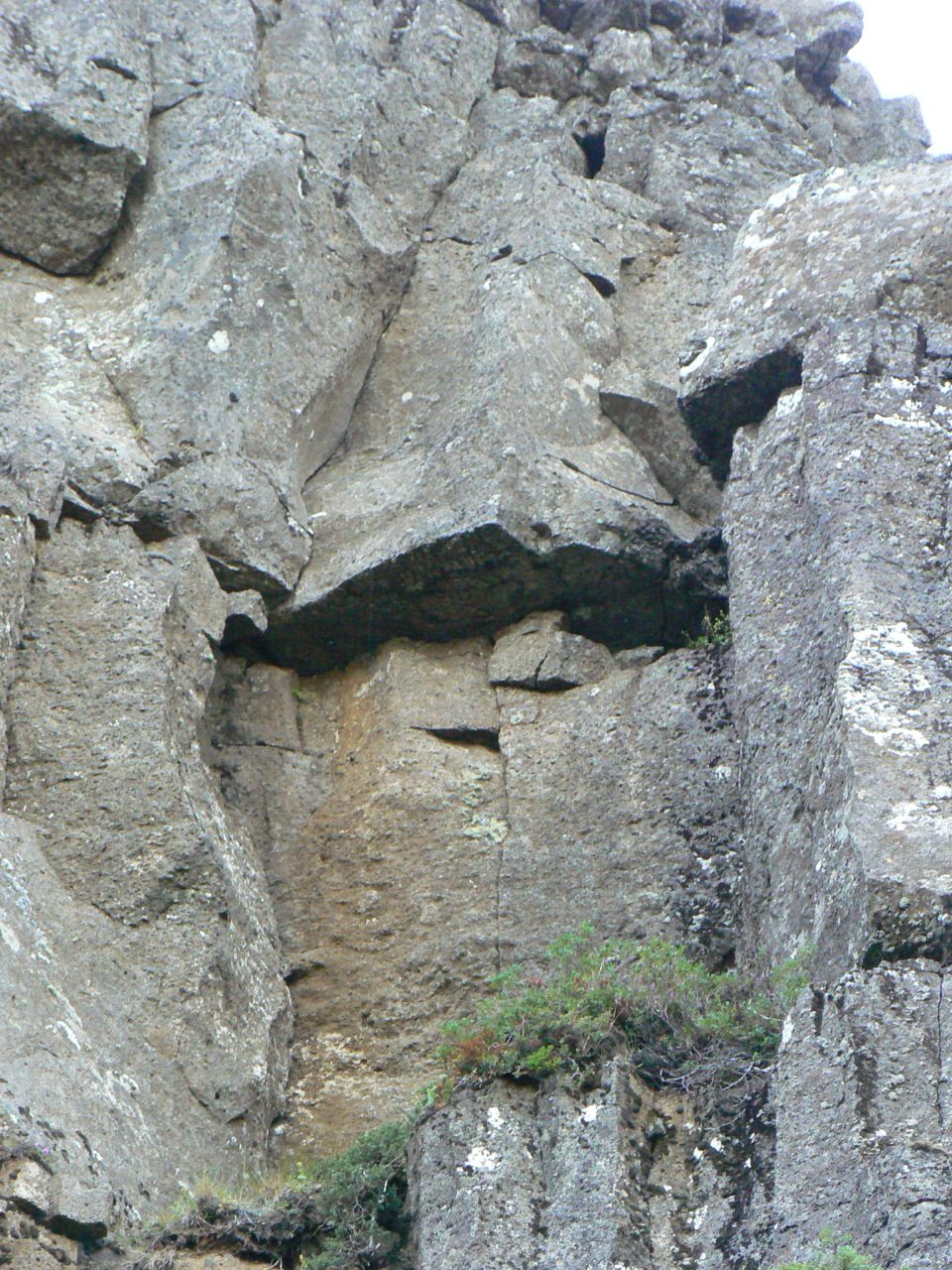
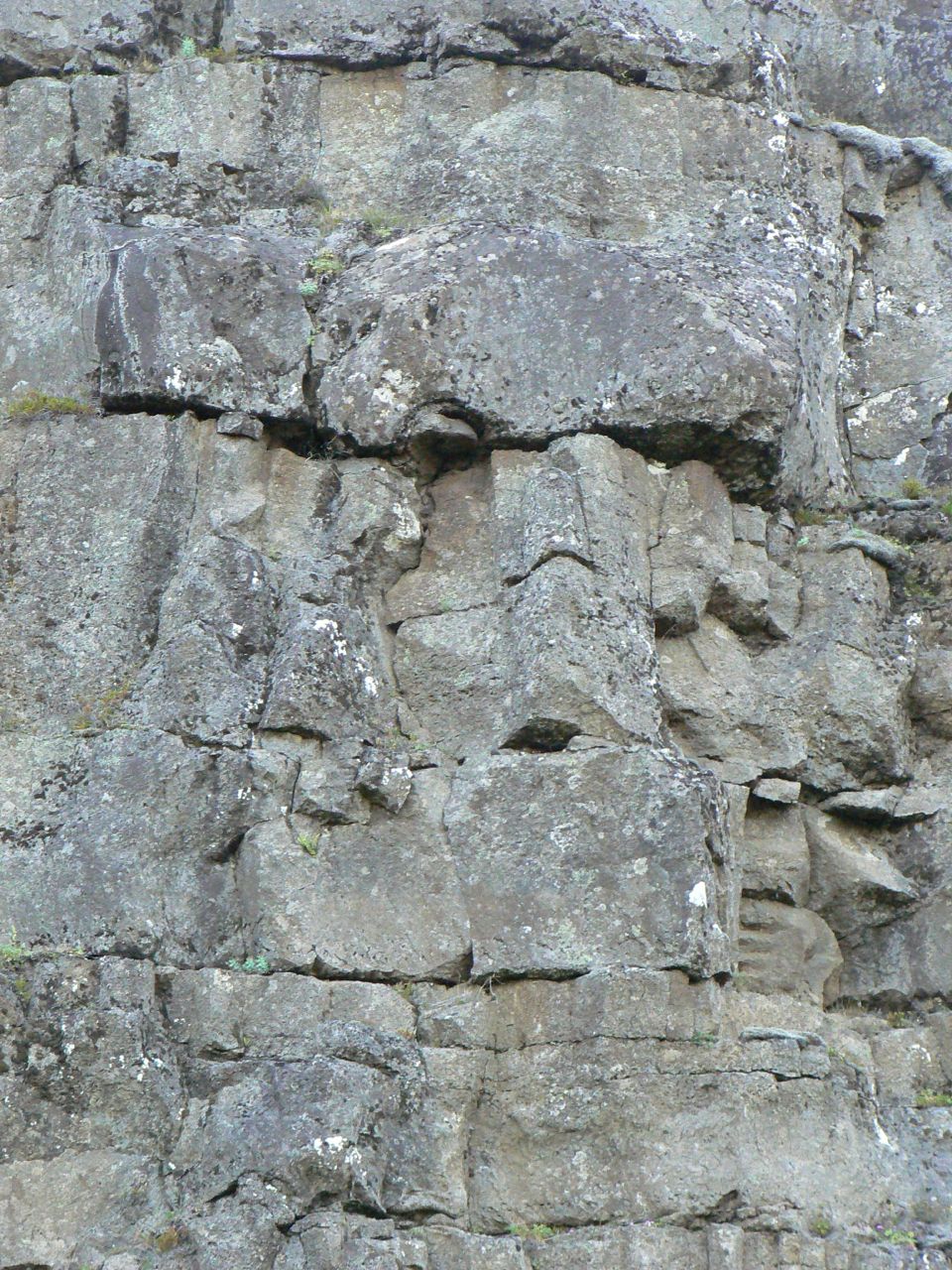
I was standing down by the church, looking up at the Alþingi site and wondering why it was placed here, of all places. Official documents point out that it was on a list of four possible sites, and was chosen because of the four it was the one situated conveniently on the country’s major trade routes (horse paths), and had sufficient pasture, water and wood (for fires) to sustain a large crowd. Makes sense. But why was it on the list in the first place? I wondered, then I got to daydreaming, as poets sometimes do, and thought about being a kid back then, attending the Thing with my family, and I looked up at the cliffs and they came into focus.

P1190629_2

A troll!

P1190612_2 Another troll!

P1190621Yet Another!
P1190625

Trolls Everywhere!

And all of them are looking down over the people. You could say that the land is taking part in the discussion that is taking part in the Thing. You could say that now the past is watching the present, and looking down over the house that is Iceland, which is embedded in that past. Time and space are unique here. They are a language. Since that’s an unusual language, at least for the contemporary, novel-driven world, it’s useful to walk through its halls a bit, to see how they’re constructed and where they lead. I’ll do that in the next post. We’ll walk among elves and dwarves and trolls. They are not part of fairy tale. They are something completely different, and provide clues to the mind of Gunnar Gunnarsson in 1940. It’ll be fun. I hope you’ll come along.