A quick note to let you know that my feet are on volcanic ground again, after a bit of time in the air. Look what I found at first light in Reykjavik…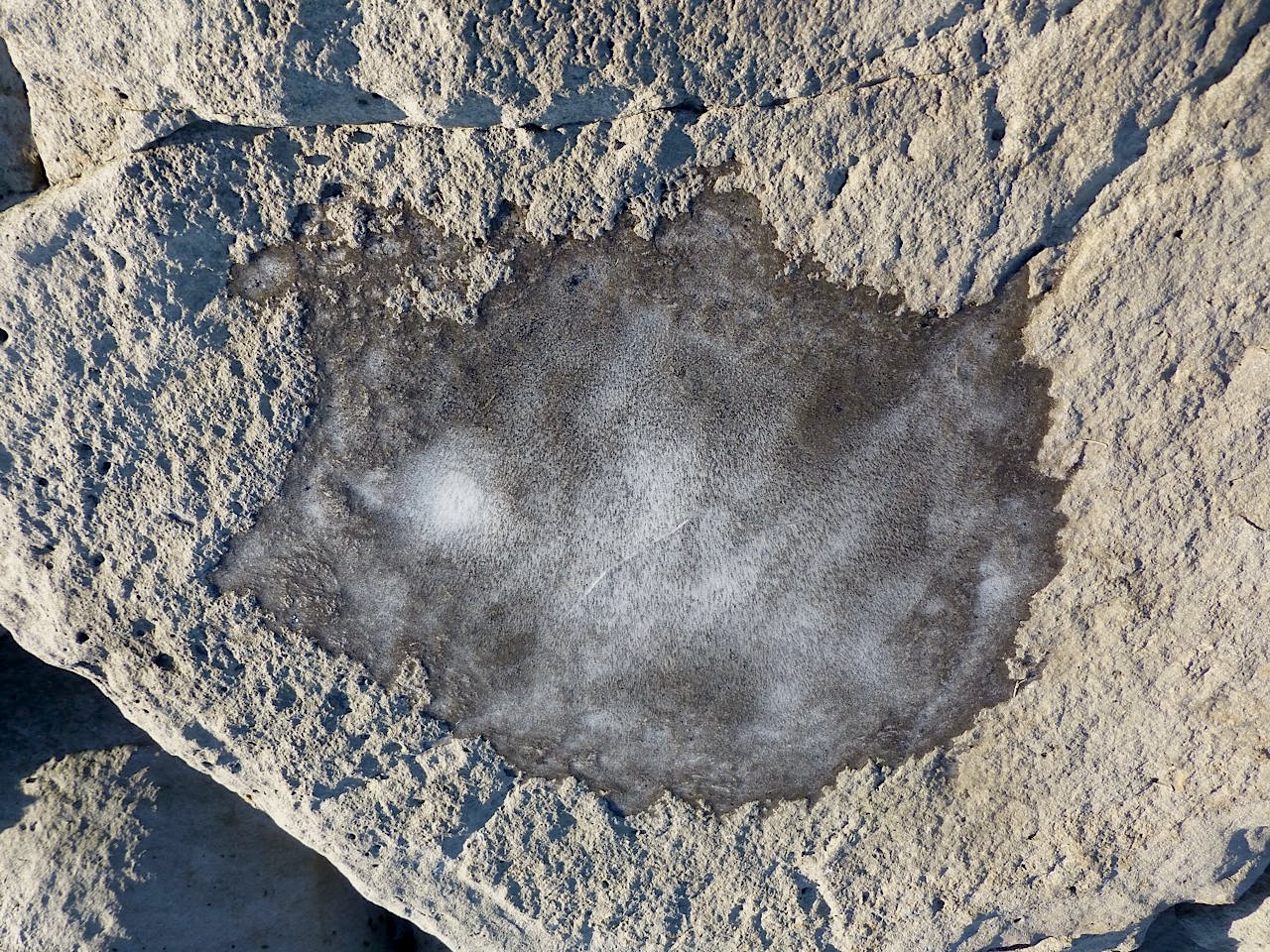 A Map of Iceland
Written in water and stone.
Everyone needs a map! Let this be ours.


A quick note to let you know that my feet are on volcanic ground again, after a bit of time in the air. Look what I found at first light in Reykjavik…A Map of Iceland
Written in water and stone.
Everyone needs a map! Let this be ours.
Look at the riddle Gunnar Gunnarsson told the Germans in 1940, just a few weeks before the invasion of Denmark and Norway and the resulting invasion of Iceland by the British and then the Americans:
It is far better for a man to recognize true inner human nature without touching it than through the words and behaviours people dress it in. Such a view into truth is far more vital than casual thought would have it. And certainly it’s no great sacrifice to hold to good taste and respect in all things. And since the talk is about sacrifice, our land has at least fully earned that, and our joy at its beauty will never be complete until these issues are ordered in such a way that gives no more ground for reprimand.
The text it is from a speech called “Our Land.” It can be read many ways. Here’s one:
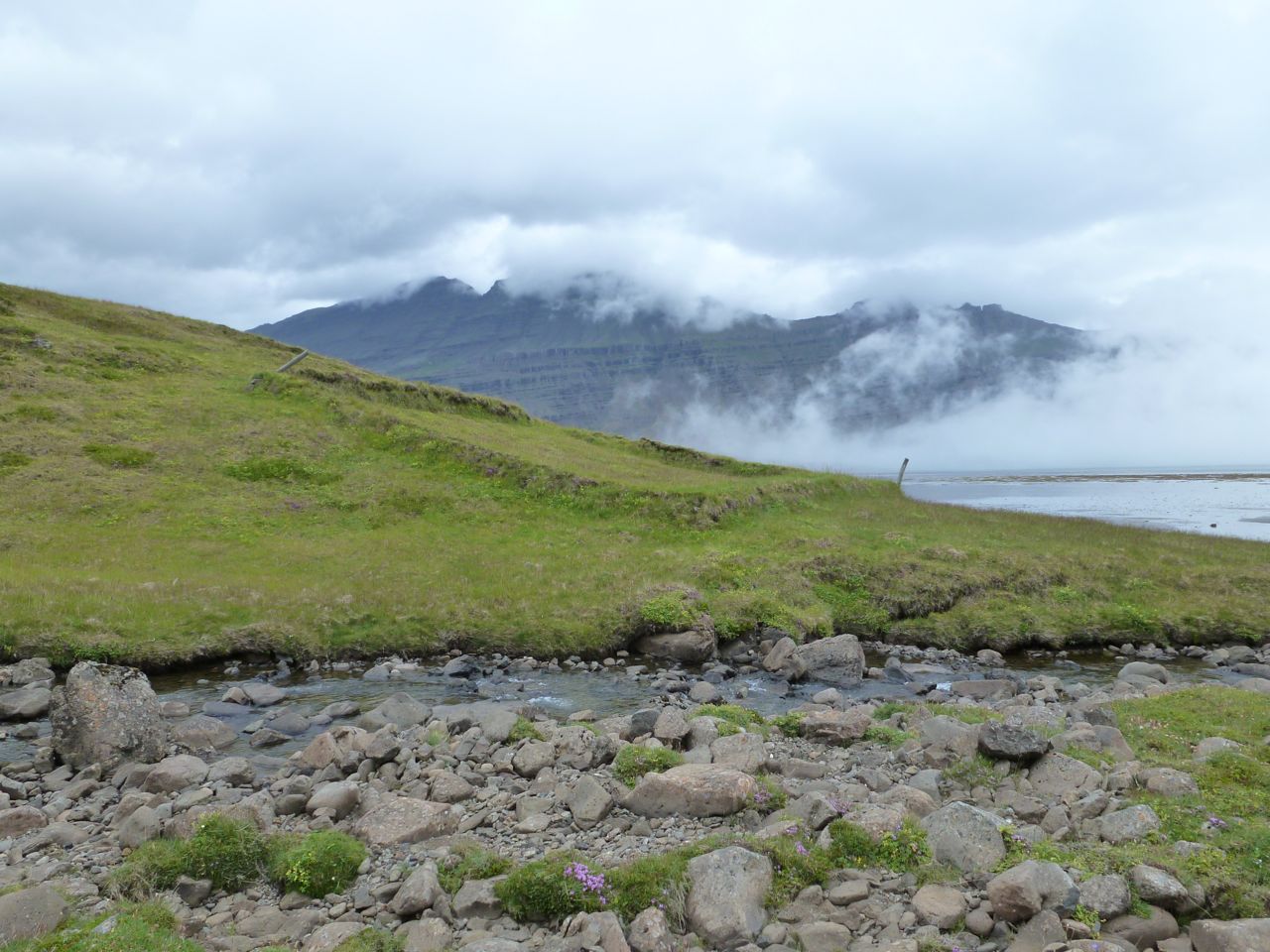
Turf Sheepfold, Reyðarfjörður
Here’s another, referencing each sentence of the passage quoted above to the argument Gunnar built up in the pages preceding it:
1. It is far better for a man to recognize true inner human nature without touching it than through the words and behaviours people dress it in.
Translation: Iceland has no history, except nature. Elsewhere (Germany included), nature is interpreted through the habits and clothing of people — in other words, through the changeability of time. In Iceland, however, nature is naked, and so are people: they are dressed in nothing, except each other. They do not exist in time — only in place. When one builds a bridge in Iceland (it is an example that Gunnar uses), one has to build it out of Iceland and not out of imported ideas, which sit within foreign customs and gardens rather than within nature itself, no matter how successful they were in other places. In Iceland, they won’t work. The land is not forgiving of any departure from its forms.

Workers’ Housing, Aluminum Smelter, Reyðarfjörður
Gunnar would not have liked this.
2. Such a view into truth is far more vital than such casual thought would have it.
Translation: Truth is untouched nature. It can be approached (and dismissed) casually, but it is not in itself dismissable. Nature is not the contemporary idea of “all things green”, nor the idea of “landscape art”, nor the notion of a goddess of nature called Natura. It is God: wordless, idea-less, unrepresentable and uncontainable. God is Iceland is Nature — or they would be, except God and Iceland and Nature have no names, and no words or ideas can be given to them, only drawn from them.
 Streambed Near Njardhvik
3. And certainly it’s no great sacrifice to hold to good taste and respect in all things.
Translation: Just as with the sacrifice of Christ, good taste and respect (based on an underlying devotion to God) are not sacrifices but a practical good in their own right. Life flows in patterns. On earth (that is to say on “Our Land”), one lives within them. Land is this shore of life, which other people call a planet, and which yet others call countries. “Our Land” is a changeable idea. It really means, “Who we are.” That’s not a modern idea.

Ryolite Streambed Near Njardhvik
4. And since the talk is about sacrifice, our land has at least fully earned that, and our joy at its beauty will never be complete until these issues are ordered in such a way that gives no more ground for reprimand.
Translation: Iceland has earned the sacrifice of human desire to its eternal forms; all those wishing to speak of sacrifice must learn to do so in a way consistent with the forms of the shore, in the way water finds its path through the grasses yet still moves with great power. Societies can be repurposed. Land cannot. Any attempts to do so will destroy the society of humans on earth. The joy of Icelanders at the beauty of those forms will not be complete until human temporal constructions are ordered in a way no longer out of touch with the streambeds of nature. The bonds between humans and God — a bond called “Our Land” — must be respected, not with words or ideas or customs, but with bodies and with rock. Only the people of a place can build there. All else will fail.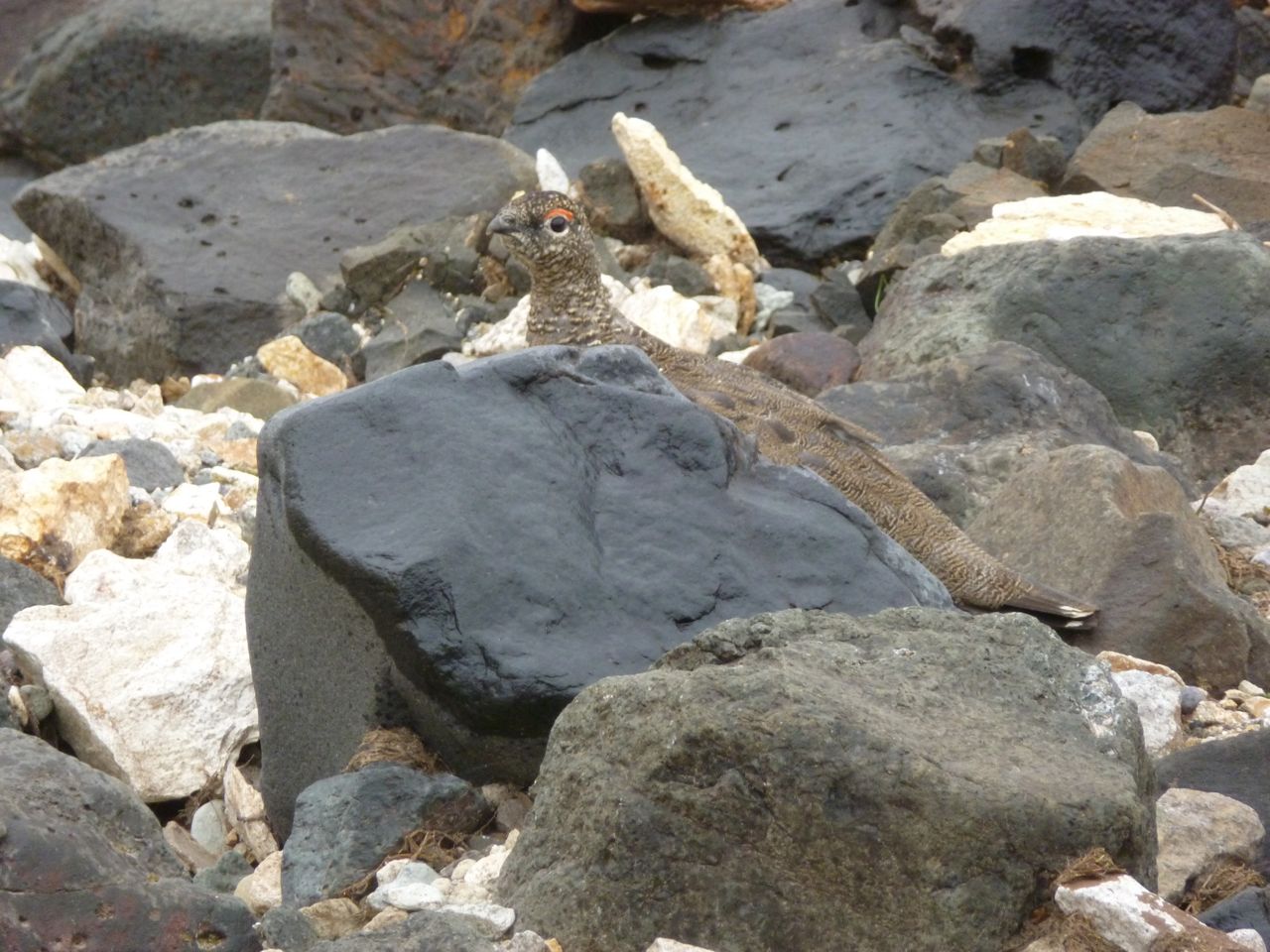
Ptarmigan Waiting for Me to Go Away
It’s a remarkable thing to say, especially to a country in the throes of praise for the sacrifice of thousands of its young men in capturing Poland to provide, in the language of the times, land for nordic people, especially when Finland is falling and talk of Scandinavia’s strategic importance is in the air. Invasion plans have already been drawn up, by both the British and the Germans. It’s an especially remarkable thing from a man like Gunnar, who spent decades advocating for a pan-Scandinavian state and who earned his income writing Scandinavian books for a German audience enamoured with the idea of becoming Scandinavian rather than Mediterranean. It’s an especially pointed statement to a Germany that has just united with Italy, on the Mediterranean, especially when Italy, Norway and Iceland are the three poles of the world given in Gunnar’s speech. Did I say ‘speech’? I meant sermon.
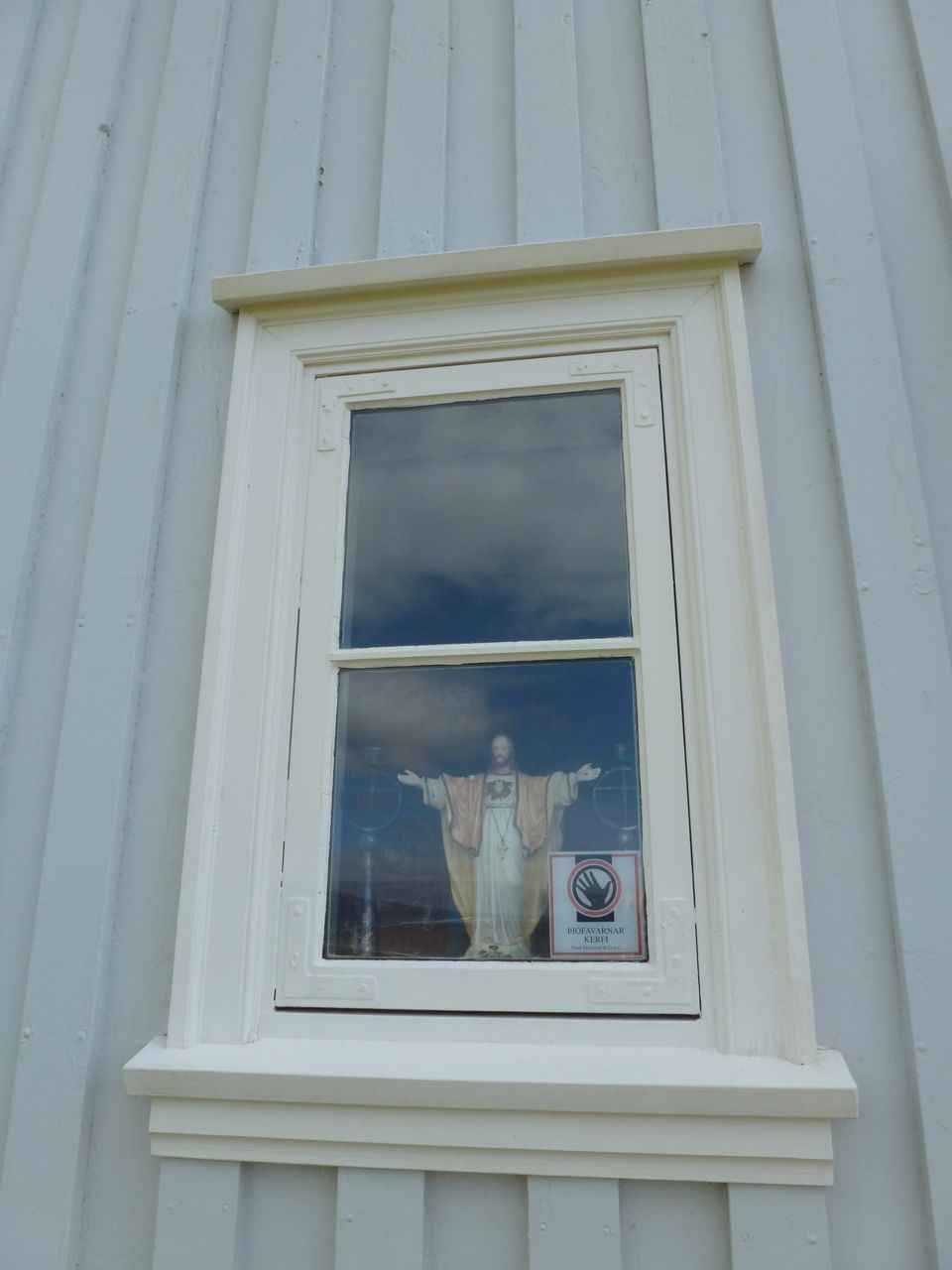
Two Security Systems Hard at Work and Ready to Embrace You. Strandakirkja
Choose the one that works for you.
Next: Gunnarsson as a Lutheran.
Before Darwin, European culture had many ways of understanding the relationship between humans, land, and evolution. Scientifically, they withered under the evidence of Darwin’s theories, but culturally many of them have remained potent. One of them is the Huldafólk, or Other People, of Icelandic folk culture. The English translation is “elves”, but these aren’t Tolkein’s elves, nor are they the fairies of Irish folklore. These are human-sized people, just more beautiful than the humans themselves.
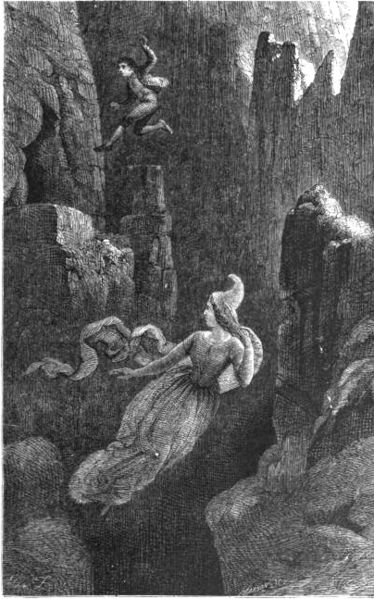
 Dvergasteinn, Seyðisfjörður
The dwarves, it is said, rowed this dwelling (rock) across the fjord, when the humans moved their church to this site, because they missed their company on Sundays. Eventually, the humans moved away and took their church with them. The stone (and its dwarves) is left.
Another alternate human is the Green Man, and his relative, the Old Man of the Woods. These people were said to be the original humans, who had risen from the earth and the trees.
 The Green Man, Görlitz, Germany
With his leafy beard, hair, and moustache.
The Green Man was an important nationalist symbol in the German struggle for independence in the mid-19th century. He was often said to be a representation of the first Christian, Judaic and Islamic human, Adam. Here those ideas kind of come together in one of the contemporary centres of German ultra-nationalism:
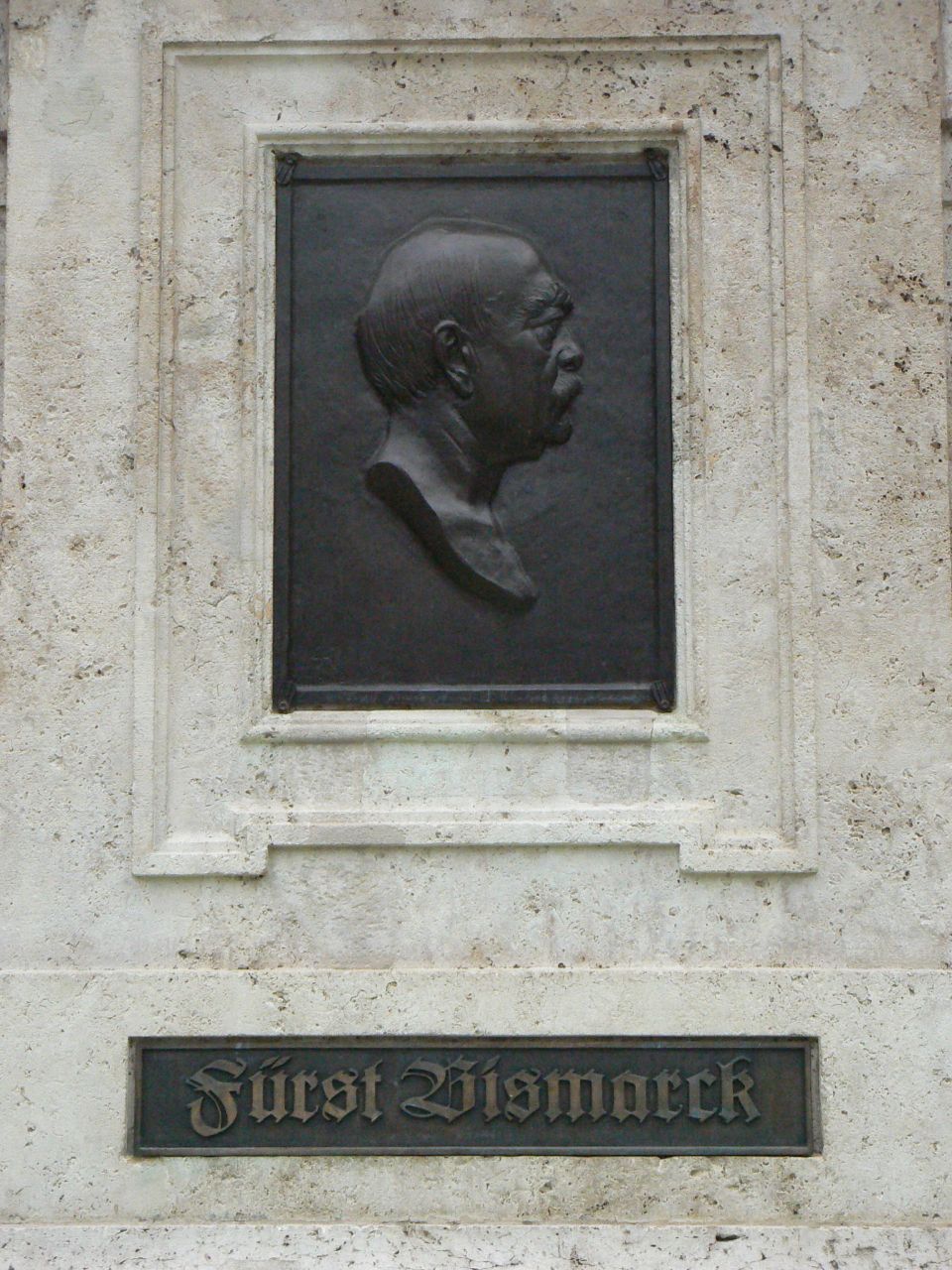 Bismarck, the Iron Chancellor, Jena, Germany
The father of Germany, with his bushy Green Man Moustache. Now a fountain.
Here is an older image of these men coming together in one spot:
 Barbarossa, or Holy Roman Emperor Friedrich I, Kyffhäuser Monument, Germany
Friedrich’s Crusade to recapture the Holy Land came to an end on June 10, 1190, when he drowned in Northern Lebanon. The monument was erected to commemorate the founding of the modern German State.
Few of Barbarossa’s (Red Beard’s) 100,000 men made it home. Legend, though, has him return to the country as an old pilgrim dressed in grey, inspecting his kingdom, which had lapsed from true observance of Christianity and was a shambles, much like this figure…

Wodin, from the lost Hall of Sagas, in Silesia
Odin of Norse Belief, or Gandalf in the modern version, or Barbarossa, take your pick. Old legends just don’t die out. Barbarossa was the code name for Hitler’s Invasion of Russia in 1941.
Depressed at it all, Barbarossa retreated to the castle on Kyffhäuser Mountain, where he lived inside the mountain with his knights, served by the dwarves of the mountain. He drank a lot of beer with them and fell asleep, only to wake a century later, ask if it was time to wake up, and then drink another beer and fall asleep once more. His beard kept growing.
 One of Barbarossa’s Dwarves
Dwarves show up continually in German folklore. Luther, the translator of the Bible and unwilling founder of Protestant Christianity, was raised in such legends, in the mountains east of Frankfurt, where his father was a coal miner and descended among them daily. Their power haunted their simple forest house.
Luther’s dwarves were the subconscious mind of the German people. They lived inside what was known as “the living rock”, or the deep rock of the mountains. Gunnar Gunnarsson, son of Iceland, descendent of men of Odin, born to a country of turf houses buried in the earth, also came from this story. So did this man:
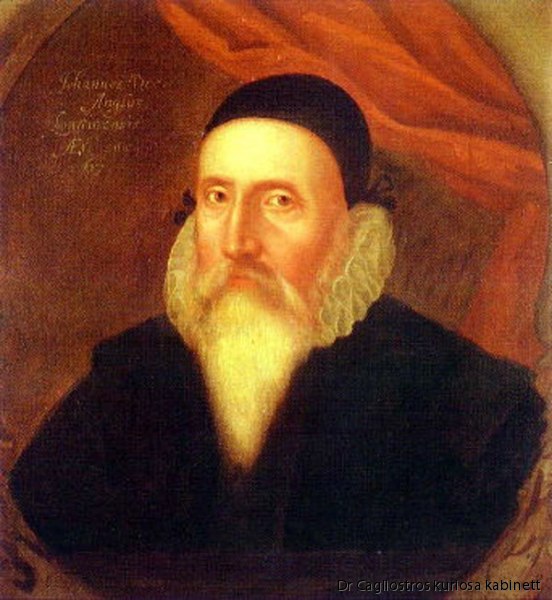 John Dee, 1527-1609
Dee was an Englishman who served as Court Astrologer to Queen Elizabeth of England, created the navigational instruments used by early European explorers in the North, and spent many years writing down his conversations with the angels. He believed that if he could learn their language, and speak it correctly, he would be able to conjure up the spirits of the earth and the air, as God did in the Book of Genesis, restart Creation, heal all war and disease, and return earth to Eden. Legend has it that when the Spanish Armada, the most powerful state in the world, attacked England, John Dee wove a magic spell around the Island and conjured up a storm, which wrecked the Spanish fleet. This act formed the basis of Shakespeare’s play, The Tempest.
 Prospero, Duke of the Island, Banishing the Half-Human Creature Caliban
The tree spirit Caliban is not unlike the Green Man.
Return Earth to Eden? Cast a spell around an island alive with spirits of earth and air? Banish the half-humans? Retreat to a mountain stronghold (an old monastery)? Found a country? Invasion from the most powerful country in the world? The old gods walking the roads in disguise? This is the context in which Gunnar Gunnarsson was operating — the old European, pre-Darwin context, that was still very much alive in his time and is still alive today. In my next post, I’ll show how these ideas illuminate parts of the speech he gave while on tour in Germany in the spring of 1940.
Well, not trolls exactly. And not exactly a house. It’s a bit of a riddle, but poets love riddles. Why, you could even say that on the northern shores of the world, poetry developed out of riddles, or that skaldic poetry did, at any rate. Here’s a famous Icelandic skald:

Egil Skallagrímsson, Skald
Ready to do battle with, what’s that, a rusty sword? More like a cleaver, I think. I have used things like that to pick cabbages. Poet farmers unite! (17th Century Manuscript from the Árni Magnússon Institute).
A scaldic poem is a ceremonial poem, given as a gift by a poet (a skald) to his patron, written in praise (or at times rousing criticism — very scalding, very scolding criticism). Scaldic poetry was worked through in intricate design and was intended as a verbal form of the intertwined patterning on a shield — a kind of protective magic. (The contemporary equivalent might be depleted uranium.) At times, skaldic poems were even recited before battle. They were part of the battle. An important part, too, that preceded the bloodiness.

The Karlevi Stone, Vickleby, Sweden
Note the vertical columns of the scaldic poem above. As Gunnar Gunnarsson pointed out in Unser Land (the speech he read from during his 1940 literary tour of Germany), they are not much different than this:

Basalt Columns, Vík í Mýrdal
A tightly-linked protective shield poem against the encroaching sea, written in the land itself. (Note: studies from Hawaii have shown that black basalt beaches like this form in hours, not centuries.)
Isn’t that cool? A poem that is the land? That is the riddle Gunnarsson was speaking from: his house is Iceland; Iceland is his house. If that sounds a little unusual, do recall: he’s a poet; he’s not really thinking in metaphor. Mostly, metaphor is for people who are not poets. It’s a useful way, for sure, of describing the work of poets, but it does do so without really accepting the poem as the reality of the world, which is the poet’s way. In the case of Gunnarsson’s house and island, that work is performed in skaldic poetry, which makes his house a shield as well — and not just a shield, but an ornament, too, like this, maybe:

Viking Broach, Sweden
Men might have wanted shields, to protect their bodies in battle, but, perhaps, just perhaps, women wanted something to hold their garments together at the shoulder, something that was as protective as a shield, something with an island in the centre and the four points of the compass around them, something that would set them at the middle of the world. In Sweden’s case, that would have been North for the Trail to the North (Nor’way), South for Denmark and the trails down the Rhine, East for Finland, and West for the Orkneys — and if you just kept going, going, going, going (whew) … aha! In the middle of the ocean… Iceland.
Once people arrived in the middle of the North Atlantic, the compass shifted. Iceland was now at the centre of the world. The other points of the compass were adjusted accordingly, to reference it. Since all directions led to water, however, Iceland became the entire earth, floating in the universe (which was a big, cold sea). The country is still roughly divided into these quadrants.

Iceland, the Compass Version
The shield and compass pattern extends beyond maps. For example, if you really wanted to get into the whole magical side of things, and weren’t squeamish about a little darkness in your life, you could play around with something like the following (You could even write it in your own blood):

Vegvisir
An Icelandic magical stave. Staves come in many shapes and were drawn for many different purposes.This one is a compass written in magical symbols, and was used to find one’s way in bad weather.
For such a stave to work (if it did), such navigation would not be done by the physical properties of the land, but by spiritual ones — and we’re not talking Christian-spiritual. In the high days of the Christian Church in Iceland, the possession of such staves could have had you condemned as a witch and beheaded at Þingvellir. That might have been awfully un-Christian, too, but, still, even today, this kind of magic is not advisable. When the Germans tried this kind of thing in the 1930s, for one thing, they invented the 1940s, which turned out to be a really bad idea.

Dresden, February 1944
Among the 20,000 people killed in the Allied bombing of Dresden and the millions of German refugees who streamed through it shortly afterwards on their way south and west from the Baltic, were untold numbers of readers of Gunnar Gunnarsson’s books about Iceland.
The pattern of land-as-compass-as-shield continues further, into practical applications of gentler spiritual principles. This time, they are placed in the interests of nationalism, where it’s not black magicians in the West Fjords or Ancient Viking ancestors or ultra-Nationalist Germans trained in the killing fields of The Chemins des Dames who are leading the way to a nation, but young women, quietly fitting their minds to the old patterns, to create a little beauty and order out of the blank, snow-white flaxen cloth woven out of the country’s fields. Think of these as self portraits…
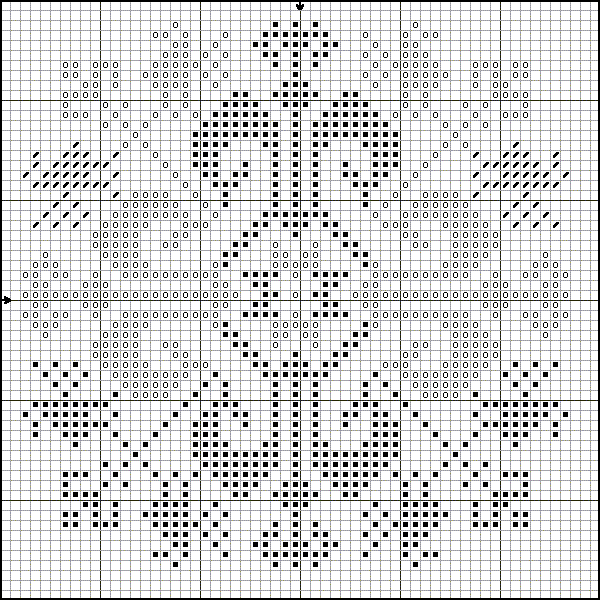
Icelandic Needlepoint Pattern
Flowers, yes, but also a hand-held mirror lifted from a dressing table, as well as the old compass, the old shield, the old broach, and the old skaldic poetry, too. Not to mention Gunnarsson’s house. Yes, the house. Such a pretty thing. Such devotion.
If you think I’m stretching this, consider that five centuries ago in the cloister below Gunnarsson’s house at Skriðuklaustur illiterate young women would have made embroidery of the flowers of the fields. It was a form of prayer, practiced between caring for the sick. Such devotion was the unique Icelandic contribution to prayerful attention and worship, in the way that the repetitive painting of icons of saints was an essential contribution to worship in Russia.

Christ Pantokrator
6th century encaustic icon from Saint Catherine’s Monastery, Mount Sinai. The power comes from about fifty coats of paint and the deliberately non-representational nature of the image. God, after all, can’t be reproduced in an image, so trying would be arrogance. Accordingly, such images aren’t representations of God. They are God’s presence, revealed when people devote themselves to old patterns.
The repetition and patterning were key. For example, just down the valley from Gunnarsson’s house at Skriðuklaustur, the old girls’ school at Hallormsstaður trained girls in Icelandic embroidery, as one part of a project to create a culture in Iceland independent from Danish influence. If the home was the heart of the country, and women were at the heart of the home, and the country was its children, then Icelandifying young women would, it seems, pay future dividends. Politification (My, aren’t I inventing words today) of national identity could follow at its own pace.

Icelandic Nationalist Embroidery, 1930s, Hallormsstaður.
The doors of the rooms in the school dormitory bear the names of trees, instead of numbers, and are set within a somewhat overgrown botanical garden. Such gardens were decorative in mainland Europe. In Iceland, they are a more practical magic.
The embroidery above is much like a map of Iceland. When you get down to ground level, after all, and experience the map that is Iceland on a human scale rather than an international or global one of contours, nation states, trade patterns, colonies, weather isobars and even corporate banking, Iceland does look like this:

Iceland at Ground Level, Neskaupstaður
The embroidery of summer!
This beautiful meadow, may I remind you, is still our shield and still our skaldic poem. It’s also Gunnarsson’s house, his novels, and the workings of his subconscious and conscious minds. Skaldic poems are full of doubling like that. We’re back to this:
His house is Iceland.
Iceland is his house.
Very skaldic, indeed. Of course, in physical terms, when this skaldic play comes to Gunnarsson’s house, the whole thing does look awfully German.

Skriðuklaustur
The German architect, the Icelandic stone, the grass roof…why, it’s an island itself. An island in itself. An island. Itself. German….German? That’s the riddle within the riddle.
The poems are our key. The first form of doubling in a skaldic poem is a kenning. Kennings are natural word forms inherent in Germanic languages (Frisian, Icelandic, Norse, English, Danish, and so on). Speakers of these languages use words like that all the time. Some English examples are: butternut, windowsill, firefly, and doublespeak. In kennings, this tendency is made artful. Each kenning is a miniature poem in itself. Take the land, for instance, such as that forming Iceland. Take a look at the series of kenning’s below. The earth is cleverly hidden with them, or perhaps cleverly revealed. The delight in recognition is part of the magic of the poem. Can you find the earth there, in its sea? (The translation [mine] is loose, to try to catch some of the music, but it’s not wildly off track, or at least not enough to hide the earth any more than it already is.)
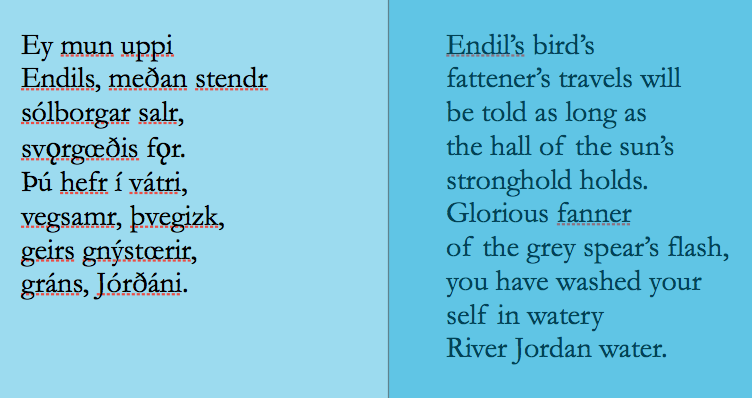
Skaldic Poem Made Out of Kennings
The earth is “The sun’s stronghold”. The others? Well, hey, it’s a riddle, right? Source.
So, that’s the first doubling: words are given multiple meanings by being joined together. In the example above, the earth is both rock and stone as well as “The sun’s stronghold” (as opposed, seemingly, to the darkness of death, underground, and the land of the salmon, or water). The other doubling comes about because the rhyme schemes of these poems were so intricate that the poem often had to be split in two columns, one representing each of its two speakers. Two speakers? Yes, that is another old Nordic style of poetry. Here’s what it looked like in its Finnish variant…

Finnish Folk Singers, Telling a Song Together
Each singer pulls the other towards himself to speak, then follows the other to listen, to pull again. It’s like rowing, or weaving.
Such poems looked like this, sometimes (the first line in each rhyming pair was given by one speaker; the second by the other… a pleasant game, for sure):

The Kalevala, Canto 27 (Opening)
Finnish is related to Pictish (and nothing else), the language of Scotland before the Vikings took the place for their own.
Here it is again, in English from the time of Gunnarsson’s youth. This time, the rhyming pairs are bound on single lines (to draw parallels with Homer, by the sounds of it):
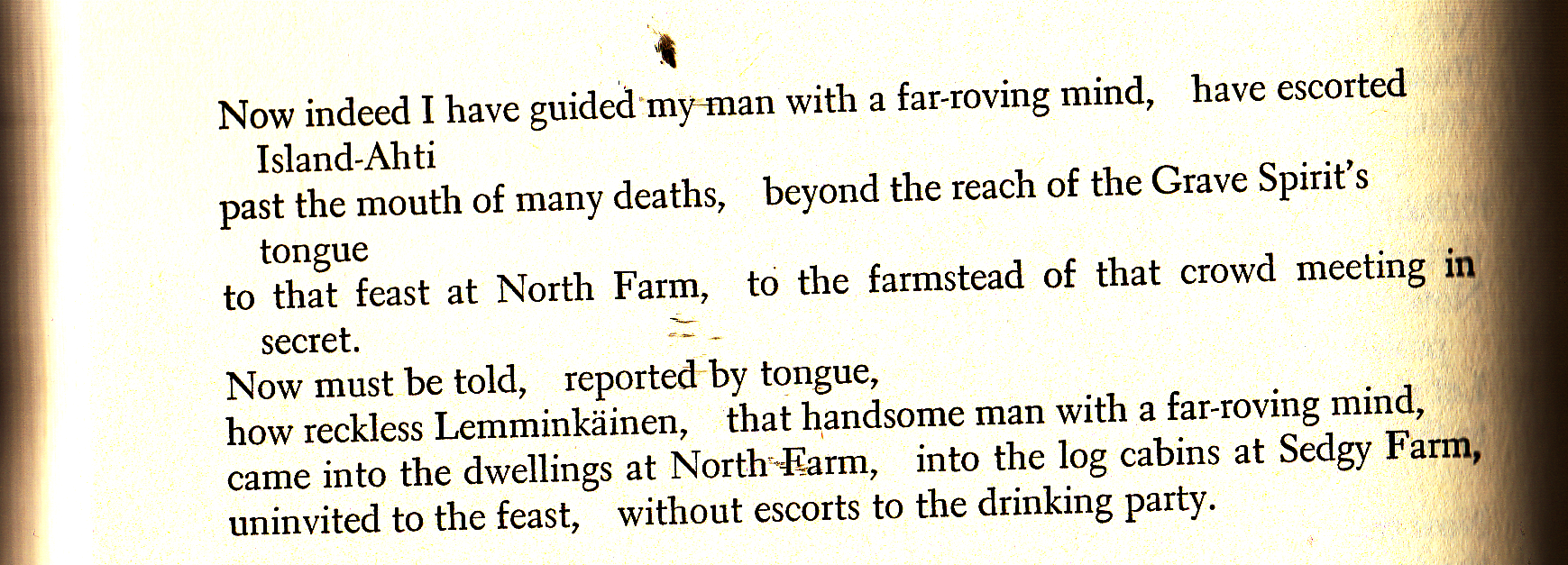 The Kalevala, Canto 27 (Opening)
Finnish folk poetry, compiled and massaged into a narrative by Elias Lönnrot. Translated by Frances Peabody Magoun, Jr. Homer was extensively read in literary circles at the time.
Two speakers. That’s the key here. But who are they? Ah, they are many things, many of which I have already hinted at here: Iceland and Germany, Gunnarsson and Denmark, Elves and the Church, earth and language, men and women, peace and war, individual and state, man and God. It looks like many things, but that’s just a linguistic convention. It’s really all part of the same conversation — if those words could be brought together into one tightly compressed thing, we would have Gunnarsson’s house. Let’s not forget that Gunnarsson was an Icelander. For a man like him, the word ‘thing’ has special significance, and looks like this:

þingvellir, the Thing Place
Iceland’s first thing, or speaking (In Icelandic, Alþingi. In Norman English parliament), took place here in the Mid-Atlantic Rift in 930. In 1000, the country chose Christianity here, for practical reasons to do with unity, self-determination and self defense.
Below the Icelandic flag above, there is a church, and a curious collection of houses…

þingvellir Church, 1850
The earliest church on this site dates from the early 11th century. The row of five houses to the right of the church represent the Icelandic state. Each time the constitution has been rebuilt from the ground up, a new house has been added to the row. The one house that is not represented here, is the one in Fljotsðalur to the North East. That’s right: Gunnarsson’s. Hey, no one said he was particularly modest. The volcano, Thor’s Shield, rises faintly in the background, from the earth’s core.
I was standing down by the church, looking up at the Alþingi site and wondering why it was placed here, of all places. Official documents point out that it was on a list of four possible sites, and was chosen because of the four it was the one situated conveniently on the country’s major trade routes (horse paths), and had sufficient pasture, water and wood (for fires) to sustain a large crowd. Makes sense. But why was it on the list in the first place? I wondered, then I got to daydreaming, as poets sometimes do, and thought about being a kid back then, attending the Thing with my family, and I looked up at the cliffs and they came into focus.
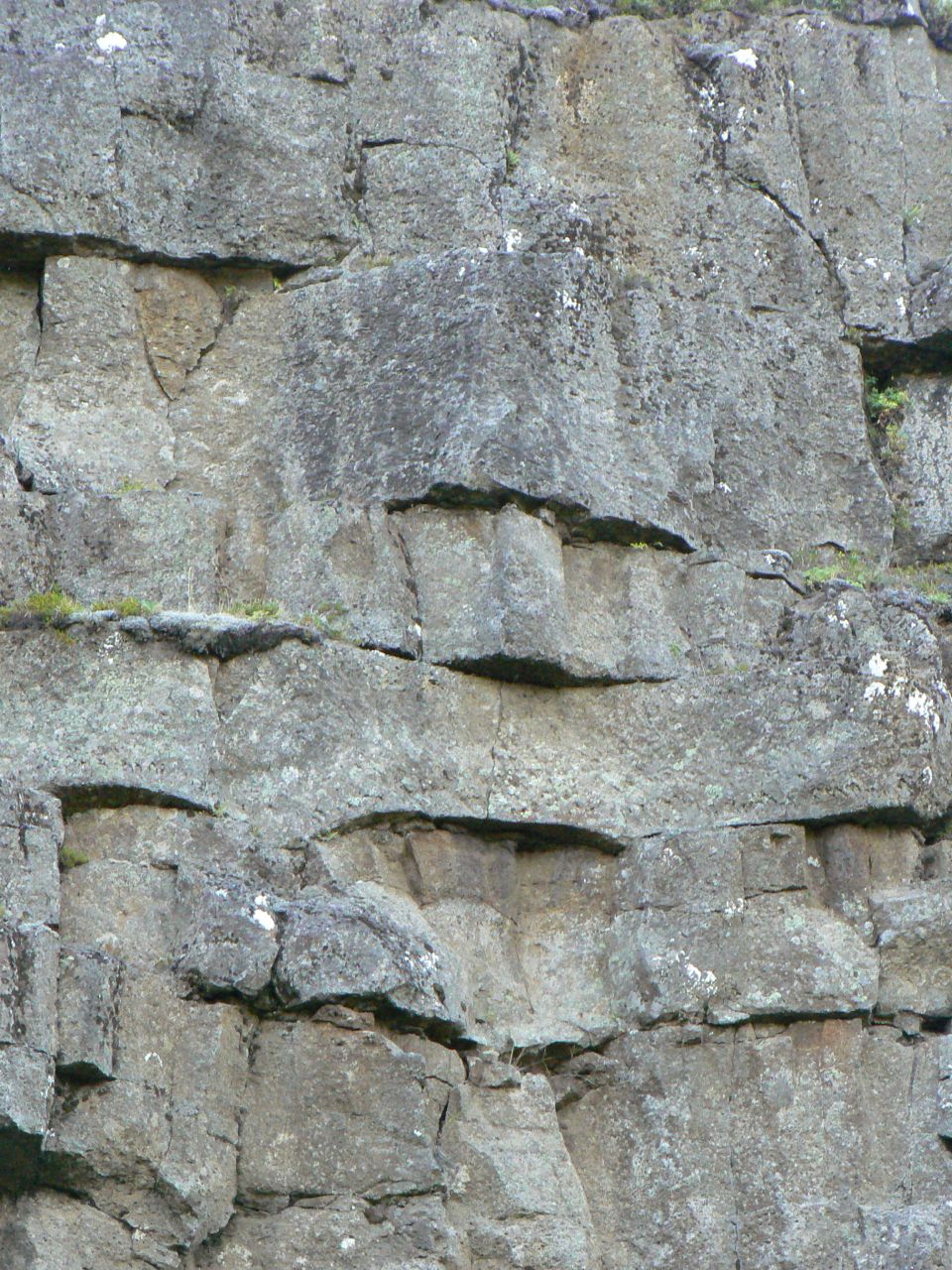
A troll!
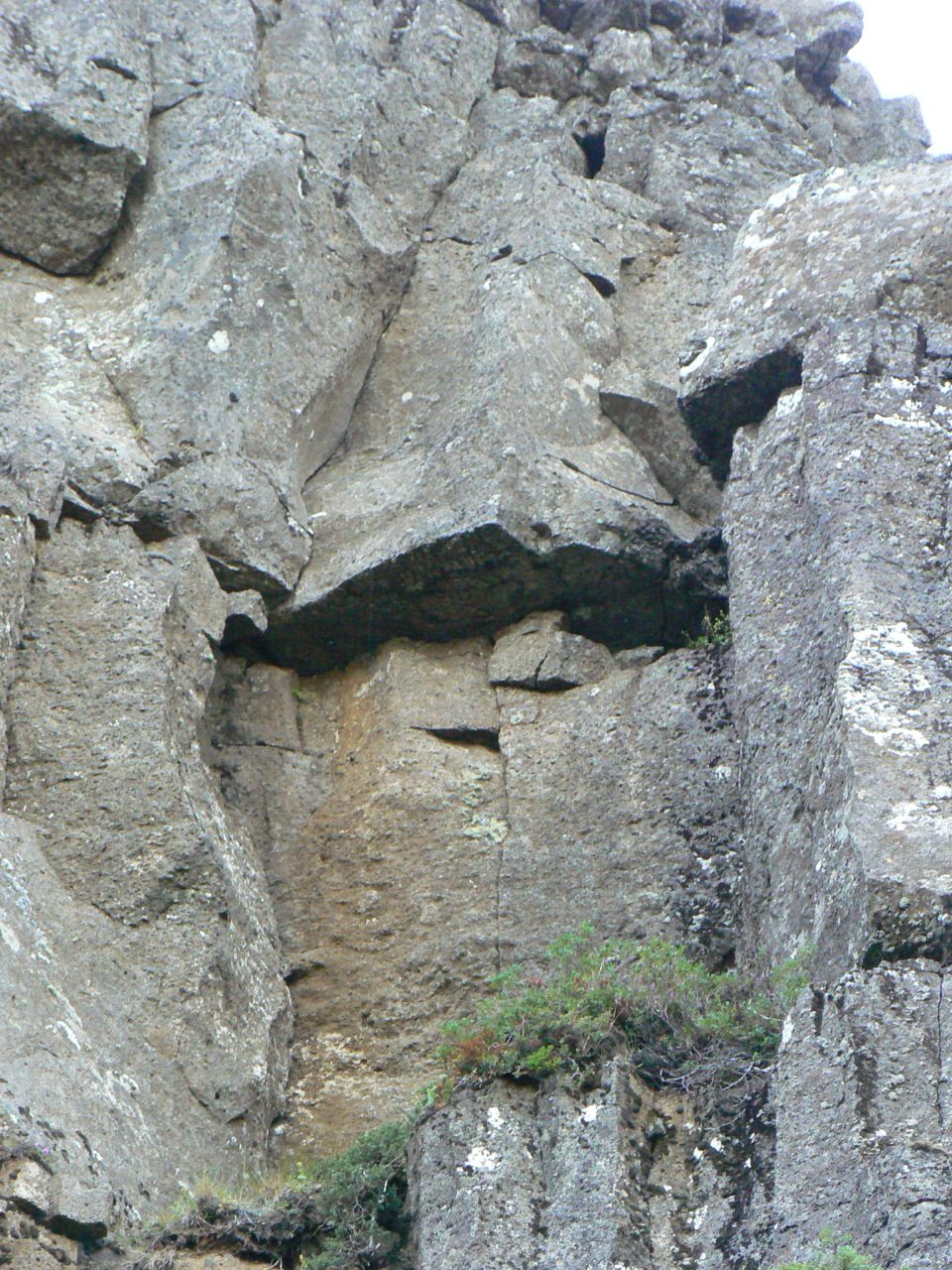 Another troll!
 Yet Another!
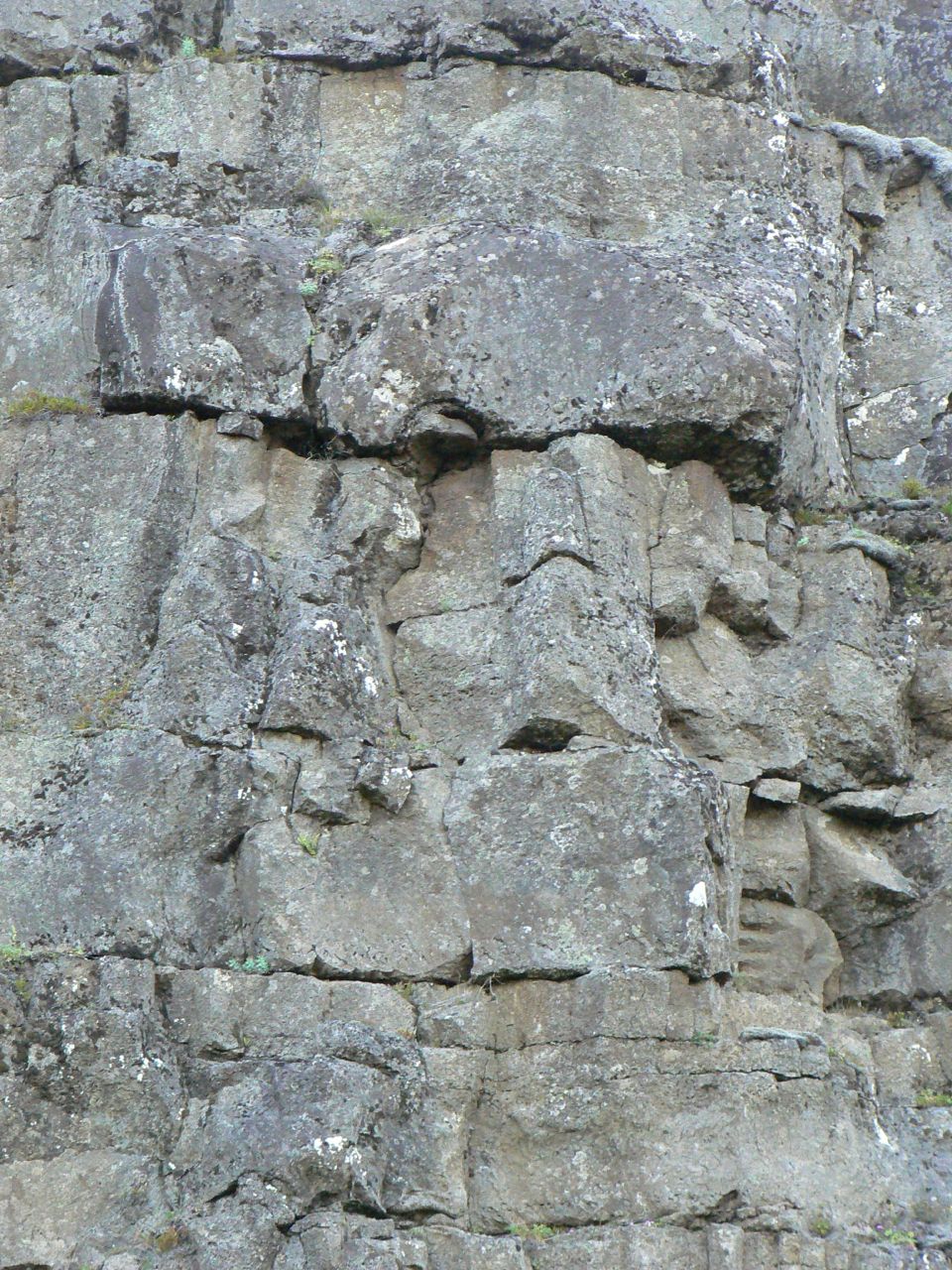
Trolls Everywhere!
And all of them are looking down over the people. You could say that the land is taking part in the discussion that is taking part in the Thing. You could say that now the past is watching the present, and looking down over the house that is Iceland, which is embedded in that past. Time and space are unique here. They are a language. Since that’s an unusual language, at least for the contemporary, novel-driven world, it’s useful to walk through its halls a bit, to see how they’re constructed and where they lead. I’ll do that in the next post. We’ll walk among elves and dwarves and trolls. They are not part of fairy tale. They are something completely different, and provide clues to the mind of Gunnar Gunnarsson in 1940. It’ll be fun. I hope you’ll come along.
Today I’d like to walk some paths between sod houses, Iceland, and Gunnar Gunnarsson’s inner world. All paths link in a vast web, each link of which is a starting point. My starting point today is a passage from Gunnar Gunnarsson’s novel, The Sworn Brothers, written during the First World War and translated into an English that was archaic even in 1921, when it was published in New York. A better contemporary title might be The Blood Brothers, especially for the passage quoted below, which tells of the ceremony by which Ingolf and Leif, the heroes of the book, become brothers by oath.
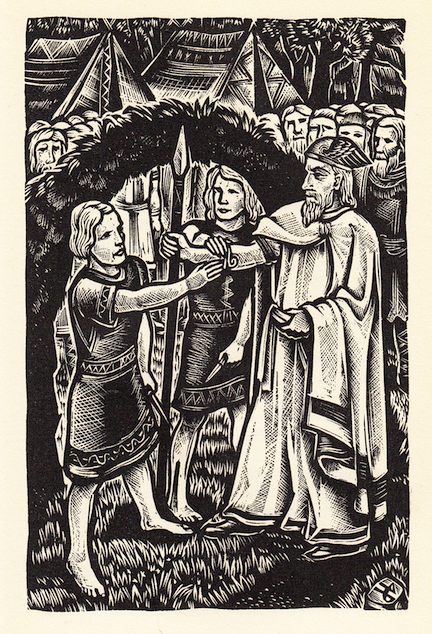
The Oath
Note the turf arch. From the German Book Club Edition of 1933 (Hamburg).
Here’s the story illustrated by that image. First, the cutting of the turf …
Ingolf and Leif had now cut loose the piece of turf, and went together to lift it. They raised it carefully till it stood straight up and formed an arch. Then Atle Jarl stepped in and placed his spear in the middle of the arch to hold the turf up. He himself stood and supported the spear while Ingolf and Leif cut loose an oblong turf under the arch. Their blood was not to run on the greensward, but was to mingle on the bare earth.
… and then the drawing of blood …
Ingolf thrust his knife-point well in and cut a deep gash. Leif put his knife right through so that the point projected a couple of inches on the other side of his calf. He had difficulty in drawing it out again. The blood ran down in red streams. The spectators felt a strange shuddering thrill at seeing how it oozed out from under the naked soles of their feet.
… the mixing of it with the earth …
Leif watched the course of his blood attentively as it approached Ingolf’s on the brown scar of earth between them. As it seemed to him to go too slowly, he stooped down, directed the streams of blood with the point of his knife, and stirred the blood and earth round between him and Ingolf. A laugh then rang out in the air from hundreds of throats.
… the proclamation of brotherhood …
Atle Jarl now proclaimed that Ingolf Arnarson and Leif Rodmarsson had entered into legal brotherhood, and named the witnesses. With that the solemn ceremony was at an end.
… and the re-laying of the turf …
The grass-turfs were carefully laid down again in order that they might grow firm and be incorporated with the earth’s life. Ingolf and Leif were now joined together by the strongest bonds that exist the blood-tie between brothers, the most sacred and inviolable of all blood and family ties. The earth by which they had been formed in different mothers’ wombs had now drunk their blood mingled, and had at the same time given them new birth, since they had passed together under the turf arch, a part of earth’s living frame. The earth knew now, and had recognized their covenant a covenant no power could break.
And now, from Iceland, a few observations. First, a turf arch …
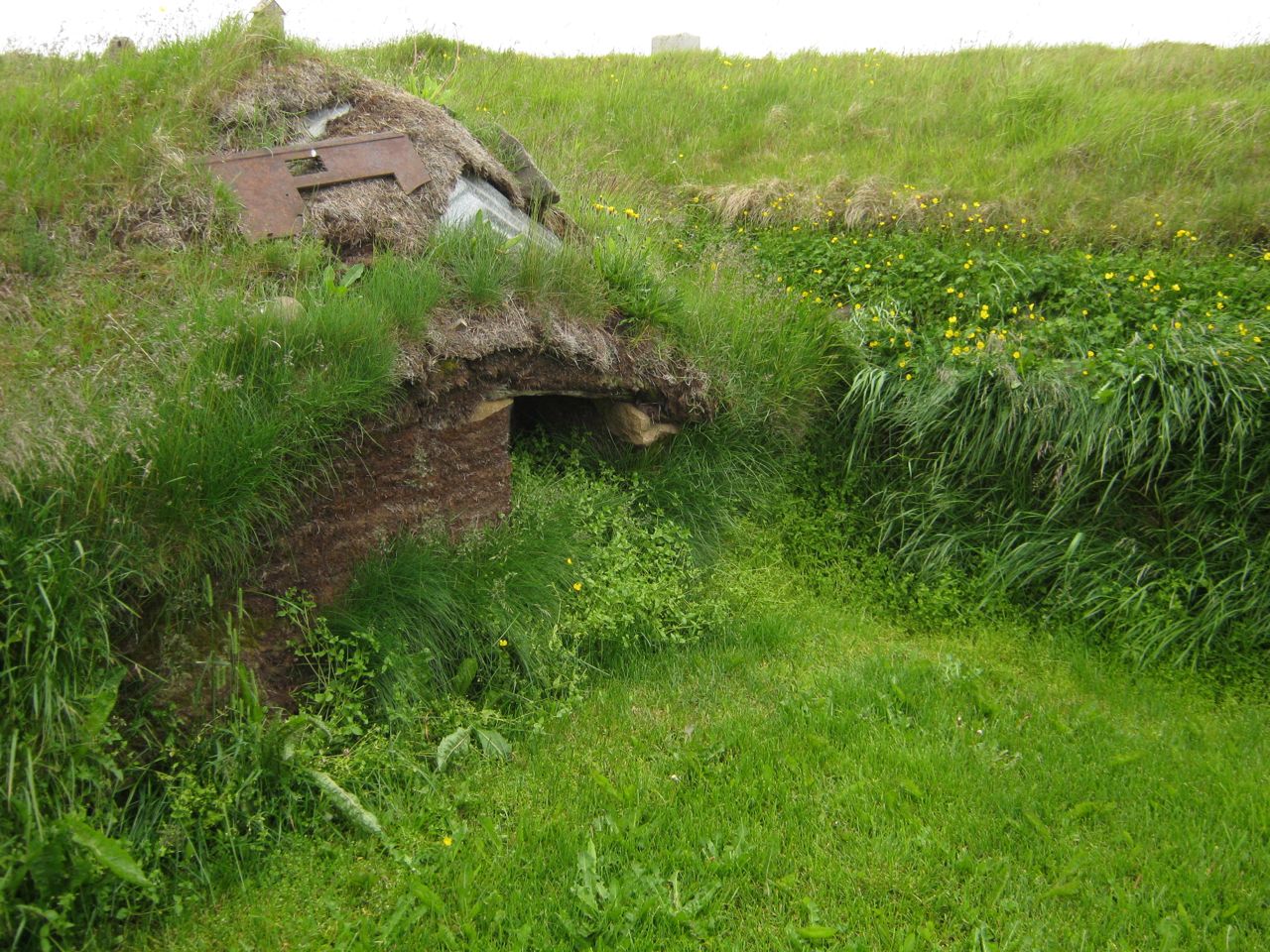 Turf Doorway, Bustarfell
In Gunnar’s representation, the sacred, pre-Christian earth that lies beneath its cloak of sod, and which figures so powerfully in The Sworn Brothers, once lay at the heart of every Icelandic house. In fact, they were cut out of it.
Next, Gunnar’s house at Skriðuklaustur, with its sod roof (designed by Fritz Höger, a German architect who shared Gunnarsson’s romance with pan-Nordic culture) …
Skriðuklaustur
Note how the space of earth inside a traditional sod house (containing darkness) has been replaced by a space of air (containing light). The sacred grass covering remains, but as it is no longer connected to the living earth, it is only symbolic. In other words, this house is a poem. It is an act of human will. It is the space into which Ingolf and Leif shed their blood, as conceived of in Gunnar’s imagination.
Below the house, the old cloister below the house is being excavated. It’s worth a look, too …
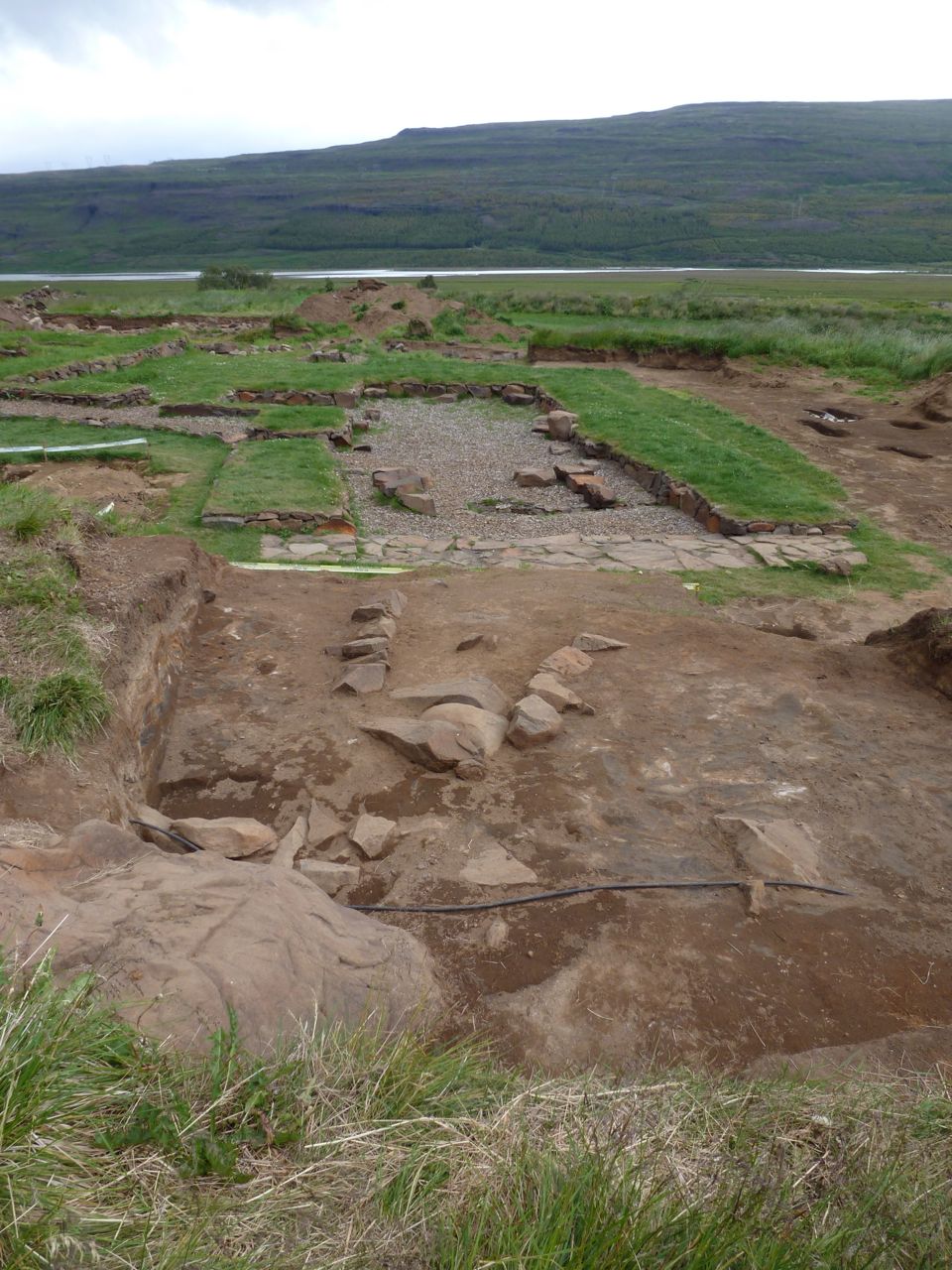
The Red Earth of the Cloister Floor (Klaustrið að Skriðu)
For perspective on the theme, a little journey north to Husavik is recommended. Besides a beautiful Christ in the form of a polar bear in its graveyard, the harbour church also has this moving painting as an altar…

Christ, Bringing Lazarus from the Dead
Right out of the mid-Atlantic Rift in Þingvellir, yet. The painting is the work of Sveinn Thorarinsson, an artist from Kilakot farm in the spreading estuary of Kelduhverfi county (1930-1931).
This is a splendidly nationalistic work. So were Gunnar’s novels. So was Gunnar’s house. Poetically thinking, Gunnar, who had returned to Iceland to build his house, had returned from the dead (Exile in Denmark, the colonial power; exile from the land and farms of his childhood, and so on.). In keeping with his modern saga, “The Sworn Brothers,” to swear his oath, he needed a sod roof, to cover the earth upon which he swore it. Here’s another variation on the theme:
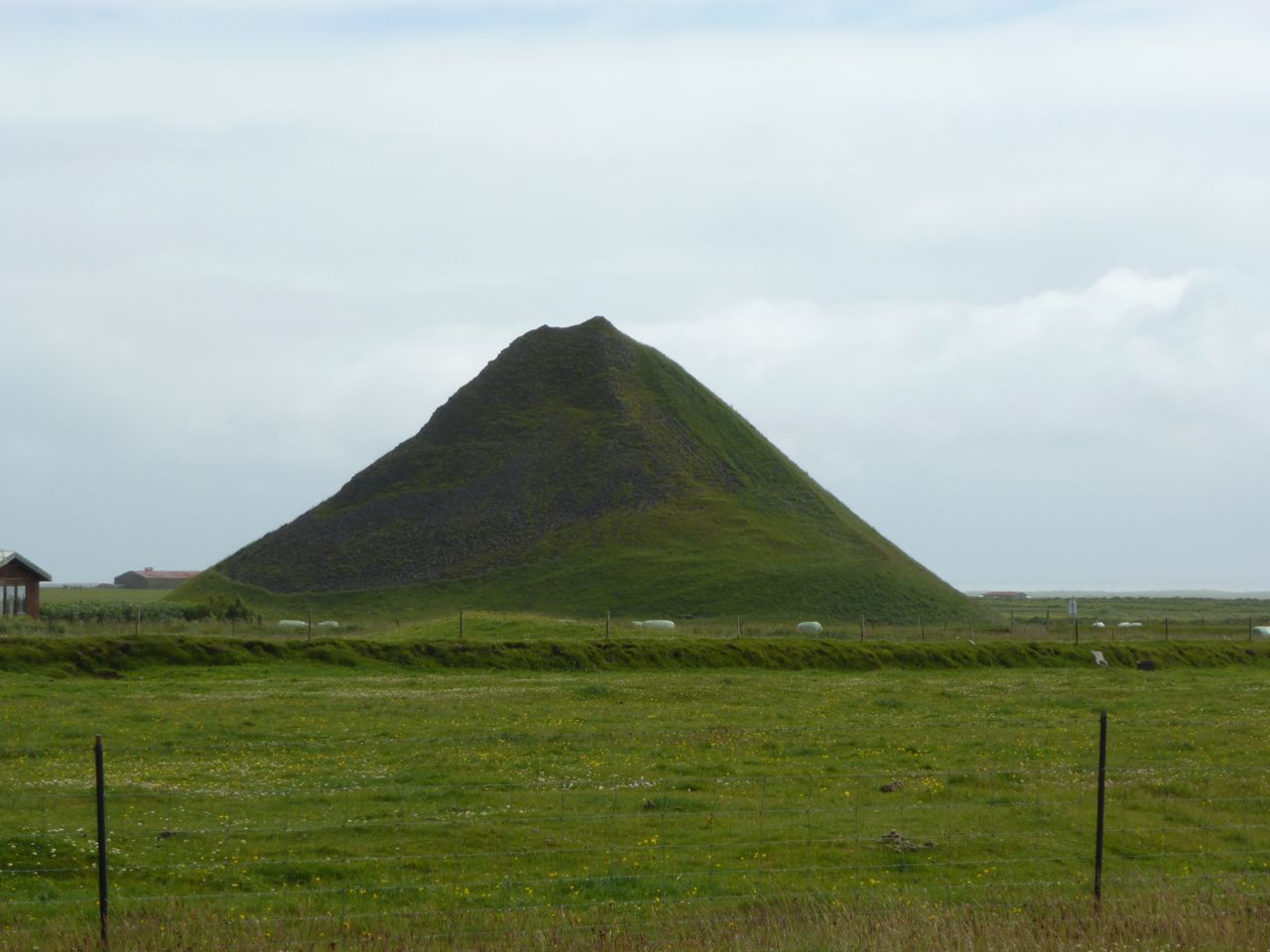
Elf House
Like a human house, it is covered with sod — just a bit more dramatically. (Out of respect for the privacy of the elves, I will not give you the locations of their houses.)
Not all elf houses are the same. Here’s one with a chimney…
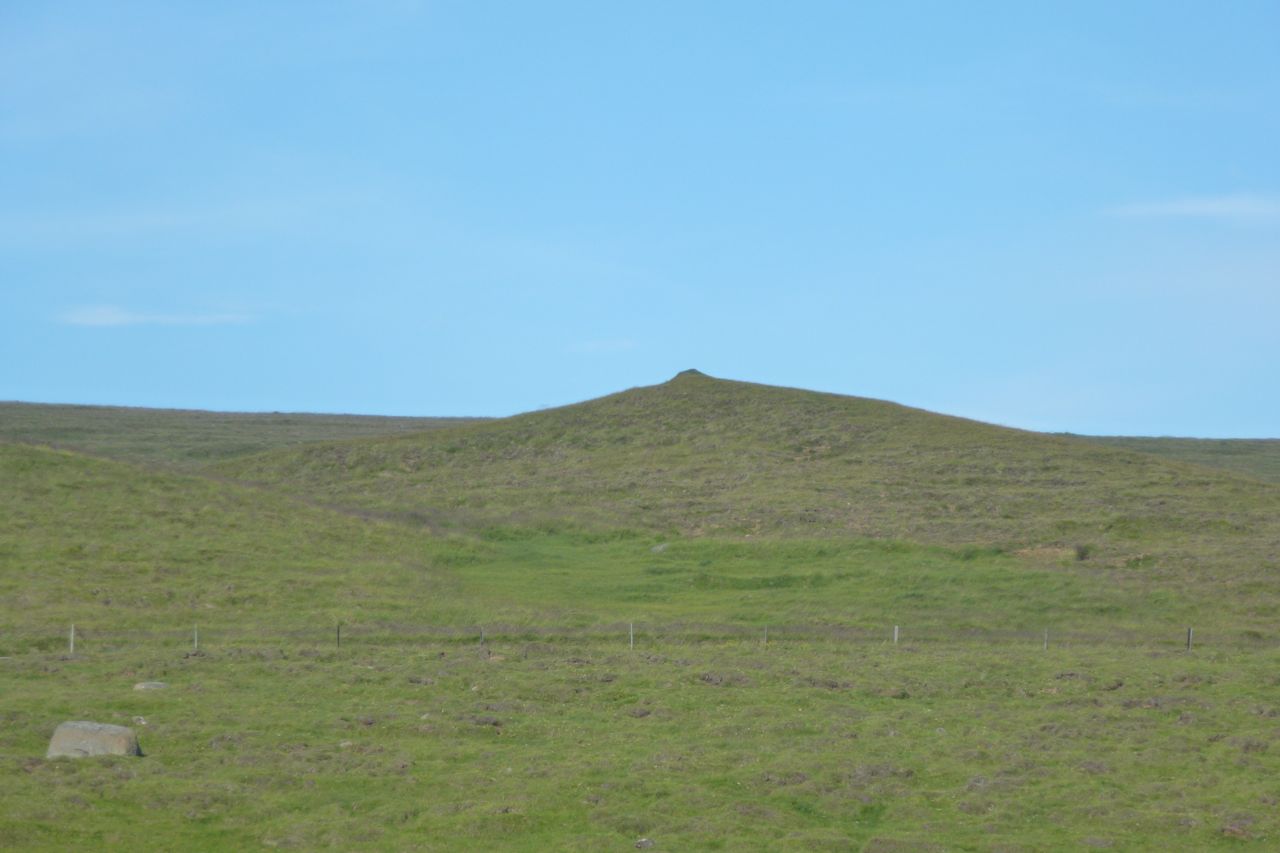
… and here’s one without sod, and with its smoke hole plugged …
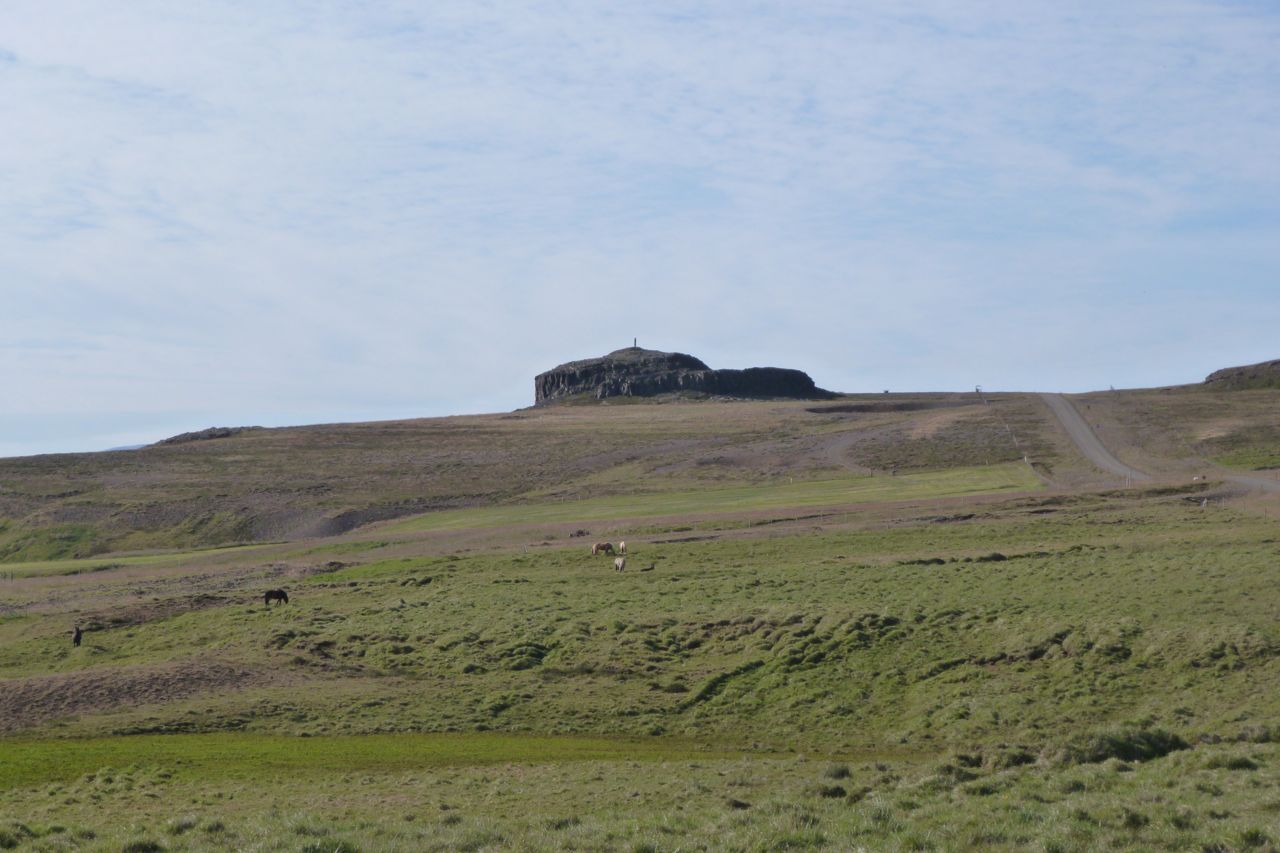 Elf Fortress, with its Roof Plugged by a Cross
It has been like this since the day the settlers arrived. As the story goes, a Christianized chieftaness sailed up the fjord, spotted this volcanic plug, and dealt with it right then and there. Luckily for the elves, there is a whole complex of plugs in the area, but, still: ouch.
A house part elf city, part peasant hut, and part elf dwelling … that’s what Gunnar was making, both out of stone, wood, glass and sod, but also out of words, between the pages of his books and in the minds of his readers (he hoped.) Considering it all poetically, and leaving aside for now questions regarding the appropriateness or timeliness of the gesture, he was bringing his books to life, through the construction of a man, or a space for a man, out of the stuff of Iceland, energized by his will.
Next: Why Elves?
The Icelandic sod houses that largely vanished in the last half of the twentieth century reflected the interests of peoples’ lives and in turn moulded the way they thought. That’s another way of saying that they acted like poems.

Icelander, Looking Out of His Sod Poem
Long ago this was a seaside cliff. Now even the coastal plains are above sea level and covered with grass.
Another way to put that is to say that Icelandic houses were the subconscious mind of Icelanders. The house below shows the modern Icelandic method of keeping the imagination green and growing.

Bishopric at Holar
A combined Norwegian-Icelandic restoration project, complete with rooftop sprinkler.
These houses varied in design, but were all built of some combination of stone, driftwood and birch wattles, but mostly out of earth and sod — a lot more sod than in the image above. That was some fancy house. For an indication of a broader range of variations, there’s a collection of photographs of a number of these houses here, showing regional and historic variations. Here’s a variation with a cat…

A Cat and Its House in Borgarfjörður Eystri
It’s been in the ownership of one human family since the heady days of the 1970s-era back-to-the-land movements.
Although such traditional houses were built largely of sod, it’s not really sod that defines them, but shelter. In Iceland, an island in the the middle of the North Atlantic, that means shelter from the sea. In complex ways, this architecture was fundamental to Gunnar Gunnarsson’s project at Skriðuklaustur, sheltered far inland in the northeast from both the sea and the deteriorating politics of Europe. To get closer to that thought, I’ll be talking about its components, one piece at a time. Today: rock.
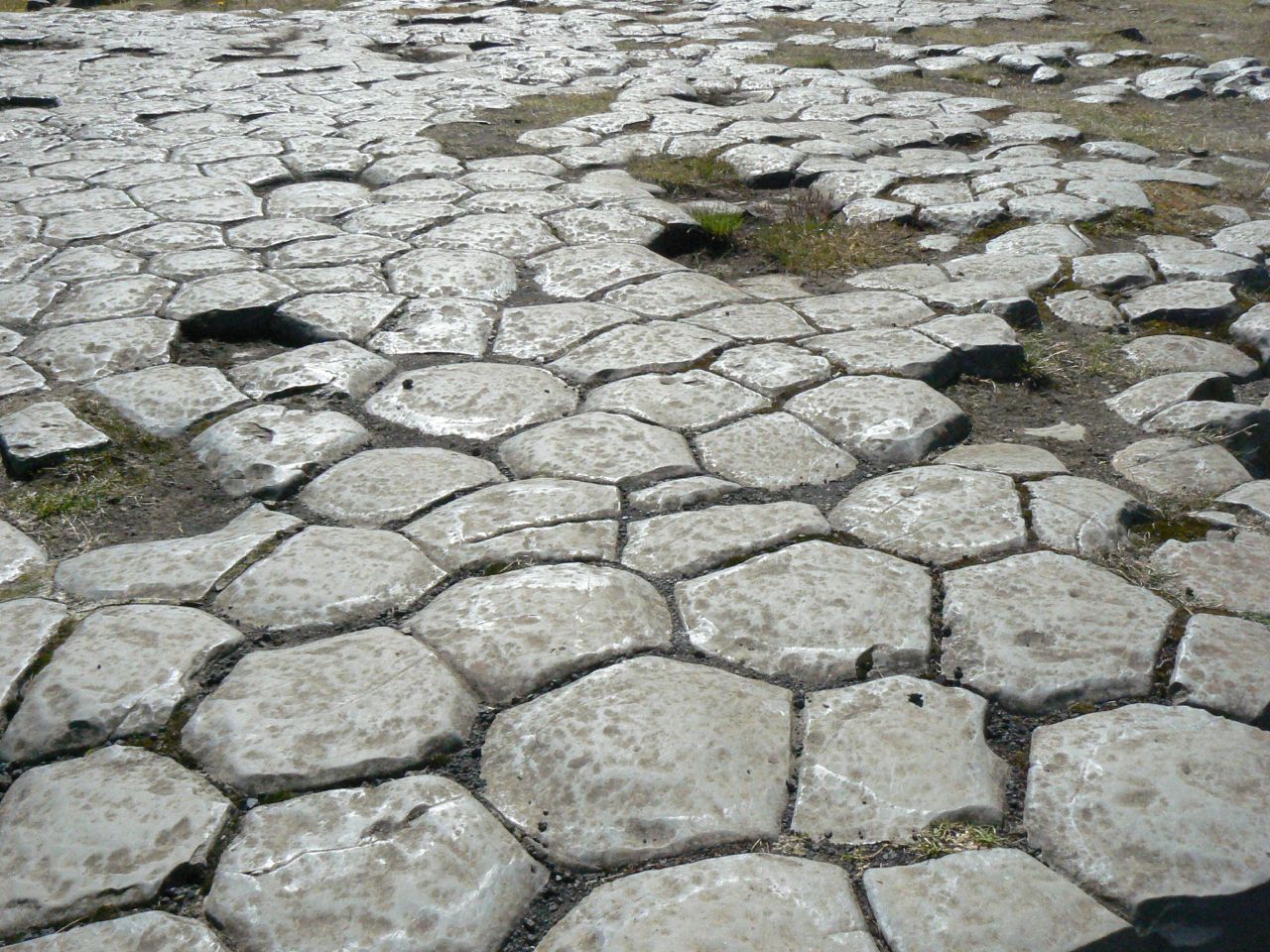
The “Church Floor” of Kirkjubæjarklaustur
Basalt Crystals Shaved Off by Ice
In terms of rock, near the core of the idea of Iceland and its houses being one, lies this thought of Gunnarsson’s on Iceland itself:
“The pillars of its cliffs are like the beams of a tightly-linked chain rhyme.”
from Our Land (1940)
Gunnarsson had in mind something like this:
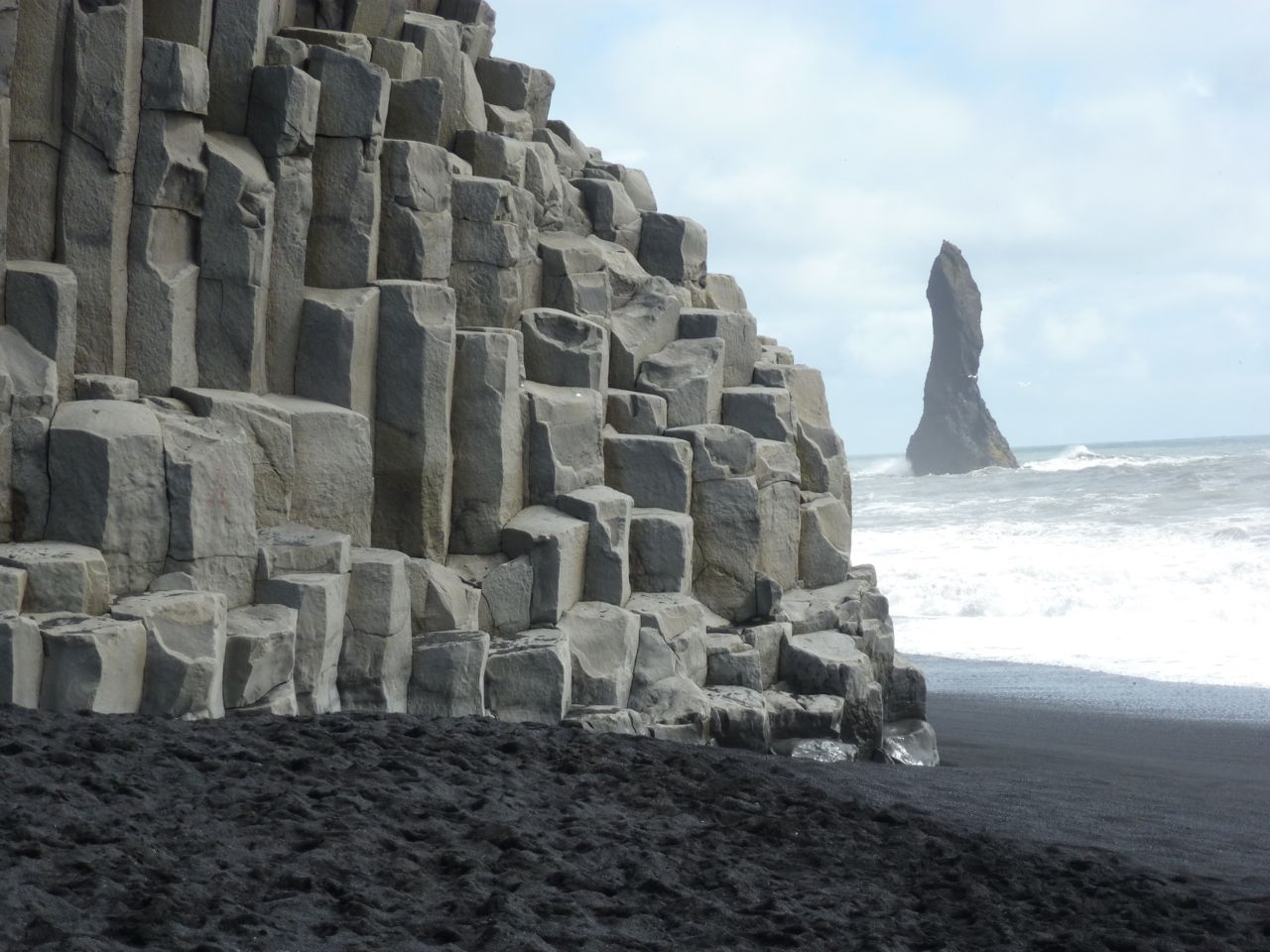
Basalt Crystals West of Vik
With a frozen troll out in the water. (I’ll be getting to those trolls in a couple days.)
The connection between sod and stone is strong — and an obvious connection to people who are used to living in the earth. After all, sod covers rock.

Dettifoss: The Beginnings of Sod …
… over the poetry of the earth. Once the sod is skin deep, the poem is still there.
The kind of people who would intuitively see the connection between the earth and their bodies and the poems that speak to them are ones to whom a house is not a typical above-ground structure with four walls, a door, windows, and a roof but something that rises from the land and sinks back down into it again, like waves.
Sod House, Bustarfell
People like that lived underground, in what were basically excavations into the poem that was the land. Such excavations drew underground space out into the light. Because of this simple, physical orientation to space, the poem was completed, and brought into the present, in the moment when a man, woman or child stepped out of the house. If you were one of those people, you carried time out with you. You were, in fact, the present of something very old and very dark.

Entering Present Time
Here, the following series of images might show what I mean. First, a chain-linked poem …

Quickly Cooled Basalt Cap on Top of Slow-Cooled Pillars
Complete with a Door
And some Icelanders at home in in their poem …
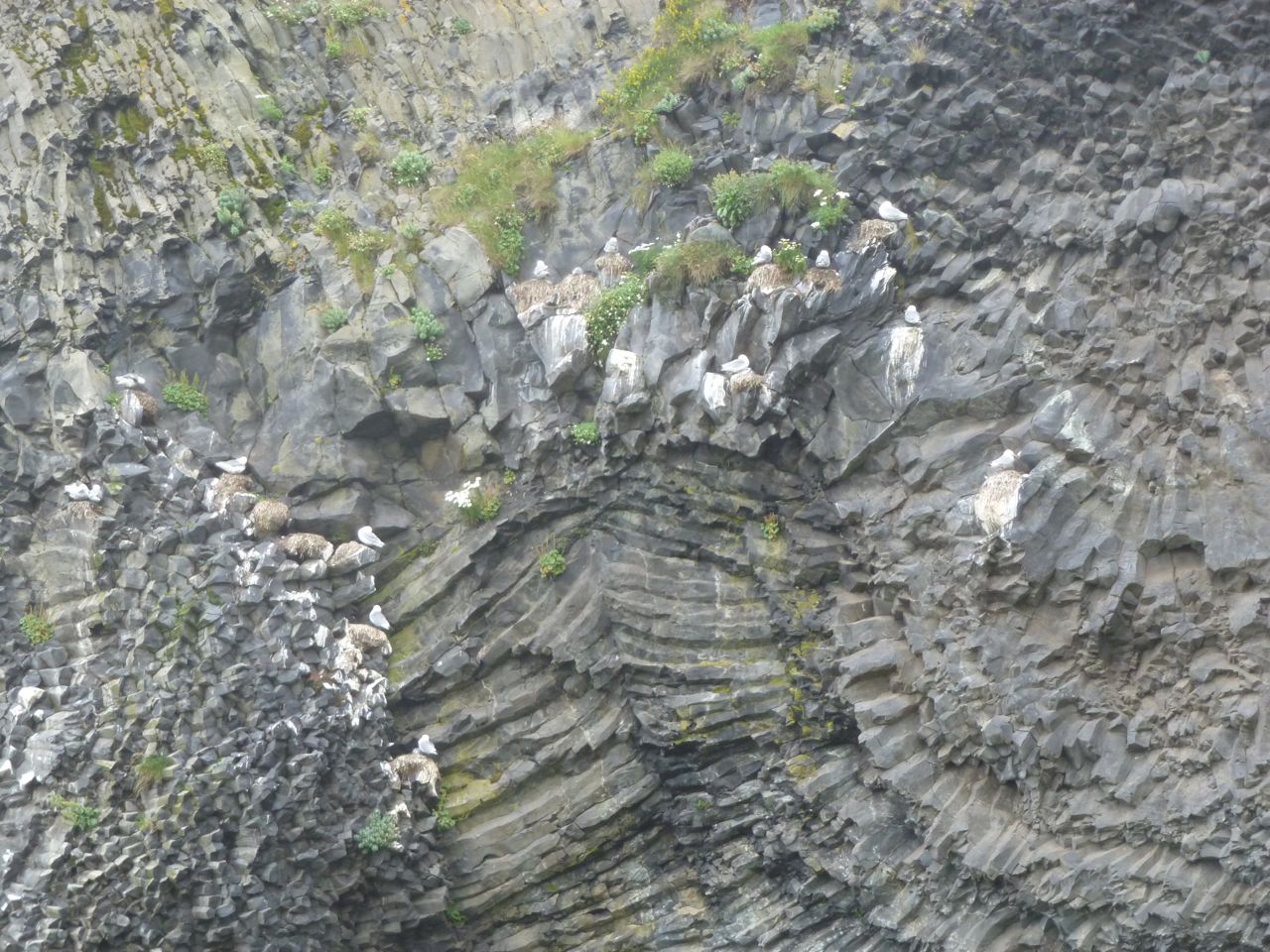
Multiple Flows of Chain Rhyme Stopped by the Cold of the World
And a bunch of Icelanders, too, at home here on the boundary of the ocean and stone. Gunnarsson’s novel The Black Cliffs makes a clear connection between birds like these, on cliffs like these, and the dark recesses of human motivation. He intended it as a kind of Heart of Darkness.
I know. I’m thinking like a poet here, but so was Gunnarsson. At Skriðuklaustur he was trying to build an enlightenment, to bring, so to speak, the unconscious past into a conscious present. In mainland Europe, the Enlightenment was built out of the scientific and technical developments of the 18th and 19th centuries.
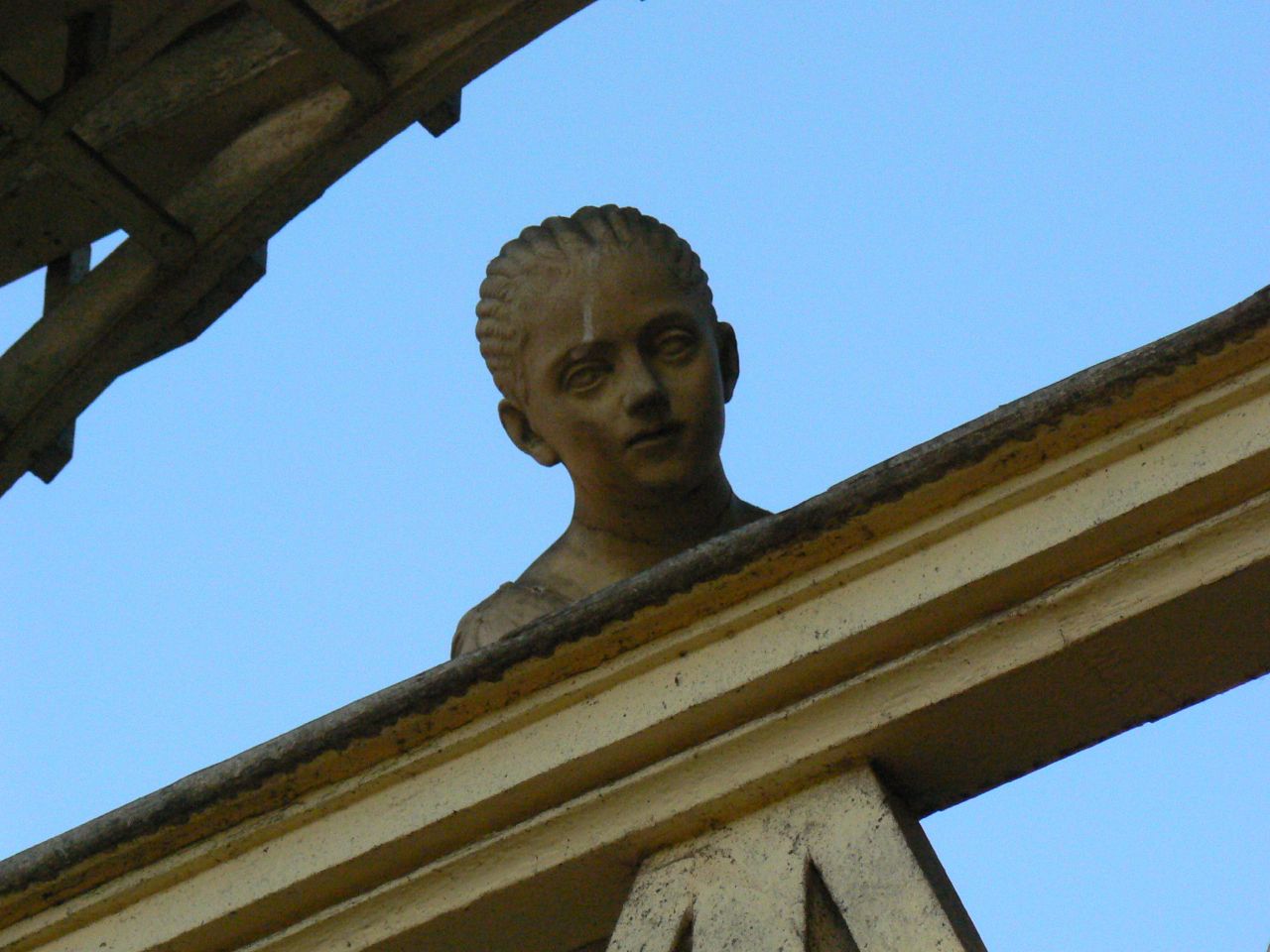 Enlightenment Era Cupid, Schloss Tiefurt, Germany
Gunnarsson was trying for a new Enlightenment, one built out of local patterns of belief rather than out of the imported classical models that were the rage in a National Socialist Germany that started out with dreams of becoming a Baltic, or Nordic, country, and became a Mediterranean one instead. Ironically, Gunnarsson’s house at Skriðuklaustur was profoundly German. (More on that soon.)
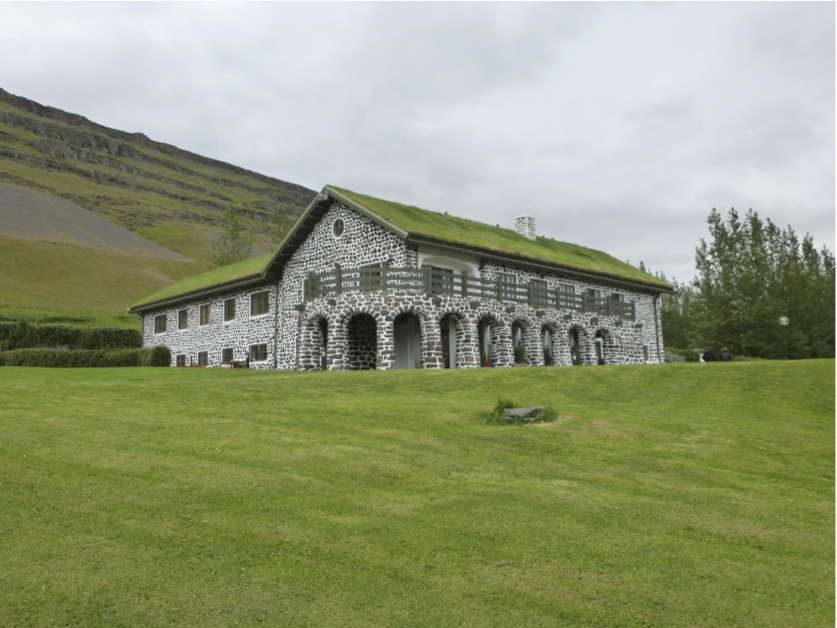
Skriðuklaustur
One important way it was German was that it was above ground. In his piece, Our Land, written for a reading tour he gave in Germany during the first year of the Second World War, Gunnarsson seems to have been musing that if Icelanders were going to start building houses aboveground, in the light, they would need some guidance — and not guidance that came purely from continental ideas. He was trying to offer it. Typically, he also wanted it to remain hidden.
Next: Hidden houses and other people.
The following description of Icelandic architecture dates from a book called “The North-west Peninsula of Iceland: being the journal of a tour in Iceland in the spring and summer of 1862, by Charles William Shepherd. You can view it here. It is a distressing and unsympathetic piece of work, which in its basic details could as easily have been written about any farmhouse through Europe, but isn’t, perhaps to shock his audience, perhaps to create some romantic sympathy, perhaps to warn against it. In other words, it has more to do with England and its politics than with Iceland, but, still, it provides some glimpses into the past, which might be useful.

Farmhouse Tools, Bustarfell
My grandfather and even my father were trained in the same tools as these in Europe. My childhood was spent with tools just like this in Canada. We didn’t let them rust, as this museum is, mind you. We took them out and used them. This is what the industrial revolution looks like at the end of the road, where it is paid for by hard, personal work.
Curiously, when Gunnar Gunnarsson went to Germany in 1940, he spoke about the one thing that was on his mind: farm houses. It is a carefully coded political statement, that is best viewed in context. Today, I’d like to give some of that context. First, an Icelandic farmhouse:

Farmhouse, Holar
Here’s Shepherd (the images are mine): “Icelandic farm-houses are invariably embedded in walls of turf from two to four feet, or even more, in thickness, through which embrasures are cut for the windows.
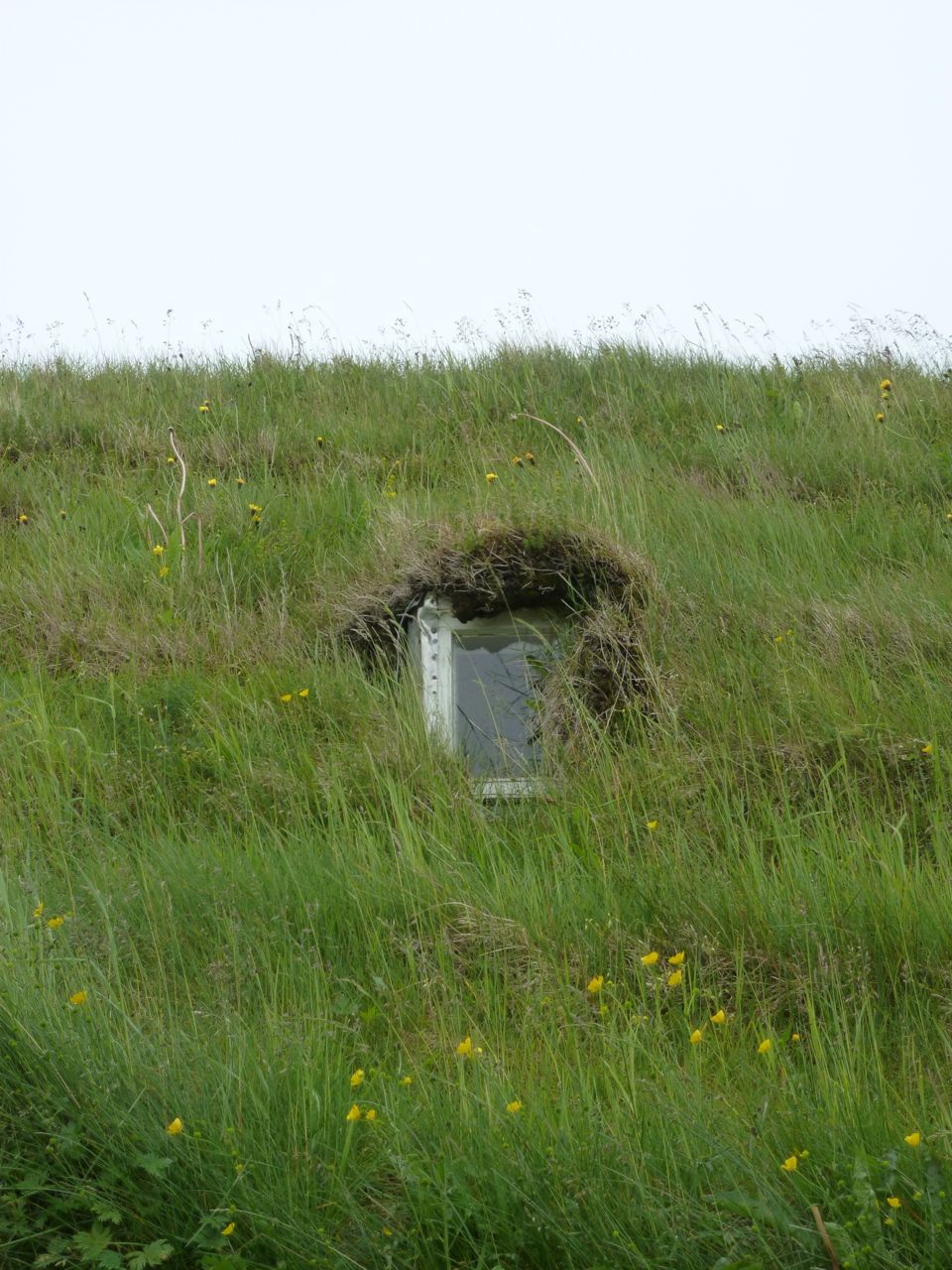
House Window, Bustarfell
Three sides of the house are thus coated, the front being generally left unprotected, but sometimes the house is entirely surrounded by turf walls, and the roof also has a coating of turf upon it externally. In front it has the appearance of several low bams, with their gable ends towards the approach, in the centre of one of which a low door is cut, while in the others a few small windows are placed here and there in no regular order, and each gable has a weather-cock on its summit. The interior of an Icelandic farm-house, however, it is no easy matter to describe.
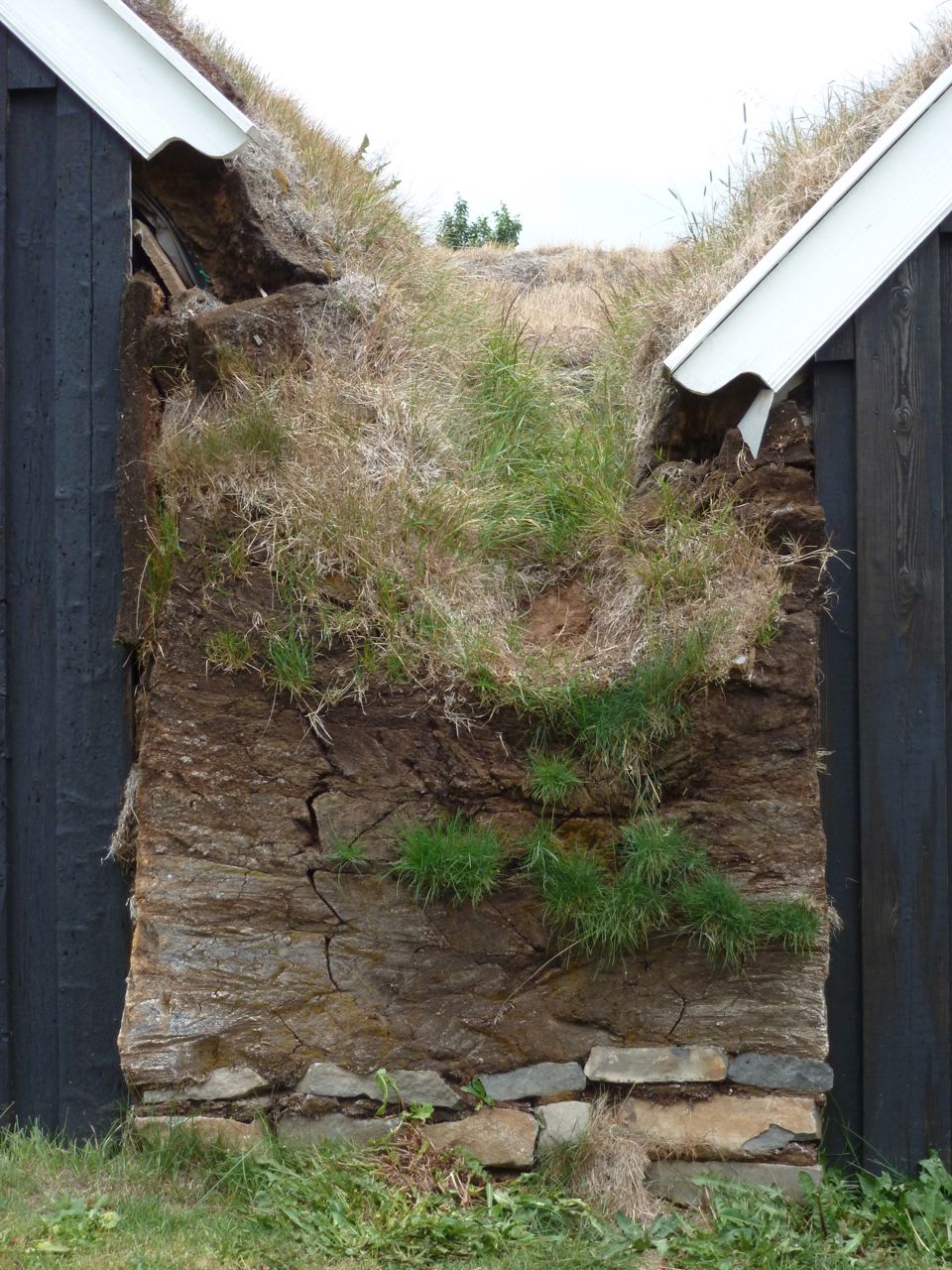 Turf Walls, Holar
The stranger who enters them is as often as not suffering from a more or less severe concussion of the brain, his head having come in forcible contact with the top of the low door-way. I have often crept through a door not more than three feet high; the general height, however, is between four and five feet Then, there is a descent of a step or two to an uneven, damp earthen floor, which is sometimes in puddles.
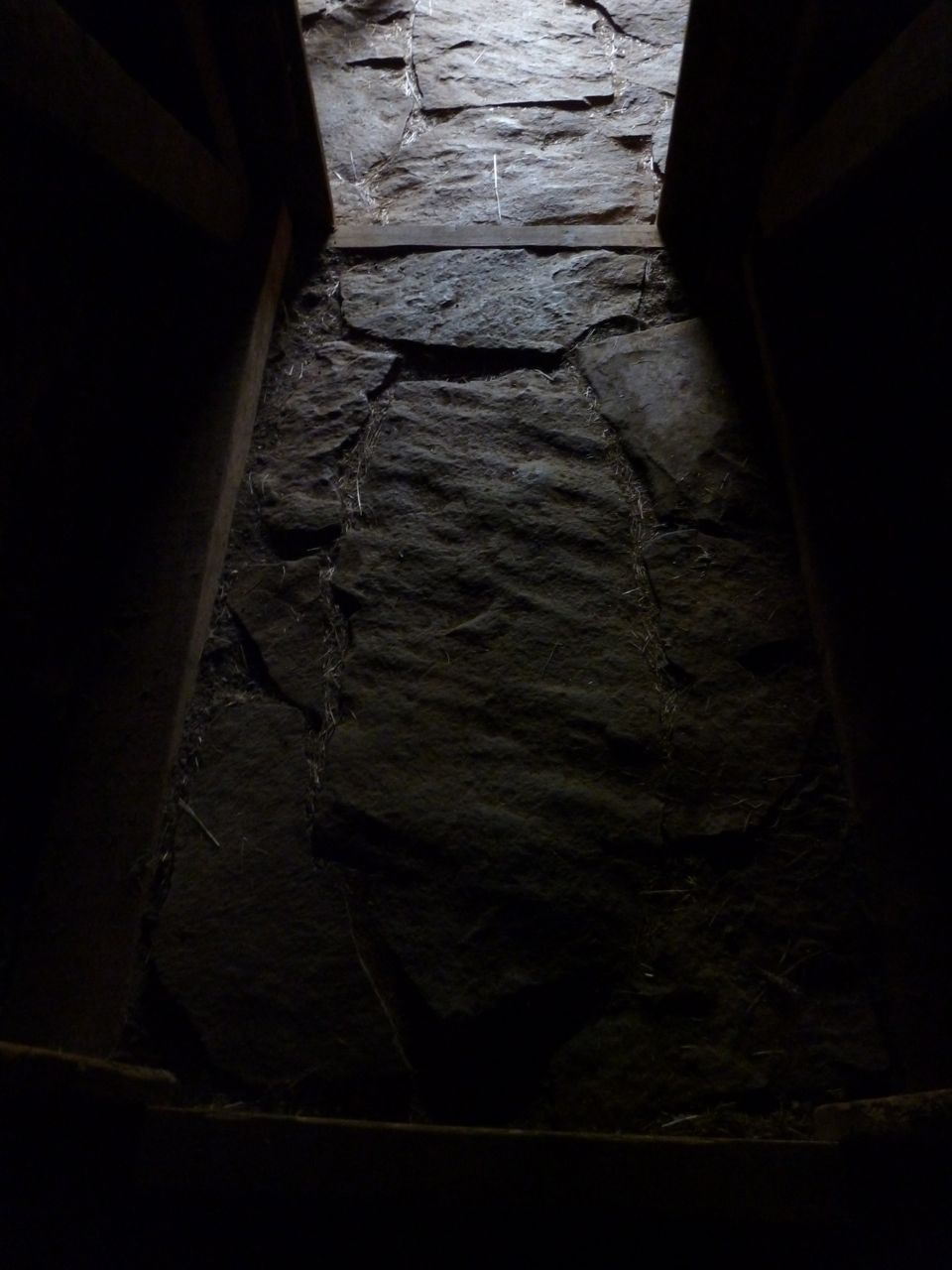
Farmhouse Entranceway, Holar
All is pitch dark; and the height of the passage barely admits of a person standing upright; nay, not infrequently a half-dried cod, or halibut, suspended from the ceiling, meets the intruder face to face. After a few yards there is an invariable stumble over a door-sill into another passage equally dark, which runs at right angles to the former, and of which there is no knowledge till the opposing earthen wall gives an unpleasant intimation of its presence.
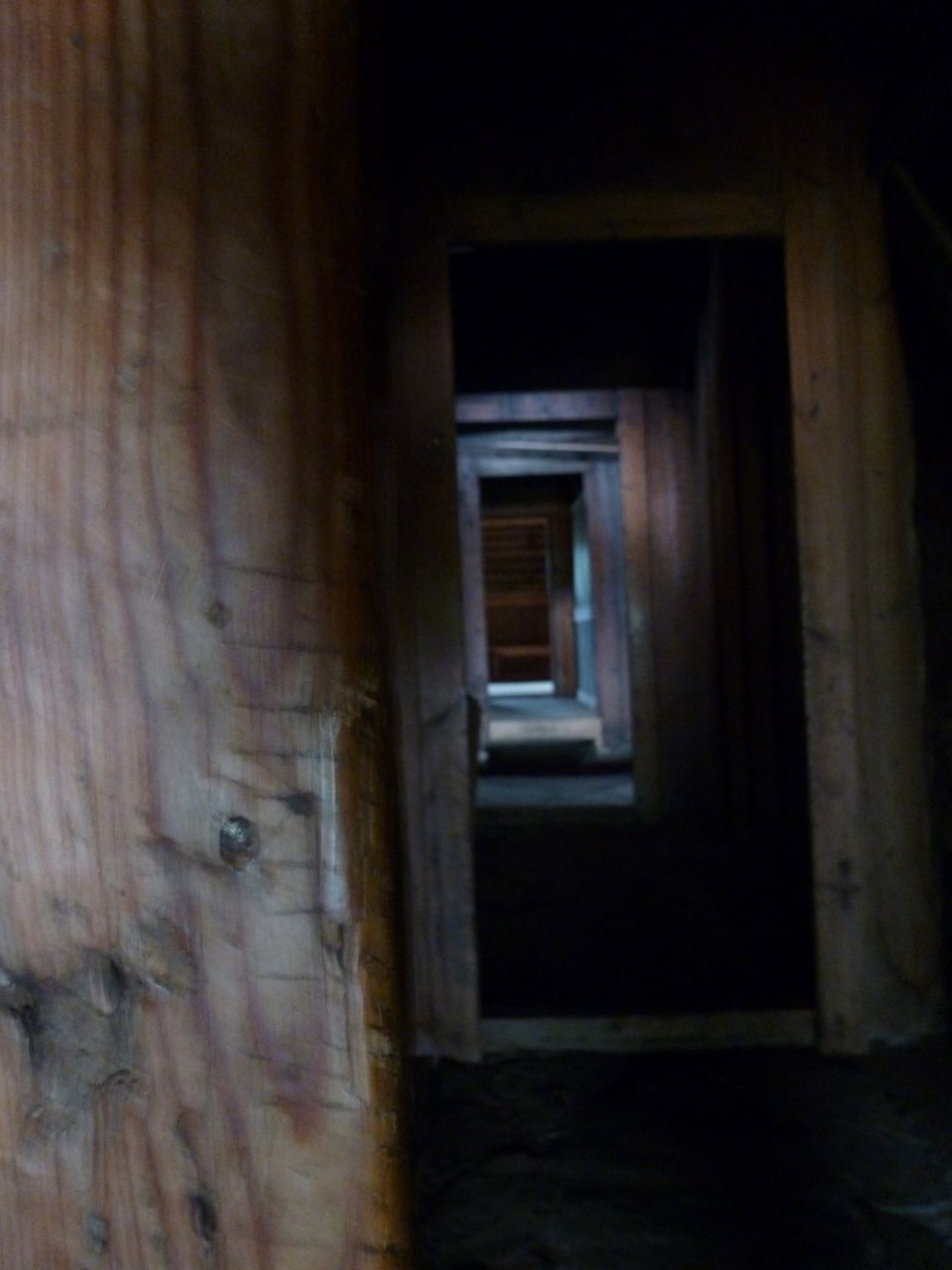
Hallway, Holar
This passage right and lefl is sometimes straight, but always has either its floor or its roof uneven, so that the explorer is continually in danger either of falling down, or of hitting his head against a rolling ceiling. The passage leads on the right and left to rooms which are the best in the house. They are from ten to fourteen feet square, and are coated entirely with deal, and often painted in various colours. One is set apart for visitors, and generally contains a bed, sometimes a four-poster, situated very often in a recess in the wall, before which a curtain is drawn in the day-time ; also, a little table under the window, looking out through a turf embrasure, two or three chairs, a chest of drawers, a small looking-glass, a few Danish prints hanging against the wall, and sometimes a shelf or two of books. A bottle of schnapps and two liquor glasses stand upon the drawers, or window-sill.
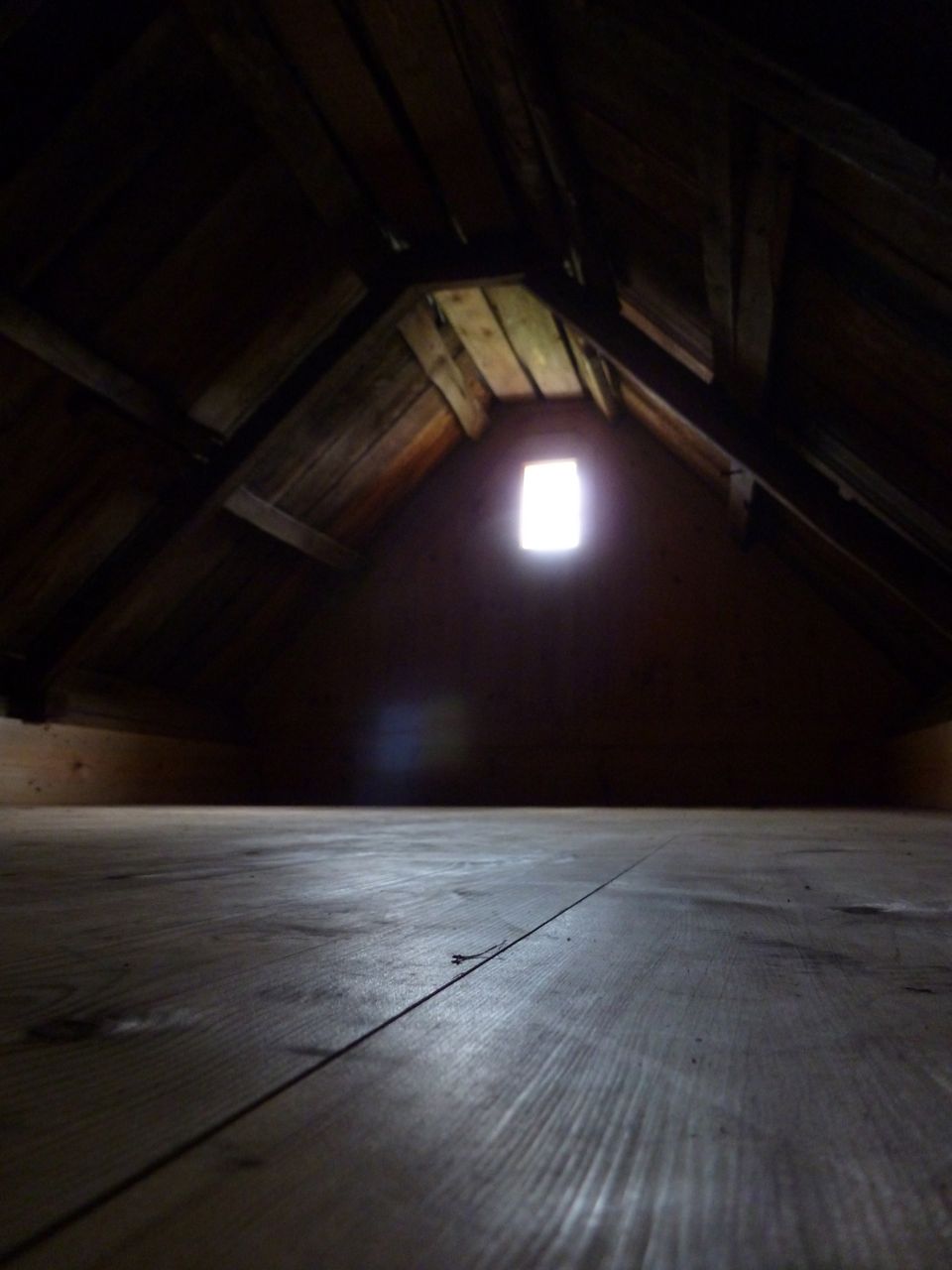
Upper Room, Holar
The floor of these rooms is raised a step above the rest of the ground-floor. Upstairs, over these rooms, are lofts, in which the inhabitants sleep. They are long low rooms, surrounded by a raised bench, from eighteen to twenty-four inches high, and three or four feet in width, on which the sleepers range themselves. The staircase is very irregular and dangerous, being often a ladder with half its spokes broken or loose, and, besides, it is in total darkness.

Work Room, Bustarfell
The kitchen, placed on the ground floor and at the back of the house behind the best rooms, is, like the passage leading to it, dark and without windows. It is generally a large room, with a peat fire smouldering in its centre. A round hole in the roof is the only vent for the smoke, so that everything is coated with soot. Quantities of peat and birch-wood are stored around, two or three tubs of water stand at hand, and a huge kettle is always on the large stones that form the fire-place, while many changes of damp garments hang and blacken on the rafters above.

Upper Window, Bustarfell
In addition to the kitchen there are other dark apartments, store-rooms, and sleeping-rooms; but the smells from dried fish and half-cured mutton, the choking effect of condensed smoke, the accumulated rubbish and smuts of ages, as well as the danger of breaking the head or neck, completely cured any curiosity we ever possessed of peering into these dark abodes.”

Out the Window, Holar
If you haven’t figured out that a traditional Icelandic relationship to darkness, light, and up and down is not the same as that of the 21st century, let alone of those people living in gaslit England, it might be helpful to scroll back up over these images again.
Here’s Shepherd again, in a piece remarkably prophetic of Gunnarsson’s intent…
“The farmer and his family, with his labourers and their families, all live under the same roof. There are no such things as labourers’ cottages in the country; in fact, two houses together are very seldom seen, except in the small towns and fishing villages. The whole household generally take their meals together, and seem outwardly to live on in equality. In the winter, for four or five months, they seldom move far beyond their immediate outbuildings, in which their cows and sheep are stalled.
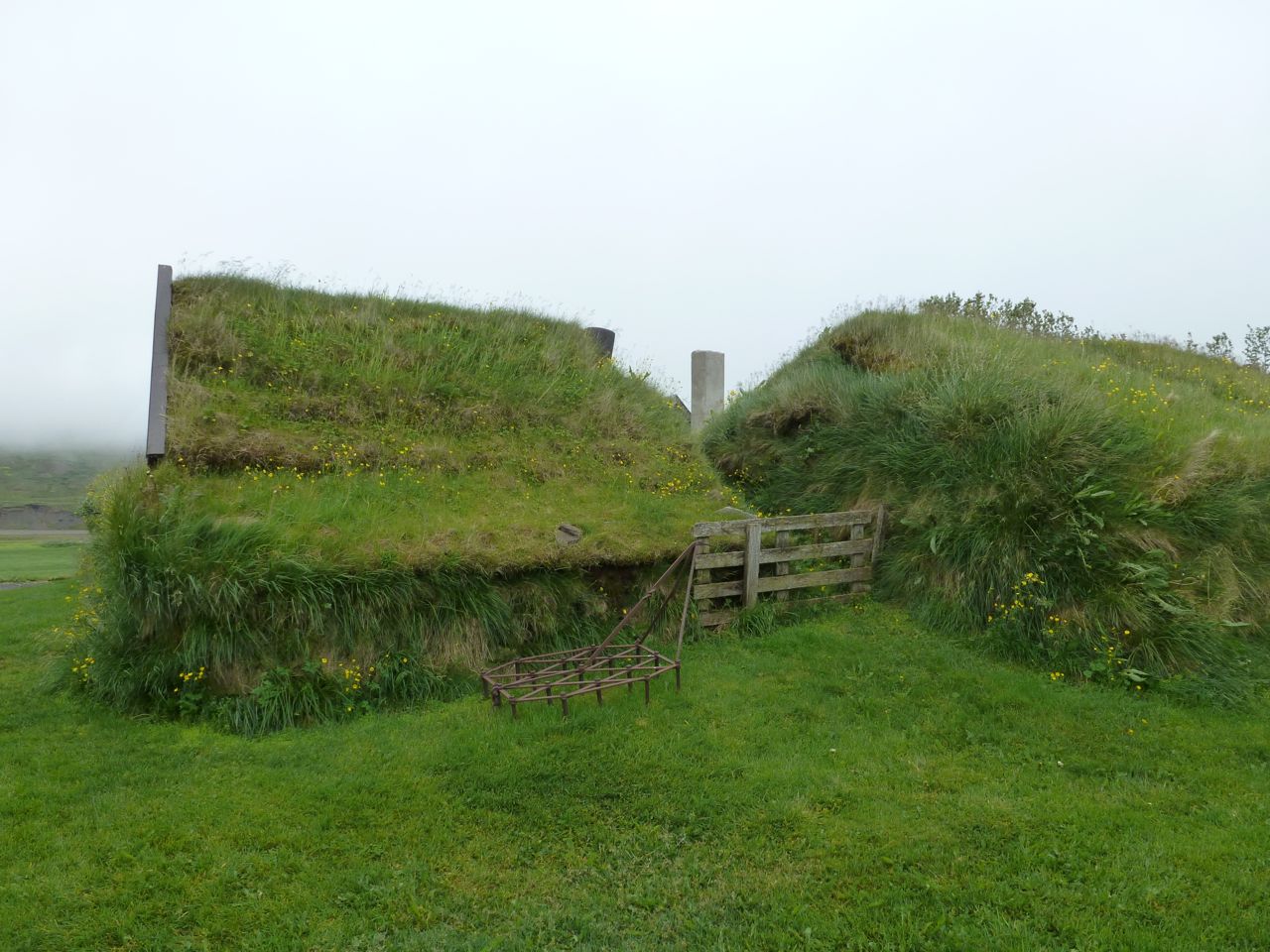
Outbuildings, Bustarfell
These poor animals are stowed away in dark houses like large oblong earth-mounds, with a small door at one end, but with no window; as a substitute, however, the turf on the flat-ridged gable is left loose, so that on fine days a little light and air can be admitted. There are several such buildings adjoining every farm-house, and the mud and filth about their door-ways are truly distressing.”
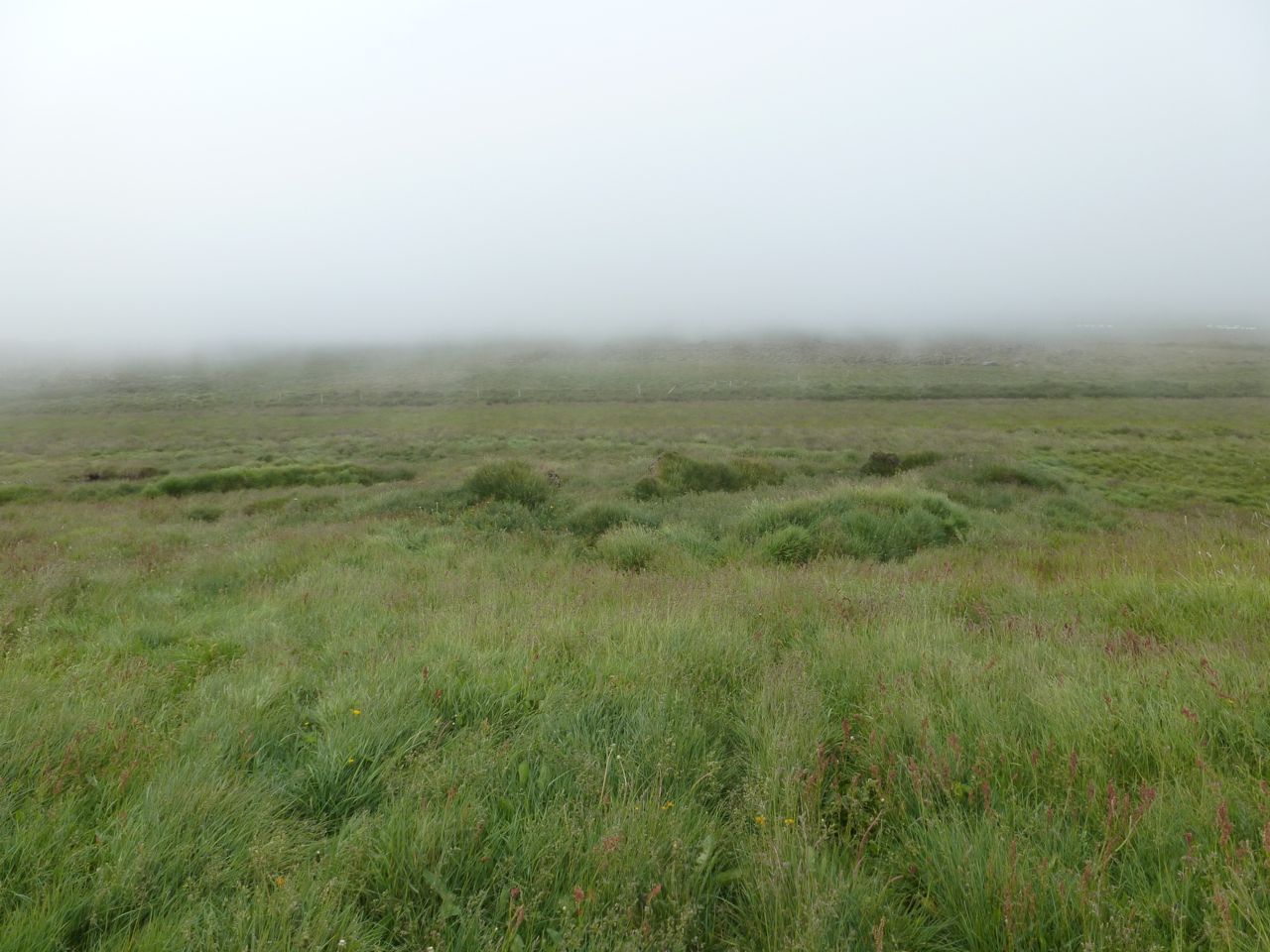 Sod House Given Back to the Grass, North of Hvitserkur
Life was hard (and windy!) in this location and no man or woman can be blamed in any way for leaving. Nonetheless, anyone who left this land also left the map of his or her unconscious that the sod house represented and embodied, with its passages between darkness and light, of low and high space, and of different qualities of light for different functions, moods and different levels of sociability. This map of the unconscious was also Gunnarsson’s map of Iceland. I’ll talk about that in the next post.
Welcome to a farm as a literary genre. I’m going to land in Iceland on March 16, 2013, and will begin my residency at the novelist Gunnar Gunnarsson’s old farm Skriðuklaustur on March 25. This blog will be an online home for the many explorations that make up this journey to the centre of the earth.
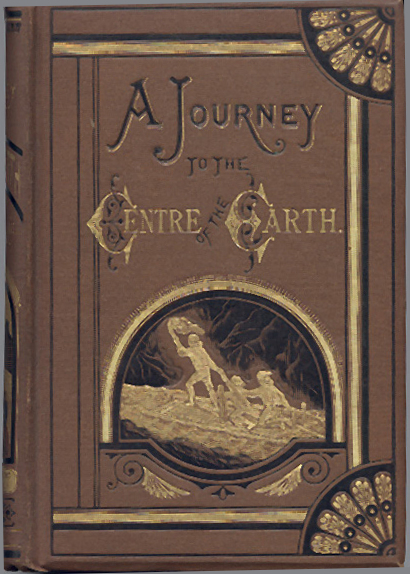
Hint: This Journey is Not Like Jules Verne’s in 1874. He made his up.
But the torch is a good touch. Let’s hang onto that, in case it gets dark.
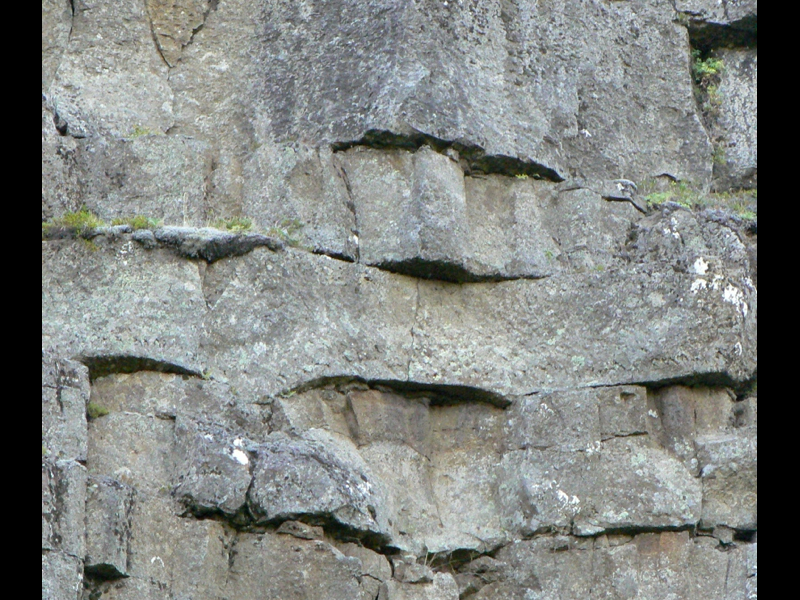
What better way to start than to get to know our characters? They are a puzzling lot, who are not quite the way they seem at first glance. For example, which one of the characters below is the troll? Is he here in Þingvellir?
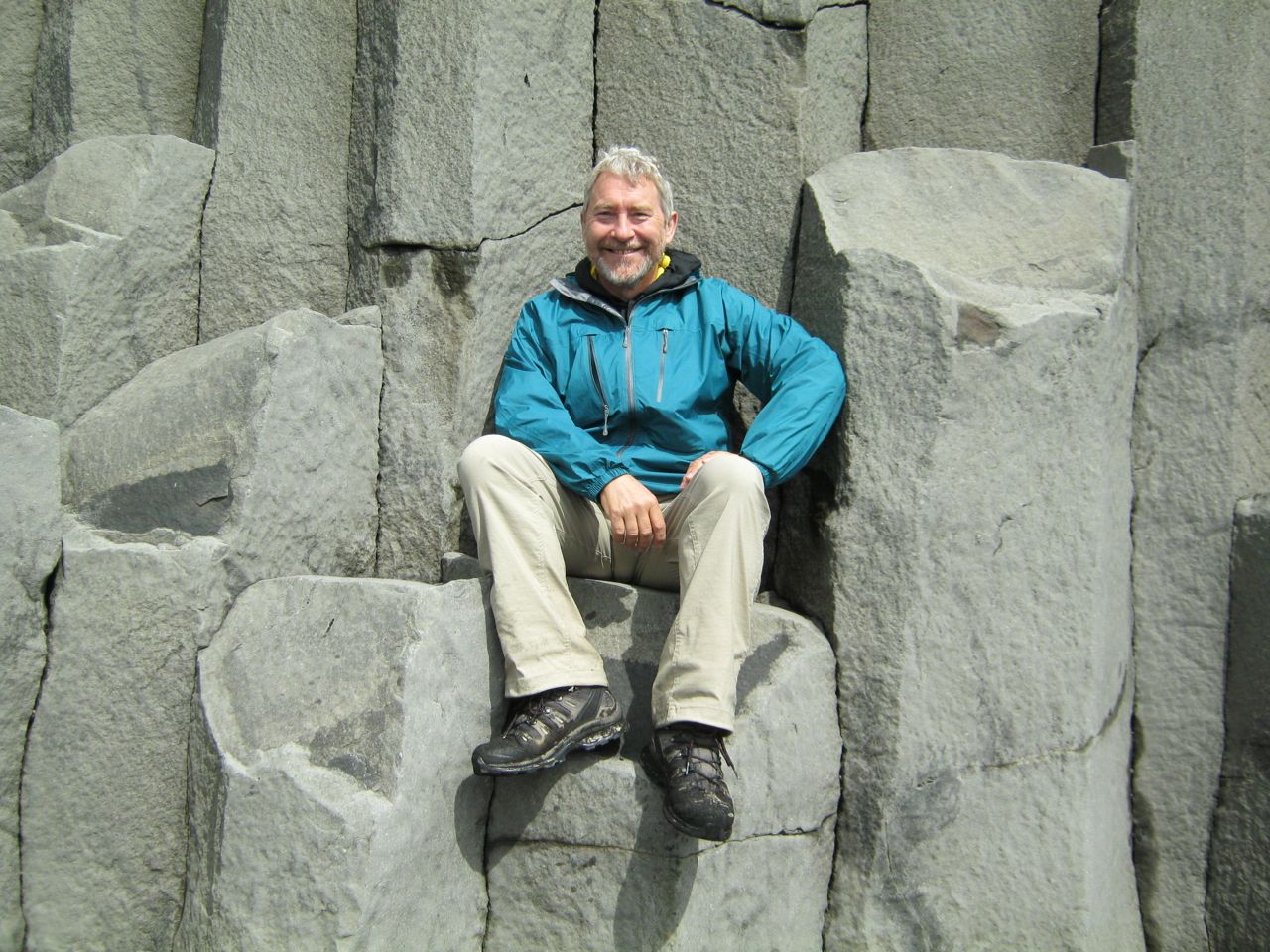
Or here west of Vik?
Or maybe here, east of Kirkjubaerjarklaustur?
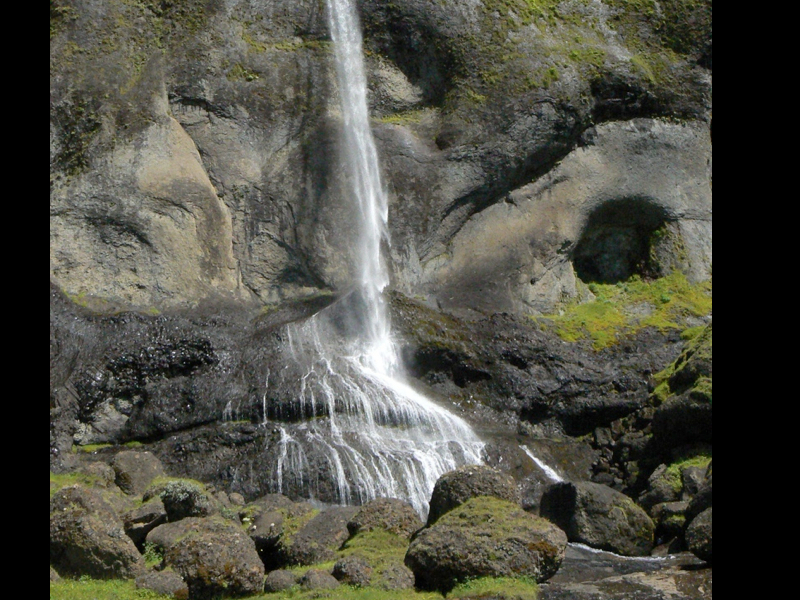 Tough, isn’t it! One of the foundations of this project is a discussion of the relationship between rock and the human subconscious, in people who have been acclimatized to a place. We’ll be talking more about that, and, of course, about word farming and other old technologies, too.
 A Farm in Iceland