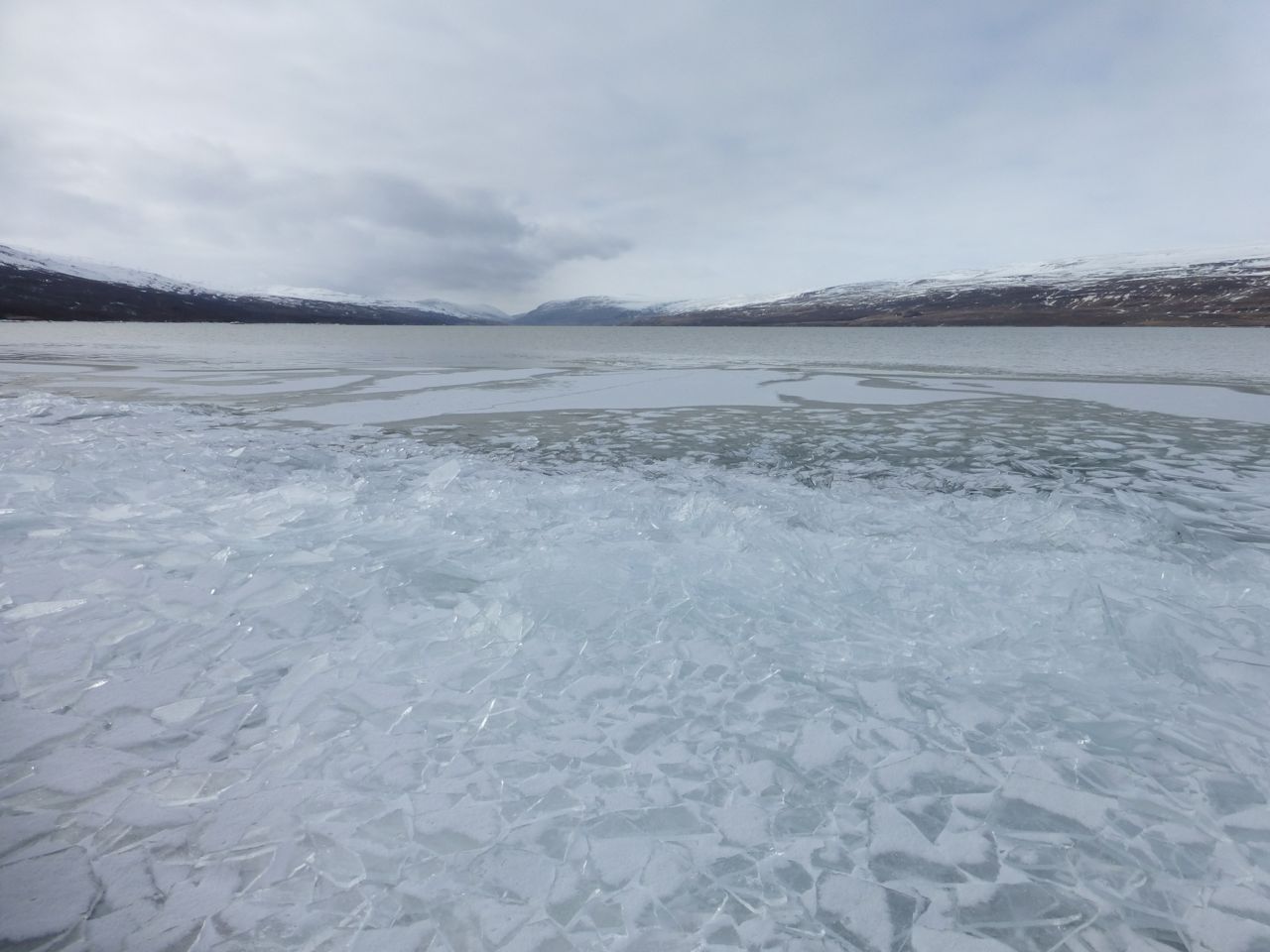
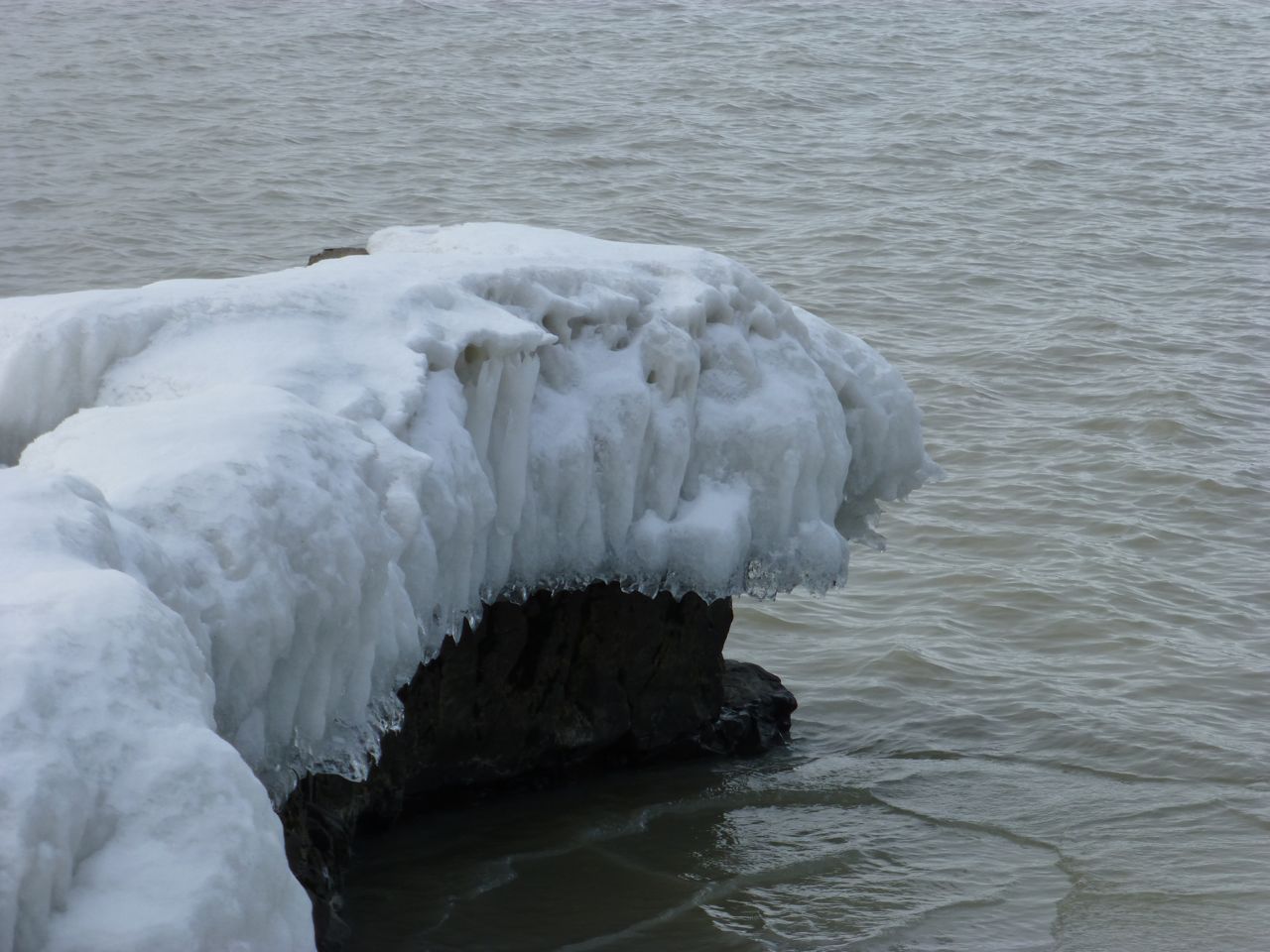
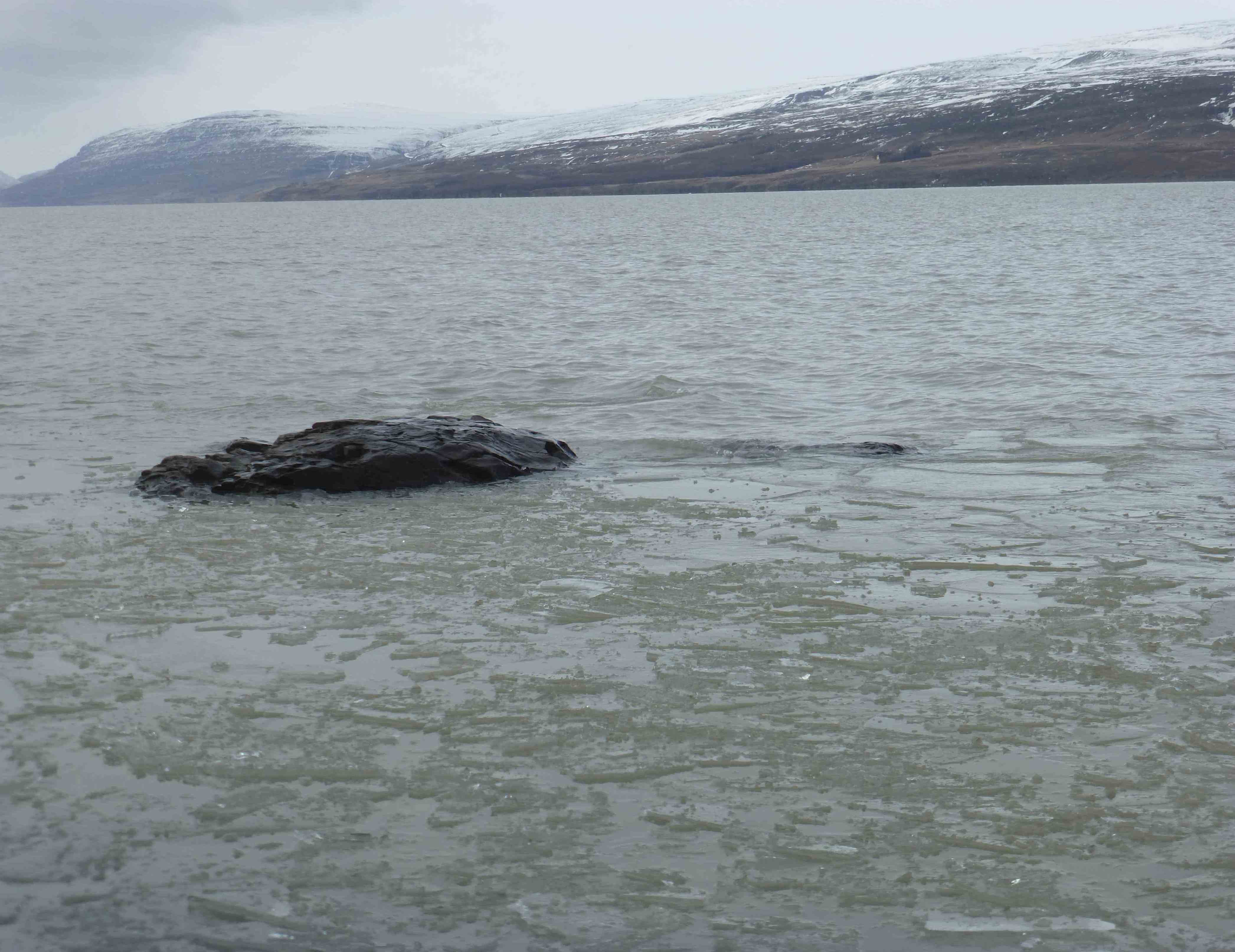
Tag Archives: Skriðuklaustur

A Line of Prayer and Poetry Made with Norwegian Wool

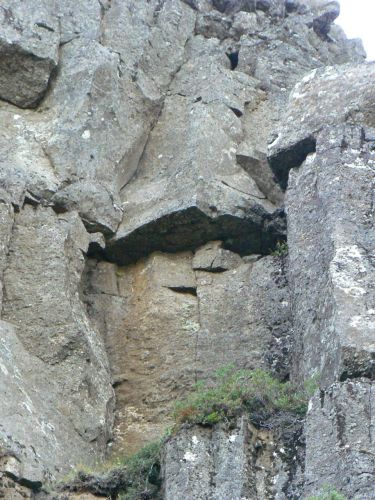
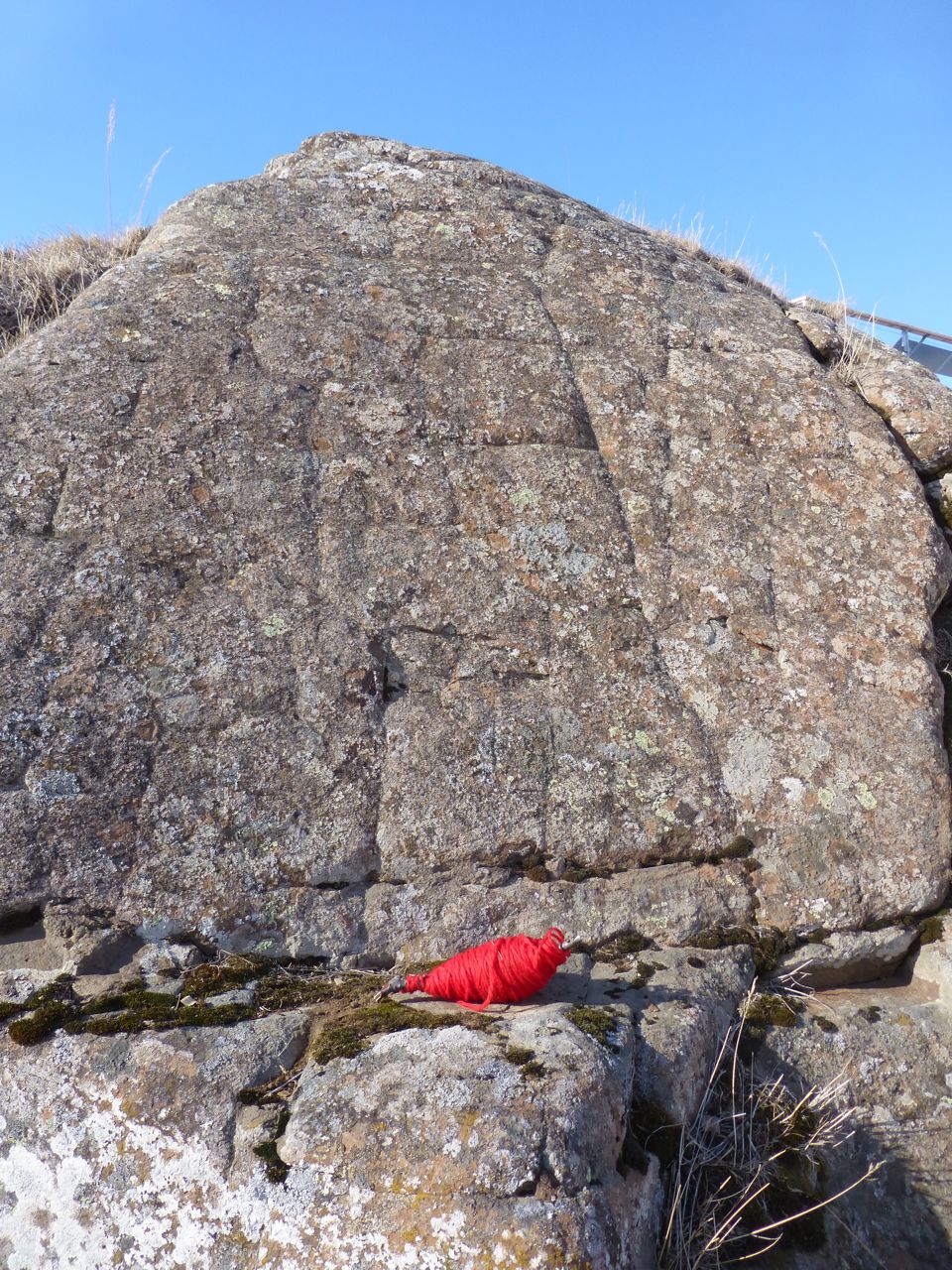
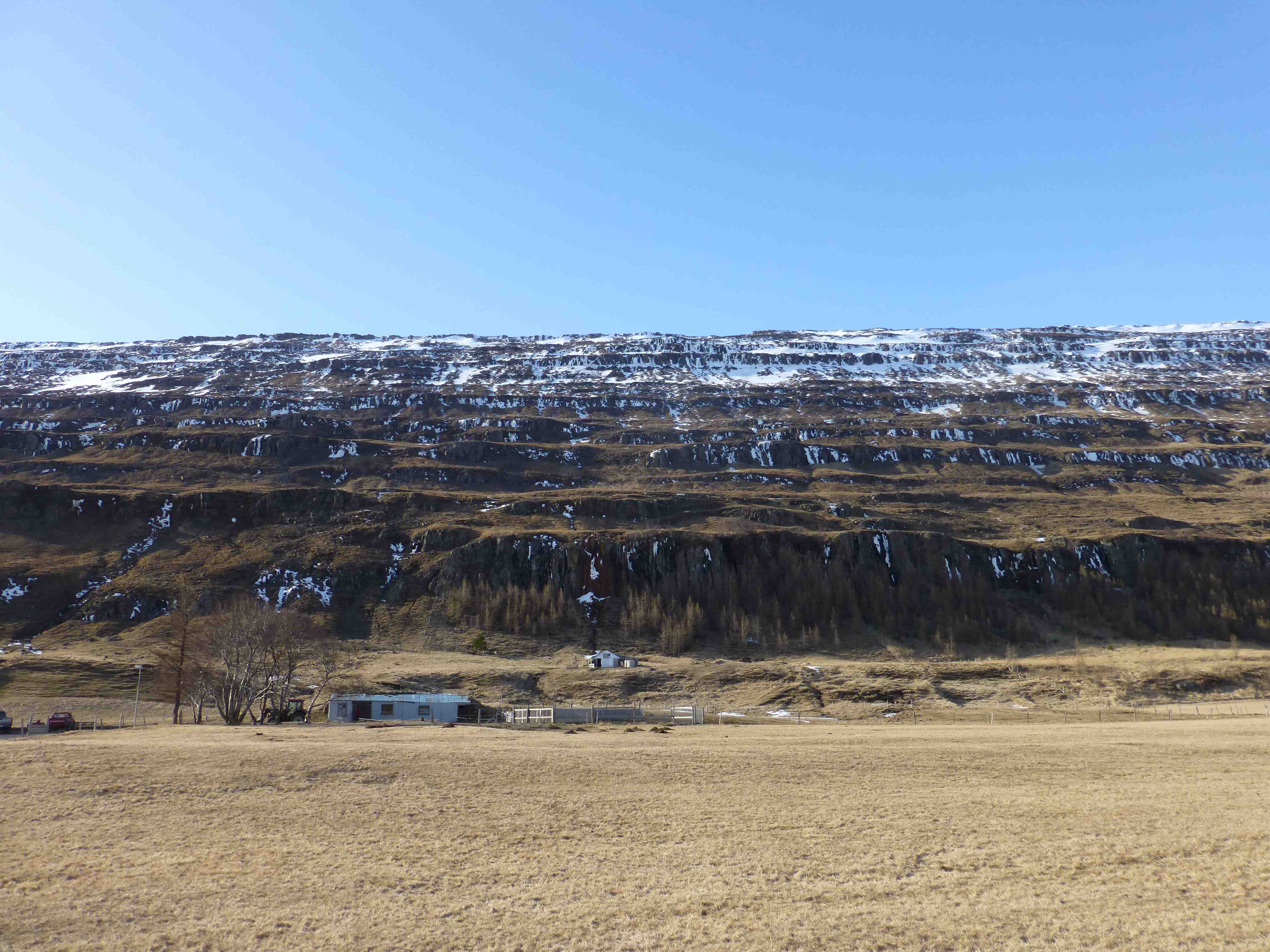
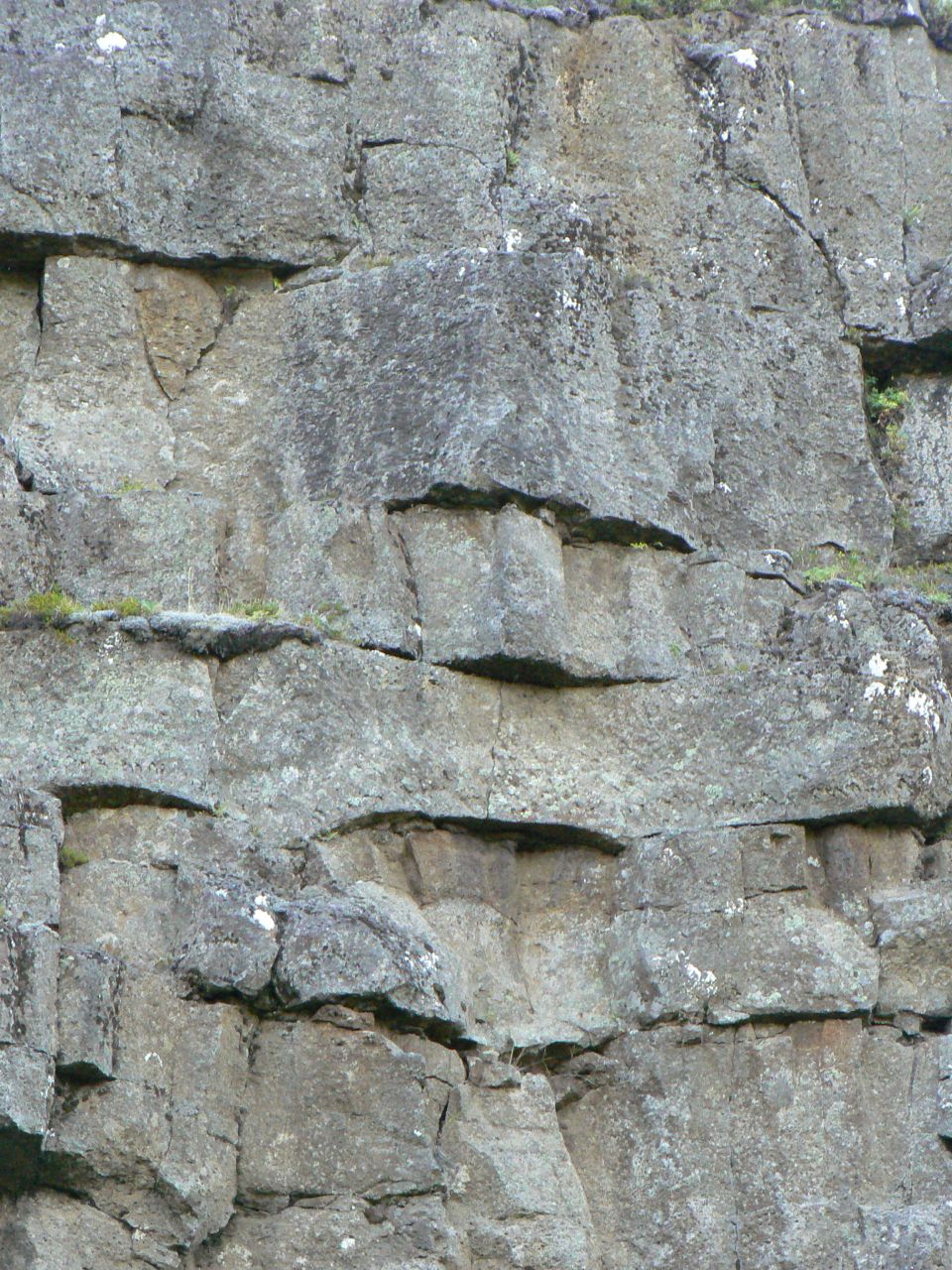
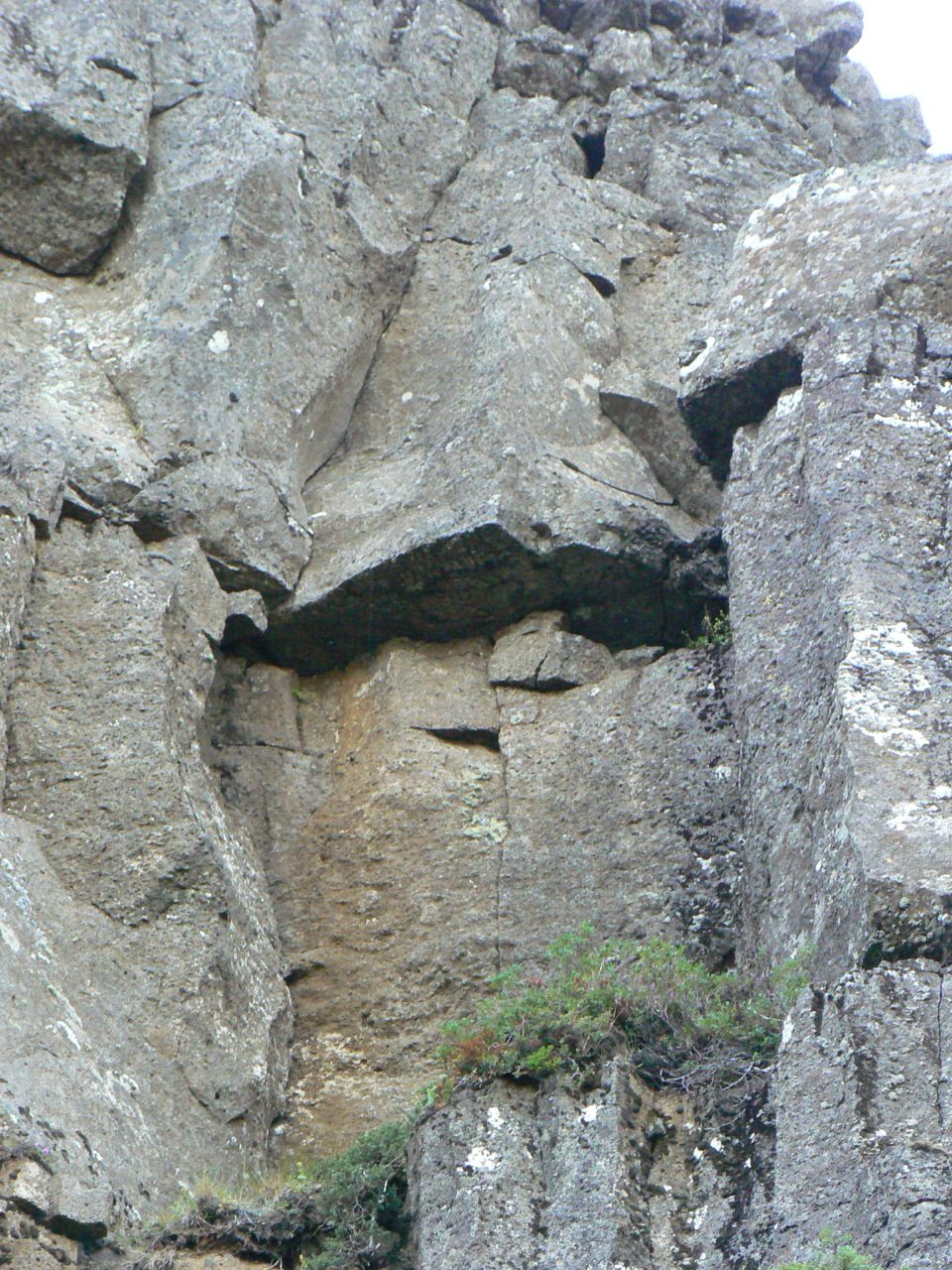
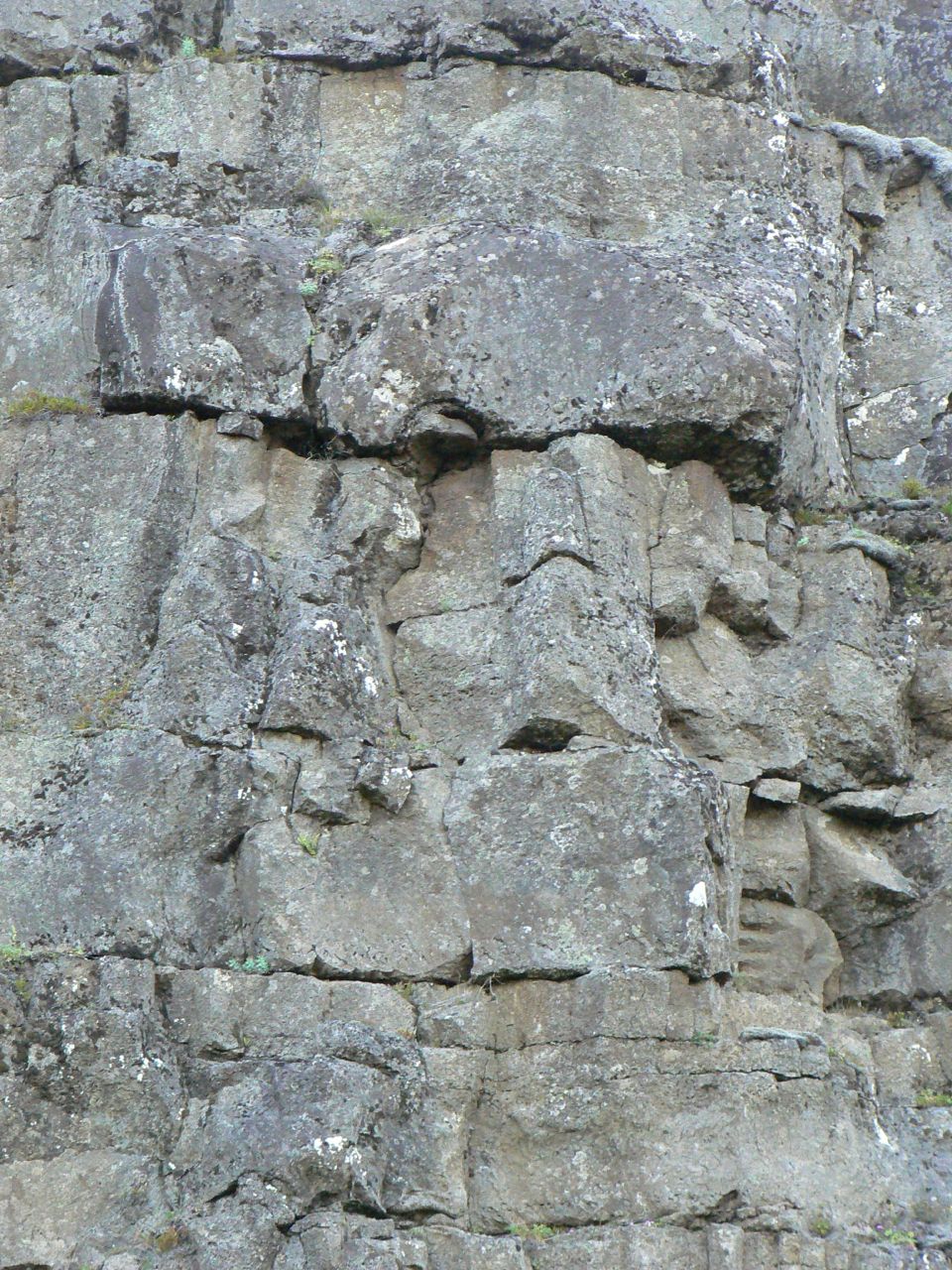
The geologists came and declared all rock forms here at this East Icelandic cloister site to be naturally occurring. I believe them. Still, were the natural shapes enhanced 500 years ago? Was the cloister built here because something was recognized in the stone? I think that’s quite likely. Is there a lost art of stonework that is built on the premise of deepening natural forms until they take on meaning? It would make sense: if one were to rub a natural cross over and over again, that would be an intense, and physical, act of prayer. Still, scientists can’t answer questions like that. Likely, no one can. One can, however, enter the spirit of stone with an open mind. That much every human has, if he or she wishes it. So, what do you think: is the image below a group of eroded basalt crystals (certainly) or is it an image of Mary and the Infant Jesus?

P1420857Skriðuklaustur Monolith

Fljótsdalur, Iceland

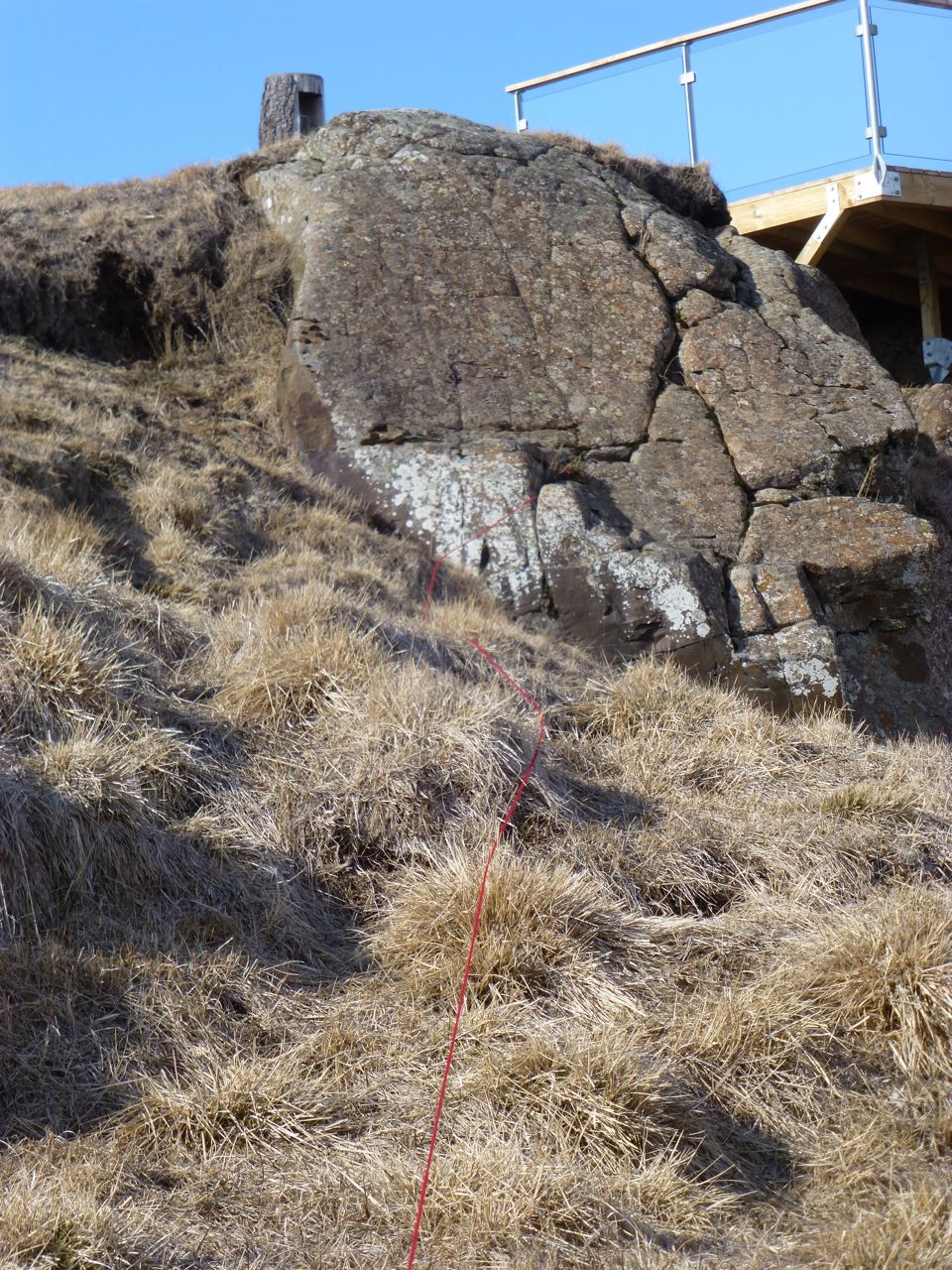
Or something else that the monks tried to rub off? Or a painting of light that only showed up when the light was at certain angles (true)? Or St. Barbara (possibly the patron saint here)? Or nothing? Maybe it doesn’t matter. This was, however, the stone that the monks saw directly in front of them when they left the entrance to the cloister church and looked, as the landscape directs one here, uphill. That, I thought, was worth thinking on. What I did to help me think on it, not being a geologist or an archaelogist but being a poet (which is an honourable thing, with deep roots of its own) was to go 40 kilometres into town in a snowstorm to buy a ball of wool and to make a line with my hands, to help me think. As a farmer (long ago, and in my heart, still), I know that the hands are a powerful tool for thinking. So, I anchored the line in a crack at Mary’s (?) feet …

angelclose
… kind of following it where I felt it was leading me…

angel

… which was, downhill, and into the church (it’s a natural flow) …

flag

… past the baptismal font and into the nave, where I discovered that I didn’t want to walk through the walls …

church

… so back again to the font (I was lost on this spiritual journey for a moment and thought about circling the font, and even tried to walk back up to Mary (?) and link her with a ribbon of life blood blowing around in the wind (ah, it was hard to keep this stuff on earth, did I mention that?), but that felt wrong, and suddenly I saw where I needed to go, drew my line of life back past the font …

font

… and through the monk’s doorway into the church (instead of the public doorway I had entered before) …

step

… and through the adjoining doorway into the cloister garden (I’ve always liked gardens, especially church ones and their Edens) …

well3

… and as you can see, to the garden well …

well

My 70 metres of Norwegian darning wool, purchased for 460 Icelandic Crowns (around $4) was just the right length to drop to the bottom. I thought that was a good sign. I then took these images, so you could walk with me and share the moment of my thinking with my hands. At this point, my Mary was joined to the well in the Garden by passing through the church and the monk’s residence… a beautiful path, I thought. Next, I went to the hillside, picked a birch twig from the grass as a spindle (among the earliest images we have of men and women are made from birch twigs, and in German the word for bone and the word for birch are the same, and my family is German, so, hey) and, starting at the well, rolled the now-charged string back up, and as I wound that 70 metres around a tiny axle, over the wood chips …

floor

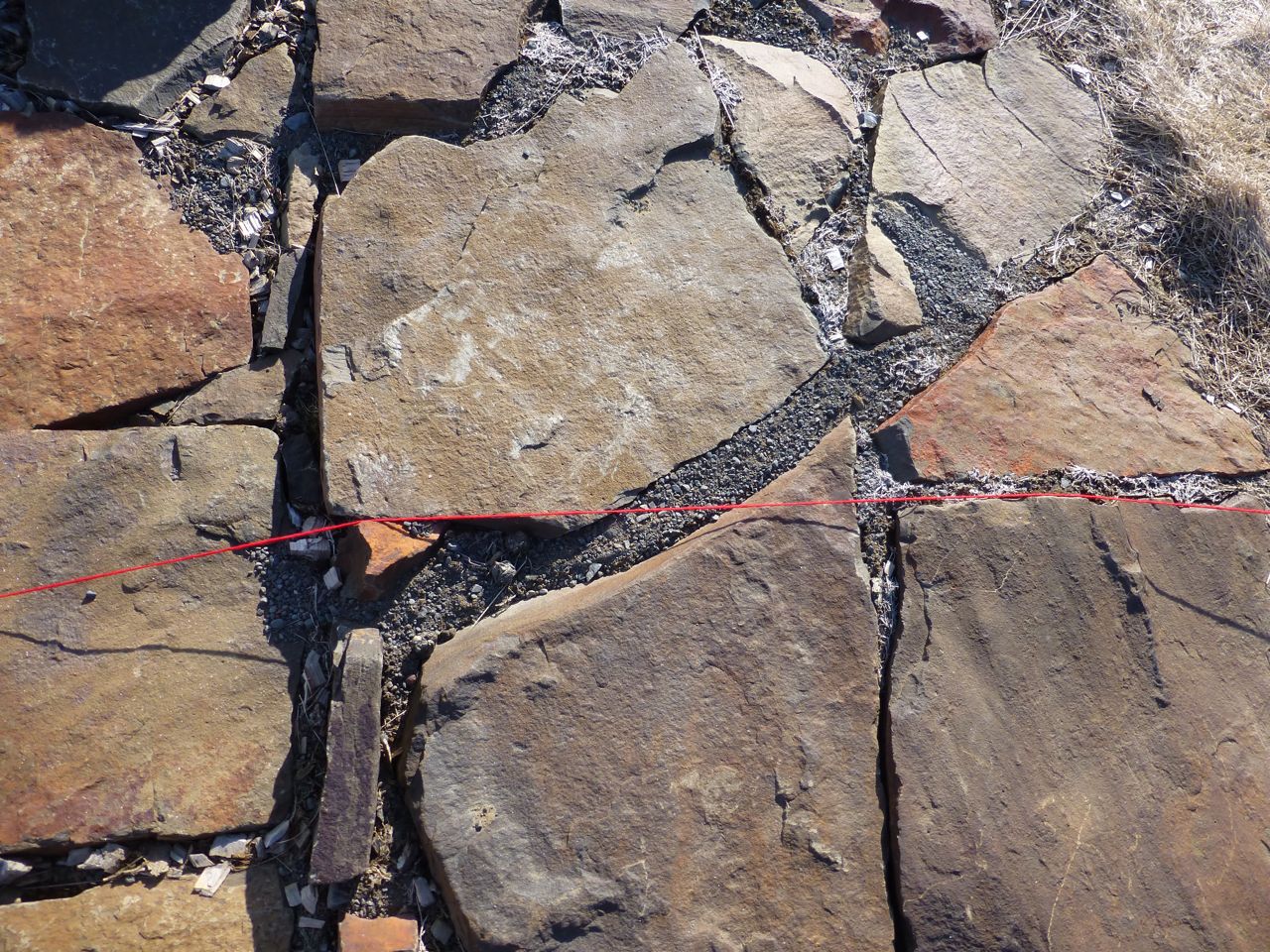
… past the stones that once supported the church walls …

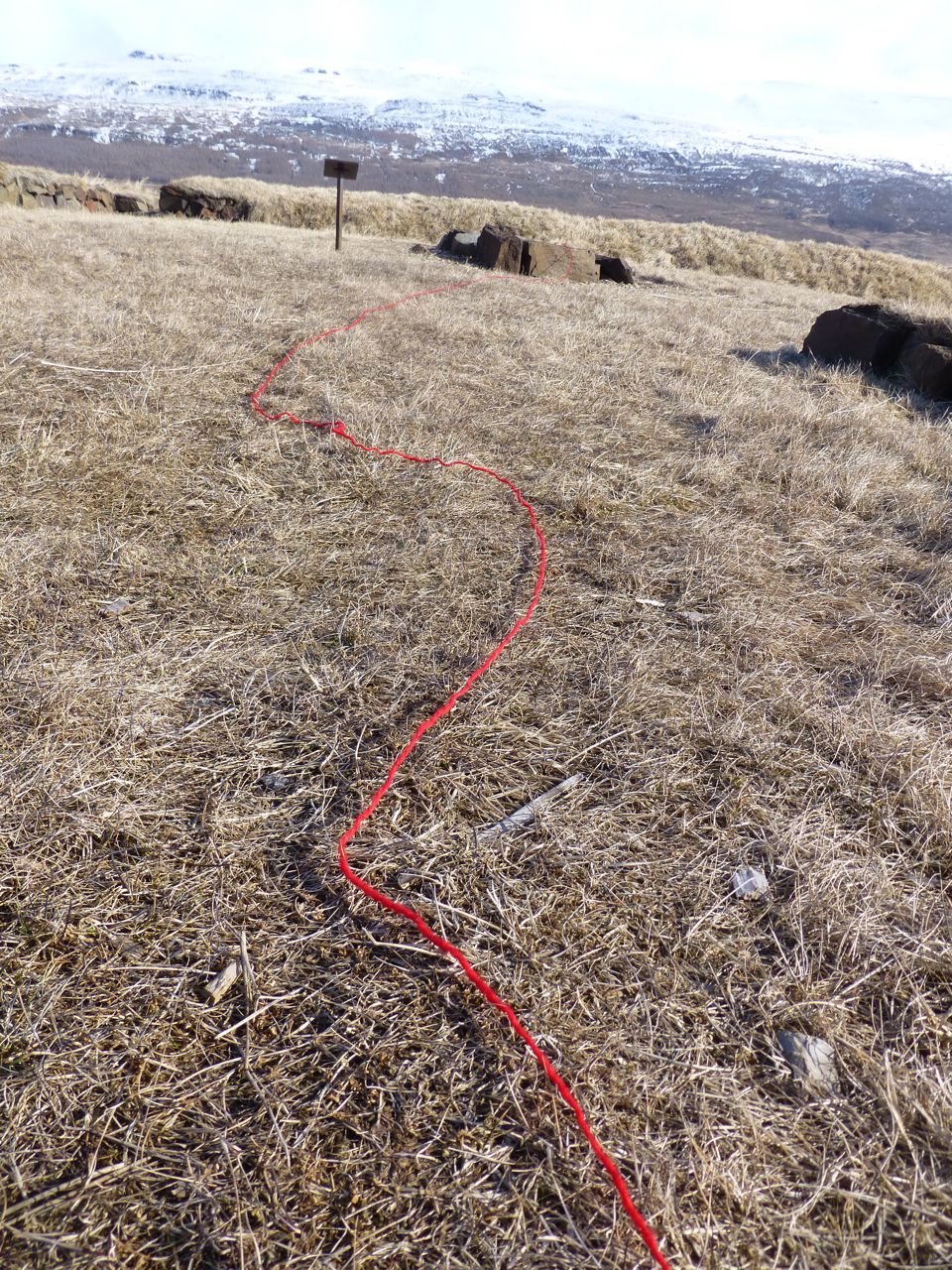
stone2… and through the grass …

grass… I felt that I was winding life on the axle of the universe or the pole of the earth, day by day by day, that with each twist of the birch twig to accept the string, a year passed, and I felt life in that string, not just the life the wind gave it, but energy from the universe; I felt that I was weaving with an ancient craft, in a small physical prayer, from the well up to … well, let’s just say Mary, who after all, was a spiritual fire in a human form, until all that energy was there, wound up on its spindle, at her feet …

wound

… and that was my prayer. Not an approved Christian prayer, but, then, I am not a Christian, only a man who walks in a world of spirit, with the sense to know that if you stay at a monastery, do the work. Did I learn anything about the material reality of that stone? No. That’s for geologists and archaeologists. But I did learn this: when I carried that bobbin of yarn back up to my roomI felt that I was carrying a living heart, and carried it with the reverence and care that seemed fitting to that, next to my own, and I realized that if I unwound this thread, anywhere, let’s say tomorrow, or the day after that, or a year after that even, the energy that I had wound with the motion of my body onto that birch twig, would be there and join the points of that new story back to that stone (and my questions of it) and the church and the well. The line was a journey, that I could now carry anywhere, and have to unwind and walk. Whatever that stone is at the cloister, it’s power came from a sense of devotion not far from that. Is poetry anything else? Well, I don’t think so anymore. Now the bobbin sits on my kitchen windowsill (I thought Mary might like the warmth of the hearth) …

woolwindow… (and the steam from my potatoes), waiting for me to think some more, in this fashion of thinking that is not done with words but with the body and in the world. Poetry had its roots there. I have learned here that it has not left them. For me, that stone is not the same.

Colonial House Building 101, an Icelandic Novel

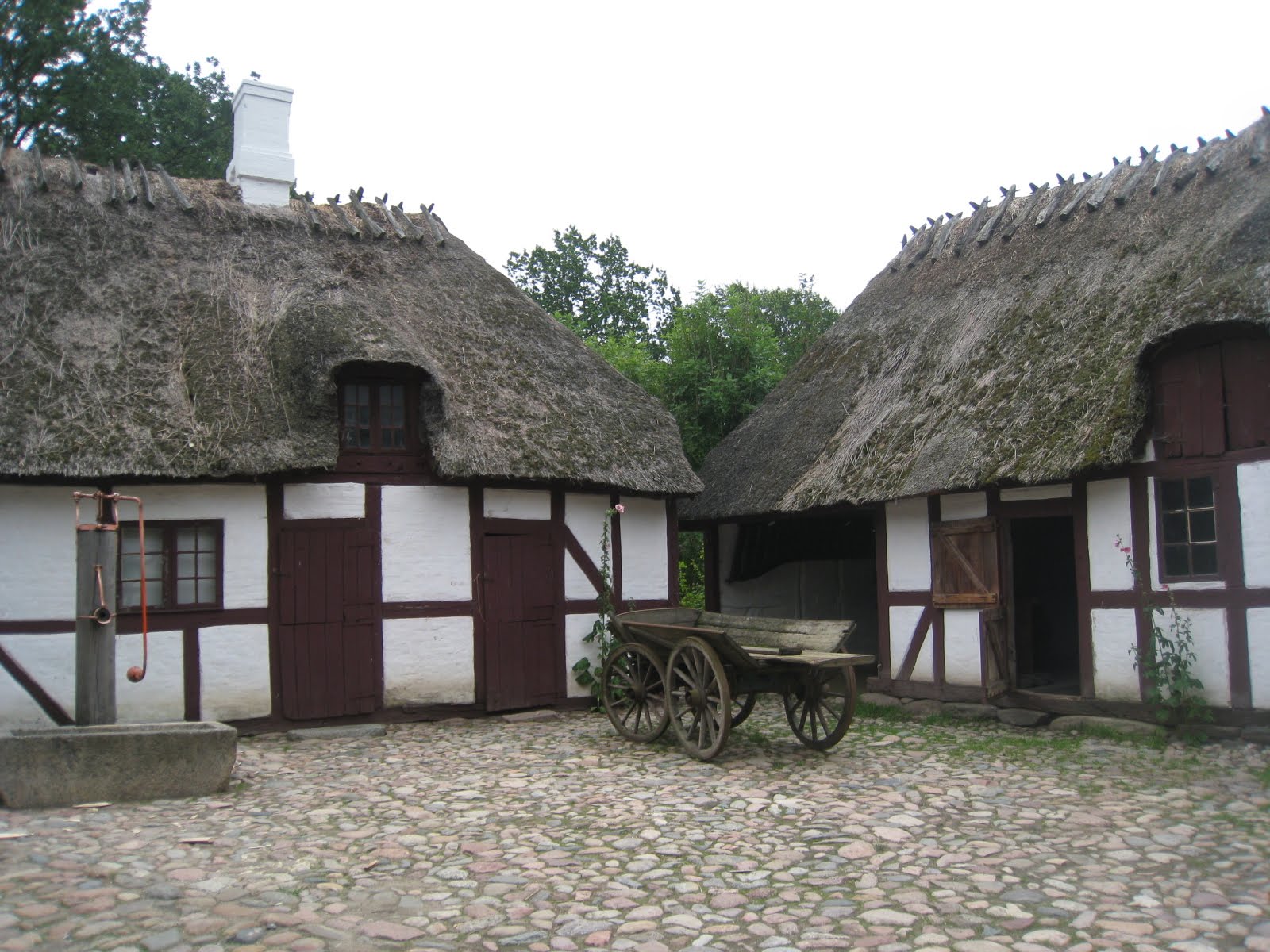
Gunnar Gunnarsson, Novelist and boy from the colonies, left Denmark (the colonial heartland) in 1939 to build a farm on Iceland (the colony) that would provide in a physical form the cultural direction of his novels. His friend the North German architect Fritz Höger, who volunteered to design Gunnar’s farmstead, had in mind something like this …

010Half-Timbered Danish Farmhouse

Den Fynske Landsby, Fyn, Danmark. The working courtyard in front follows the ancient Norse (and thereafter Icelandic) architectural model of a tun, an open air working room between buildings. Gunnar’s farmstead was to have a large an open tun between buildings, which was abandoned when the additional buildings were never constructed.

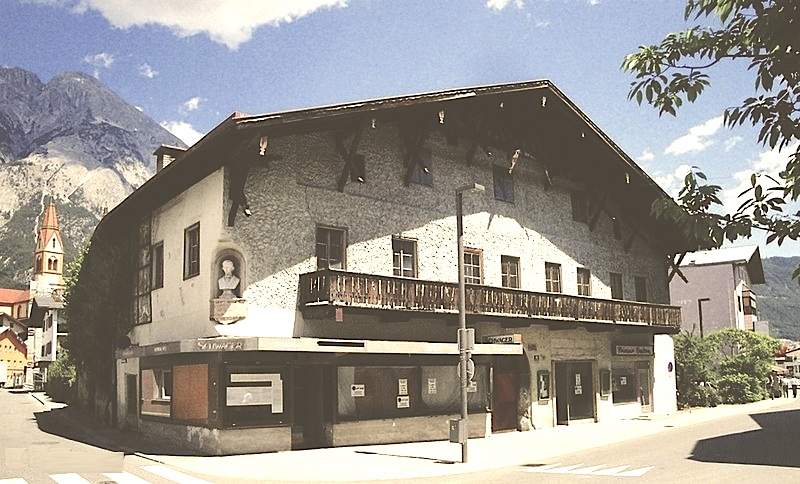
A German architect building a Danish-style building on Scandinavian soil for a man who lived his life between the German and Danish worlds would be a way of making peace with the Prussian takeover of Schleswig Holstein (Höger’s area of Germany) from the Danes. It was, of course, the time of an ascendent Nazi Germany, so the idea of a country house built by a German architect would contain some notions of German country houses, and in this case, a Tyrolian one (dominant at the time, with the annexation of Hitler’s Austria fresh in everyone’s minds, and all) …

Telfs, Untermarkt strasse, Tirol, AustriaTelfs, Austria

Note the balcony. It provides a commanding viewpoint. A central part of Höger’s design was to build a large terrace in a roman or Italian extension of this model. An absolutely key part of German culture is that Germans like to live outside. Their terraces are their summer homes. It’s not quite like that for Canadians, like myself, or Icelanders, who lives in countries a bit less amenable to lounging around in the cold. Still, what was done was done. What Gunnar had in mind was a totally different idea of living outside, much like this …

landhusLandhus Farm Barn, Fljótsðalur

This is a variation on the icelandic version of the previous two architectural methods: build the house out of the materials of the earth itself; your whole life is lived within and on the land. In such a situation, a terrace is rather redundant. Gunnar was committed to the idea of human habitation fitting into the land as if it were not even there, or as if it were an extension of it, like this…

housepointThe Foundation Walls of a Former Turf House

Overlooking the Lagarfljót

What he got is more like that than other houses in Iceland …

snugGunnar’s House Seen from Down the Hill

True to Gunnar’s vision, it changes colour with the seasons. True to Fritz’s, it is made out of cemented, rather than stacked stones. Fritz had in mind cut, square blocks of good German rock. There is no such rock in Iceland. The local boys settled on round stones from the river. Score: Germany 1; Iceland 1. A draw.

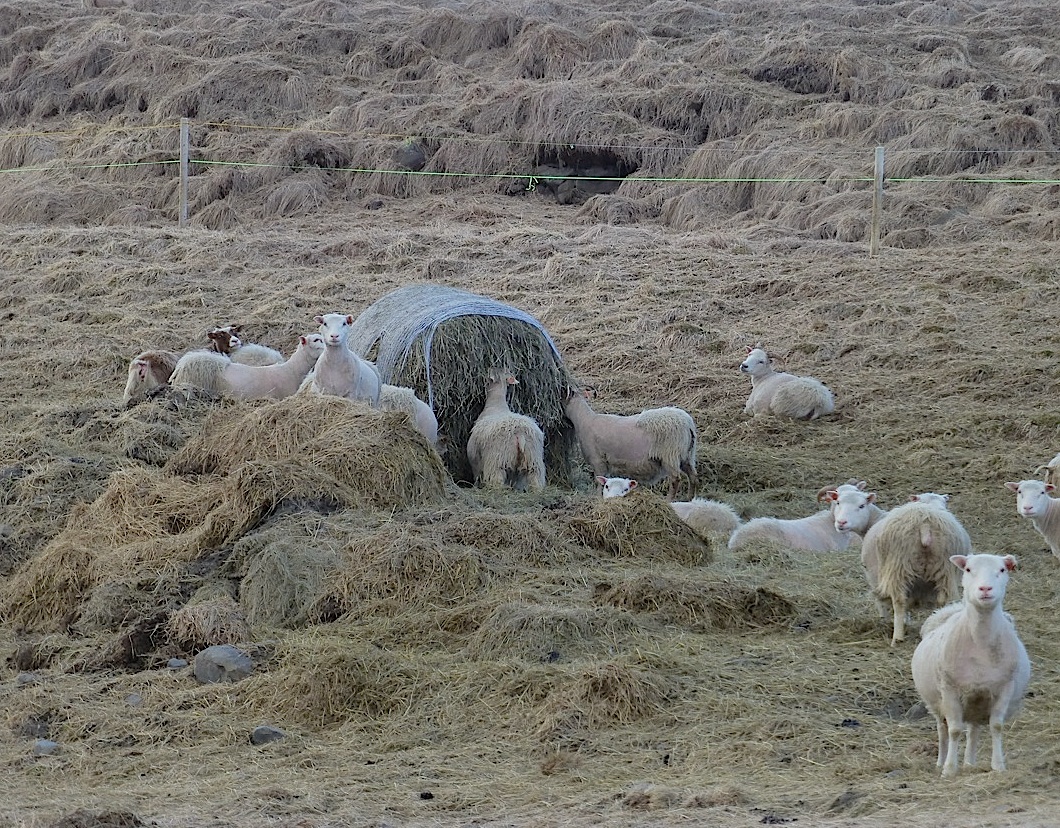
Thing is, Gunnar’s whole idea was that architecture, and especially how it fit into a landscape, determined the soul of a people and their ways of thinking. He was dead set against putting non-Icelandic architecture within Iceland, as it would, he felt, damage the people and their ability to survive. Now, one reason his farming venture failed is that there was war (started by his readers, the Germans), and a resulting invasion of Iceland by the British and the Americans, who paid so well for labourers to build their infrastructure that there were no surplus young men to care for animals like this …

top

Icelandic Ewe Demonstrating Ancestral House Roof Clambering Technique on a Hay Bale

Go, girl!

… and in this way the war ripped out the economic underpinning of Gunnar’s farm. What’s more, the rough and ready construction methods the young men learned on the American and British bases had a kind of effect that eventually led to this…

red

Definitely Not Gunnar-Approved Architecture

Thrown together for reasons of utility and nothing else. That is what farms look like throughout Iceland. There doesn’t appear to be the money on many to build anything better and, besides, it works. This kind of raw utilitarianism would not have appealed to Gunnar, and he would have feared that it would have led to sloppiness. He might have seen this, for example, as a consequence …

stuffSheep Pigging Out on a Haybale

But what Gunnar did not foresee was a permanent divorce of Icelanders from their land. A tiny fraction of the original rural population now has to grow more sheep, cows and horses than ever before … something has to give. The solution has been German, rather than Icelandic, industrial farming methods, capitalized on American industrial farming models. Has all this led to the wealth and security Gunnar was trying to create with his tun-based farmstead that would bring German agricultural models to the land and separate Iceland from colonial overlordship by teaching farmers how to get more wealth from their land, and keep it rather than giving it away to colonial capital managers?

0307-Iceland2_full_600Not quite yet. There’s more than one way to lose your sovereignity. Perhaps the process of decolonization is not complete and something can still be learned from Gunnar’s attempt. Heck, it could have been him holding that protest sign. Perhaps Gunnar’s time has come.

Gunnar Gunnarsson Secret Agent: Part II

When the Icelandic writer Gunnar Gunnarsson returned to Iceland in 1939, with fame and fortune and a reputation greater than most other North European writers, he built the house that houses me now at Skriðuklaustur farm. His goal was no less than to save Iceland. The question of “from what?” is a good one — and one important to ask and to answer in the early 21st century.

wind

Icelanders Standing Firm Against the Wind

Hofstaðir, March 20, 2013

A drive to protect his homeland had been a major motif of all Gunnar’s novels, essays, reading tours and his innumerable literary and political lectures from before the First World War up through the beginning of its sequel. They took him down roads few followed, tangled him up with German nationalist ideology, Danish communist ideology, Scandinavian pan-nationalism, nordic cultural politics and English globalism, and left him as a riddle. It’s not that hard to unravel, though, and goes to the heart of modernism and the developments that came out of it, including the time you and I live in today.

beatles

Competing Beer Signs and a Bit of 1960s Who-ha

Not exactly Gunnar’s idea. Reykjavik, March, 2013.

Gunnar was a conservative man, who in his own life climbed several social classes and learned some hard lessons about being a colonial subject along the way (and carried some of its brittleness along with him). In the new colonialisms that are springing up around the world as I write these words and you read them, including new political structures based around oil, water, religion and the melting of northern ice, Gunnar’s words of warning and mock-modesty to a gathering of students in Copenhagen in 1925 are as much to the point now as they were then.

I am embarrassed to be speaking out publicly on a matter which by many will undoubtedly be labeled as a Utopia and thus probably rendered inconsequential, despite that we and all our surroundings are nothing but former Utopias, but since I have been requested to do so I have not wanted to refuse the request. There may be as much liability in silence as in speech.

The Northern Kingdom, 1925

By this point in history, Scandinavian politicians had given up on pan -Scandinavianism. Not Gunnar. Seemingly, not some students, either. The point about silence being culpable remains a good one, however slyly it may originally have been said and however much it might be turned on its head, to say that there is as much liability in speech as in silence.

In a way, as a rural intellectual and literary artist (as was Gunnar), I know what he means. One has things to say that come from a great distance from urban intellectual structures and one must try to find a way to translate them, with words that remain elusive and at times just don’t see quite up to the job. This guy knows it, too, I suspect.

grimsstadir

Bragi Benediktsson Shelters from the Wind Behind His Weather Station in Grimsstaðir

A Chinese Billionaire wants to buy this land for a golf resort. It looks more like the setting of a Biblical parable or a northern military outpost. As a point of interest, Bragi would have been four years old when Gunnar came back home.

Still, Gunnar was worrying a bone. It’s worth looking at what he found and had sunk his teeth into. I’ll be doing that here over the next few days, as I argue that Gunnar was acting (at least in his own mind) as a secret agent, even a double agent, in Iceland’s interests (as he understood them). He was doing so in complex literary ways that fit none of the regular literary genres. Fiction? Short story? Parable? Political tract? Essay? Poetry? Saga? All of them at once is more like it. None of his literary endeavours were really fiction or literary as the terms are understood today — to our poverty, by the way, not his.

novelsandothers

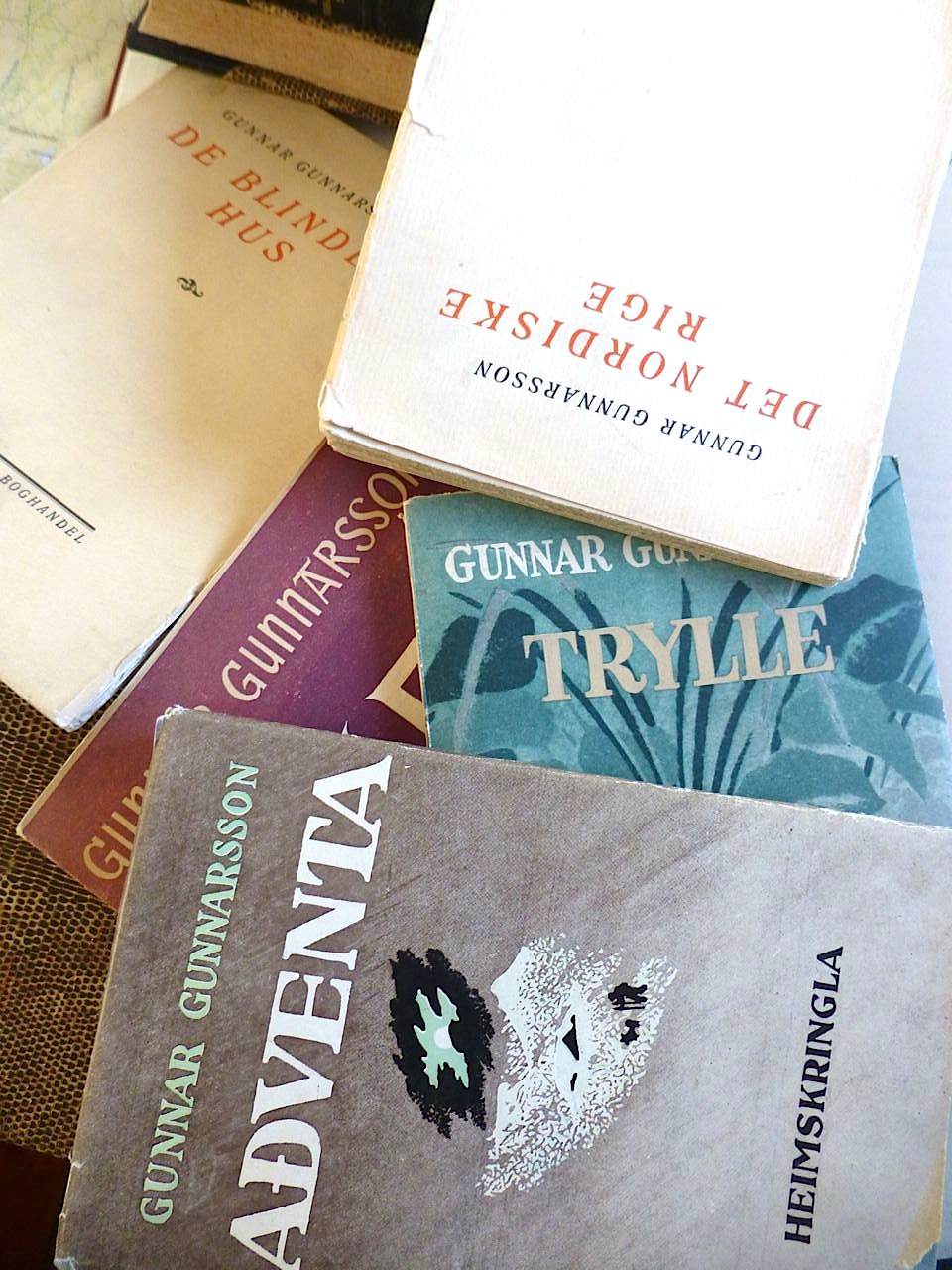
Some of Gunnar’s Books in the Skriðuklaustur Artist’s Residence

And some novels on the bottom shelf. What a change in worlds.

Still, poverty. Gunnar had known incredible poverty from childhood, he had a very clear view of it, and he wanted to dispel it. Part of this poverty was the poverty of lack of access to influence structures of power, including the ruling social classes. More precisely, Gunnar knew poverty well enough to know that it could be a strength, as long as it did not lead to powerlessness, foreign occupation, exploitation, and starvation. Those were all within Icelandic experience as well, and he believed he had found a way to dispel them by writing in Danish, the colonial language, and using it and his immense popularity within Germany as springboards to influence German public opinion and ultimately German foreign policy in the crucial years leading up to World War II.

P1390067

Gunnar’s Book “Advent” Was the Perfect Cover for a Secret Agent

Literary, a Christian parable, autobiographical, romantic, and heroic, Advent was first published in German in 1936, in Danish in 1937, and in English in 1939. For a book that has gone on to sell a million copies, it is intriguingly non-narrative. There is, I think, a message in that for writers everywhere.

Advent appealed to all groups of Gunnar’s audience, and had a special political message for each of them. Let me take a moment here to show you some portions of the German one. This is the story of a shepherd Benedikt who returns every year to the highlands, as Icelanders still do every year, to gather in sheep that others have abandoned to the cold. Alone except for his animal companions, he goes where no others will go, heroically overcoming the harsh elements. We should remember that no book was published in Germany during the rule of the Third Reich that did not further its political aims, and what were those in 1936? The same as the always were: the annexation of Germany’s territories divorced from it by the Treaty of Versailles after World I, firstly, as well as the annexation of Austria and all Germans to the East, secondly (for example in the Ukraine and Russia), into a Greater Germany. They were, in the sense of the Regime, lost sheep, that only a true leader dared to bring home. The imagery of the book, however, is not particularly German, as that is understood today. Take a look:

51jjvzSMACL._SL500_SS500_

Alpine Imagery in “Advent in the High Mountains”

Germany is a largely flat, rainy, foggy country. The imagery here is from its edges: Austrian, Bavarian, Czech and Polish — exactly the objects of Hitler’s eye. Not only that, but this peasant figure is a common folk motif from the Mountains of Giants in Silesia — the old man of the mountains, said to have sprung from the land and the trees themselves, the ancestor of all Germans. Accident? No, not in the Third Reich.

This kind of identification of land, heroism, personality, and politics differed little from Gunnar’s return there to set up his farm (or ideal country) in 1939. It’s a story in which his farm was a kind of novel (and political vision), just as “Advent” was a kind of farm (or political vision). There really was very little difference — they just operated in different spheres, that’s all. Well, there was one difference, of course. That difference looked a bit like this…

ski

German Mountain Troops on a Skiing Break, 1936

The photo was taken in Garmisch-Partenkirchen during the Mountain Division’s early build-up in 1936, on the site of the 1936 Winter Olympics, on the slopes of the Zugspitze, the highest mountain in the Bavarian Alps. These troops were instrumental in the assaults on Greece and Crete. Hitler sacrificed them all.

Gunnar, nationalist that he was, was not a National Socialist. His vision was nonviolent and inclusive of all points of view — and Hitler’s was neither. The German people? No, Gunnar’s audience wanted the rural ideals that Gunnar did. They wanted to return home to the land from the nightmare of exploitive urbanization and industrialization. For the most part, it was simple and sincere, rather Utopian, as Gunnar seemed to have realized deep down, and as strangely complicit in and mis-used by the National Socialist program as was Gunnar himself. The path to that realization, however, was a hard one for all.

stamp

Back to the Middle Ages: 1945, Hand-Printed Russian-Occupied German Stamp

Ironically, if such a word can even be used for such horrors, the retrogressive nature of Hitler’s agrarian-political vision, forged in the poorhouses of Vienna, hardened in the trenches of the First World War, and cynically enabled by the German military classes in the 1920s, led in the end to the simplest, physical expression of the core of its vision: destruction of modernity and the true creation of a new agricultural peasantry. So much for fantasy written as the world.

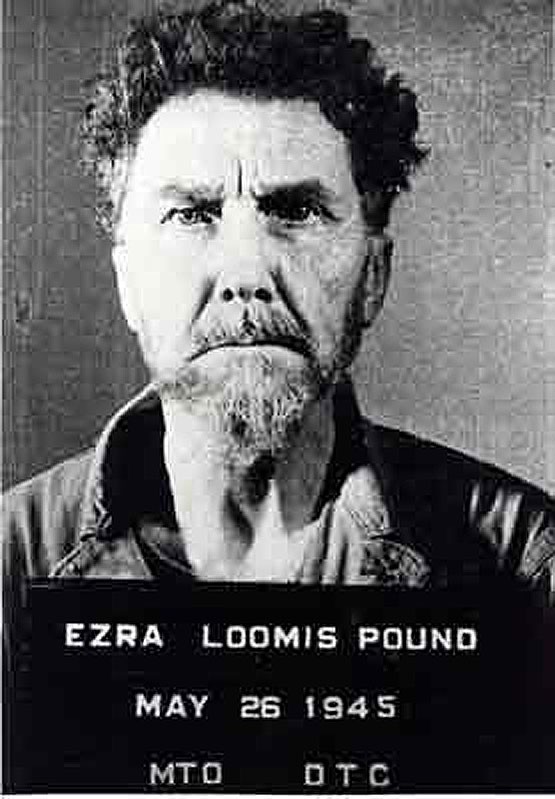
Well, that was Hitler’s vision gone wrong. Gunnar’s was far more wordly than that, and escaped  much of the tragic fate of Hitler’s. The parallels with Hitler are strong: nordic romanticism, strong central leadership, the shaking off of colonial chains, re-definition of culture on the most elementary of local terms, and so on, but it ends there. Gunnar was neither a Nazi nor a violent man. In fact, he had more in common with his American contemporary, Ezra Pound, than anything, and even in comparison to Pound, Gunnar was an angel. Pound was just a brilliant fool, caught in a hard place by his own folly and pride.

13469_Ezra_Pound_1945_May_26_mug_shot

US Army Mugshot of the Poet Ezra Pound

Pound, a staunch American nationalist and a naive supporter of Mussolini’s centralized leadership, stayed in Italy during World War II, in part to retain contact with his daughter, who was raised by peasants in the Italian alps. “What thou lovest well,” he wrote, ” remains. The rest is dross.” He paid his way during the war years by broadcasting rambling speeches over Radio Rome, encouraging American GIs to give up the war by explaining to them such things as the poetry of ee cummings. He paid for that by arrest on a charge of treason, and eventual incarceration for 13 years on a charge of insanity. Was he a fascist and a Nazi? No, not really, but even so he went miles further down the road of complicity than Gunnar ever did.

It’s important to straighten out the “nazi” word, or history will remain a cloudy pool and our collective future decisions will be made in a darkness that Gunnar and Pound, despite their failings and tom-foolery attempted, at the least, to shine light within. Gunnar’s publication in German was brave, foolish, dangerous and perhaps misguided and imperious, but was not done in any way to further Germany’s racial and military goals. It was done to further his own goals. Even the Americans did not share those. Advent went on from Germany to have a remarkable history. It even became an American Book of the Month Club selection, when the Americans needed some propaganda symbol of Icelandic independence and the heroism of lone sailors in the bitter cold of the North Atlantic, battling the German U-Boot threat from Reykjavik. Paper was rationed in the United States at that time; books were not published that without the approval of the Army. In that context, Advent must have had strong approval, indeed, as it was widely distributed.

shepherd

Now Benedikt is Young and Wearing a Fur Version of an American Military Helmet!

And the mountains look like North Atlantic Waves. Amazing.

And that was Gunnar, Icelander to the core, negotiating a path between worlds, used by all, and seeking to retain is independence in between — not always successfully, but never without stoic pride. Ironically, the American occupation of Iceland, and the more damaging German occupation of Denmark, which led to Icelandic independence in 1944, a kind of child of the United States (while Denmark was still occupied by a more sinister invader) created the climate in the mid-1950s in which Iceland was deemed worthy of reward for a Nobel Prize — a country that had come out of the Second World War with its independence (just the kind of humanism that the Nobel Prize was set up to support). A deeper irony denied the prize to Gunnar, and gave it to the Icelandic communist Haldor Laxness instead (not exactly the primary goal of the Nobel Prize Committee). The gods must be laughing.

Odin_hrafnarOdin’s and His Ravens, Thought and Memory

Sharing gossip about the world.

This conversation will continue tomorrow, with a closer look at the game Gunnar was playing with the Nazis. Thought and memory (or mind) … we’ll certainly be coming back to that, too.

Easter on Middle Earth

Christ has arisen. This isn’t just a bit of a ghost story with a happy ending. If your imagination is rooted in the earth, or even in books, should that be your fate, it is mathematics and geometry.  Here’s the middle view of Christ’s ascension, in this stopping house, this alms house, this shelter from storm, this cloister between worlds:

churchforfarm

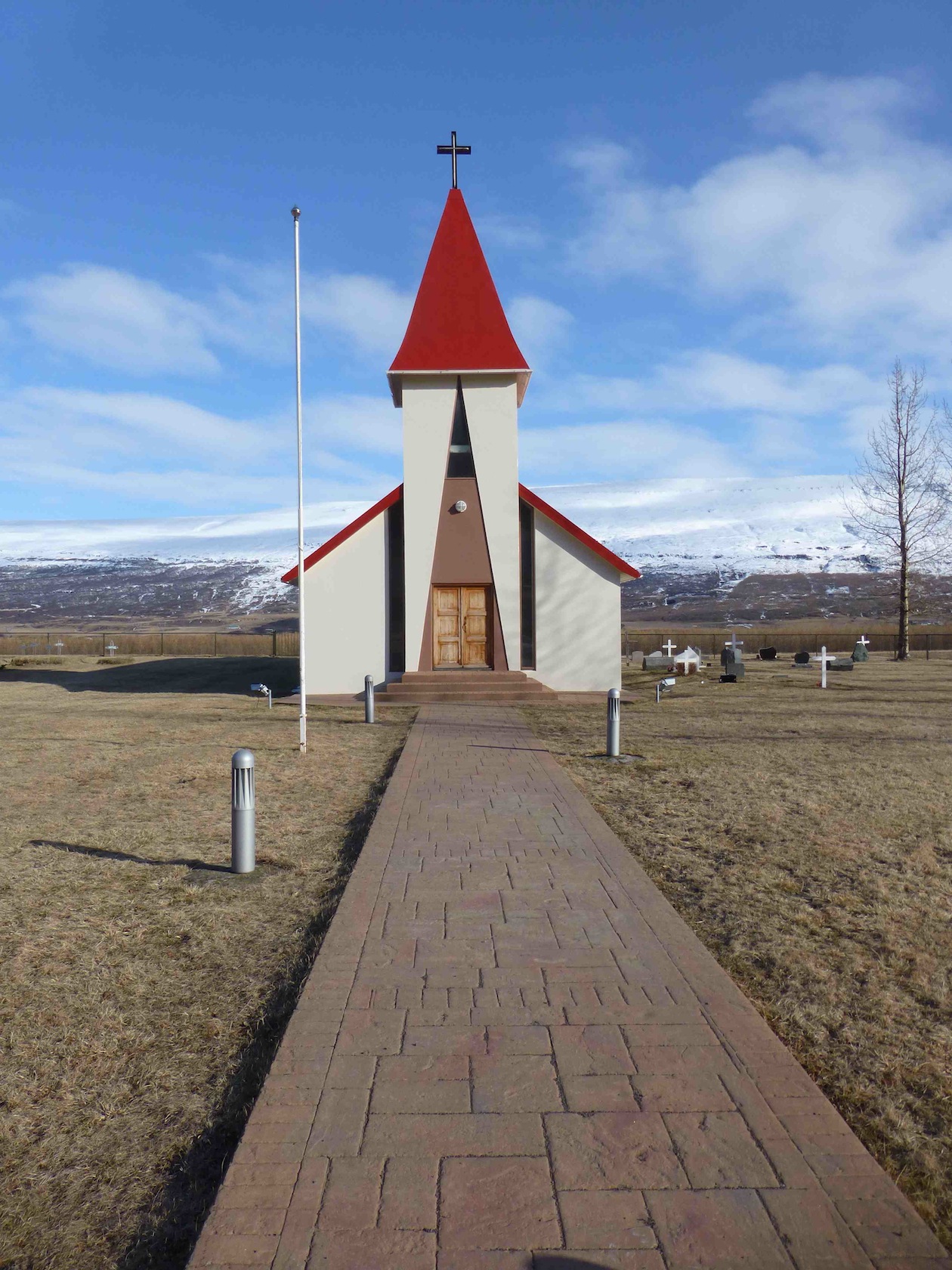
ValÞjofsstadur Church, Fljótsdalur

Note the mathematical precision of its construction. Note as well the Father, the Son and the Holy Ghost of the entrance, and how one enters through the Middle Way, Christ, the Son. That’s not an accident.

The Church makes eternal order out of temporary beauty. That’s kind of its point. It is a form of intellectual activity.

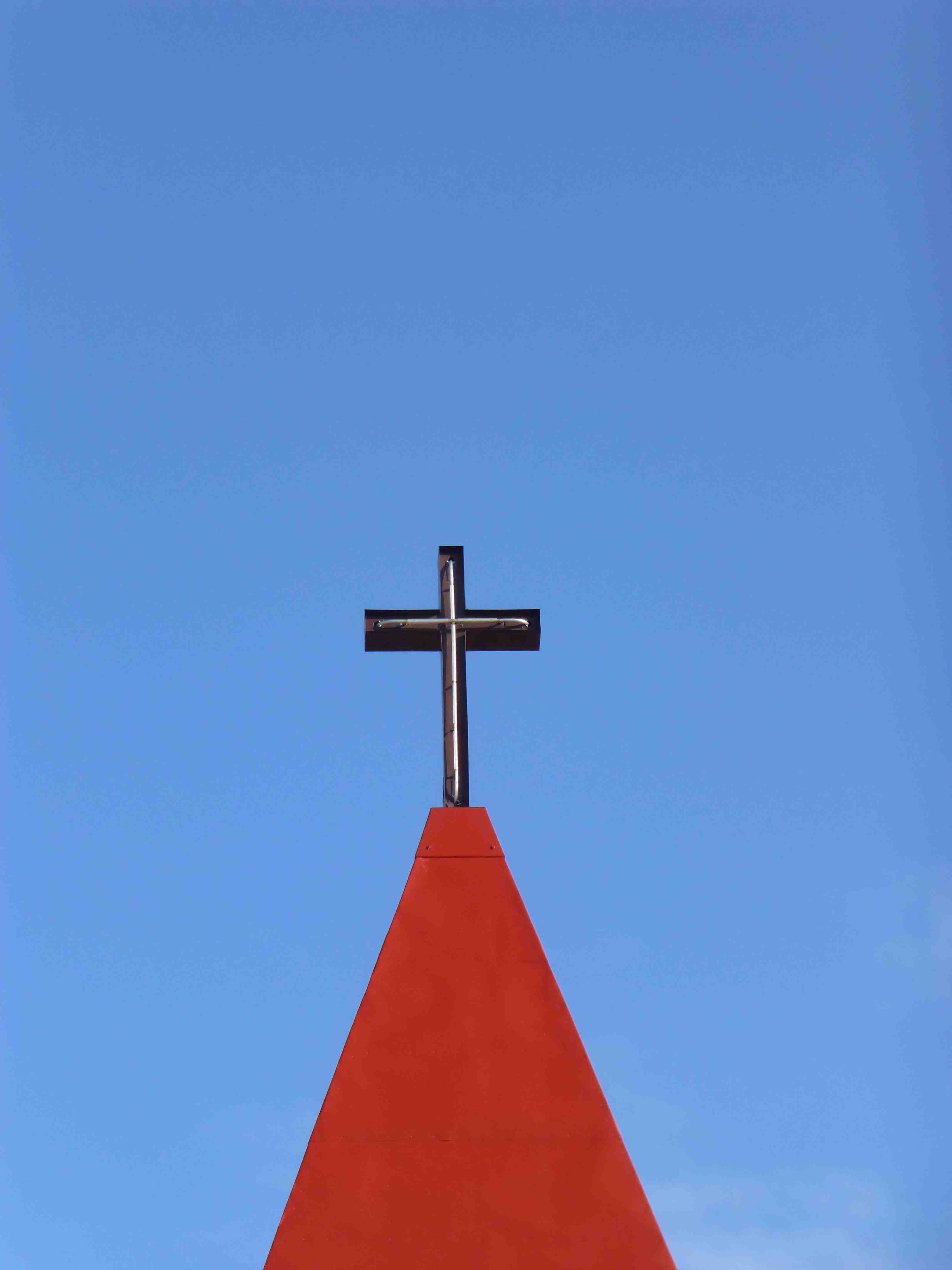
crossforfarm

The Point

It’s not just a cross. It’s an entire intellectual tradition. All Western peoples today stand within it. It’s inescapable. Nor should it be escaped from. It is.

Gunnar Gunnarsson’s childhood farm, that guided much of his writing, faced out over the graveyard where the church now stands. Here’s how it looks today, with the old turf houses gone but the old trees remaining.

valpjofsstadur

ValÞjofsstadur

This is the week that the farmer brings the manure out by the wheelbarrow load and dumps it in his field. You can see some of it there in the centre of the image, just in front of the buildings. Sweet springtime!

Easter is a celebration of rebirth and renewal from the dead (and the stink of closed winter barns full of way too many animals). Another way of putting that is to say that the dead don’t leave the living, nor do the living leave the dead, but that they’re all travelling together on one road that leads out into the fields and the light after a long, cold winter. Here, then, is the real church, in its wild state …

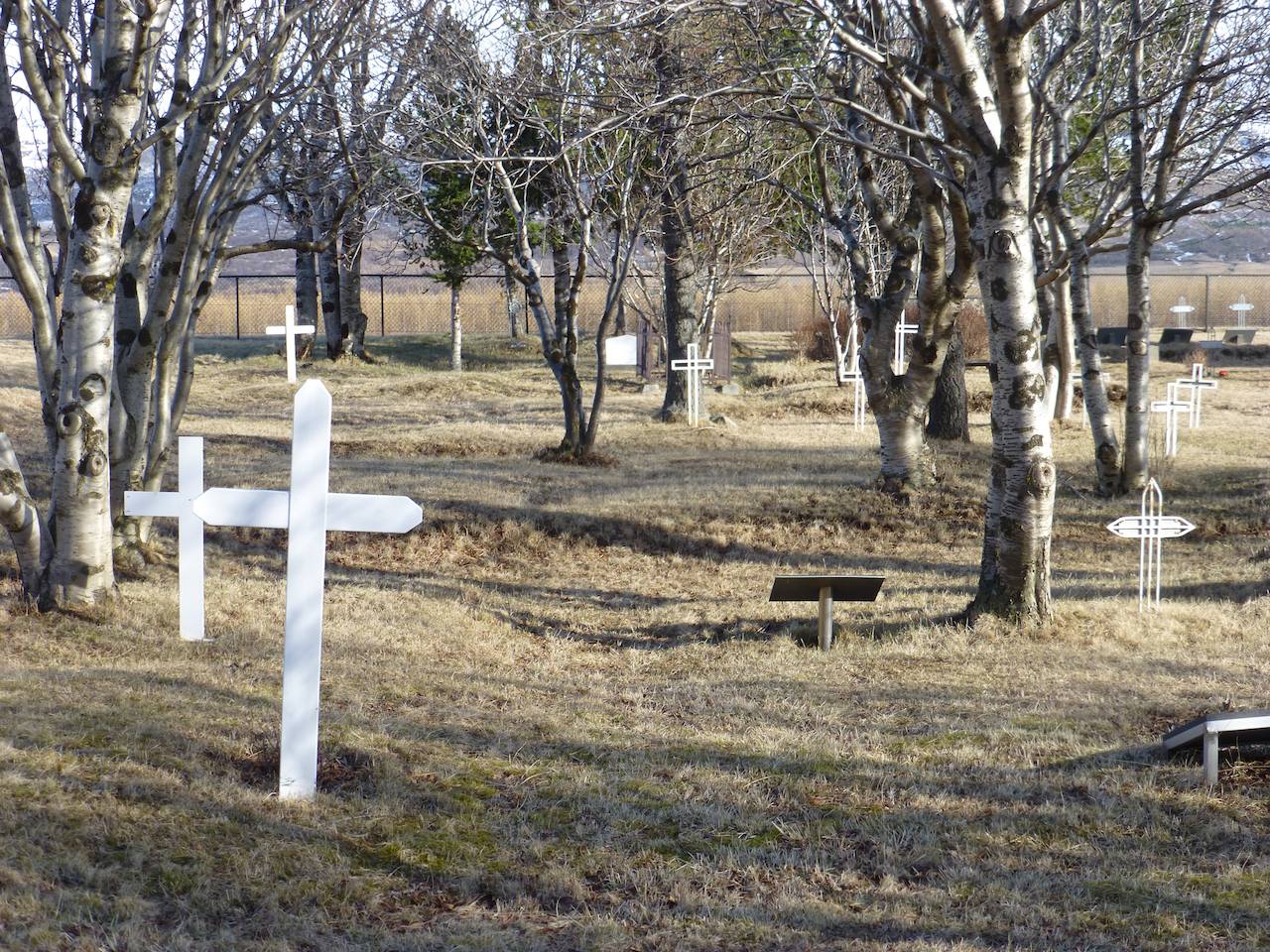
ahnenValÞjofsstadur Graveyard

The ancestors lie quietly in their pews, most with a form of mathematical perfection rising from their souls. It is a joyous place, a sanctuary from the work of the world, a kind of retirement, shall we say, a waiting.

I have been writing poems about Easter, so forgive my mind for wandering like this through the trunks of these trees, but look, both churches are standing together in communion, the church among the ancient trees, the ancestral church, and the new one rising from the mind …

twochurchesChurch, Ancestors, and the Ancient Trees, ValÞjofsstadur

All travelling together into the sky, all tied to the earth, on the middle way.

When the earth and its peoples are stood with organically, as Gunnar stood with them and that farmer with his manure still does, rather than under-stood, or standing under, as a priest might put it (especially in the past), looking down from his or her pulpit and speaking the Words of God to his or her “flock”, its patterns flow like water and light and know no bounds. A boy, or a man, such as Gunnar, perhaps, could learn to write books just by walking in the world with his eyes open.

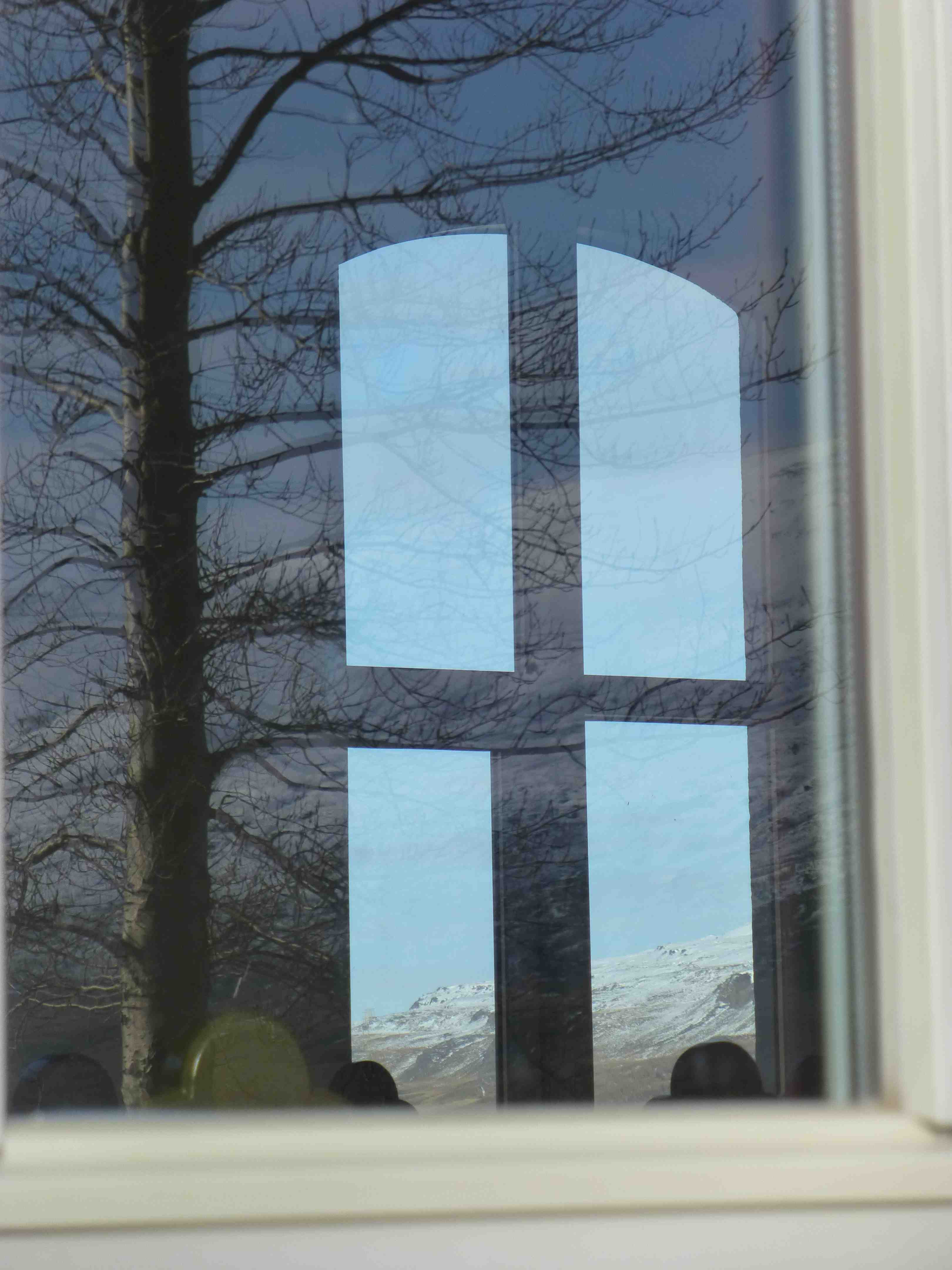
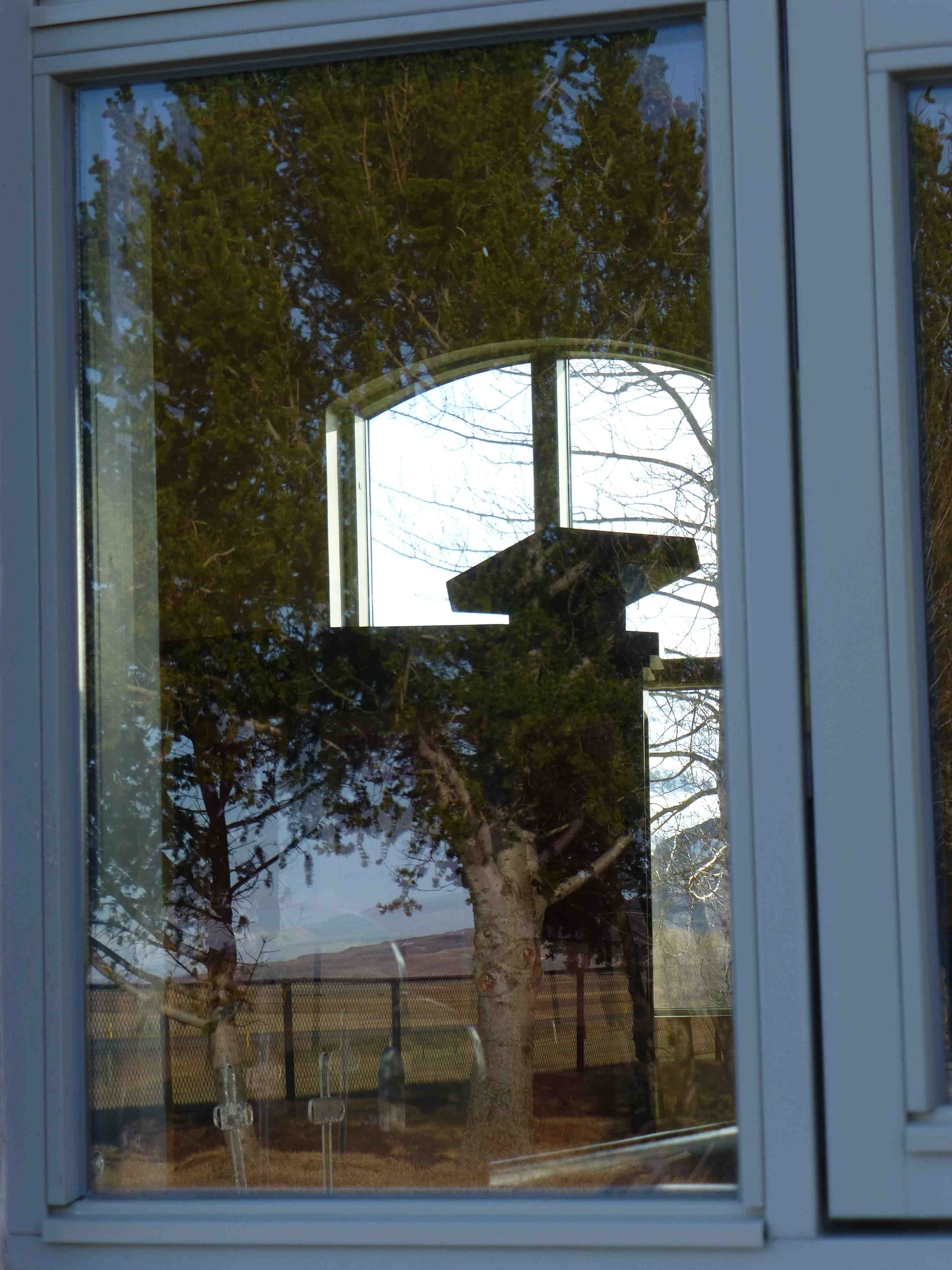
treewindow

The Church, the Cross, Chairs like Tombstones, the Mountains and the Ancient, Sacred Trees

Are all woven from light, from the inside and the outside, from reflection and what is seen through.

A window, now that’s an ancient word. Consider this, every river in Iceland has the same name. It’s an á, pronounced ‘ow’. In German, that would be an “au”, a meadow, a place of particular fruitfulness, naturally fed by wetland water — and usually the place at which Irish monks set up their missionary churches in the 9th century. That’s not far from Iceland, really, where the early farms were set up along river bottoms, which could produce the abundance of grass necessary for 10th century Norse farming practices, and these rivers were all variations on an á. One just down the road from Skriðuklaustur, for example, is the Hengifossá …

hengifossaHengifossá Mouth

And the river of the wind? Ah, here it is …

windowquadrants

The Four Cardinal Directions

Notice how the Wind’s Á, its meadow, opens from inside, so the outside can come in. First, though, one has to go inside.

The tradition of the church and its remarkable magical buildings constructed to ancient conceptions of mathematical balance and beauty go very deep, with roots in the world. Here’s the pulpit …

pulpitThis is a Book

But not just a paper one. The world is part of the spiritual picture. It is through it that one finds the light. And the Word. And the word.

By “world” here, I don’t mean the usual thing. I don’t mean “the community of men and women and their children” and the national and international relationships they build up between themselves, as the word is often understood, but the world as stood with, which is often called the earth. There’s an old book in Nordic tradition, called Volvens Spådom (The Prophecy”, which in one of its opening passages goes like this…

volvensThe Middle Way from Volvens Spådom

Without a world, the sun and stars have no anchor. That is to say, no tether, no home, which is to say that they are not at-home, or, to use the old word, they are not haunting. In the middle way, on Middle Earth, things haunt.

Things haunt like the reflections in the windows above, like the trees growing from hallowed ground, and like this image that has been made from them, purified in the manner of making wine (in this case, making wine from light and the world) …

eyewindow2

The Eye of God and the Mountains of ValÞjofsstadur…

…seen through the wind’s oh, its á, its au, its river of ValÞjofsstadur Church. The mind streams in with it. That’s the kind of spiritual place this world is, witnessing the mathematical beauty that streams through it, because, after all, a window opens two ways. It is, in fact, not a mouth or an eye, but a passage, a path, a way.

I took those images yesterday. Today, I went out to witness the sun rise, and I discovered that on this holy morning, before the first planes started flying to Keflavik from Europe, the Middle Earth was clear for all to see who were awake and walking. In the West …

P1370820

The Moon, Setting

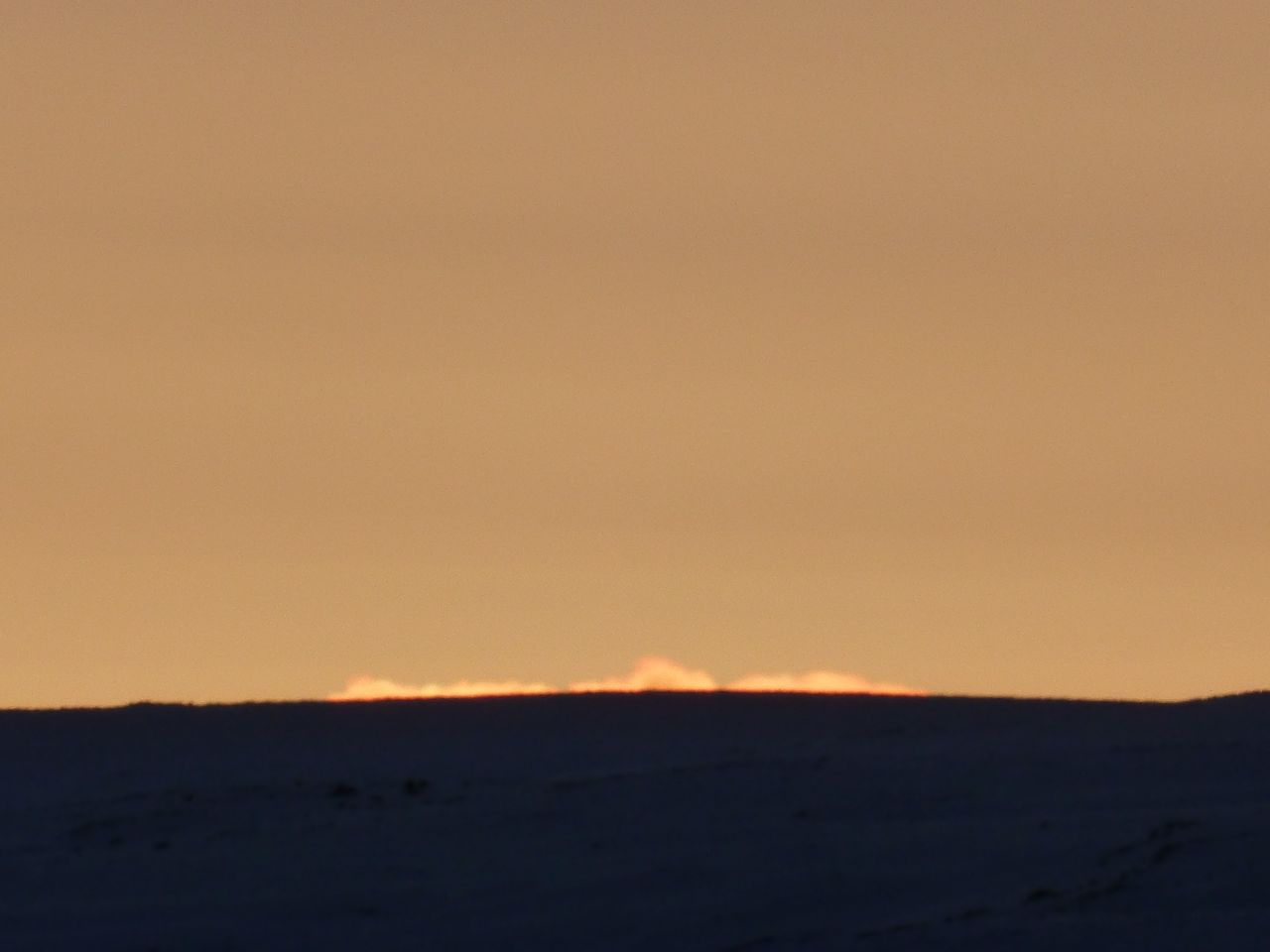
… and in the East, across the sky …

P1370776

The Sun, Rising

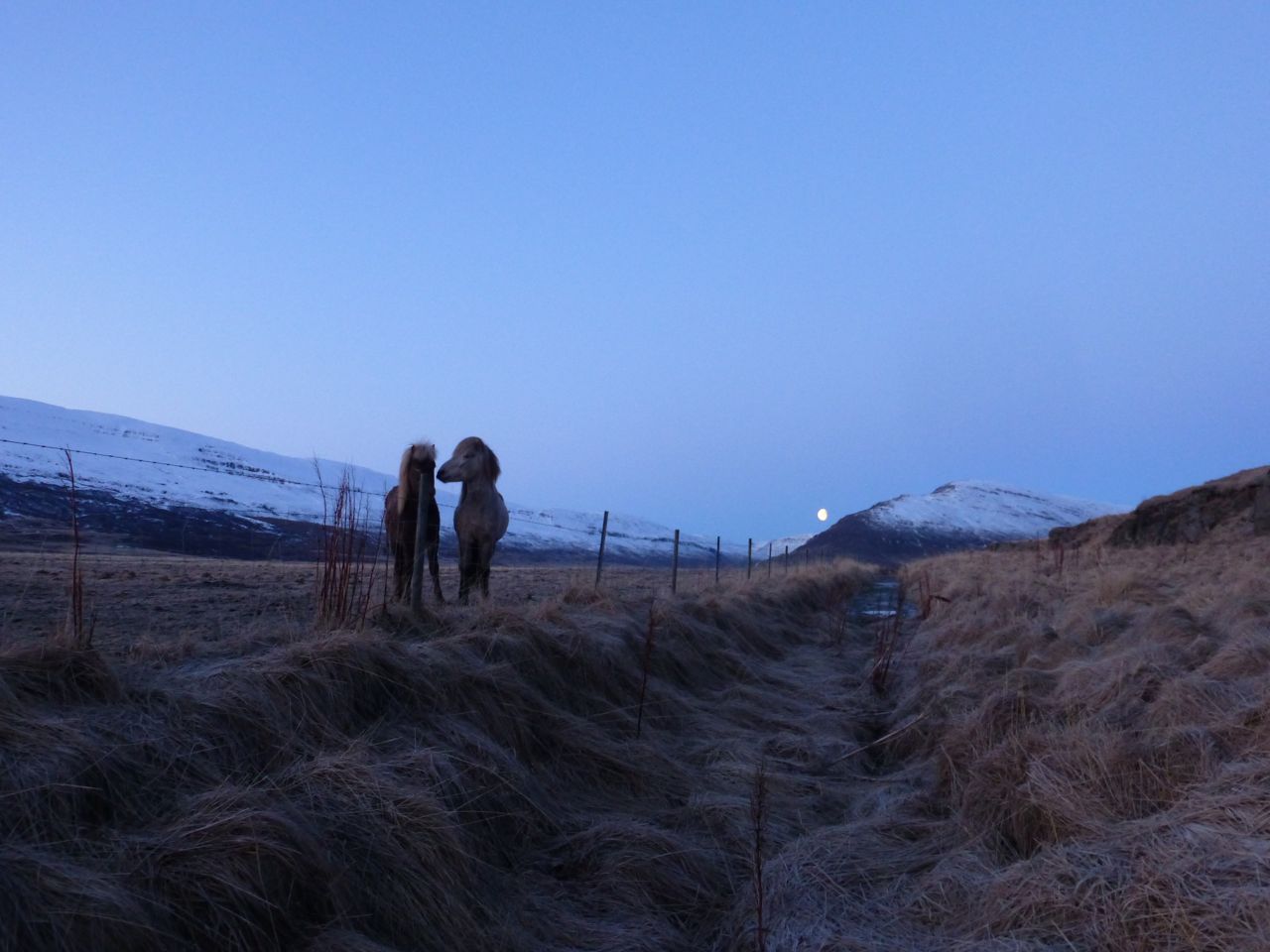
… and in between …

P1370850The Horses of the World

The horses are spiritual creatures. Here they are in the words of the scottish poet Edwin Muir, best known for translating Kafka into English. This is written after the devastating war that Gunnar had hoped to prevent by uniting all Nordic peoples on the Middle Way. Ironically, it ws Muir, who endured more directly the anguish and fear of that conflict who found, in the horses of the world, the horses of God’s Grace, his Eden, his au…

(Dear Readers, it’s a longish poem, but not a difficult one, and it is one of the best in all of human tradition. If reading poetry is not your thing, why not scroll down to the images or listen to my reading of it here. The link will take you to a new page. When done, please press the back button to continue …

The Horses.

I hope you’ll listen and read and look at the images. That would be like being together on this day.)

Here’s am image to set the scene …

P1370886

The Horses

Barely a twelvemonth after
The seven days war that put the world to sleep,
Late in the evening the strange horses came.
By then we had made our covenant with silence,
But in the first few days it was so still
We listened to our breathing and were afraid.
On the second day
The radios failed; we turned the knobs; no answer.
On the third day a warship passed us, heading north,
Dead bodies piled on the deck. On the sixth day
A plane plunged over us into the sea. Thereafter
Nothing. The radios dumb;
And still they stand in corners of our kitchens,
And stand, perhaps, turned on, in a million rooms
All over the world. But now if they should speak,
If on a sudden they should speak again,
If on the stroke of noon a voice should speak,
We would not listen, we would not let it bring
That old bad world that swallowed its children quick
At one great gulp. We would not have it again.
Sometimes we think of the nations lying asleep,
Curled blindly in impenetrable sorrow,
And then the thought confounds us with its strangeness.
The tractors lie about our fields; at evening
They look like dank sea-monsters couched and waiting.
We leave them where they are and let them rust:
‘They’ll molder away and be like other loam.’
We make our oxen drag our rusty plows,
Long laid aside. We have gone back
Far past our fathers’ land.
And then, that evening
Late in the summer the strange horses came.
We heard a distant tapping on the road,
A deepening drumming; it stopped, went on again
And at the corner changed to hollow thunder.
We saw the heads
Like a wild wave charging and were afraid.
We had sold our horses in our fathers’ time
To buy new tractors. Now they were strange to us
As fabulous steeds set on an ancient shield.
Or illustrations in a book of knights.
We did not dare go near them. Yet they waited,
Stubborn and shy, as if they had been sent
By an old command to find our whereabouts
And that long-lost archaic companionship.
In the first moment we had never a thought
That they were creatures to be owned and used.
Among them were some half a dozen colts
Dropped in some wilderness of the broken world,
Yet new as if they had come from their own Eden.
Since then they have pulled our plows and borne our loads
But that free servitude still can pierce our hearts.
Our life is changed; their coming our beginning.

Edwin Muir
P1370898An Icelandic Blue in the Skriðuklaustur Pasture
Middle Earth contains not just humans and horses on their spirit paths, but, of course, our trees …
P1370752
Poplar on Easter Morning
… elves (more on that, soon) …
P1370763Easter Sunrise Through Frosted Glass
… sacred space …
P1370767The Cloister at First Light
… trolls, charmed …
P1380048
… the dead, of all kinds …
P1370860
Giant’s Skull in a Cave in the Skriðuklaustur Cliff
Turned to stone, I may point out by the rising sun … which, on this day, is Christ ascending. Accident? Coincidence? No. It is part of the sacred order of things viewed as things. After all, a “Thing” is a meeting place, in the old languages, a parliament, a place of talking and coming together, of all the people … including, I presume, the sheep which shelter in this cave in summer.
… because even though it is a Christian world, it is built upon the bones of an older one, and does not dishonour them and is not dishonoured by their presence. How could it be? If it were so, God would be made by men. It is to this world that Gunnar returned when he left Denmark in 1939. All during his time on Mainland Europe, he was walking the Middle Path, living between worlds, trying to be a broker between them, trying to be a writer, which in the pre-modern Icelandic tradition of his birth and youth meant to be a pastor, to write sacred texts and to present them to the people, to stand among them but slightly apart, and to look both ways, like a wind’s á. This is the character we meet in his 1932 novel Vivivaki, a reclusive writer in the Icelandic highlands, to whom the Dead awake on New Year’s Eve, to the sound of the Danish National Hymn on the radio, and who look to this rebirth as the Resurrection and look to him as God. Next, I’ll unravel the rest of Gunnar’s life as a Secret Agent, but first, the blessings of this day of rebirth and ascension and grace, from the blind earth …
P1370782
… to the light of the sky …
P1380096
Blessings, all, from Skriðuklaustur.

Sighting The Wyrm in Lagarfljót

The lake that runs to the sea from this old monastery site in East Iceland is called the Lagarfljót. It is a long and beautiful thing that catches the light from the mountains and the sky and softens them — not that they are harsh to start with. It also has a wyrm, like the monster of Loch Ness or the “Ogopogo” of Okanagan Lake of the North America’s Pacific Northwest. Cryptozoology is good for tourism. Here in the sacred birch forests of East Iceland …

P1370240

… with the elves catching the mid-day sun …

lichen

Lichen on Birch

(I hope to have the elvish connection to lichen ready for you in a couple days.)

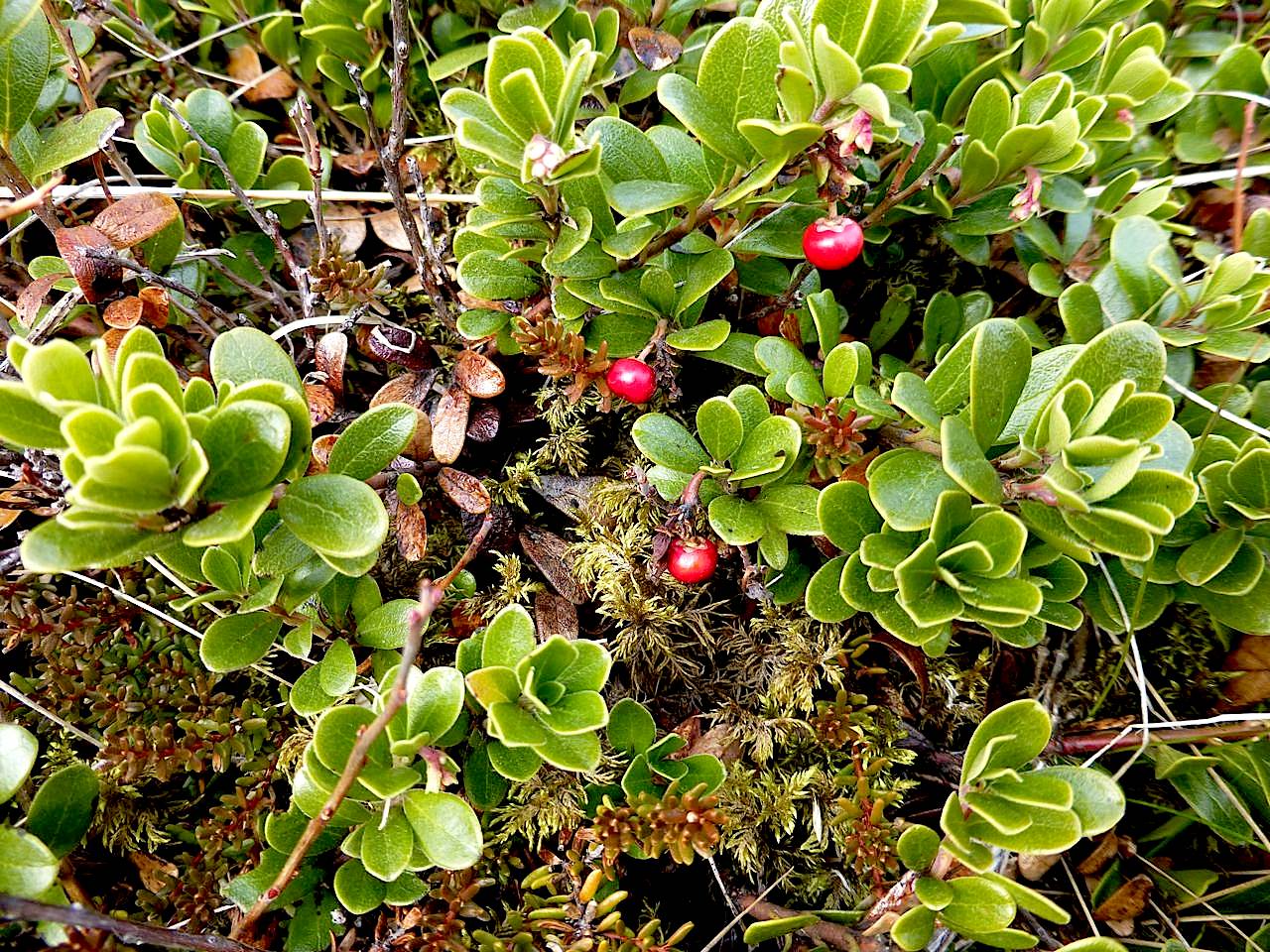
… and a moment to enjoy the red berries that the birds missed in the winter …

berries

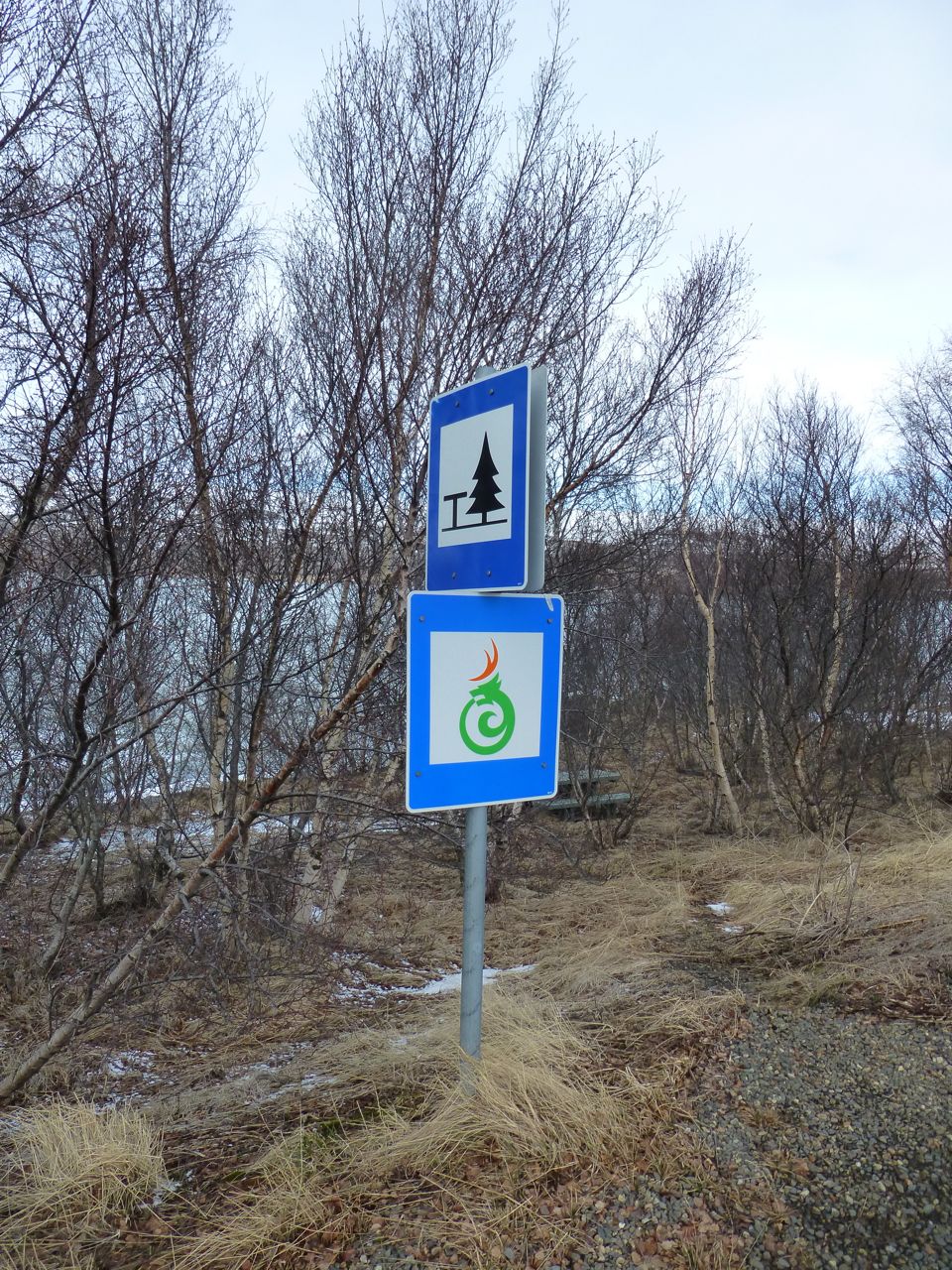
… because I’m a poet and poets are easily distracted by pretty things (so are wyrms, whose stories are similar enough to the serpents of the Rhine and the Celtic Moselle and the Ring of the Nibelungs to raise a poet’s eyebrow or two), but finally things were looking up. The government was there first, helpful as Icelanders are …

P1370118 A Good Place to See The Wyrm

Shall we? Down the trail through the old, slightly mouldering but still charming early-Nationalist picnic site, and, hey, look, already we see signs of an apex predator eating the locals…

P1370116

We Must be On the Right Track

And then I lost my doubt, because I heard the birds singing…

P1370166

See the Birds?

No, I don’t either.

There weren’t any birds, that’s why. It was the lake that was singing, like a choir of angels. That was actually better than birds.

P1370184

All Winter Long the Ice Has Been Singing As the Waves Break it Up and Knock it Around

Then they do it in the spring. It is haunting. What a magical lake.

And that’s when I first saw the wyrm (well, after a few more steps) …

P1360998

Wyrm

Being a Canadian and a bit biased towards polar bears, that’s what I thought it was at first. Here’s its head, so you can have a closer look …

P1370001

Wyrm Head

Note the nice ribbing. Even the Worm in Dune has that. (Look to my upcoming posting on elves and lichen for an explanation of how forms like this are cast up by stone.)

Then I turned and saw this wyrm…

wormhead3

A Dead Ringer to Tolkein’s Smaug…

… or a crocodile. Note the hump, too.

Now, to set things straight, here’s the story of the Wyrm in Lagarfljót: Read it Here. And here’s a video that played on Icelandic TV a year ago … View it Here. And here’s my warning on reading mythic imaginations literally, with photographs of the dreamtime stone that is Canada’s “Ogopogo” — or would be if there were greater general understanding of how pre-industrial people thought. Read it here. This is important stuff. A little respect for the truth of ancient story, and how it was laid down and how it was not, goes a long way towards rebuilding human relationships to the earth. To tell those stories, I am here at Skriðuklaustur.  It has been a beautiful day. Tomorrow, images of Easter in East Iceland, and if things go well the second part of my series on Gunnar Gunnarsson, Secret Agent.

Gunnar Gunnarsson, Double Agent: Part 1

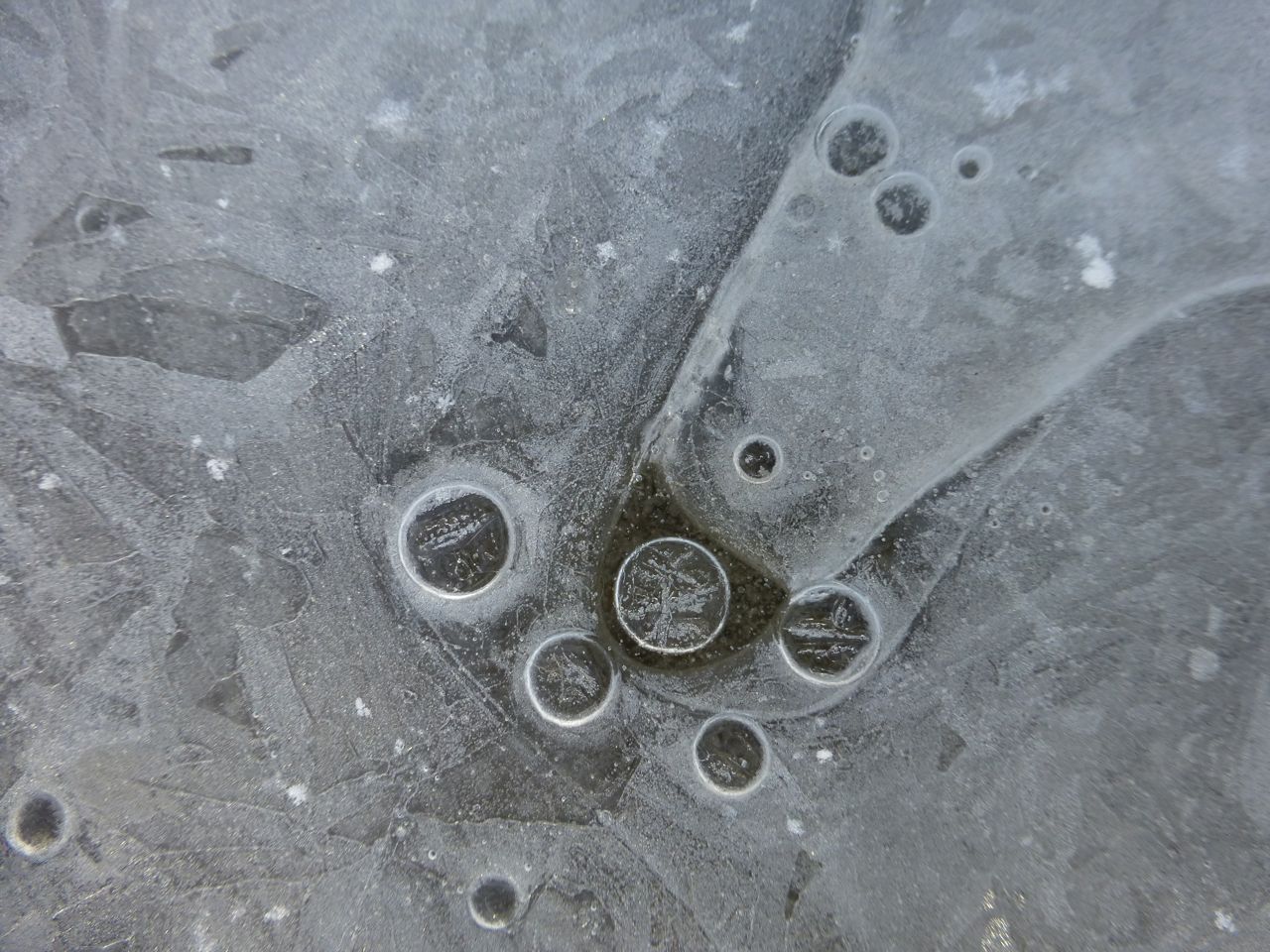
Yesterday I mused on the origins of story in lines that cut across pools of presence. Part of the story was the human response to them, that brought them together into art. (If you missed it, you can track through it right here.) Today I’d like to talk about Gunnar Gunnarsson, and how some of those lines are circles, and that they too have a story. Now, circles are very special lines. They have no beginning or end, no directionality and can can extend from every point into every conceivable shape, as long as it has no beginning and end. Circles are eternal. Their boundaries separate into inner and outer representations of … what exactly? Ah, that’s Gunnar’s game. Here’s a circle:

grassline21 Air Caught Within a Seasonal Icelandic Pond

Intersection of Highways 848 and 87

And here’s another:

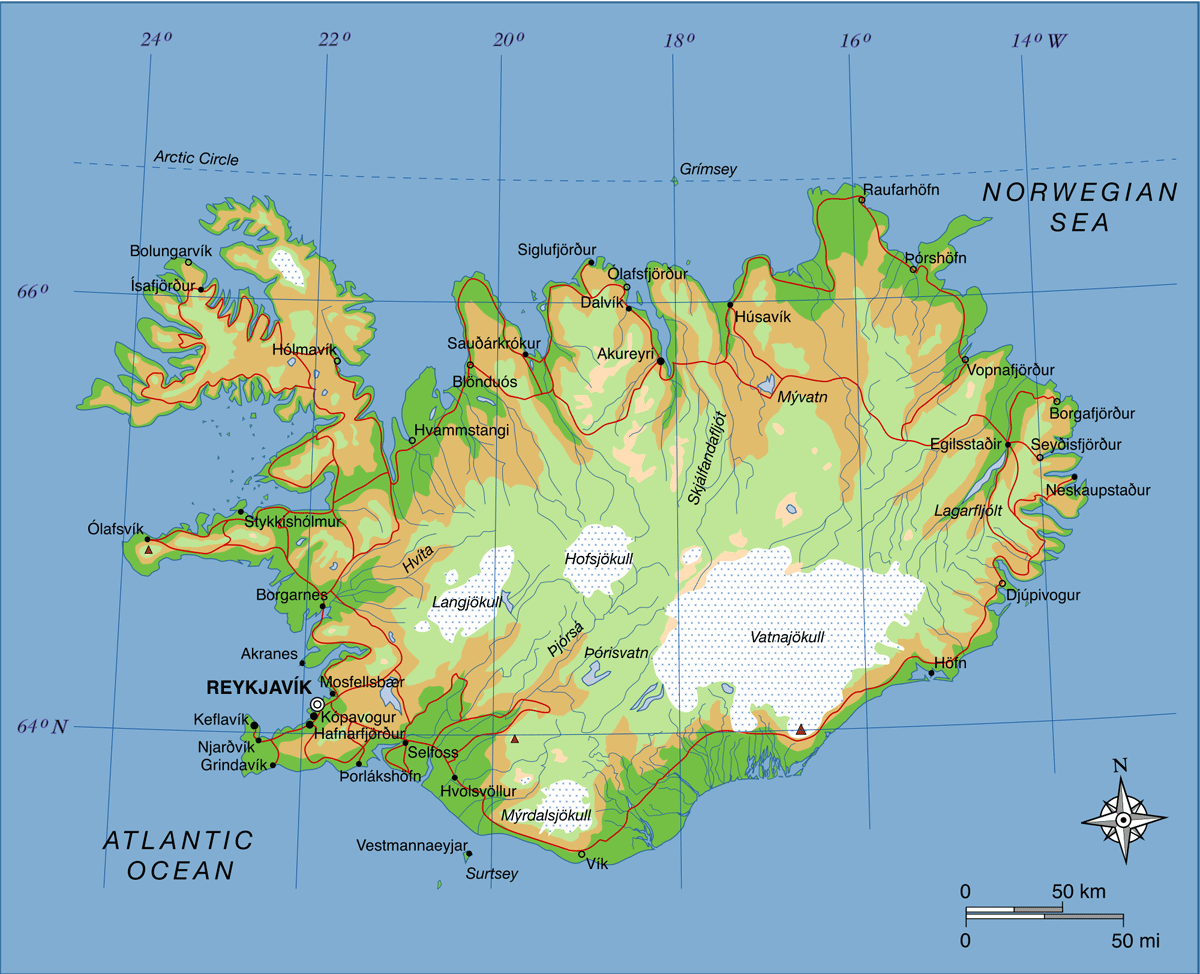
iceland-physical-map

Iceland (Source)

Well, almost a circle. Sort of. If you took off the scrunchy bits. It has a circle-like edge, at any rate. Here, this might be closer:

2maps

Three Maps of Iceland

Two for tourists and one in words to keep tourists away.

That’s a copy of the text “Unser Land” or “Our Land” that Gunnar read on his spring 1940 tour of 50 cities in Germany, immediately after the sod was laid on the roof of his house and just before the German invasion of Denmark and Norway. Here’s how Gunnar starts off:

It rises majestically out of the sea when approached from the water. It grips the heart like a heroic song, touched with eternity, sown with destiny. There is nothing small about its appearance.  Even though its face varies from place to place, it remains integral — a pure vision.

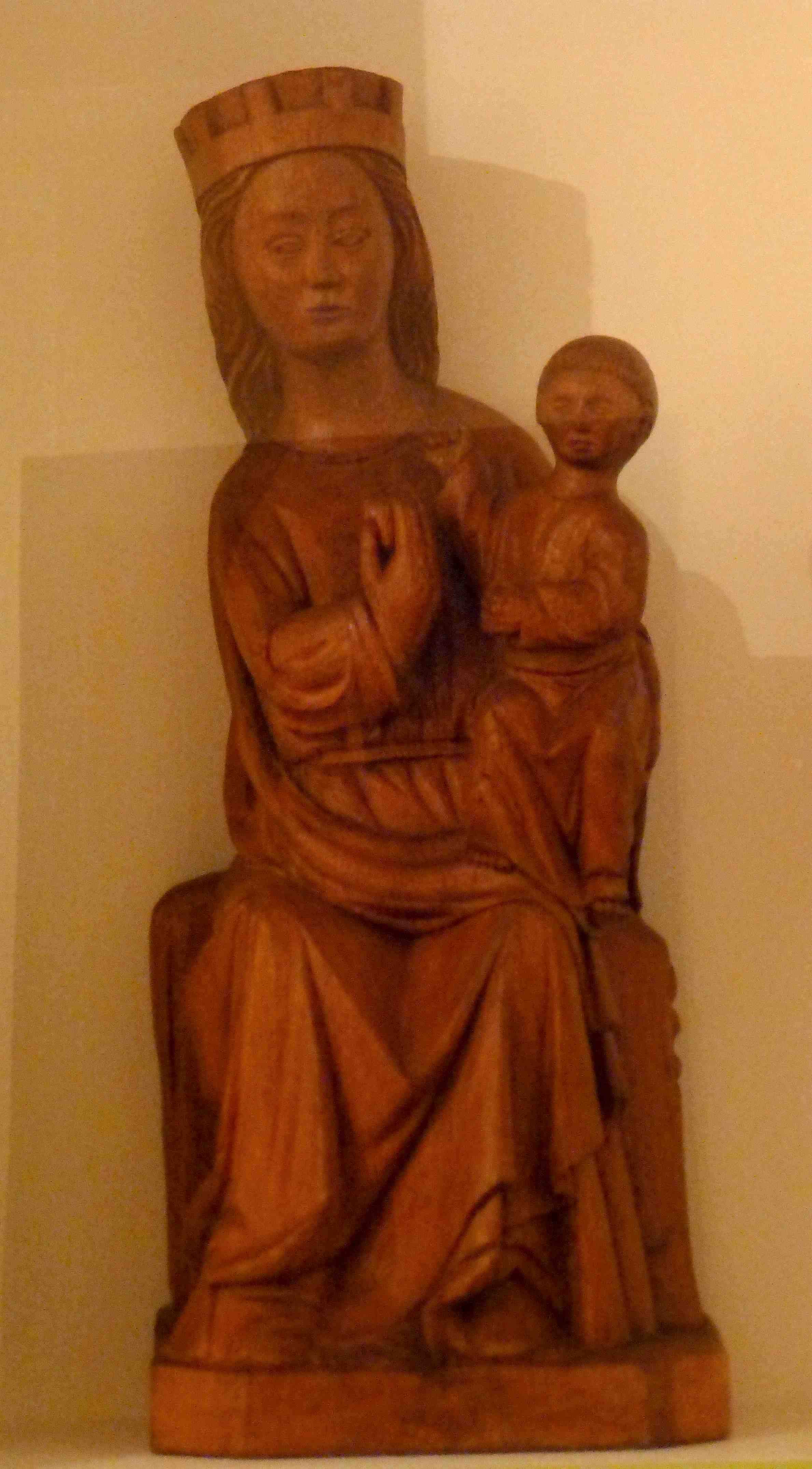
A pure (or untrammelled) vision? It’s like a shaman’s spirit stone or a statue of Mary with the Christ Child. Speaking of which, here’s one:

madonna2

The Skriðusklaustur Madonna…

… in her glass box, with reflected light, and looking very Icelandic indeed (replica).

By “pure vision” Gunnar had many things in mind, including nature in its rawest, least adapted, least, shall we say, artistically crafted, farmed, developed, urbanized or written version and the Madonna. Now, even if we accept that Gunnar idealized his mother and lost her at the age of eight, and then bought the farm next door some 45 years later and set up his writing desk where he could look up the valley and see that childhood, which he called the purest image of eternity, and even if we accept that Iceland, the land, is alive and represents human consciousness just as the consciousness of Icelanders represents the land (which, indeed, Gunnar argues in the latter part of his speech), and even if the madonna above comes from his farm in East Iceland, the Madonna and Iceland — or even Gunnar’s farm — just aren’t exactly the same thing. In his text, though, they are. The title gives us a clue as to what he means by that: “Our Land”. Whose land? Apart from raw, physical and spiritual nature, like this …

ice28here are some of the many possibilities:

ourlandThe Our Land Game

In playing this game, it’s good to remember that Gunnar was a showman and a businessman speaking to his main audience: the Germans, who had swarmed (to take a word from the German) to his books for decades. Indeed, they had done so to a whole genre of Nordic romances from Sweden, Norway and Iceland, that was fed, ultimately, into the German war machine. In other words, Gunnar was speaking to two audiences at the same time: Icelanders (himself, most specifically) and Germans who had a longing to get out of Middle Europe and to create a new centre of balance around the Baltic (somewhat removed from them by the Treaty of Versailles). If I’m right, he intended his text to be a cipher, read differently by both groups. The madonna was intended for the Germans. The pure nature for the romantics. The way of looking both ways at once, for himself. Himself, Gunnar was a boy from the fjords of East Iceland, a farm kid, from a long line of farmers. He remained so to the end. In the context of 1940, with German and Russian invasion of Poland a fait accompli and Germany reassertive along the south shore of the Baltic, “Our Land” meant several further things, which I will speak to over the following few days in this Easter season of death and rebirth, grace and forgiveness. One of them was “land to live upon,” a concept which was one of the cornerstones of Germany’s violent foreign policy, by which Germany sought to fulfill what it (or at least Hitler) saw as its “destiny” — another word that Gunnar carefully sows at the beginning of his speech. His audience would have been all ears. In my next post I will discuss the bearing this concept had on Jews and their culture and the horrific story of the Holocaust, but let’s be kind to ourselves. These things are hard and need their time and space to unfold. Until then, look at the world of Gunnar’s nature, islands of air, always different, always the same, and frozen into one picture of pure spiritual vision. Applying this boyhood observation of paradise to the divisive and self-devouring complexities of German political life in the 1930s might have been unwise on Gunnar’s part, but the boyhood observation is a thing of beauty…

iceandlines51


The question is: what does one, as a man, make out of that? And that cross we will carry tomorrow.

Home in Skriðuklaustur

The residency begins. Gunnar Gunnarson was there to greet me. The tree growing out of his head, that’s my wish for growth and spirit here. gunnarGunnar Gunnarson at Skriðuklaustur

Gunnar came here when there was nowhere else to go but to go back home. It was 1939. The war he had dreaded was on the horizon, and some of its shadow stuck to him. He resolved to go back farming.

reddoor

Skriðuklaustur Chicken Coop

The farming didn’t pan out all that well. My father and grandfather came to Canada from Germany with the same dream, and under very similar pressures, one after the first half of the Twentieth Century War and one after the second half of it. I am the dream they made, and so when I see things like this …

rustMy Father’s and Grandfather’s Tools at the Top of the World

The remains of Gunnar’s dream, Skriðuklaustur

… I know it is time to roll up my sleeves and get back farming. Tomorrow my work at Skriðuklaustur begins. I intend to farm here, but in words, and at a very deep level. Look for my discussion of the life in rock, as the first words from this new and old ground. It feels great here. I am here to honour Gunnar and my own ancestors, and to bring their stories together in the living ground of words. As I came close to the Klaustur, this is who saw me first …

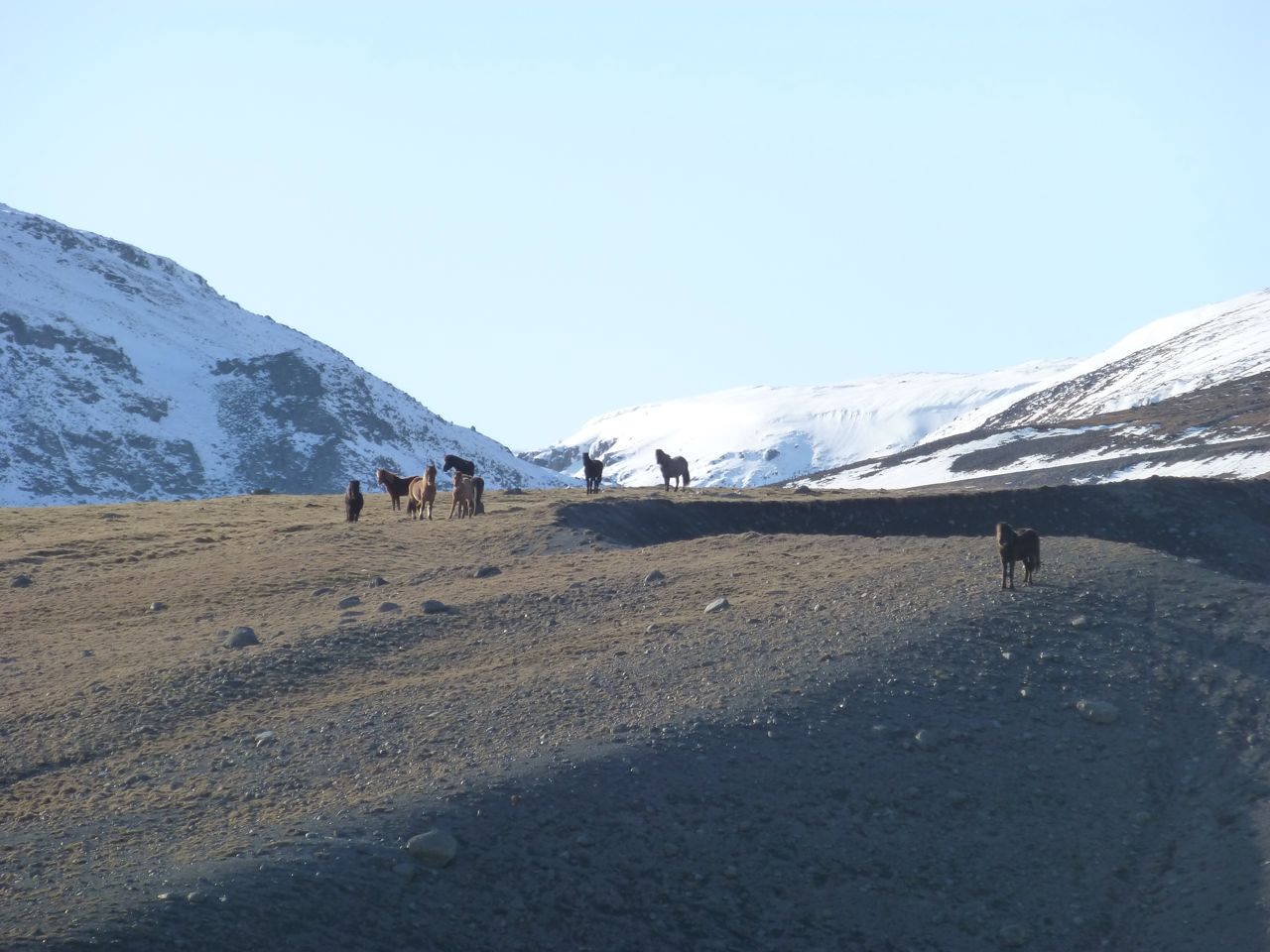
horsesHorses in Fljotsdalur

What a great welcome!

Elves, German Nationalism, and Gunnar Gunnarsson

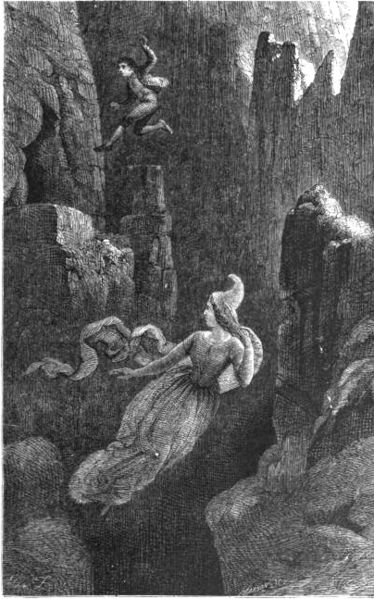
Before Darwin, European culture had many ways of understanding the relationship between humans, land, and evolution. Scientifically, they withered under the evidence of Darwin’s theories, but culturally many of them have remained potent. One of them is the Huldafólk, or Other People, of Icelandic folk culture. The English translation is “elves”, but these aren’t Tolkein’s elves, nor are they the fairies of Irish folklore. These are human-sized people, just more beautiful than the humans themselves.

374px-Jumping_after_Hildur
Jumping After Hildur
A man jumping after an elf (English Engraving, 1864)
Another set of alternate people are the dwarves of Norse (and occasionally Icelandic) legend…
P1020278Dvergasteinn, Seyðisfjörður

The dwarves, it is said, rowed this dwelling (rock) across the fjord, when the humans moved their church to this site, because they missed their company on Sundays. Eventually, the humans moved away and took their church with them. The stone (and its dwarves) is left.

Another alternate human is the Green Man, and his relative, the Old Man of the Woods. These people were said to be the original humans, who had risen from the earth and the trees.

greenThe Green Man, Görlitz, Germany

With his leafy beard, hair, and moustache.

The Green Man was an important nationalist symbol in the German struggle for independence in the mid-19th century. He was often said to be a representation of the first Christian, Judaic and Islamic human, Adam. Here those ideas kind of come together in one of the contemporary centres of German ultra-nationalism:

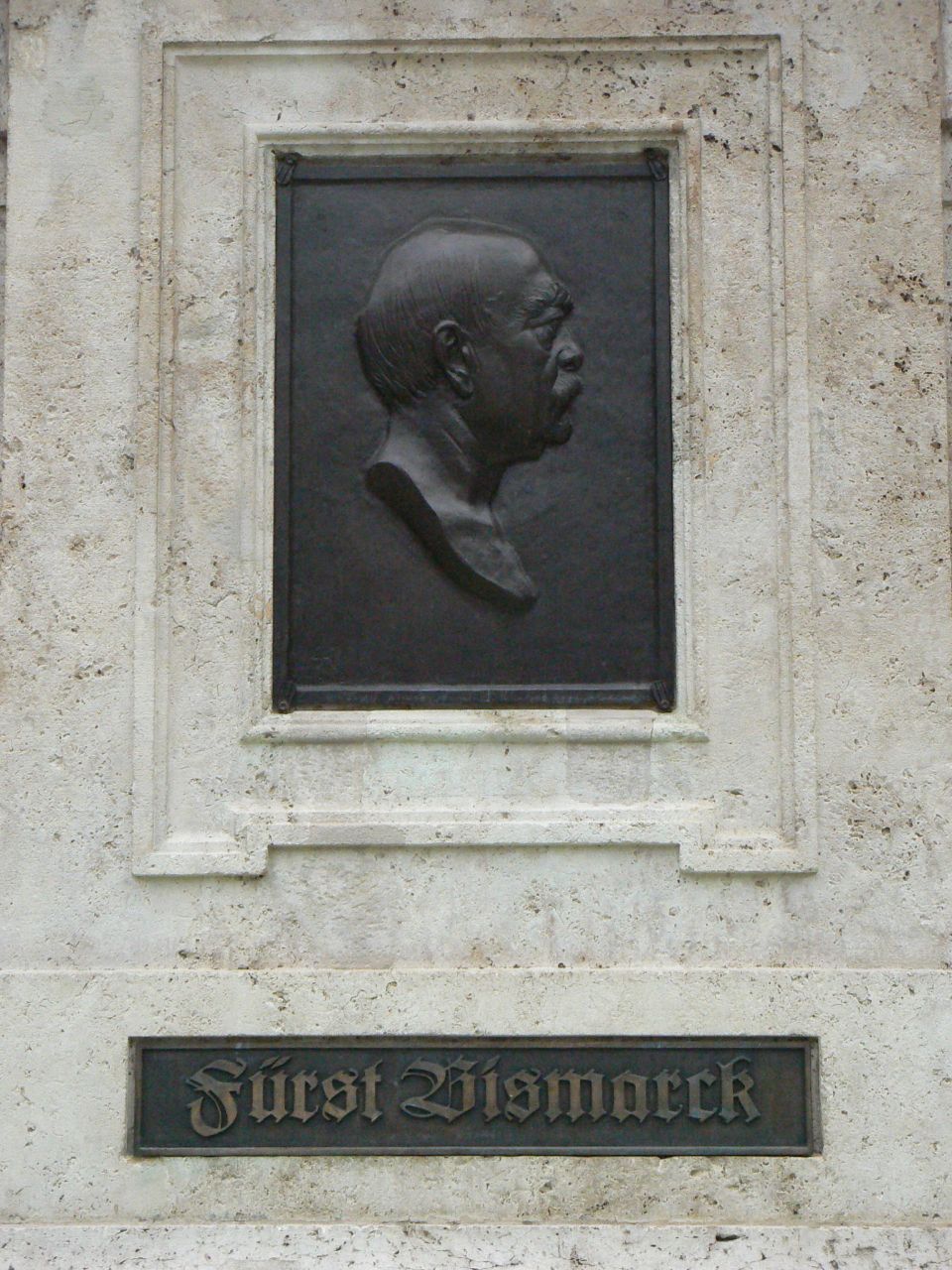
bismarckBismarck, the Iron Chancellor, Jena, Germany

The father of Germany, with his bushy Green Man Moustache. Now a fountain.

Here is an older image of these men coming together in one spot:

barbarossaBarbarossa, or Holy Roman Emperor Friedrich I, Kyffhäuser Monument, Germany

Friedrich’s Crusade to recapture the Holy Land came to an end on June 10, 1190, when he drowned in Northern Lebanon. The monument was erected to commemorate the founding of the modern German State.

Few of Barbarossa’s (Red Beard’s) 100,000 men made it home. Legend, though, has him return to the country as an old pilgrim dressed in grey, inspecting his kingdom, which had lapsed from true observance of Christianity and was a shambles, much like this figure…

wodin

Wodin, from the lost Hall of Sagas, in Silesia

Odin of Norse Belief, or Gandalf in the modern version, or Barbarossa, take your pick. Old legends just don’t die out. Barbarossa was the code name for Hitler’s Invasion of Russia in 1941.

Depressed at it all, Barbarossa retreated to the castle on Kyffhäuser Mountain, where he lived inside the mountain with his knights, served by the dwarves of the mountain. He drank a lot of beer with them and fell asleep, only to wake a century later, ask if it was time to wake up, and then drink another beer and fall asleep once more. His beard kept growing.

P1160220One of Barbarossa’s Dwarves

Dwarves show up continually in German folklore. Luther, the translator of the Bible and unwilling founder of Protestant Christianity, was raised in such legends, in the mountains east of Frankfurt, where his father was a coal miner and descended among them daily. Their power haunted their simple forest house.

Luther’s dwarves were the subconscious mind of the German people. They lived inside what was known as “the living rock”, or the deep rock of the mountains. Gunnar Gunnarsson, son of Iceland, descendent of men of Odin, born to a country of turf houses buried in the earth, also came from this story. So did this man:

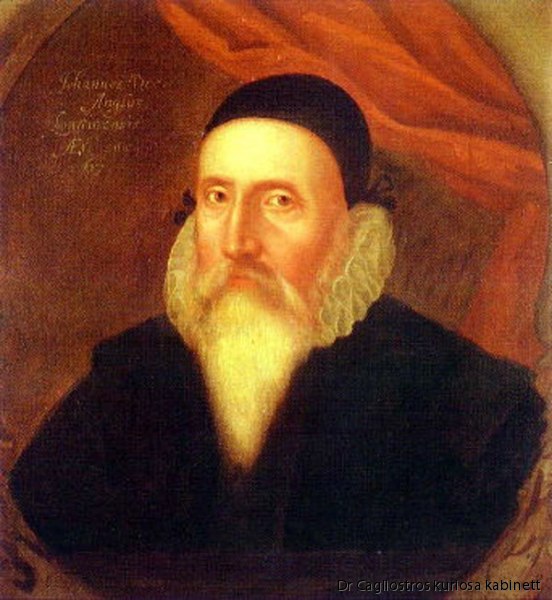
DeeJohn Dee, 1527-1609

Dee was an Englishman who served as Court Astrologer to Queen Elizabeth of England, created the navigational instruments used by early European explorers in the North, and spent many years writing down his conversations with the angels. He believed that if he could learn their language, and speak it correctly, he would be able to conjure up the spirits of the earth and the air, as God did in the Book of Genesis, restart Creation, heal all war and disease, and return earth to Eden. Legend has it that when the Spanish Armada, the most powerful state in the world, attacked England, John Dee wove a magic spell around the Island and conjured up a storm, which wrecked the Spanish fleet. This act formed the basis of Shakespeare’s play, The Tempest.

prosperoProspero, Duke of the Island, Banishing the Half-Human Creature Caliban

The tree spirit Caliban is not unlike the Green Man.

Return Earth to Eden? Cast a spell around an island alive with spirits of earth and air? Banish the half-humans? Retreat to a mountain stronghold (an old monastery)? Found a country? Invasion from the most powerful country in the world? The old gods walking the roads in disguise? This is the context in which Gunnar Gunnarsson was operating — the old European, pre-Darwin context, that was still very much alive in his time and is still alive today. In my next post, I’ll show how these ideas illuminate parts of the speech he gave while on tour in Germany in the spring of 1940.

Trolls and House Building: A Field Guide

Well, not trolls exactly. And not exactly a house. It’s a bit of a riddle, but poets love riddles. Why, you could even say that on the northern shores of the world, poetry developed out of riddles, or that skaldic poetry did, at any rate. Here’s a famous Icelandic skald:

Egil Skallagrímsson, Skald

Ready to do battle with, what’s that, a rusty sword? More like a cleaver, I think. I have used things like that to pick cabbages. Poet farmers unite! (17th Century Manuscript from the Árni Magnússon Institute).

A scaldic poem is a ceremonial poem, given as a gift by a poet (a skald) to his patron, written in praise (or at times rousing criticism — very scalding, very scolding criticism). Scaldic poetry was worked through in intricate design and was intended as a verbal form of the intertwined patterning on a shield — a kind of protective magic. (The contemporary equivalent might be depleted uranium.) At times, skaldic poems were even recited before battle. They were part of the battle. An important part, too, that preceded the bloodiness.

374px-Öl1,_karlevi

The Karlevi Stone, Vickleby, Sweden

Photo by Berig.

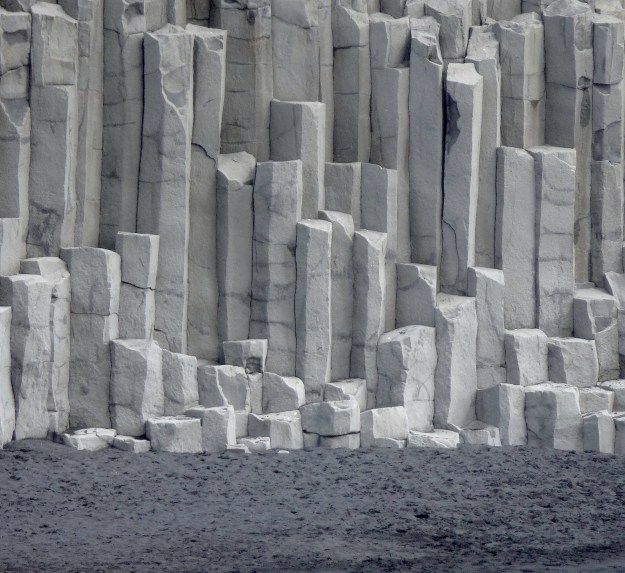
Note the vertical columns of the scaldic poem above. As Gunnar Gunnarsson pointed out in Unser Land (the speech he read from during his 1940 literary tour of Germany), they are not much different than this:
pillars1

Basalt Columns, Vík í Mýrdal

A tightly-linked protective shield poem against the encroaching sea, written in the land itself. (Note: studies from Hawaii have shown that black basalt beaches like this form in hours, not centuries.)

Isn’t that cool? A poem that is the land? That is the riddle Gunnarsson was speaking from: his house is Iceland; Iceland is his house. If that sounds a little unusual, do recall: he’s a poet; he’s not really thinking in metaphor. Mostly, metaphor is for people who are not poets. It’s a useful way, for sure, of describing the work of poets, but it does do so without really accepting the poem as the reality of the world, which is the poet’s way. In the case of Gunnarsson’s house and island, that work is performed in skaldic poetry, which makes his house a shield as well — and not just a shield, but an ornament, too, like this, maybe:

h2_1992.59.1

Viking Broach, Sweden

Men might have wanted shields, to protect their bodies in battle, but, perhaps, just perhaps, women wanted something to hold their garments together at the shoulder, something that was as protective as a shield, something with an island in the centre and the four points of the compass around them, something that would set them at the middle of the world. In Sweden’s case, that would have been North for the Trail to the North (Nor’way), South for Denmark and the trails down the Rhine, East for Finland, and West for the Orkneys — and if you just kept going, going, going, going (whew) … aha! In the middle of the ocean… Iceland.

Once people arrived in the middle of the North Atlantic, the compass shifted. Iceland was now at the centre of the world. The other points of the compass were adjusted accordingly, to reference it. Since all directions led to water, however, Iceland became the entire earth, floating in the universe  (which was a big, cold sea). The country is still roughly divided into these quadrants.

icerecoloured

Iceland, the Compass Version

The shield and compass pattern extends beyond maps. For example, if you really wanted to get into the whole magical side of things, and weren’t squeamish about a little darkness in your life, you could play around with something like the following (You could even write it in your own blood):

2000px-Vegvisir.svg

Vegvisir

An Icelandic magical stave. Staves come in many shapes and were drawn for many different purposes.This one is a compass written in magical symbols, and was used to find one’s way in bad weather.

For such a stave to work (if it did), such navigation would not be done by the physical properties of the land, but by spiritual ones — and we’re not talking Christian-spiritual. In the high days of the Christian Church in Iceland, the possession of such staves could have had you condemned as a witch and beheaded at Þingvellir. That might have been awfully un-Christian, too, but, still, even today, this kind of magic is not advisable. When the Germans tried this kind of thing in the 1930s, for one thing, they invented the 1940s, which turned out to be a really bad idea.

6a00d83452a98069e200e54f76d8928833-640wi

Dresden, February 1944

Among the 20,000 people killed in the Allied bombing of Dresden and the millions of German refugees who streamed through it shortly afterwards on their way south and west from the Baltic, were untold numbers of readers of Gunnar Gunnarsson’s books about Iceland.

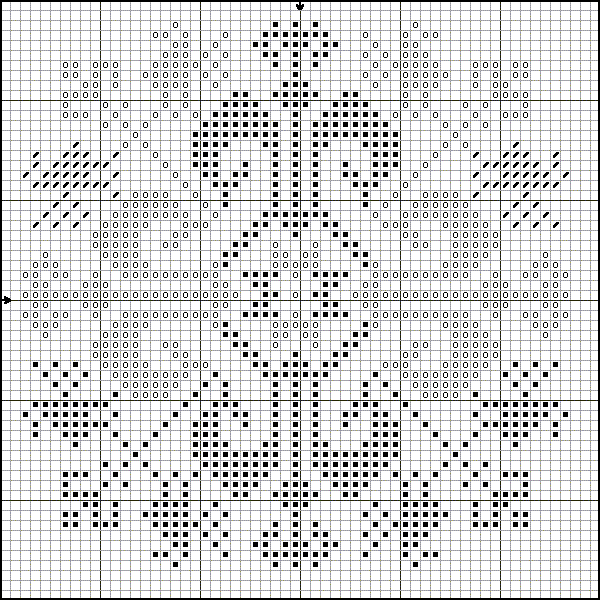
The pattern of land-as-compass-as-shield continues further, into practical applications of gentler spiritual principles. This time, they are placed in the interests of nationalism, where it’s not black magicians in the West Fjords or Ancient Viking ancestors or ultra-Nationalist Germans trained in the killing fields of The Chemins des Dames who are leading the way to a nation, but young women, quietly fitting their minds to the old patterns, to create a little beauty and order out of the blank, snow-white flaxen cloth woven out of the country’s fields. Think of these as self portraits…

icesymbl

Icelandic Needlepoint Pattern

Flowers, yes, but also a hand-held mirror lifted from a dressing table, as well as the old compass, the old shield, the old broach, and the old skaldic poetry, too. Not to mention Gunnarsson’s house. Yes, the house.  Such a pretty thing. Such devotion.

If you think I’m stretching this, consider that five centuries ago in the cloister below Gunnarsson’s house at Skriðuklaustur illiterate young women would have made embroidery of the flowers of the fields. It was a form of prayer, practiced between caring for the sick. Such devotion was the unique Icelandic contribution to prayerful attention and worship, in the way that the repetitive painting of icons of saints was an essential contribution to worship in Russia.
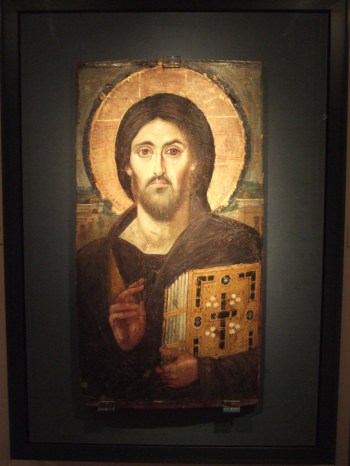
christ-icon-cc-phool-4-XC

Christ Pantokrator

6th century encaustic icon from Saint Catherine’s Monastery, Mount Sinai. The power comes from about fifty coats of paint and the deliberately non-representational nature of the image. God, after all, can’t be reproduced in an image, so trying would be arrogance. Accordingly, such images aren’t representations of God. They are God’s presence, revealed when people devote themselves to old patterns.

The repetition and patterning were key. For example, just down the valley from Gunnarsson’s house at Skriðuklaustur, the old girls’ school at Hallormsstaður trained girls in Icelandic embroidery, as one part of a project to create a culture in Iceland independent from Danish influence. If the home was the heart of the country, and women were at the heart of the home, and the country was its children, then Icelandifying young women would, it seems, pay future dividends. Politification (My, aren’t I inventing words today) of national identity could follow at its own pace.

hallormsstadur

Icelandic Nationalist Embroidery, 1930s, Hallormsstaður.

The doors of the rooms in the school dormitory bear the names of trees, instead of numbers, and are set within a somewhat overgrown botanical garden. Such gardens were decorative in mainland Europe. In Iceland, they are a more practical magic. 

The embroidery above is much like a map of Iceland. When you get down to ground level, after all, and experience the map that is Iceland on a human scale rather than an international or global one of contours, nation states, trade patterns, colonies, weather isobars and even corporate banking, Iceland does look like this:

p1190188

Iceland at Ground Level, Neskaupstaður

The embroidery of summer!

This beautiful meadow, may I remind you, is still our shield and still our skaldic poem. It’s also Gunnarsson’s house, his novels, and the workings of his subconscious and conscious minds. Skaldic poems are full of doubling like that. We’re back to this:

His house is Iceland.

Iceland is his house.

Very skaldic, indeed. Of course, in physical terms, when this skaldic play comes to Gunnarsson’s house, the whole thing does look awfully German.

P1020160

Skriðuklaustur

The German architect, the Icelandic stone, the grass roof…why, it’s an island itself. An island in itself. An island. Itself. German….German? That’s the riddle within the riddle. 

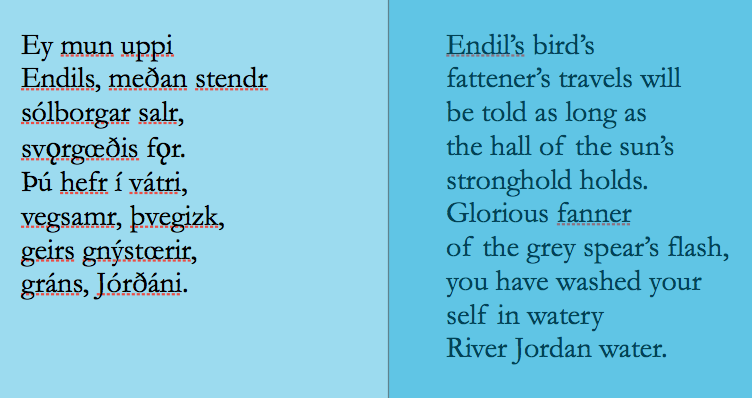
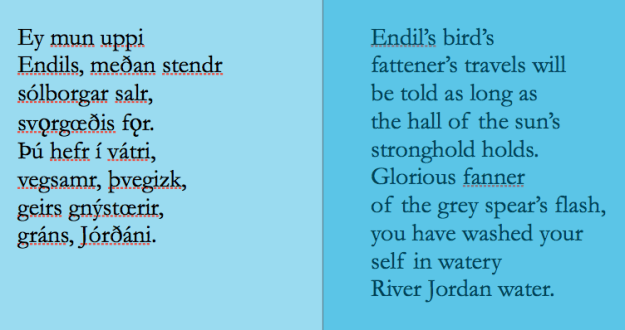
The poems are our key. The first form of doubling in a skaldic poem is a kenning. Kennings are natural word forms inherent in Germanic languages (Frisian, Icelandic, Norse, English, Danish, and so on). Speakers of these languages use words like that all the time. Some English examples are: butternut, windowsill, firefly, and doublespeak. In kennings, this tendency is made artful. Each kenning is a miniature poem in itself. Take the land, for instance, such as that forming Iceland. Take a look at the series of kenning’s below. The earth is cleverly hidden with them, or perhaps cleverly revealed. The delight in recognition is part of the magic of the poem. Can you find the earth there, in its sea? (The translation [mine] is loose, to try to catch some of the music, but it’s not wildly off track, or at least not enough to hide the earth any more than it already is.)
endil2

Skaldic Poem Made Out of Kennings

The earth is “The sun’s stronghold”. The others? Well, hey, it’s a riddle, right? Source.

So, that’s the first doubling: words are given multiple meanings by being joined together. In the example above, the earth is both rock and stone as well as “The sun’s stronghold” (as opposed, seemingly, to the darkness of death, underground, and the land of the salmon, or water).  The other doubling comes about because the rhyme schemes of these poems were so intricate that the poem often had to be split in two columns, one representing each of its two speakers. Two speakers? Yes, that is another old Nordic style of poetry. Here’s what it looked like in its Finnish variant…
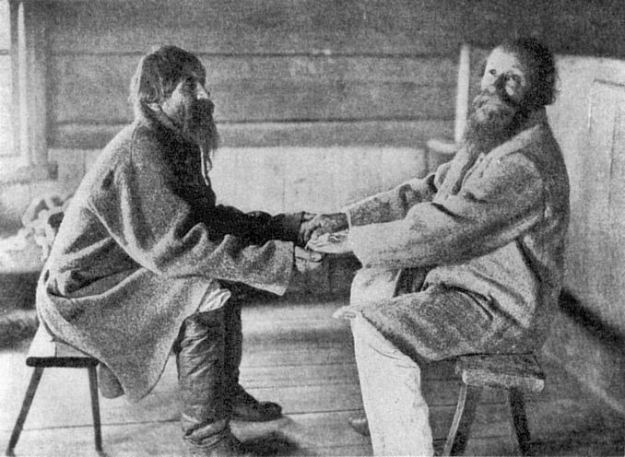
These two Finns are singing the Kalevala, the national epic of Finland

Finnish Folk Singers, Telling a Song Together

Each singer pulls the other towards himself to speak, then follows the other to listen, to pull again. It’s like rowing, or weaving.

Such poems looked like this, sometimes (the first line in each rhyming pair was given by one speaker; the second by the other… a pleasant game, for sure):

kalevala1

The Kalevala, Canto 27 (Opening)

Finnish is related to Pictish (and nothing else), the language of Scotland before the Vikings took the place for their own.

Here it is again, in English from the time of Gunnarsson’s youth. This time, the rhyming pairs are bound on single lines (to draw parallels with Homer, by the sounds of it):

27The Kalevala, Canto 27 (Opening)

Finnish folk poetry, compiled and massaged into a narrative by Elias Lönnrot. Translated by Frances Peabody Magoun, Jr. Homer was extensively read in literary circles at the time.

Two speakers. That’s the key here. But who are they? Ah, they are many things, many of which I have already hinted at here: Iceland and Germany, Gunnarsson and Denmark, Elves and the Church, earth and language, men and women, peace and war, individual and state, man and God. It looks like many things, but that’s just a linguistic convention. It’s really all part of the same conversation — if those words could be brought together into one tightly compressed thing, we would have Gunnarsson’s house. Let’s not forget that Gunnarsson was an Icelander. For a man like him, the word ‘thing’ has special significance, and looks like this:

P1190592

þingvellir, the Thing Place

Iceland’s first thing, or speaking (In Icelandic, Alþingi. In Norman English parliament), took place here in the Mid-Atlantic Rift in 930. In 1000, the country chose Christianity here, for practical reasons to do with unity, self-determination and self defense.

Below the Icelandic flag above, there is a church, and a curious collection of houses…

P1190582

þingvellir Church, 1850

The earliest church on this site dates from the early 11th century. The row of five houses to the right of the church represent the Icelandic state. Each time the constitution has been rebuilt from the ground up, a new house has been added to the row. The one house that is not represented here, is the one in Fljotsðalur to the North East. That’s right: Gunnarsson’s. Hey, no one said he was particularly modest. The volcano, Thor’s Shield, rises faintly in the background, from the earth’s core.

I was standing down by the church, looking up at the Alþingi site and wondering why it was placed here, of all places. Official documents point out that it was on a list of four possible sites, and was chosen because of the four it was the one situated conveniently on the country’s major trade routes (horse paths), and had sufficient pasture, water and wood (for fires) to sustain a large crowd. Makes sense. But why was it on the list in the first place? I wondered, then I got to daydreaming, as poets sometimes do, and thought about being a kid back then, attending the Thing with my family, and I looked up at the cliffs and they came into focus.

P1190629_2

A troll!

P1190612_2 Another troll!

P1190621Yet Another!
P1190625

Trolls Everywhere!

And all of them are looking down over the people. You could say that the land is taking part in the discussion that is taking part in the Thing. You could say that now the past is watching the present, and looking down over the house that is Iceland, which is embedded in that past. Time and space are unique here. They are a language. Since that’s an unusual language, at least for the contemporary, novel-driven world, it’s useful to walk through its halls a bit, to see how they’re constructed and where they lead. I’ll do that in the next post. We’ll walk among elves and dwarves and trolls. They are not part of fairy tale. They are something completely different, and provide clues to the mind of Gunnar Gunnarsson in 1940. It’ll be fun. I hope you’ll come along.

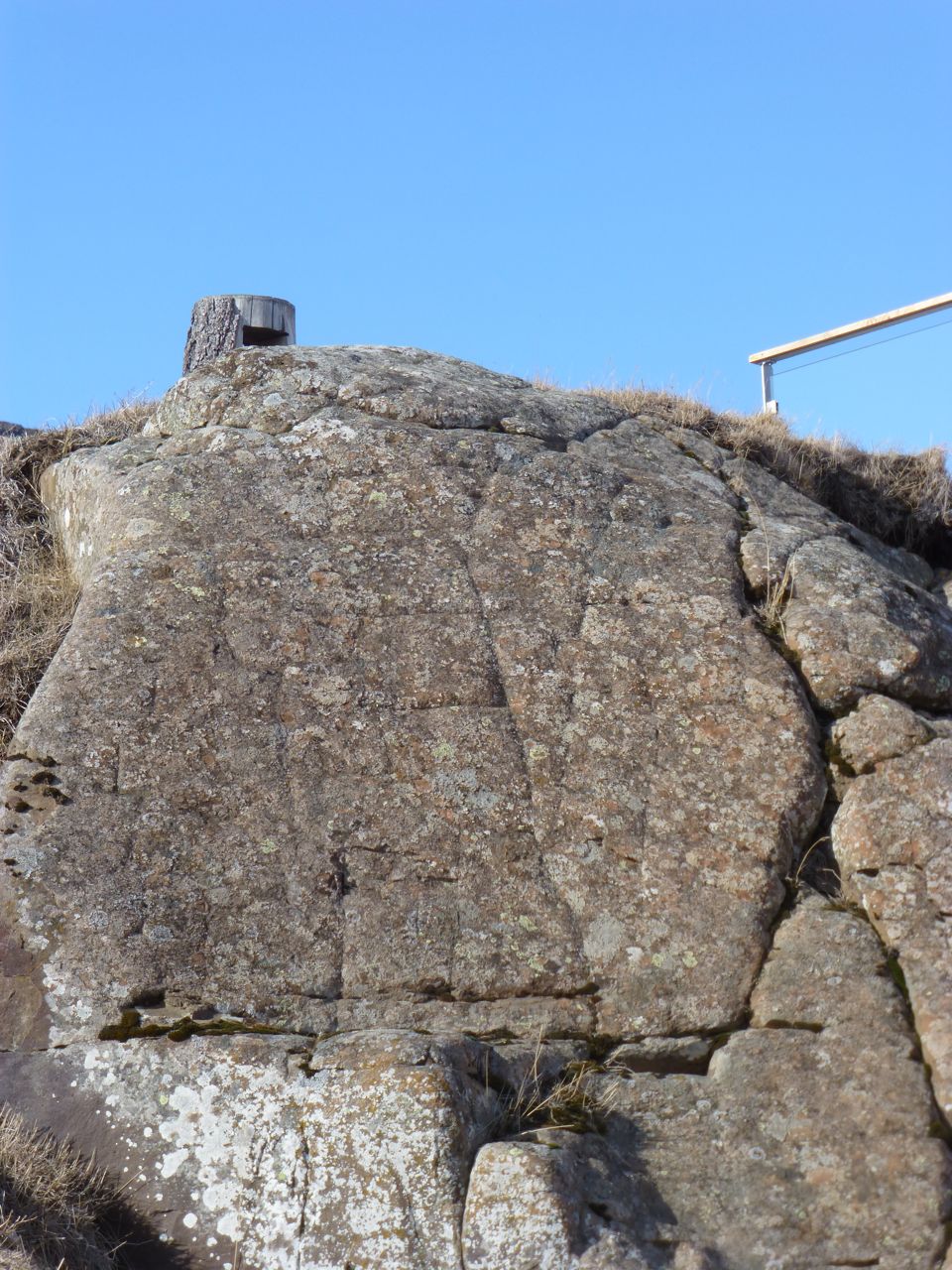
The Novelist, Sod Roofs, and the Other People

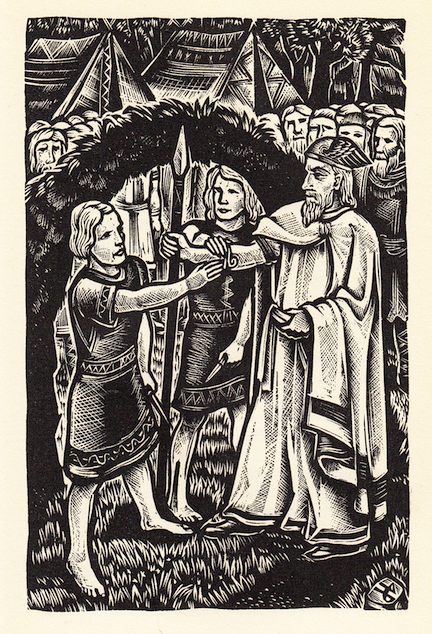
Today I’d like to walk some paths between sod houses, Iceland, and Gunnar Gunnarsson’s inner world. All paths link in a vast web, each link of which is a starting point. My starting point today is a passage from Gunnar Gunnarsson’s novel, The Sworn Brothers, written during the First World War and translated into an English that was archaic even in 1921, when it was published in New York. A better contemporary title might be The Blood Brothers, especially for the passage quoted below, which tells of the ceremony by which Ingolf and Leif, the heroes of the book, become brothers by oath.

eidbrueder2

The Oath

Note the turf arch. From the German Book Club Edition of 1933 (Hamburg).

Here’s the story illustrated by that image. First, the cutting of the turf …

Ingolf and Leif had now cut loose the piece of turf, and went together to lift it. They raised it carefully till it stood straight up and formed an arch. Then Atle Jarl stepped in and placed his spear in the middle of the arch to hold the turf up. He himself stood and supported the spear while Ingolf and Leif cut loose an oblong turf under the arch. Their blood was not to run on the greensward, but was to mingle on the bare earth.

… and then the drawing of blood …

Ingolf thrust his knife-point well in and cut a deep gash. Leif put his knife right through so that the point projected a couple of inches on the other side of his calf. He had difficulty in drawing it out again. The blood ran down in red streams. The spectators felt a strange shuddering thrill at seeing how it oozed out from under the naked soles of their feet.

… the mixing of it with the earth …

Leif watched the course of his blood attentively as it approached Ingolf’s on the brown scar of earth between them. As it seemed to him to go too slowly, he stooped down, directed the streams of blood with the point of his knife, and stirred the blood and earth round between him and Ingolf. A laugh then rang out in the air from hundreds of throats.

… the proclamation of brotherhood …

Atle Jarl now proclaimed that Ingolf Arnarson and Leif Rodmarsson had entered into legal brotherhood, and named the witnesses. With that the solemn ceremony was at an end.

… and the re-laying of the turf …

The grass-turfs were carefully laid down again in order that they might grow firm and be incorporated with the earth’s life. Ingolf and Leif were now joined together by the strongest bonds that exist the blood-tie between brothers, the most sacred and inviolable of all blood and family ties. The earth by which they had been formed in different mothers’ wombs had now drunk their blood mingled, and had at the same time given them new birth, since they had passed together under the turf arch, a part of earth’s living frame. The earth knew now, and had recognized their covenant a covenant no power could break.

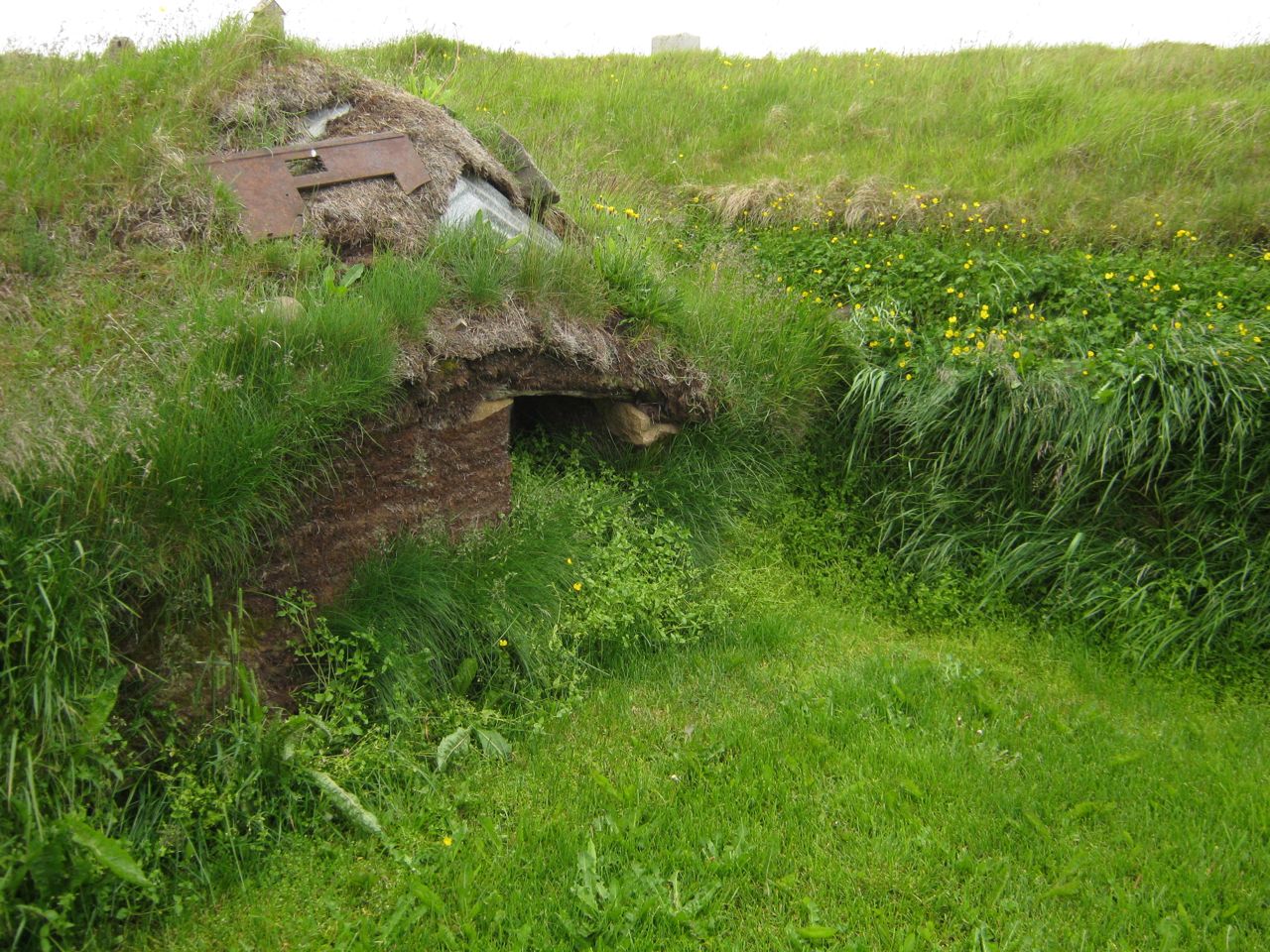
And now, from Iceland, a few observations. First, a turf arch …

Egilstadur to Ardalur 039Turf Doorway, Bustarfell

In Gunnar’s representation, the sacred, pre-Christian earth that lies beneath its cloak of sod, and which figures so powerfully in The Sworn Brothers, once lay at the heart of every Icelandic house. In fact, they were cut out of it.

Next, Gunnar’s house at Skriðuklaustur, with its sod roof (designed by Fritz Höger, a German architect who shared Gunnarsson’s romance with pan-Nordic culture) …

P1020160

Skriðuklaustur

Note how the space of earth inside a traditional sod house (containing darkness) has been replaced by a space of air (containing light). The sacred grass covering remains, but as it is no longer connected to the living earth, it is only symbolic. In other words, this house is a poem. It is an act of human will. It is the space into which Ingolf and Leif shed their blood, as conceived of in Gunnar’s imagination.

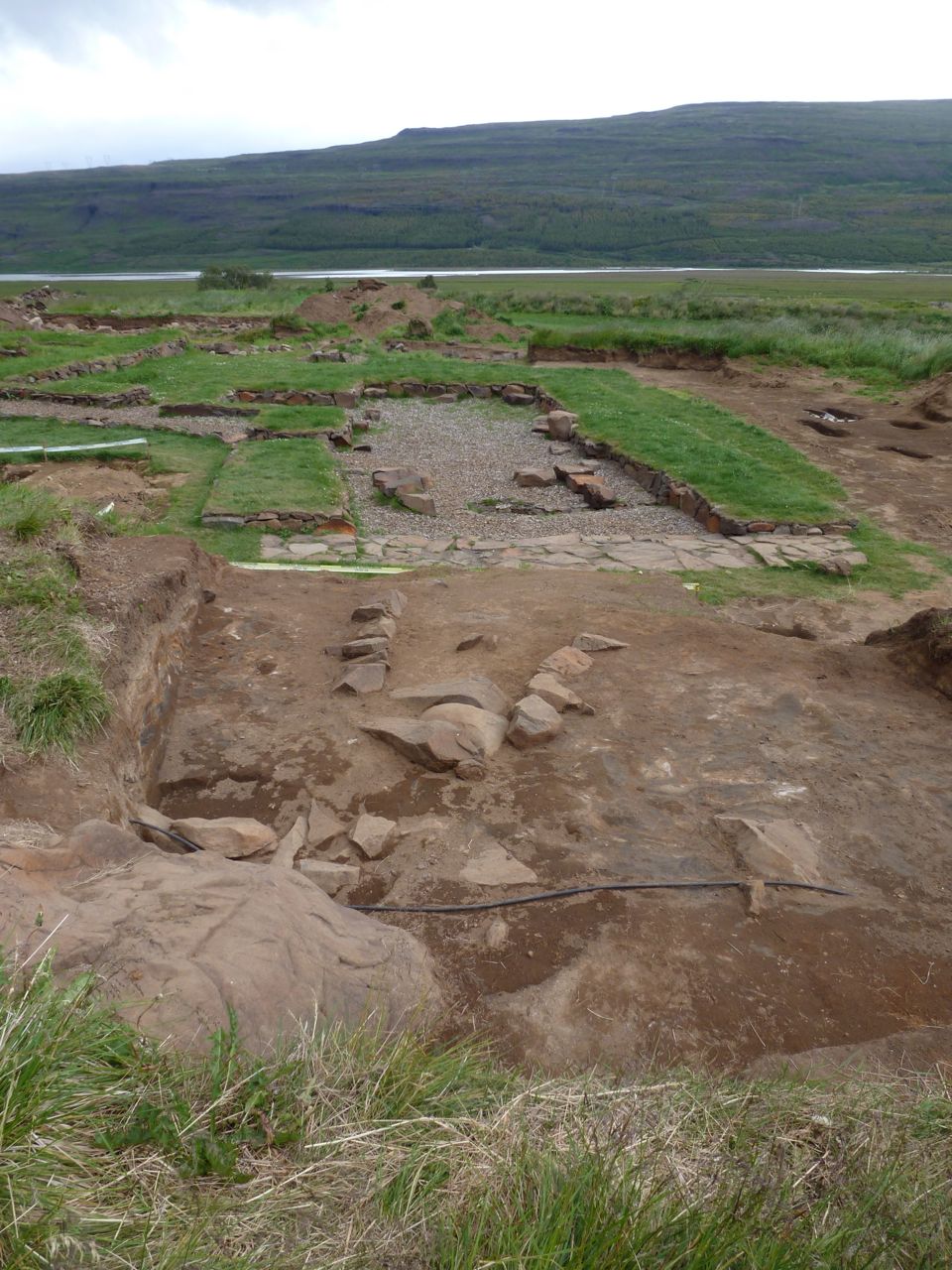
Below the house, the old cloister below the house is being excavated. It’s worth a look, too …

P1020175

The Red Earth of the Cloister Floor (Klaustrið að Skriðu)

For perspective on the theme, a little journey north to Husavik is recommended. Besides a beautiful Christ in the form of a polar bear in its graveyard, the harbour church also has this moving painting as an altar…

lazarus

Christ, Bringing Lazarus from the Dead

Right out of the mid-Atlantic Rift in Þingvellir, yet. The painting is the work of Sveinn Thorarinsson, an artist from Kilakot farm in the spreading estuary of Kelduhverfi county (1930-1931). 

This is a splendidly nationalistic work. So were Gunnar’s novels. So was Gunnar’s house. Poetically thinking, Gunnar, who had returned to Iceland to build his house, had returned from the dead (Exile in Denmark, the colonial power; exile from the land and farms of his childhood, and so on.). In keeping with his modern saga, “The Sworn Brothers,” to swear his oath, he needed a sod roof, to cover the earth upon which he swore it. Here’s another variation on the theme:

elfhill

Elf House

Like a human house, it is covered with sod — just a bit more dramatically. (Out of respect for the privacy of the elves, I will not give you the locations of their houses.)

Not all elf houses are the same. Here’s one with a chimney…

P1040294

… and here’s one without sod, and with its smoke hole plugged …

crossElf Fortress, with its Roof Plugged by a Cross

It has been like this since the day the settlers arrived. As the story goes, a Christianized chieftaness sailed up the fjord, spotted this volcanic plug, and dealt with it right then and there. Luckily for the elves, there is a whole complex of plugs in the area, but, still: ouch.
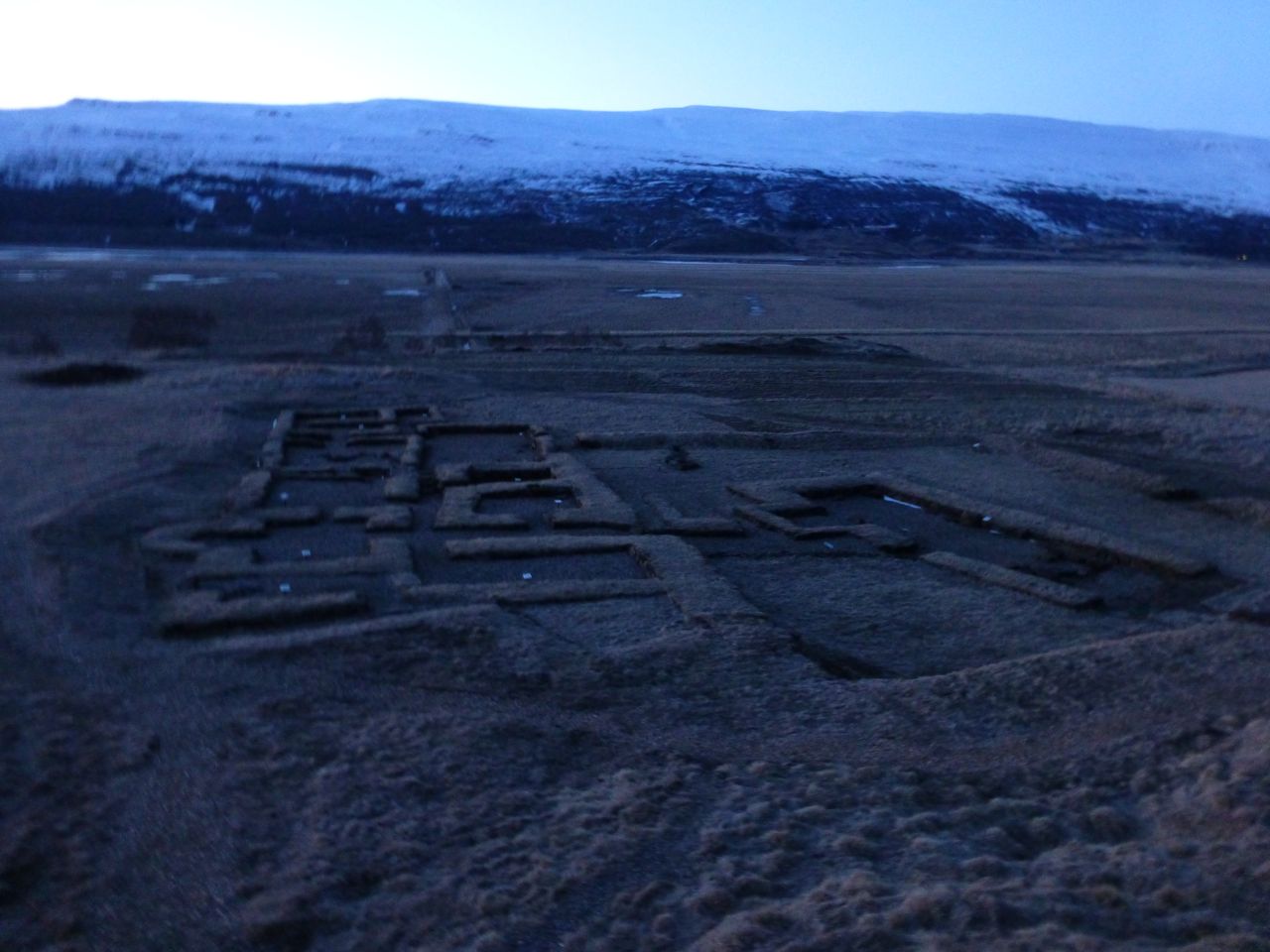
A house part elf city, part peasant hut, and part elf dwelling … that’s what Gunnar was making, both out of stone, wood, glass and sod, but also out of words, between the pages of his books and in the minds of his readers (he hoped.) Considering it all poetically, and leaving aside for now questions regarding the appropriateness or timeliness of the gesture, he was bringing his books to life, through the construction of a man, or a space for a man, out of the stuff of Iceland, energized by his will.
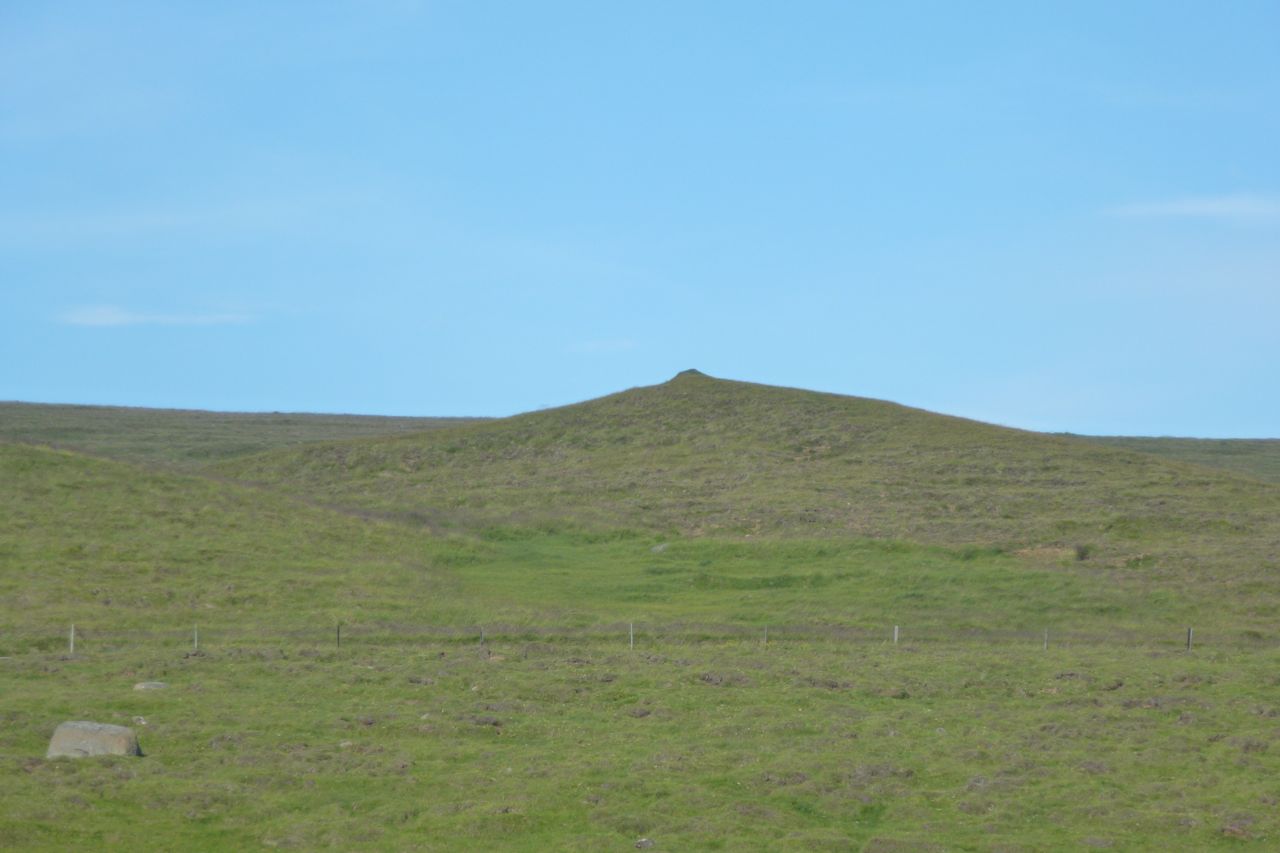
Next: Why Elves?