So, like, you want to see trolls, eh. Well, there’s the troll park at Fossátun.
Cartoon trolls. Fibreglass shells. 3D graffiti.

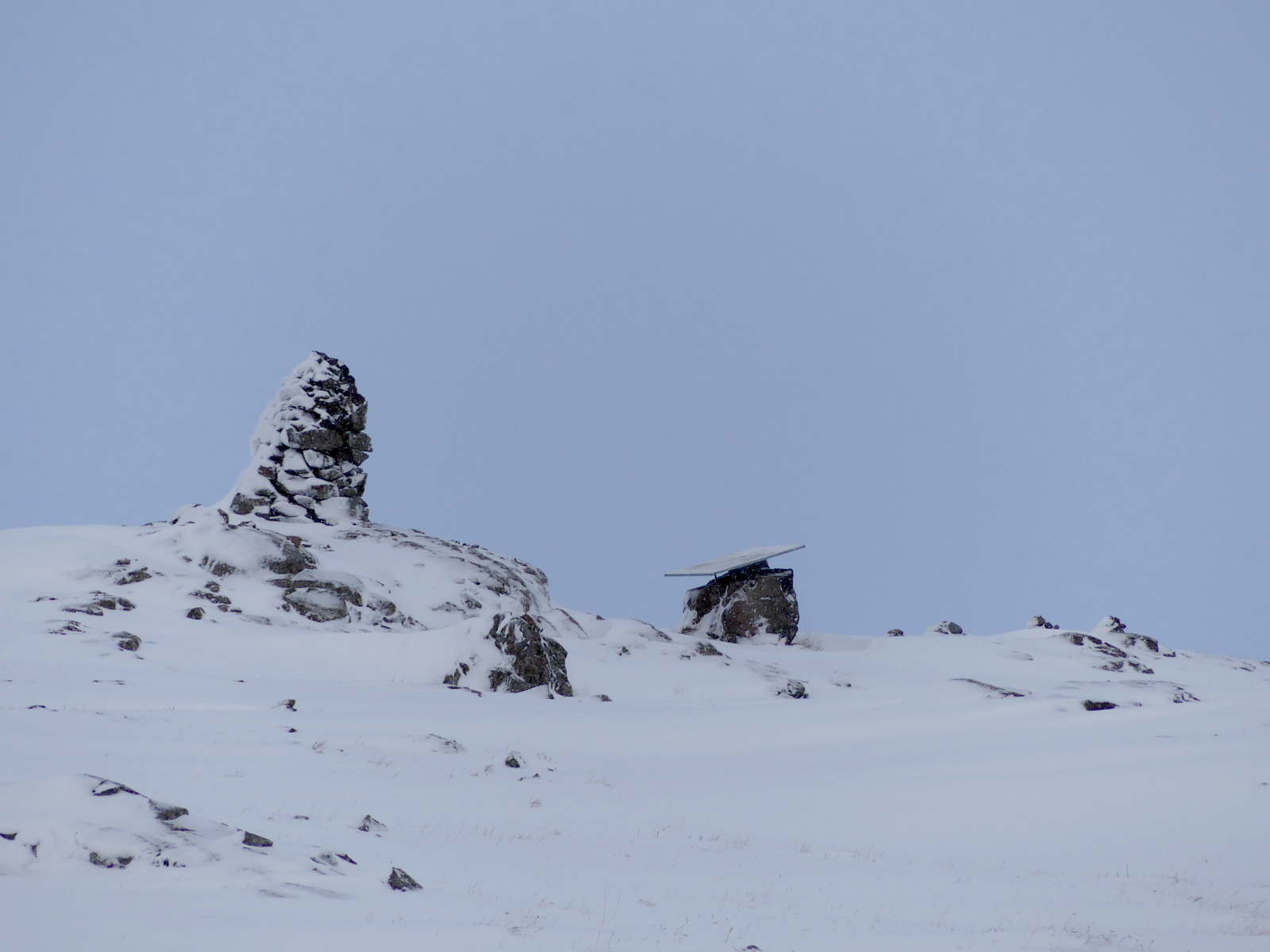
If you carefully turn around, you’ll find the real thing.
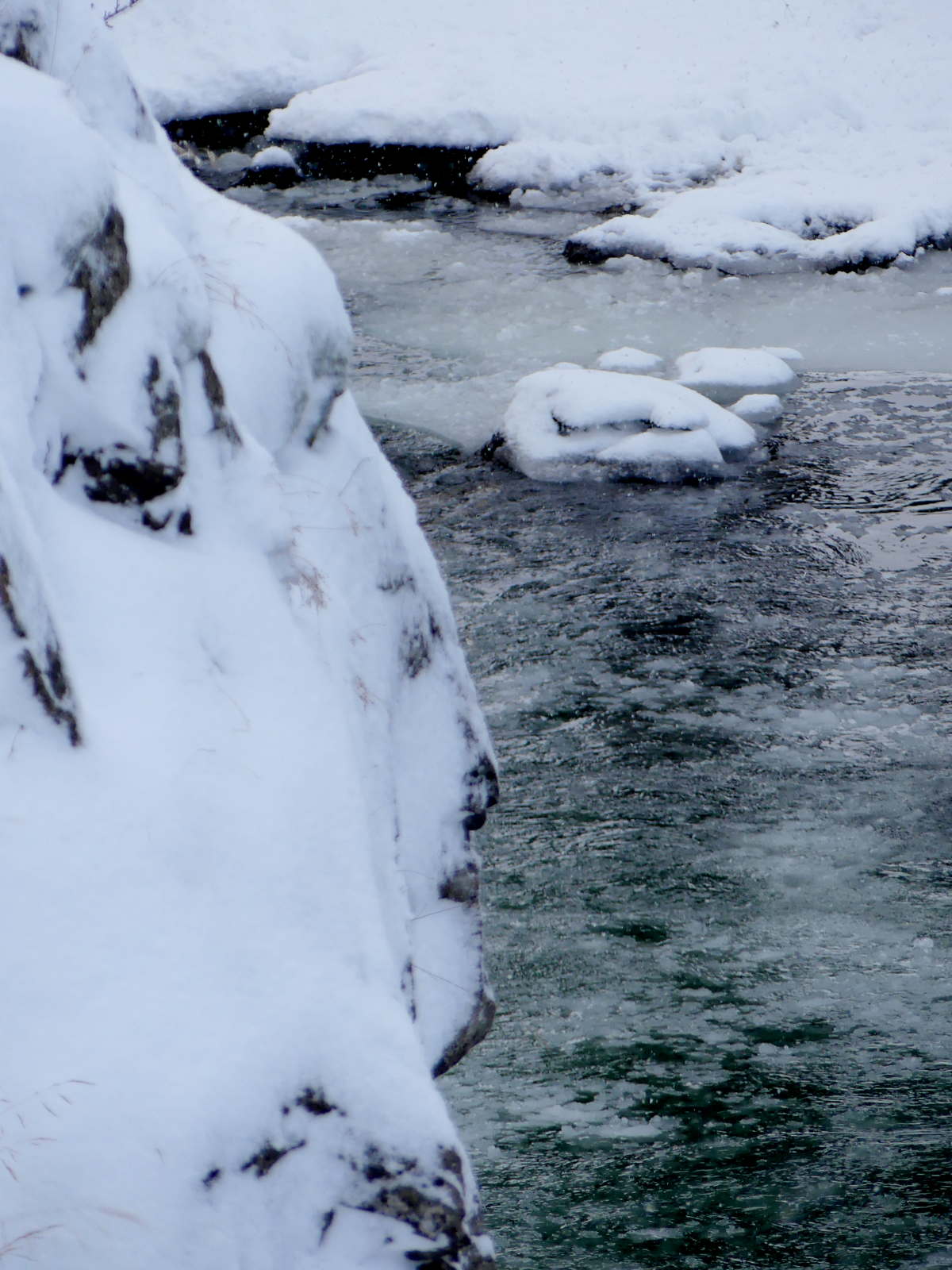
Sure, laugh.

So, like, you want to see trolls, eh. Well, there’s the troll park at Fossátun.
Cartoon trolls. Fibreglass shells. 3D graffiti.
If you carefully turn around, you’ll find the real thing.
Sure, laugh.
Sure they do.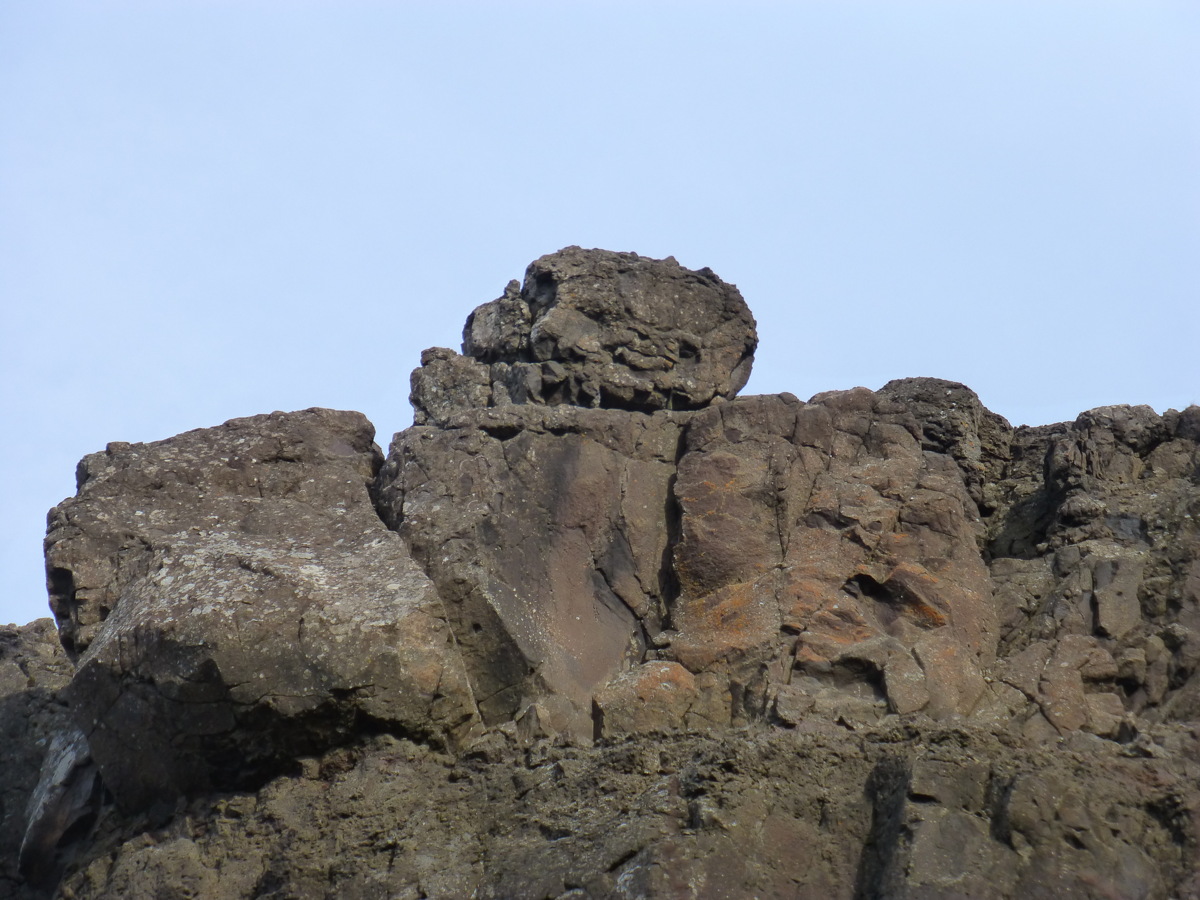
 Mysteriously, mind you, and in slow motion. You’re not in a hurry, are you?

Don’t let the dragon in the canyon bottom worry you. He’s in slow motion, too
~
Hengifossá Canyon
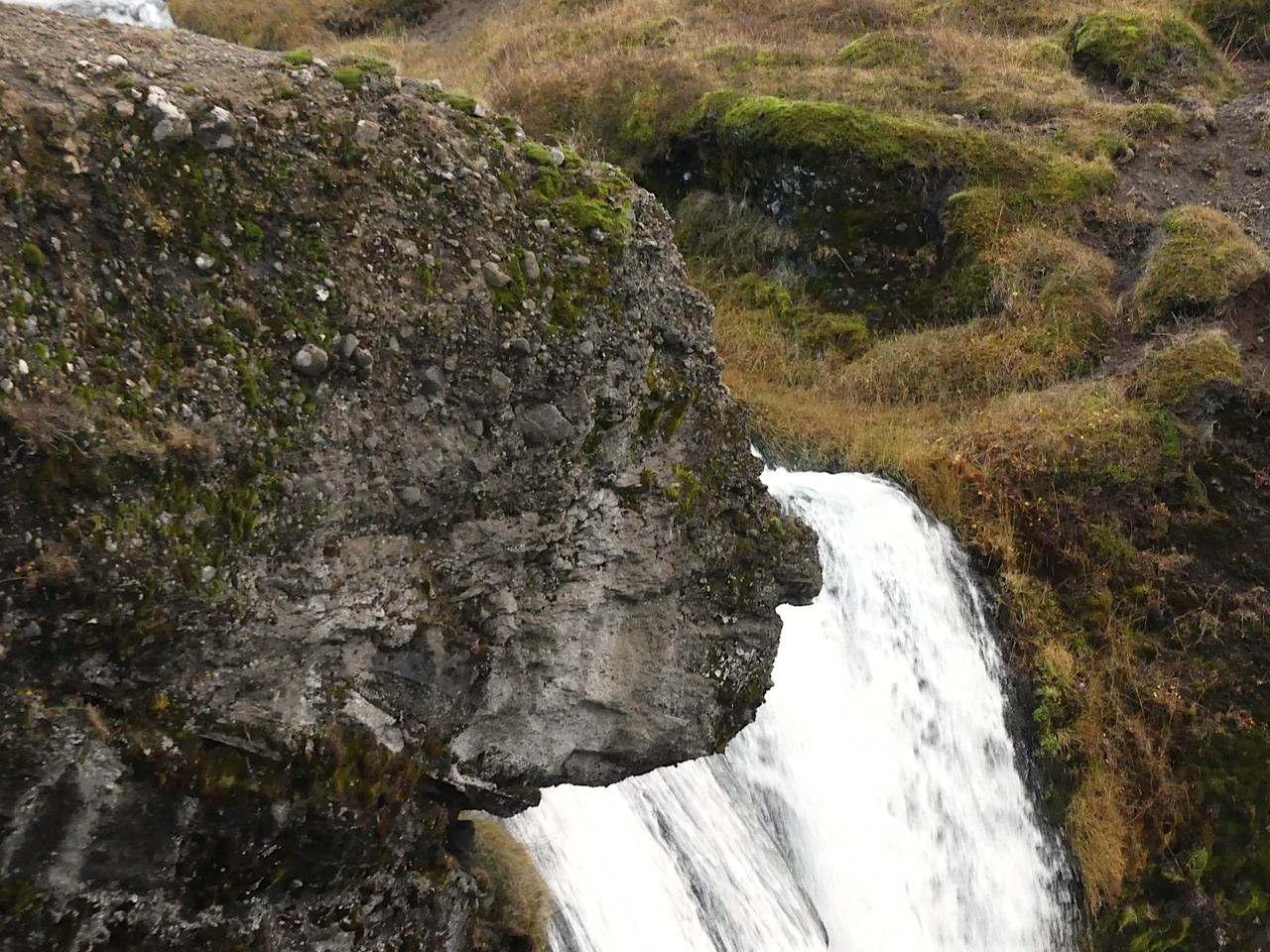
This troll is marked on no map, yet so many travellers have found it that access has been blocked — an unusual thing for Iceland, but necessary. I leave it for you to find it yourself. Note the old house site to the troll’s left. Yeah, on the grassy slope, and at its base. People used to live closer to trolls than they do now.

Still, take a look in the troll’s ear to the right above, and then to the goofs chatting in there, as if they were on the set of a silent movie.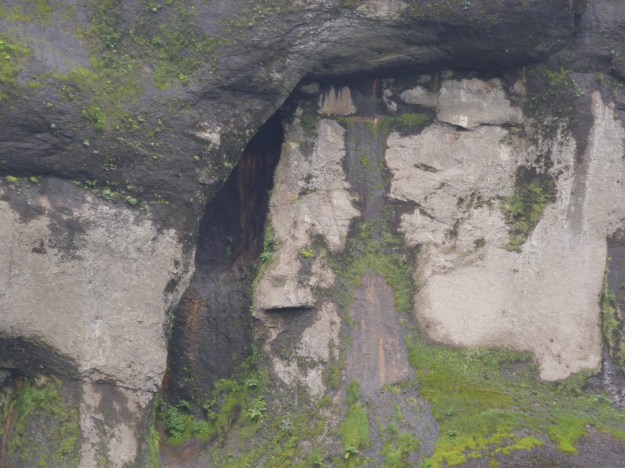 How can you block access to what doesn’t belong to you in the first place? How can you stop a conversation that has no sound? You can’t, but you can give it space.
Some trolls love the wind.
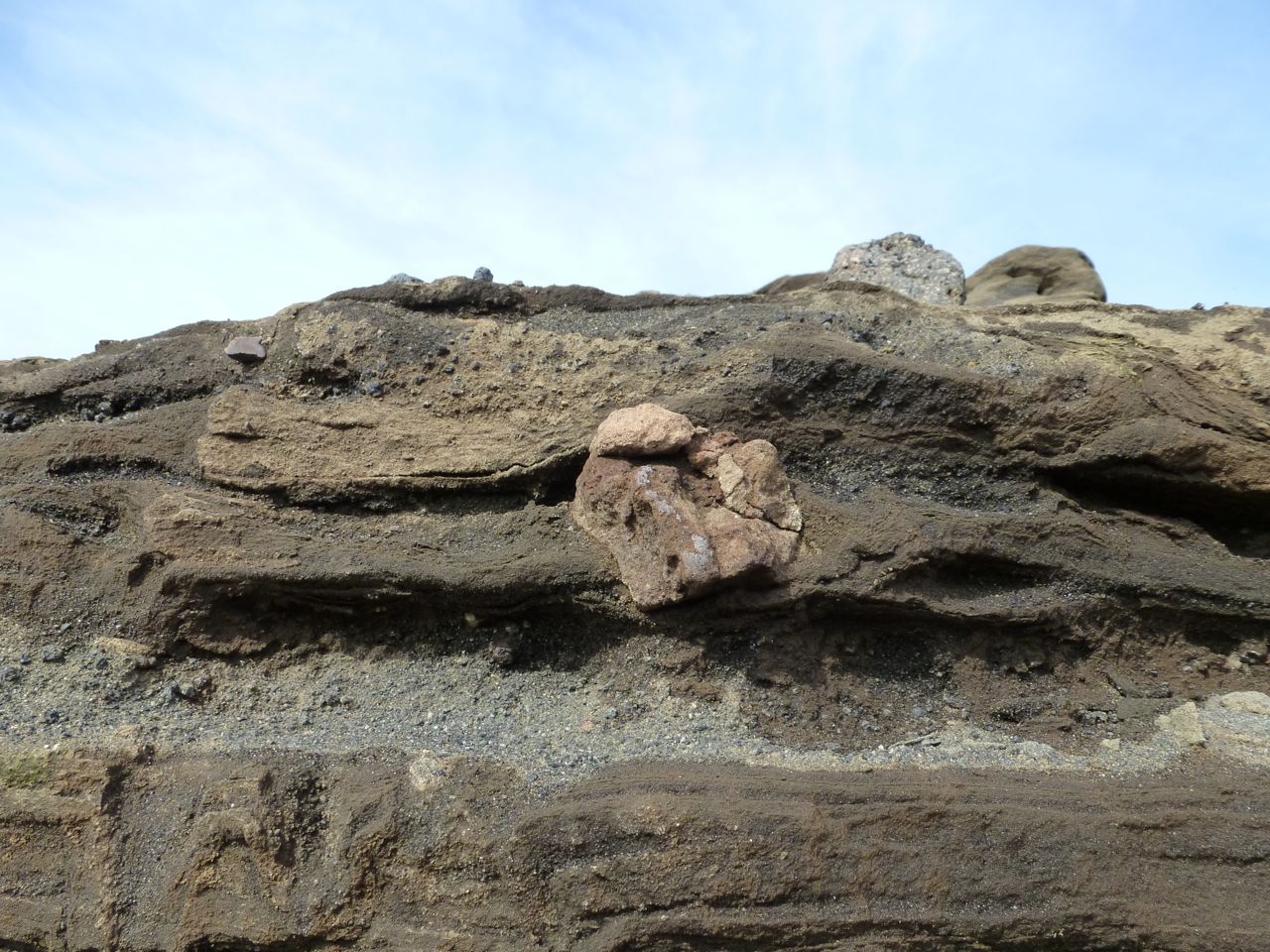
Others laugh at it.

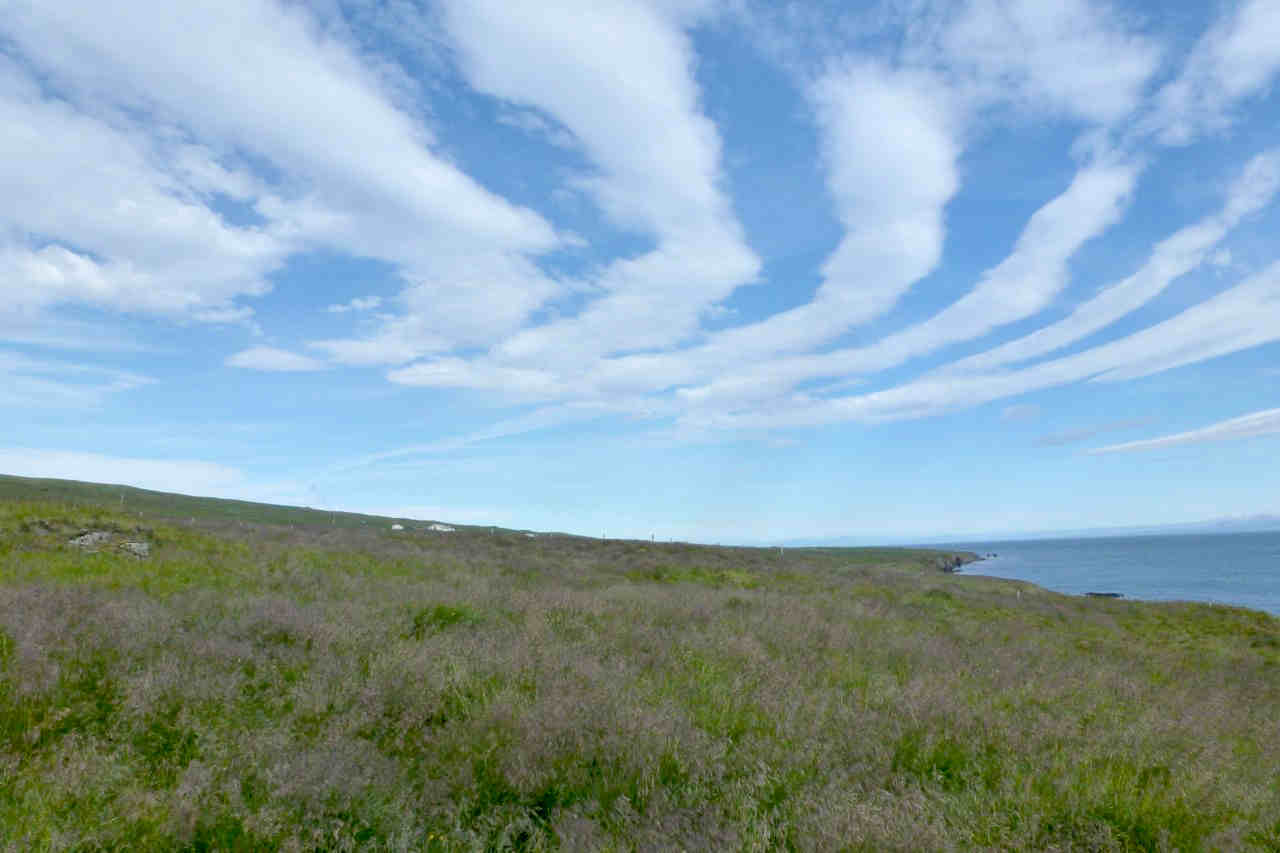
It’s a good thing, because the wind is everywhere when you live in the sky!
 This early april view of trolls Goðafoss is for all of you who are caught in the heat of the south. Time to plan that next spring trip, for sure.

Whose trapline, that’s what I ask.
Trolls!
 It’s not the safest spot for sheep.
 Berserk Lava Field Falls at Dusk
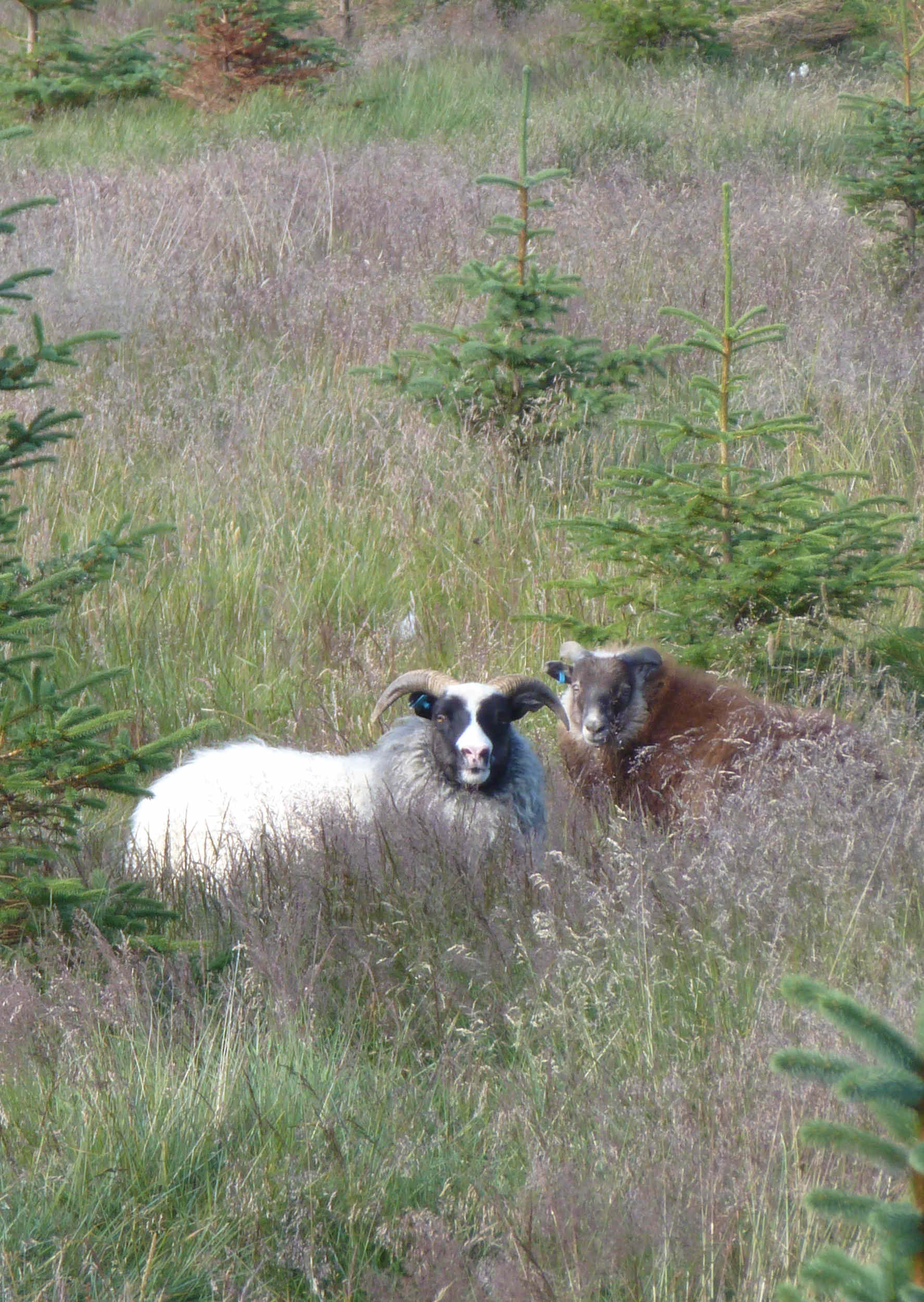
This is about a book, that has come out of this blog, and Iceland. In Iceland, I learned that one of the ancient arts, older than poetry but as old as the art of knitting, is the art of haying. Here are a couple of Icelandic sweaters in their natural form outside of Stykkishólmur, hard at work turning hay into yarns. I was picking bilberries for lunch. They seem kindly, I think.
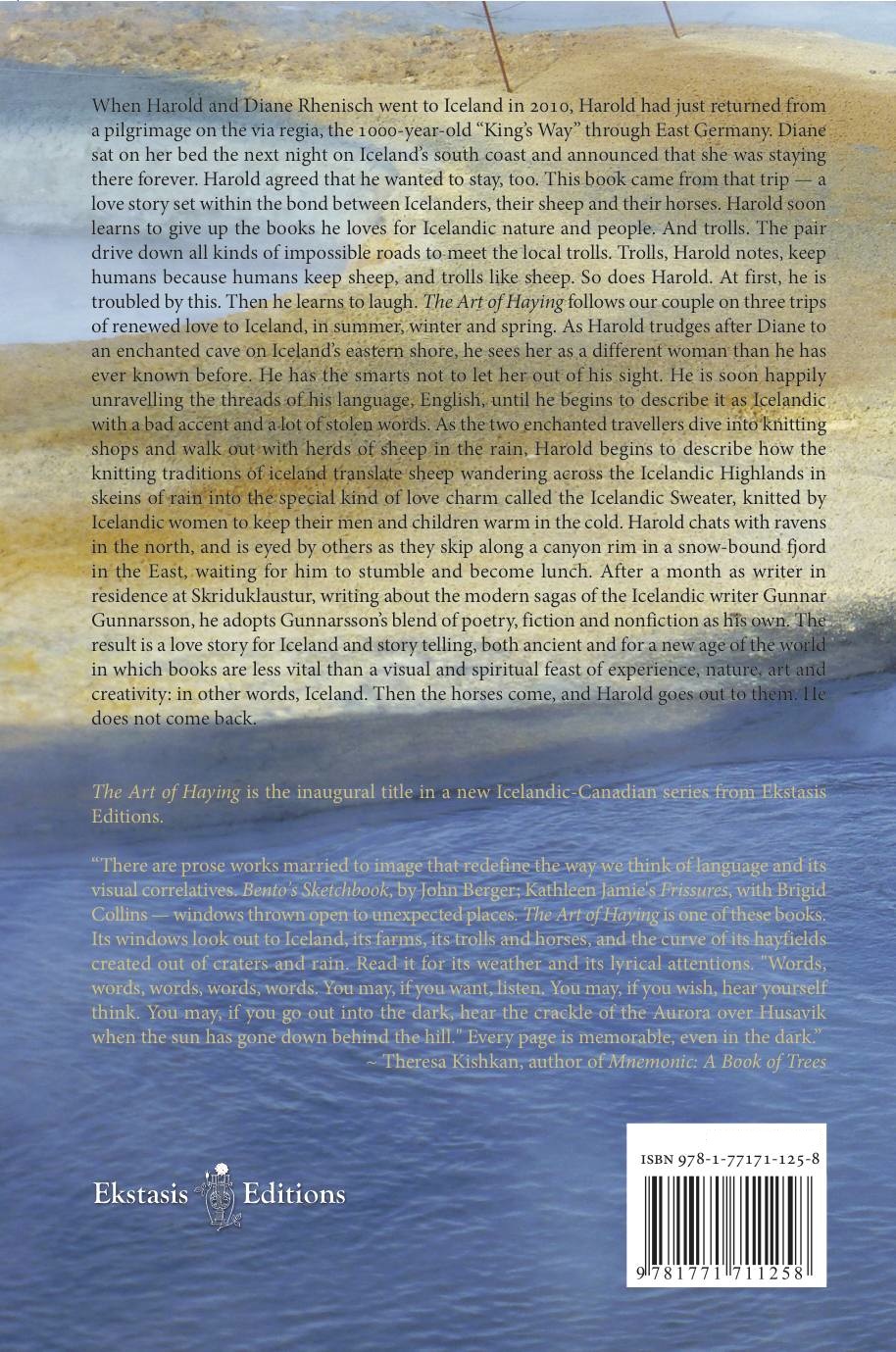
And here is the cover of my new book, The Art of Haying: A Journey to iceland (Ekstasis Editions, 2015), which is all about that, and the future of books, and a lot more. No bilberries. That will have to wait until my next Iceland book. A few bilberries on a Stykkishólmur park bench, a tub of Skyr, and thou. That kind of thing.

This is a love story, for a country, for a woman, and for a way of life in which the old is new and the new is old and a man frees himself from the walls that books have made in his mind — walls that he previously didn’t know were there. It’s a scary thing, to have been kept by books my whole life, and then, one day, to step outside their pastures, but that’s what happened. The Art of Haying, is about drawing a line through grass and making a new beginning from it, not just for me but for culture on the northern shoulder of the world. Here’s a glimpse of one of the books I talk about in The Art of Haying.
The book is gorgeous, and contains over 200 photographs from three seasons around all of Iceland. It has the mare of the sun on the Reykjanes Peninsula..

… and a Keltie in Kopasker, luring Icelandic fishermen in to the books’ pastures.
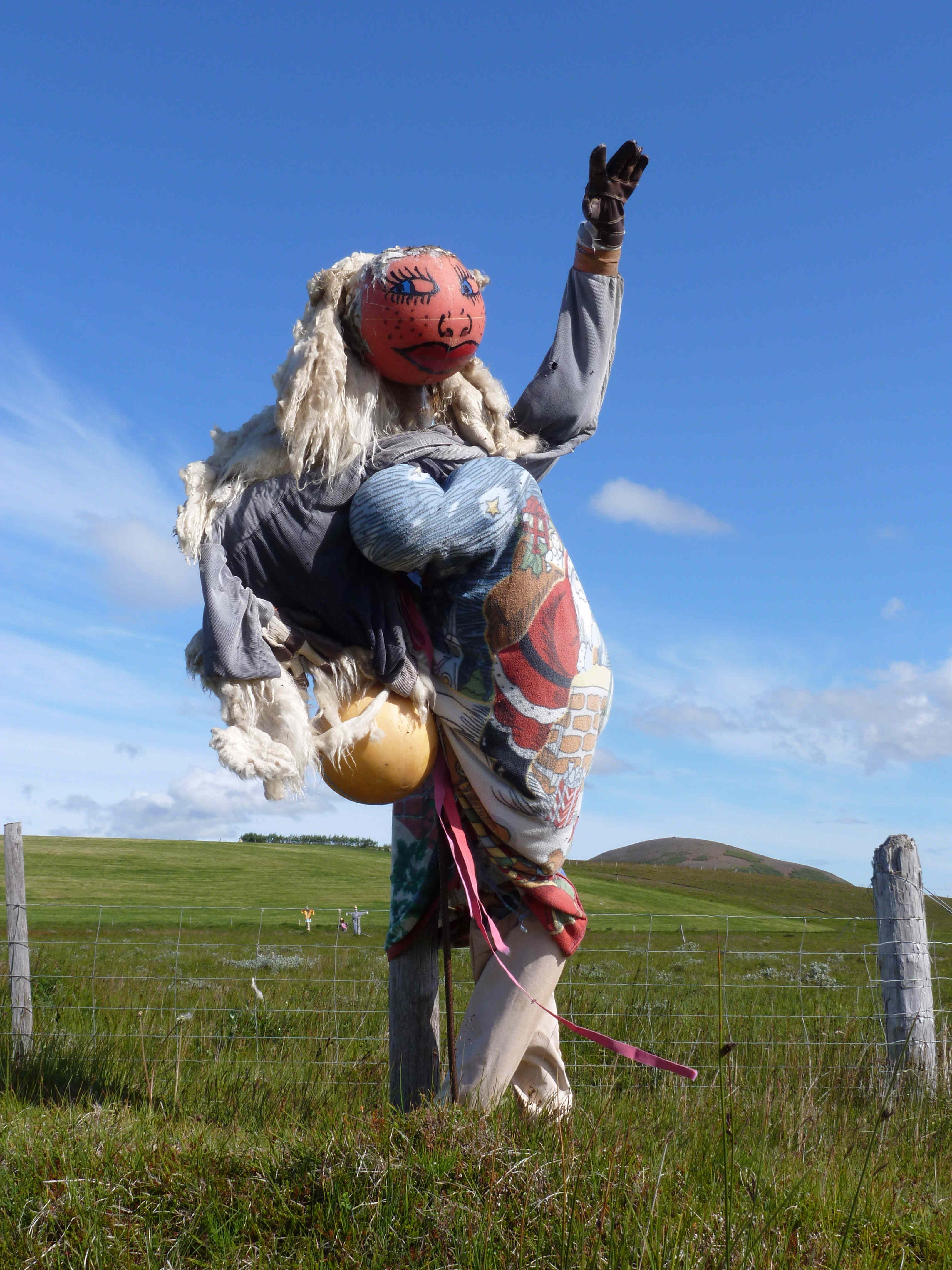
It has so much more. Don Quixote of Reykjavik, for example.

Sometimes it’s worth getting up before dawn! The veils of the world are lifted and pushed aside! The Icelandic imagination was formed from life in houses such as the turf house at Hólar below, and the scripts of darkness and light they wrote for the body and the mind that followed it like a hand.

The Art of Haying is a travel book, a book of gentle, playful philosophy and wit, a love story, and a story of spirit. Horses are human souls here, like this one in its bookish pastures in Reykjahlíð.
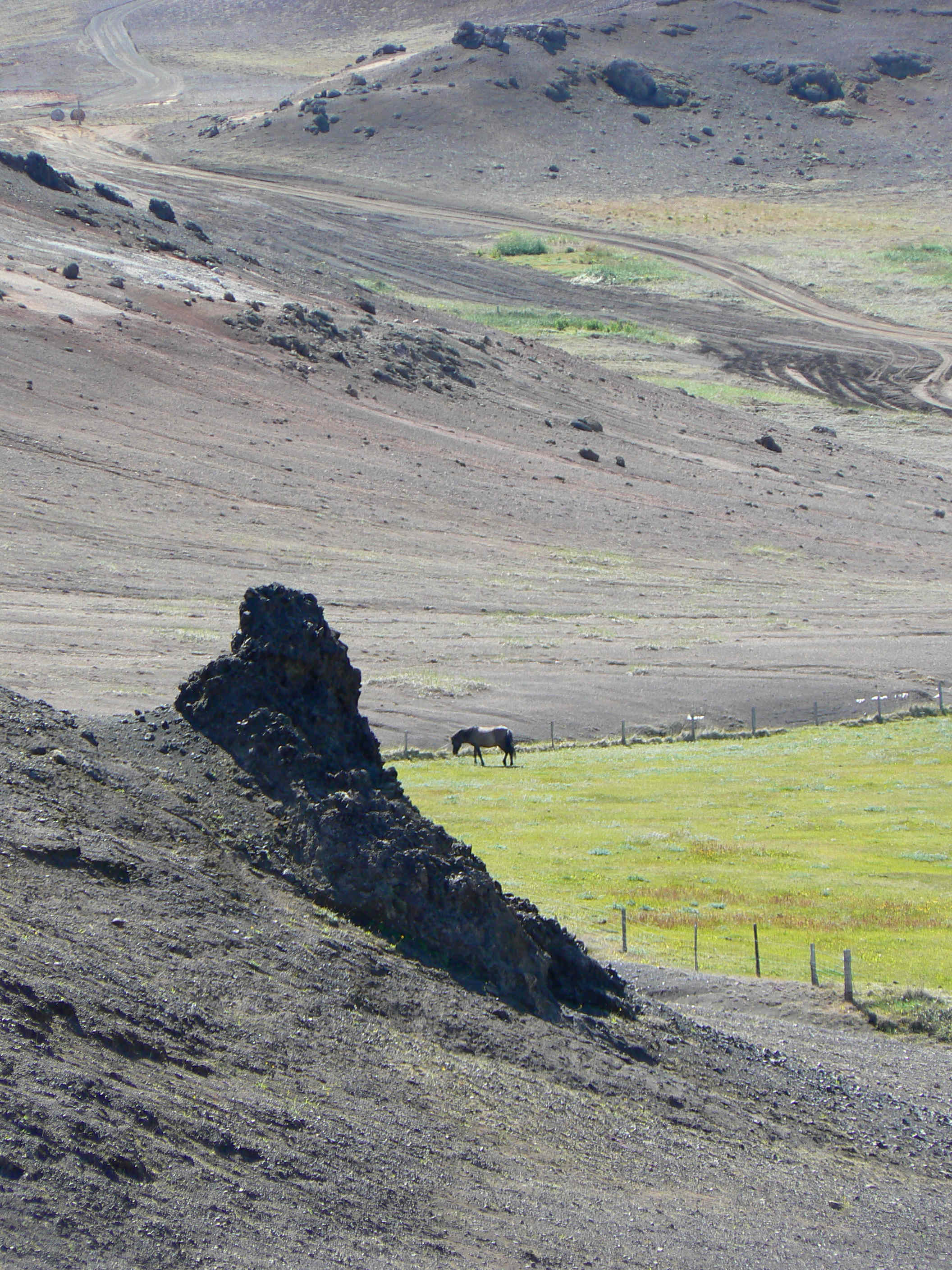
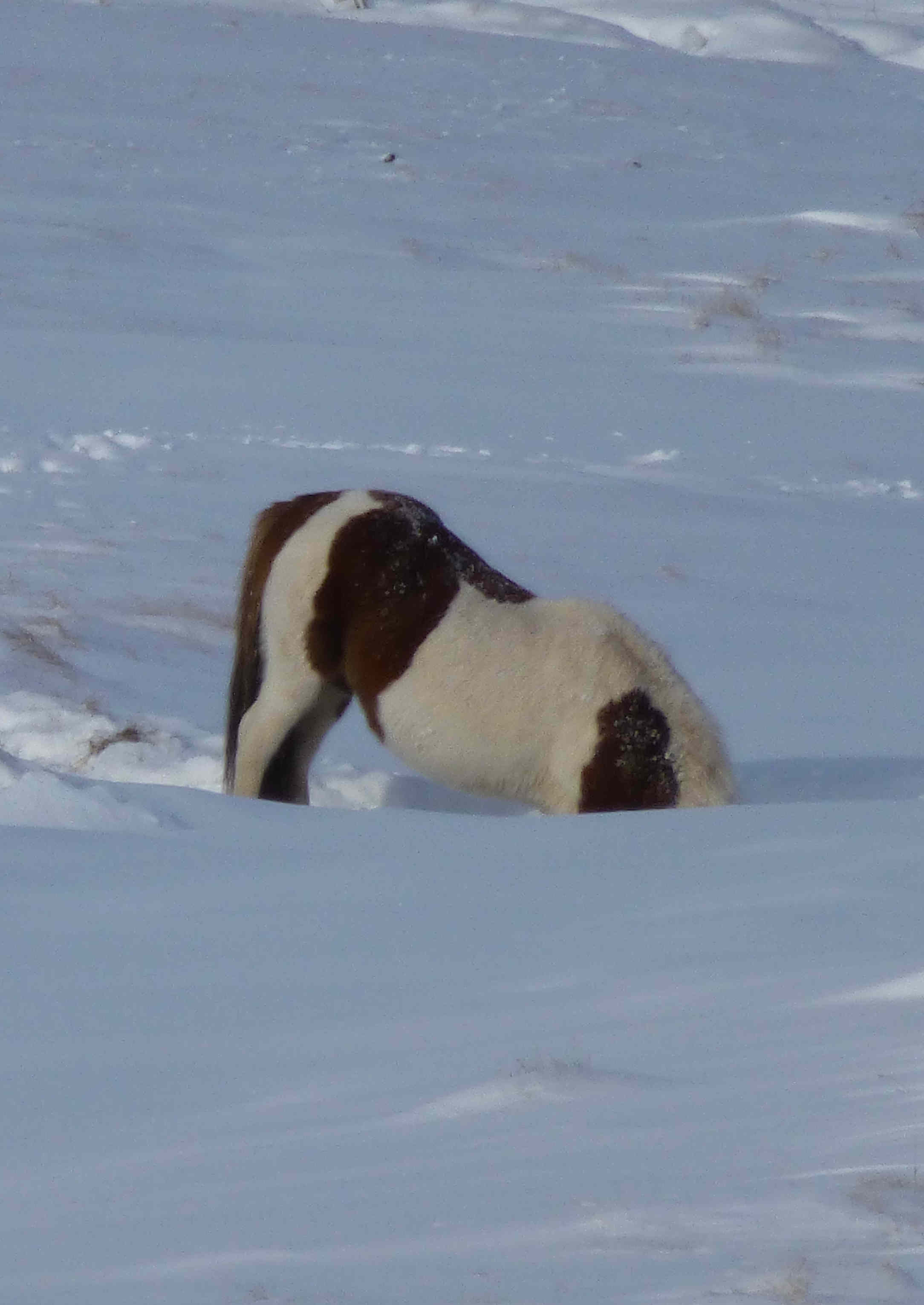
If you’ve never met an Icelandic horse, that might seem merely a poetic device, but if you have, well, I’ll let this horse at Hófstaðir in the Skagafjörður show you how to drink at that trough.
And, of course, it’s a real book, told in the play between words and photographs, so it has a back cover too…
There is a unique form of creativity on Iceland, that in my three visits I had the privilege of glimpsing and at times even walking within. It’s a kind of playfulness within things giving their full dignity, not as objects of commerce, but as presences with which one shares the world, and which have within them creative energy, always ready for release, if one leads them to the right pastures, or out of them. Here’s the god Oðin’s horse Sleipnir, for example, waiting for his master on the Hverfisgata in Reykjavik.
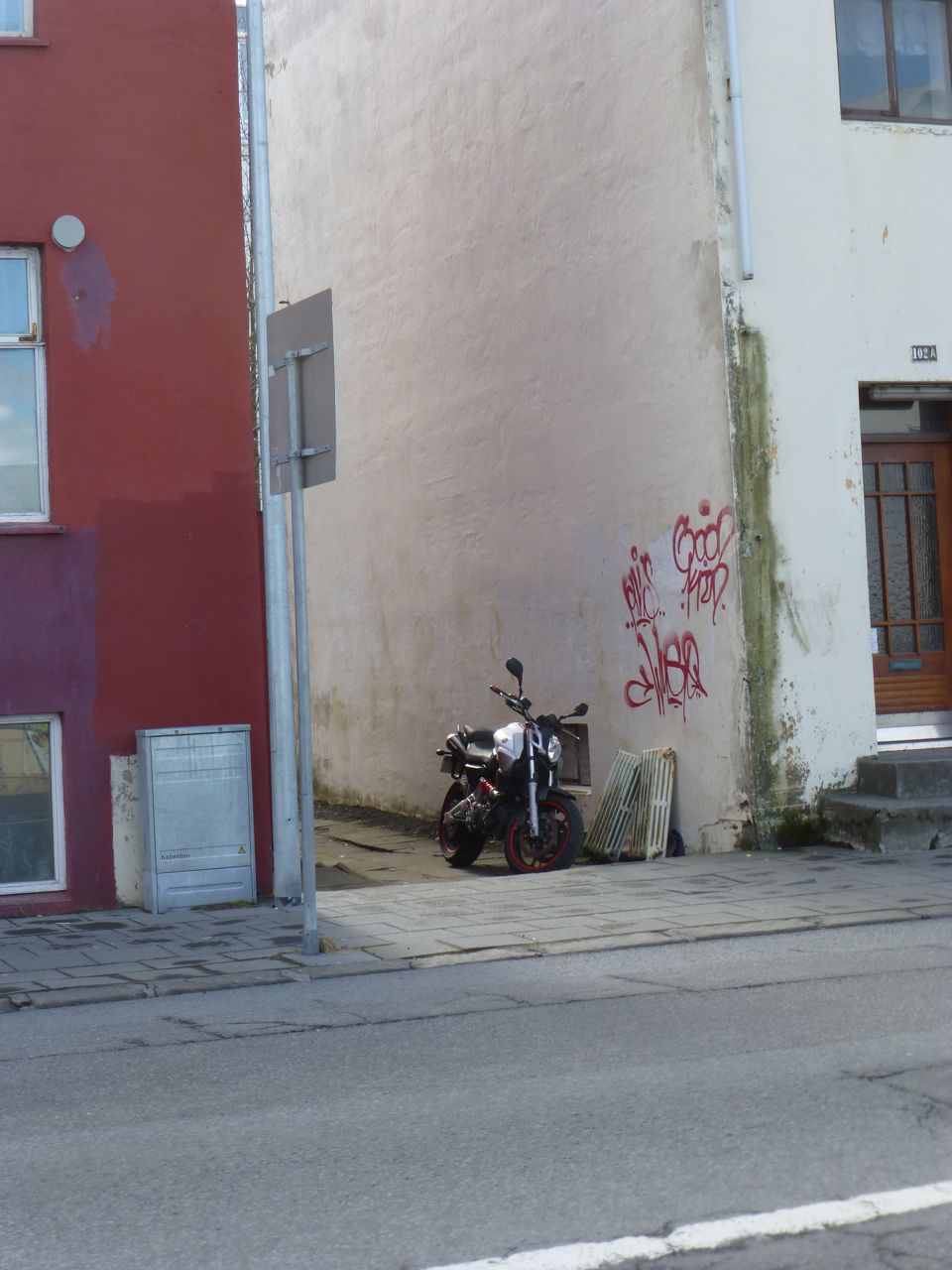
What is a world beyond books like? Well, I think you’ve guessed it: much like the one with books but completely different. Books are not going away. The Art of Haying is one, after all, but it is a different sort of book, one which escapes the barbed wire fences of textual dominance and does what the horses of Iceland do. All summer men work round the clock to put up hay for them, such as here, out the back of the Víðimyri sod church …
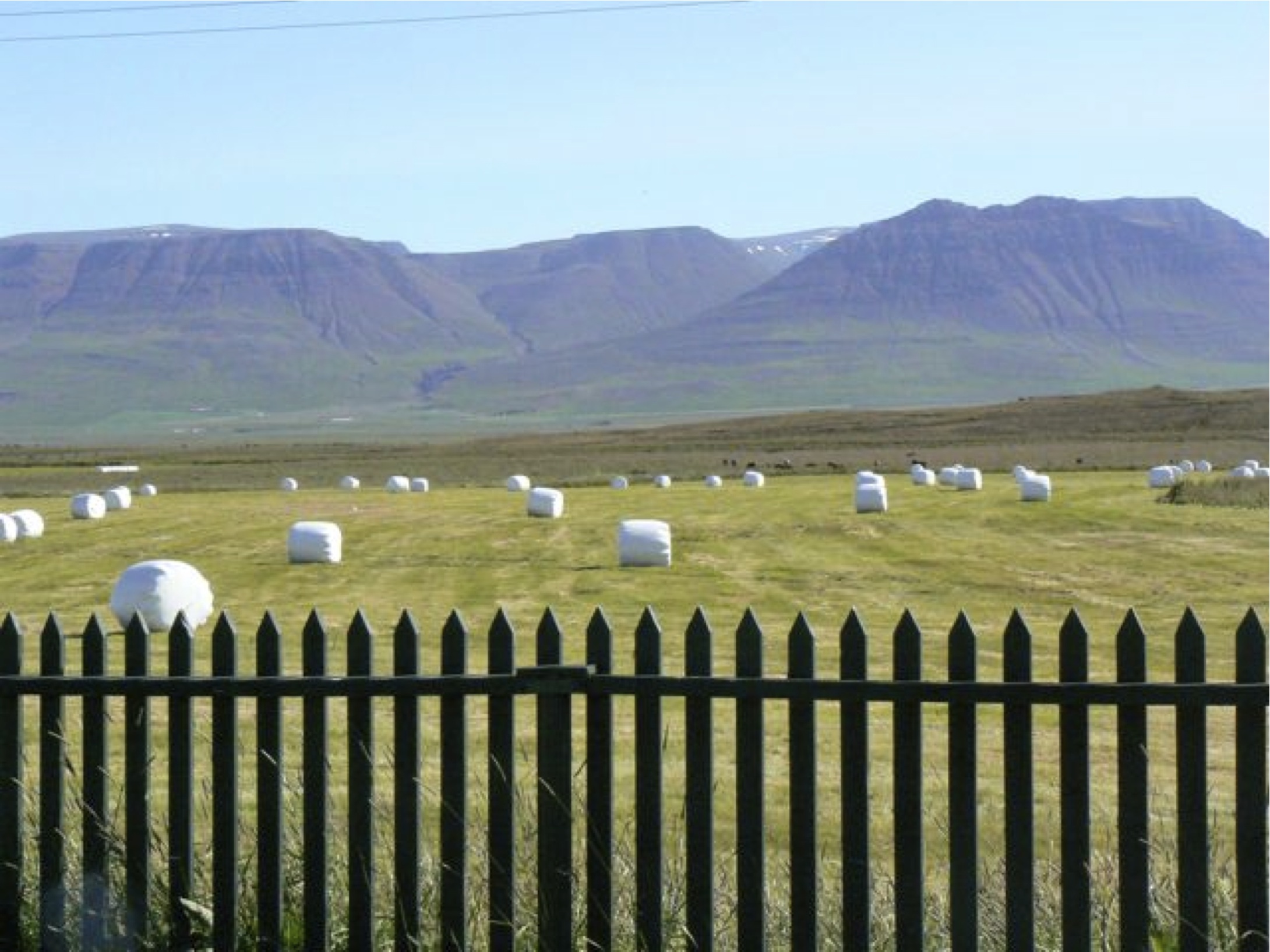
… and all winter the horses live in societies of their own, fed by men and women. This is considered by all a solid foundation for an economy. Here’s a group of Icelandic literary critics up to their own business on a spring day by Sóleyjarbotnar Farm in the Sturlufljöt, for example.

And here’s what Theresa Kishkan, the author of some of the most exquisite essays and lyrical novels in English or any other language, has to say about the dance that is this book:
There are prose works married to image that redefine the way we think of language and its visual correlatives. Bento’s Sketchbook, by John Berger; Kathleen Jamie’s Frissures, with Brigid Collins — windows thrown open to unexpected places. The Art of Haying is one of these books. Its windows look out to Iceland, its farms, its trolls and horses, and the curve of its hayfields created out of craters and rain. Read it for its weather and its lyrical attentions. “Words, words, words, words, words. You may, if you want, listen. You may, if you wish, hear yourself think. You may, if you go out into the dark, hear the crackle of the Aurora over Husavik when the sun has gone down behind the hill.” Every page is memorable, even in the dark.
Ah, yes, there are trolls here, in a place where the human imagination is not bound but is out on the land itself and is read there. Here’s one at Klausturhamrar early on Easter morning.

There’s a secret about the trolls in the book, but you’ll find that out when you read it. Here, though, I’d like to introduce you to the incident that sparked The Art of Haying. I joined my wife in Reykjavik on the second of two trips across the old Iron Curtain into the former East Germany. It was that experience, which broken down the walls that the Twentieth Century gave to me, and all of us who lived through it. When I arrived in Iceland, I was ready to see, and I did. A part of that two-way pilgrimage on the Northern Camino is in my new book of poems Two Minds, because it’s there I met Khezr, the Sufic Green Man, who graces the cover of my book.

The story of that remarkable encounter is here: http://haroldrhenisch.com/2015/10/06/khezr-the-hidden-prophet-and-my-two-minds/. So, there you have it, two journeys that become one, and two minds united, outside the walls, by attention to words and what is more than words.
One of the attractive parts of being a human is the innocence that comes along with that. I like that. In the face of the truth (Trolls keep humans because humans keep sheep and trolls like sheep.), the myth still persists that humans keep sheep because it’s a human world. That’s sweet. Another bit of this truth thing is that humans build churches on top of elves, or, in Iceland, next door, because in Iceland things are never black and white.

Black and White and Blue, too. Mývatnssveit.
Kodak went bust because they didn’t invent a film for this.
But I jest. The thing about the elves, though, and the churches, that matters. It’s not too many cultures that don’t see such a big problem with a strata title arrangement. Gunnar comes from that land-use plan. In a strong way, his writing is an attempt to put it down in black and white print. He, of course, missed this:
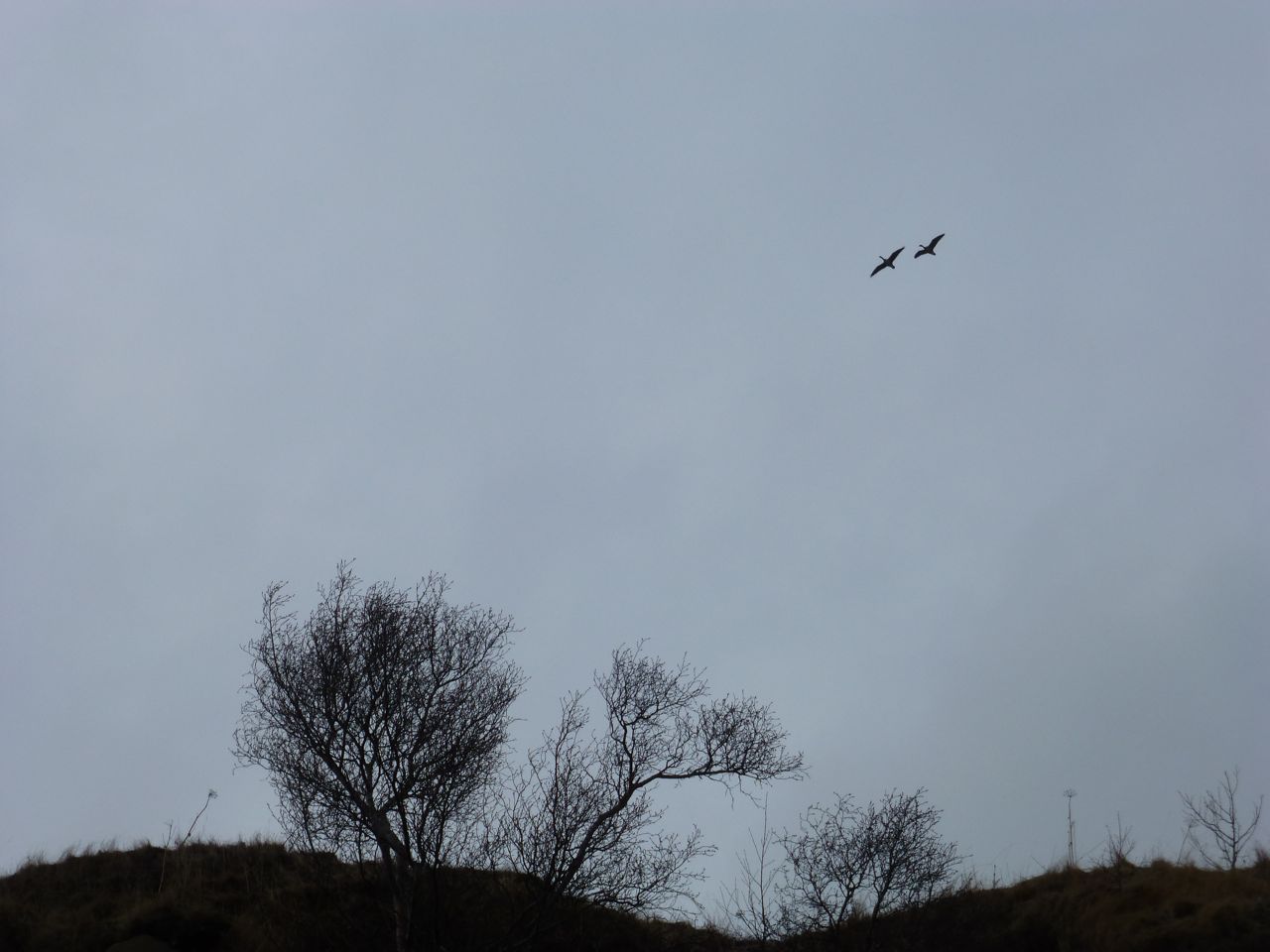
Black and Blue
Not just a blind spot for Gunnar, but for Kodak, too.
But, again, I jest. This, however, is not a jest. This is serious. If you want to understand how humans can see elves in the world science, great grand daughter of the church, is positive contains no elves and never did, there are books you can buy for that in Iceland, and they will send you here (for example)…
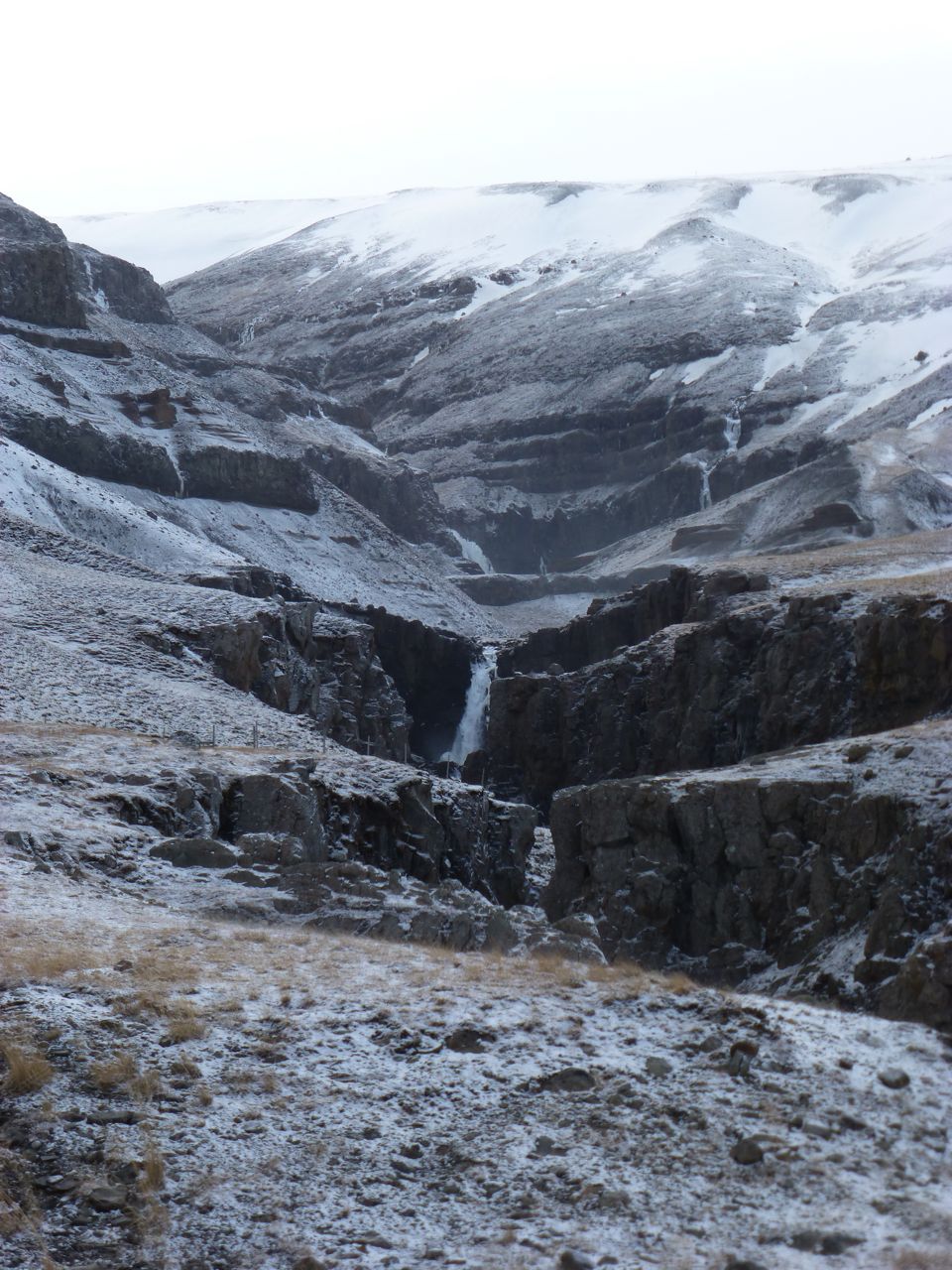
The View up to Tofúfoss and Jonsfoss from Melarett
Well, you didn’t need a guidebook for that. The thing is, the elves aren’t in the rock so much as in the human mind that is completely anchored to rock and that is an awfully hard thing to explain and shouldn’t be explained. Still, one can talk around the idea, because one consequence of it is that these elves are liable to show up anywhere, and, because people used to be really anchored to the rock, most likely around churches …

Skriðuklaustur on the Day the Geese Chose to Come and Stay
… and pretty much twenty-four hours a day, everything that goes on between those churches and those rocks is under constant surveillance. These are the people who know the truth of the matter…
 … but we’re not listening. So, that leaves a bit of time and wondering. Where are the elves? And, while we’re at it, the trolls? Well, here are some of the elves …
 Elves, Underneath the Monastery Viewing Deck
A nice new roof!
Lots of them …

A Whole City of Elves
So, if you were going to build a monastery in the East of Iceland, and it had to be near here, where the trails to the north, south, east and west crossed, then beside the elves would probably be a good idea. Now, I’m not going to get into what I think has been done to these rocks or what their secrets are (give me a couple days), but I’d like to point out that down below the monastery, there are worse things than elves.
 Things like trolls, and …
 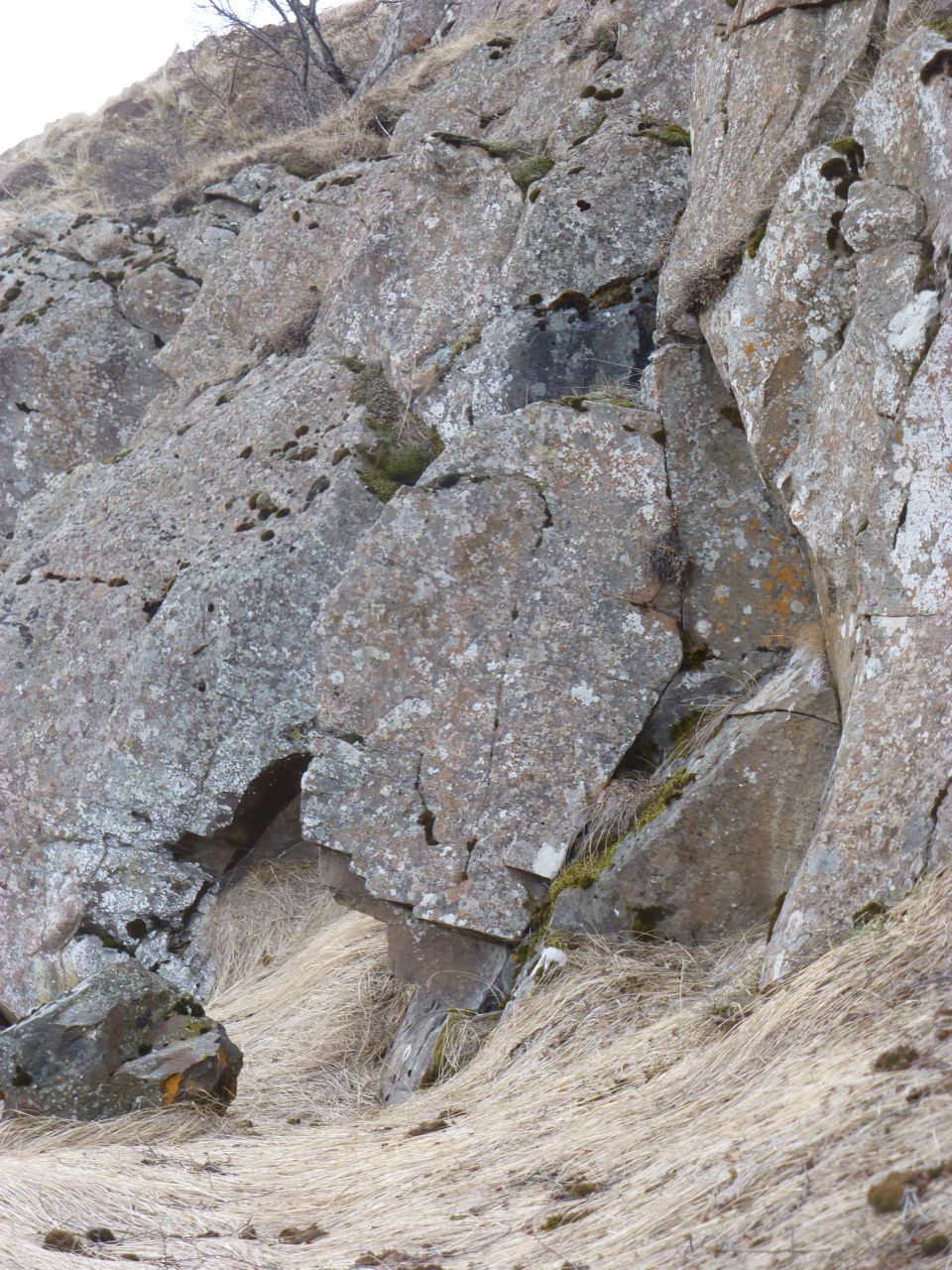 … elves under a troll enchantment. Now, to be clear: these are not Tolkein-style elves and trolls. These are some form of the human subconscious, seen through the things of the world. In this picture of psychology, however, trolls keep sheep …
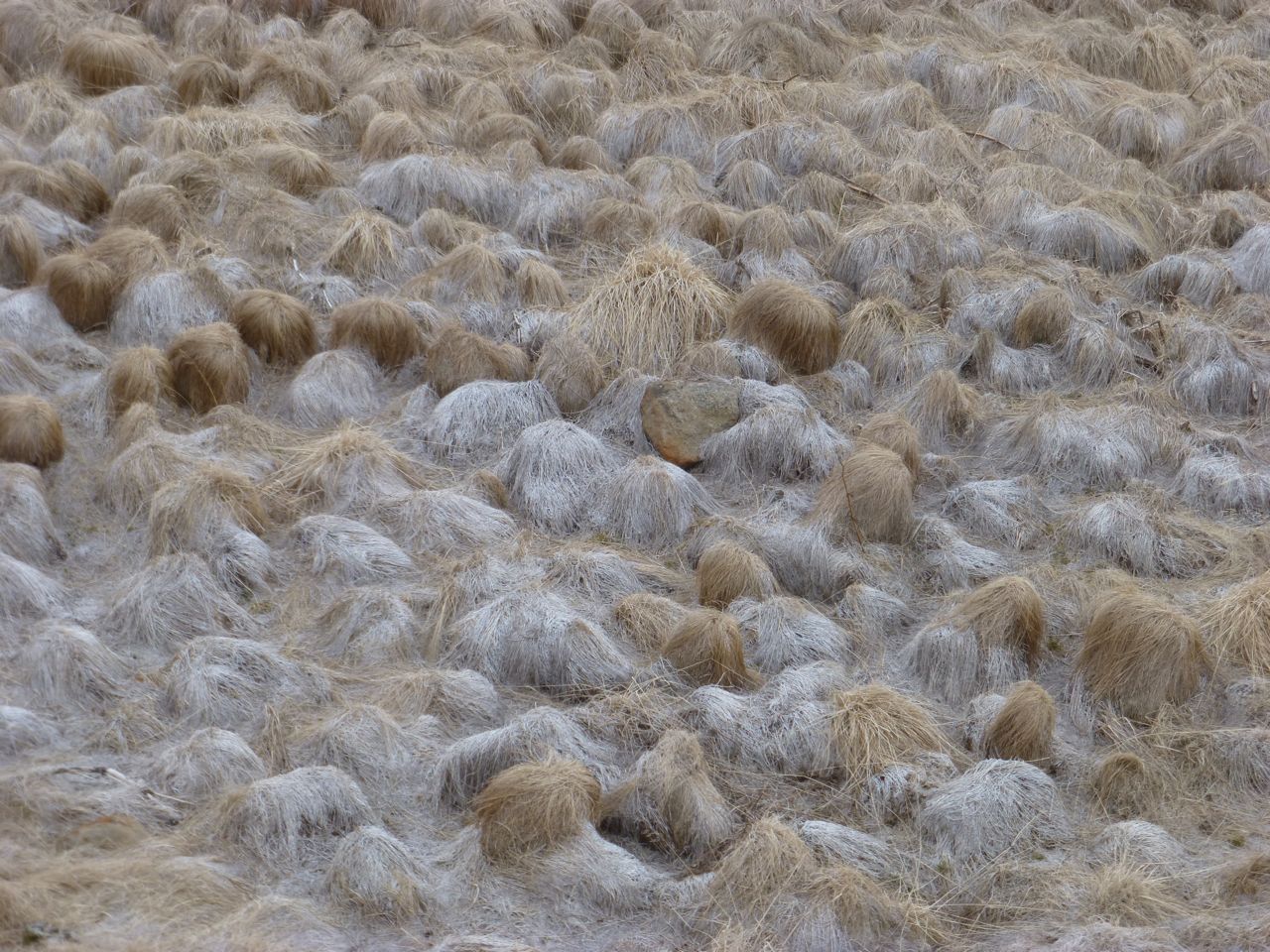
Lots of Sheep!
They are a flock that roams in a time inaccessible to human vision, but just on the edge of it. Sometimes that edge seems very close …

Pride of the Flock
At any rate, they are beautiful sheep …
 … with a faithful shepherd …

… that just happens to actually be …
 … more elves. How can you take a photograph of such a story? Cameras are tools of a scientific world, and record it well, but they’re no good at the tenuous world of perceptions, mixed with emotions and a sense of place that come to people when the land and themselves meet in a physical place that is really a kind of fire. So… time to bring out the wool again, and see where it leads.
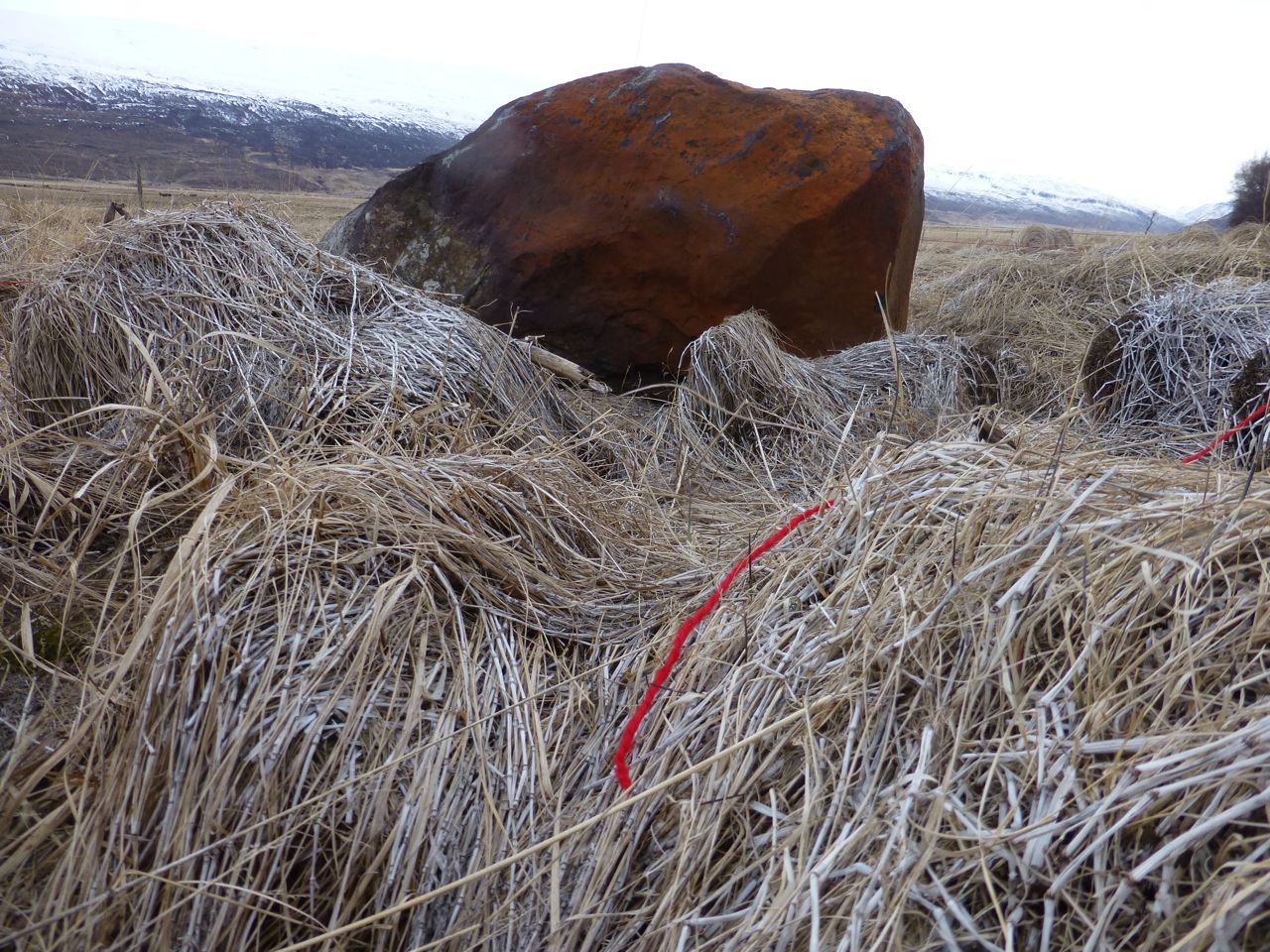
I started in the flock, in the grass, with the idea of winding between the sheep and around the shepherd in a ring, but the wind kept me from that. Sometimes, my wool (and among the sheep, and worn from three times on and off the spindle of the world, it really was feeling like tiny lines of sheep wool now, wound and bound together as the birds were when they flew upriver and over me some 15 kilometres up the valley just a couple days ago) did go among the sheep, making a trail …
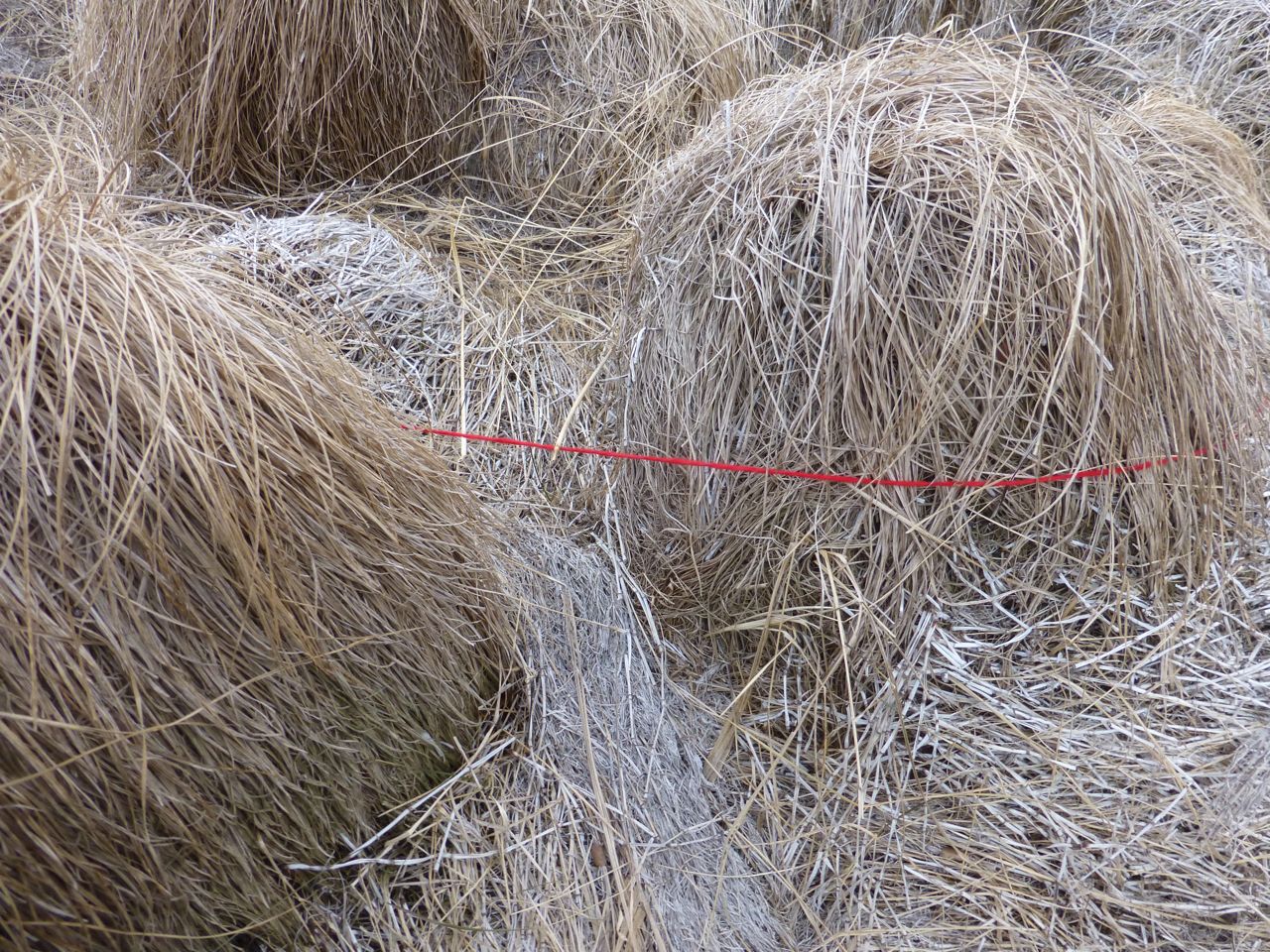
… and wandered and wove between them in the same way that sheep wander and weave the hills…
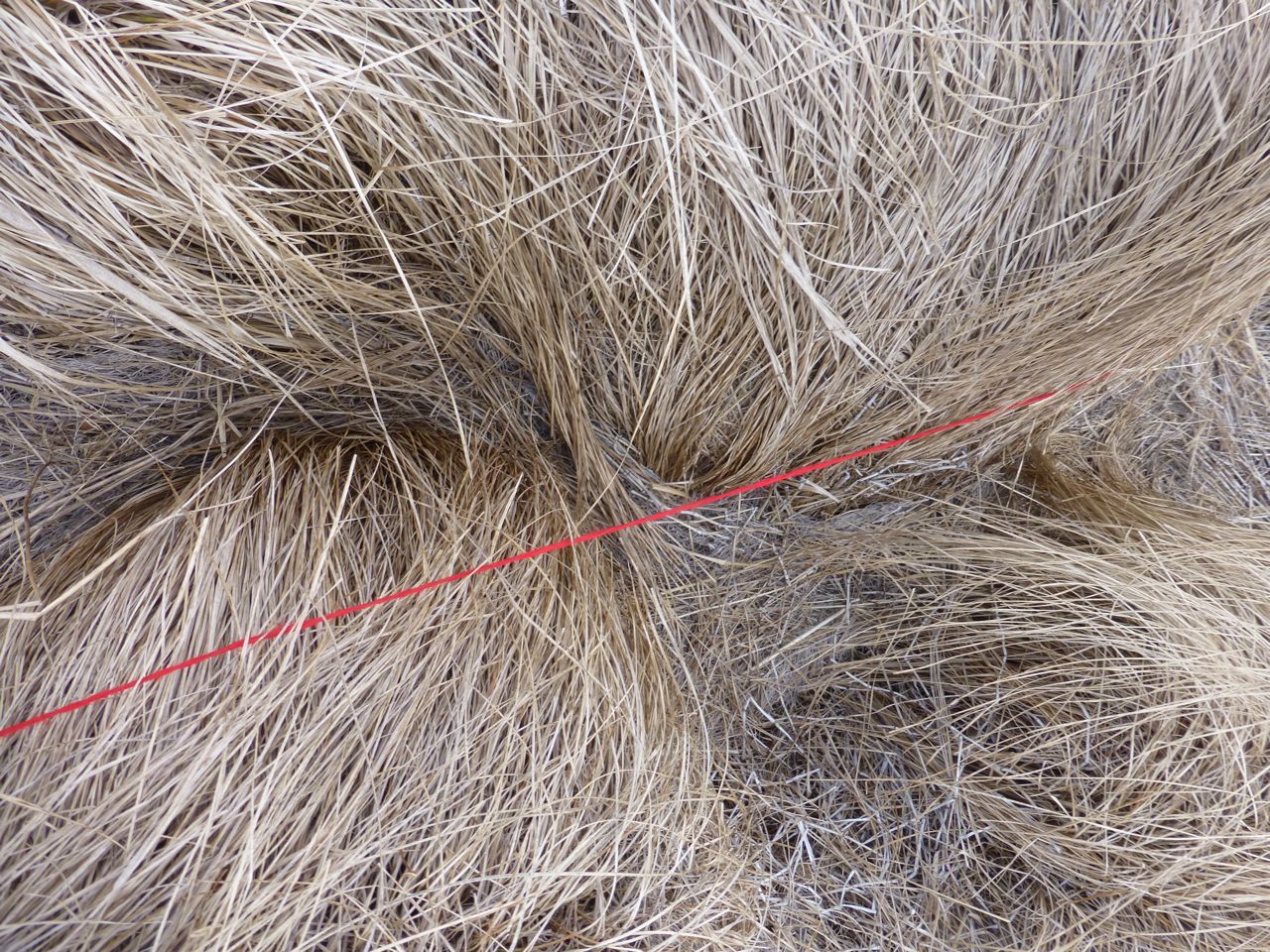
…but more often it seemed to want to hurry along over their backs …

Looking back after all my careful stepping between the sheep, I was amazed to see this pure straight line, and so I followed it as I unwound it off the spindle of the world, followed the thousands of hairs wound into its strands, reading them off with my fingers, playing them out, in a kind of tension between me and the wool and the grass and the wind, and when I felt the spindle was thinning, and knew the wool was leading me somewhere, I thought, no, this is not a story of giving it the trolls, and giving it to the elves, where would that lead? More immobility. They were, after all, in thrall. I thought, again, of the birch trees, and headed for a couple five year old saplings on the hill. Before I got there, though, I was stopped by a raven …
 … who took my wool and all its weaving into his beak. As you can see, he stands on the shoulders of a family of elves. So, I was amazed … my story that had started in the grass, and I thought would lead to a prayer for light, led to something quite different. It lead to Raven, my old friend, Odin’s memory and thought, carrying the fire away, and flying. Not only that, when I went back with my birch twig and wound my wool back on the spindle of the world, through the grass and the flock …

… under the eyes of the trolls (I felt like I was walking between worlds and needed to exercise some care, but I had my line of blood) …

No, Not One of Tolkein’s Trolls
This is the mind in it’s own earthen eye. Or a part of it.
… and under the eye of the horses, who see everything, and never go in, and walk along a different line of blood (or maybe the same one) …

… and sometimes spook, for what I now feel is good reason …
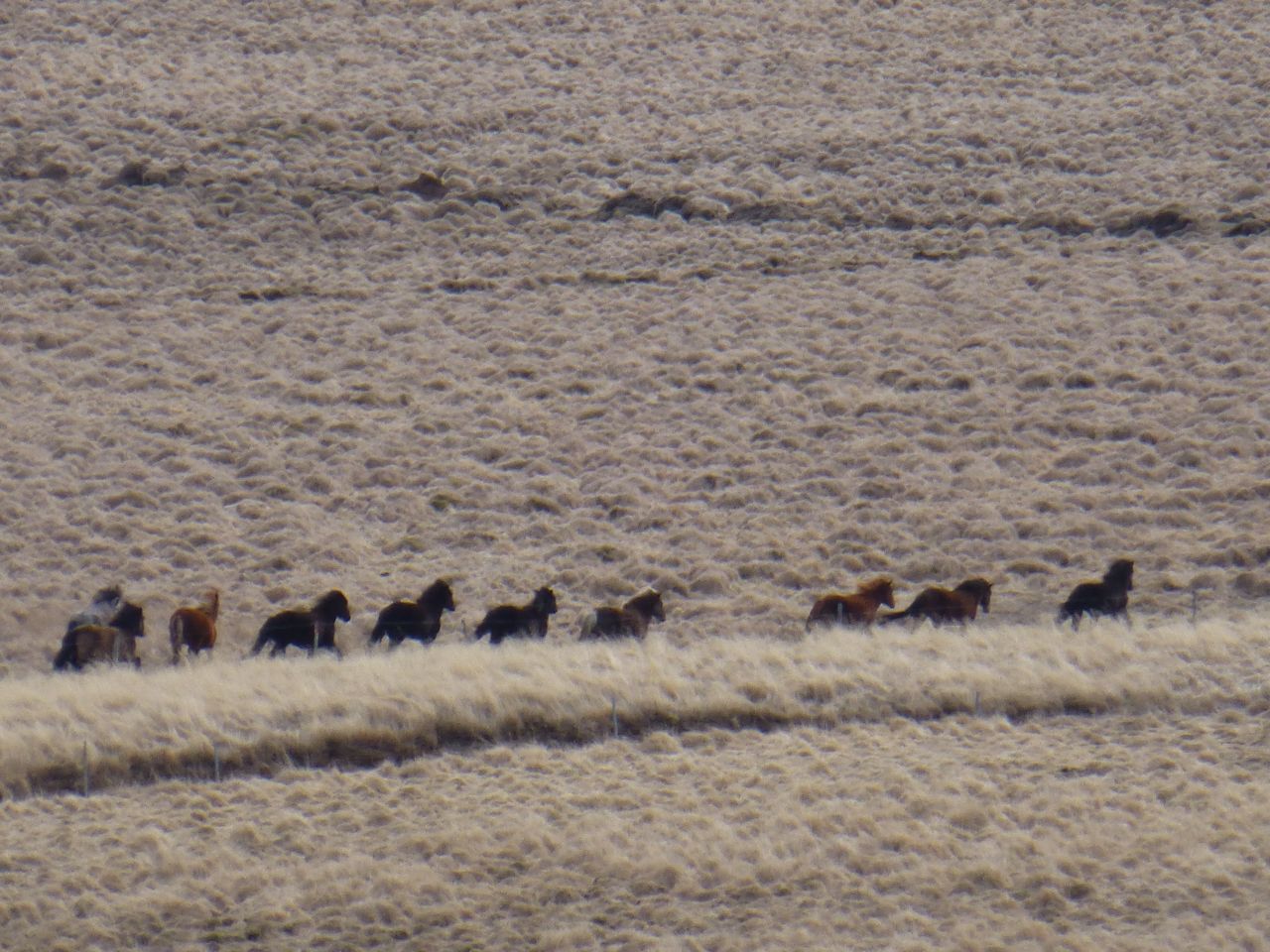
… wound my way slowly around the years of my spindle up to the rocks …
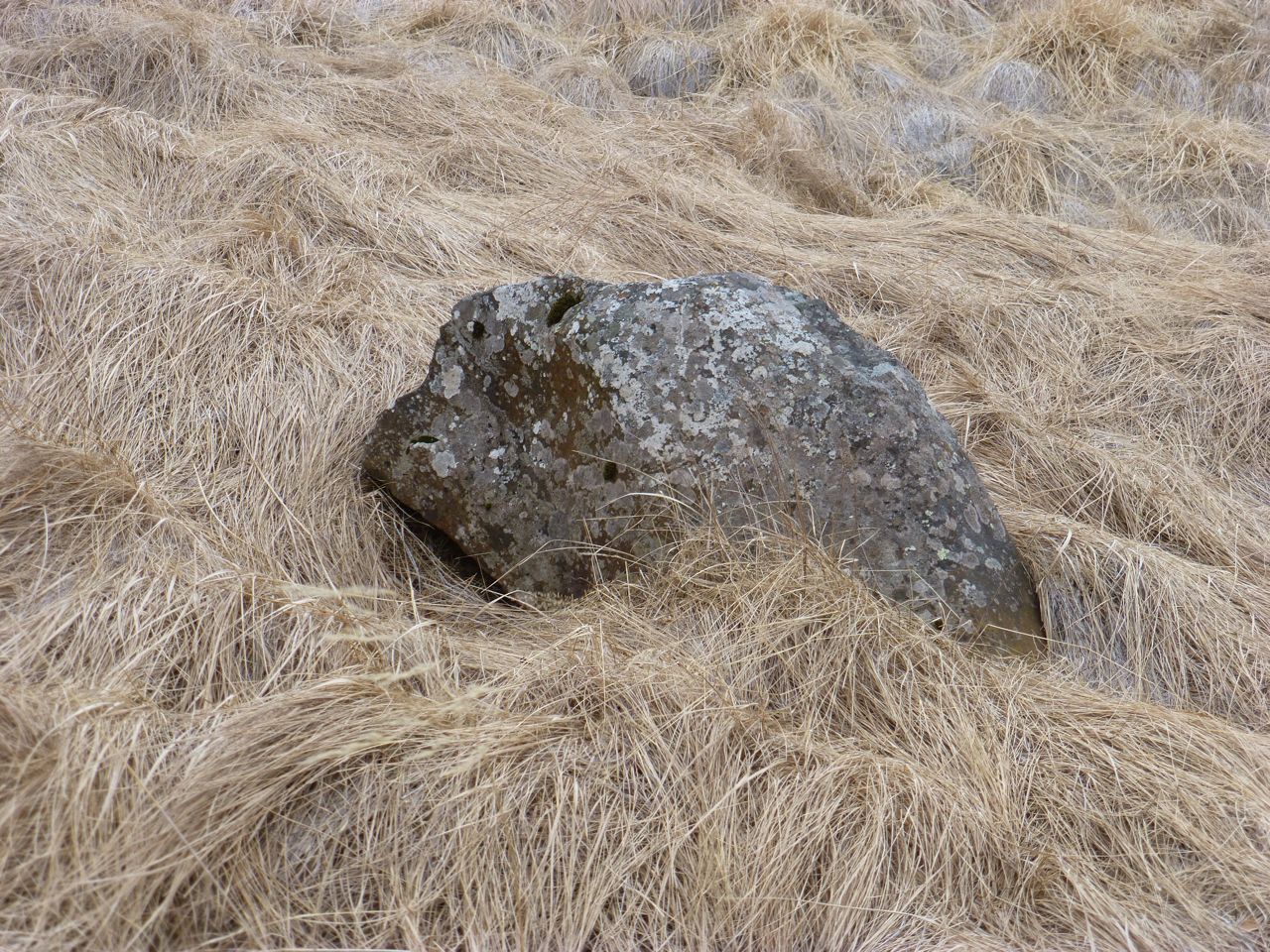 Killing Fields or What
… carefully …
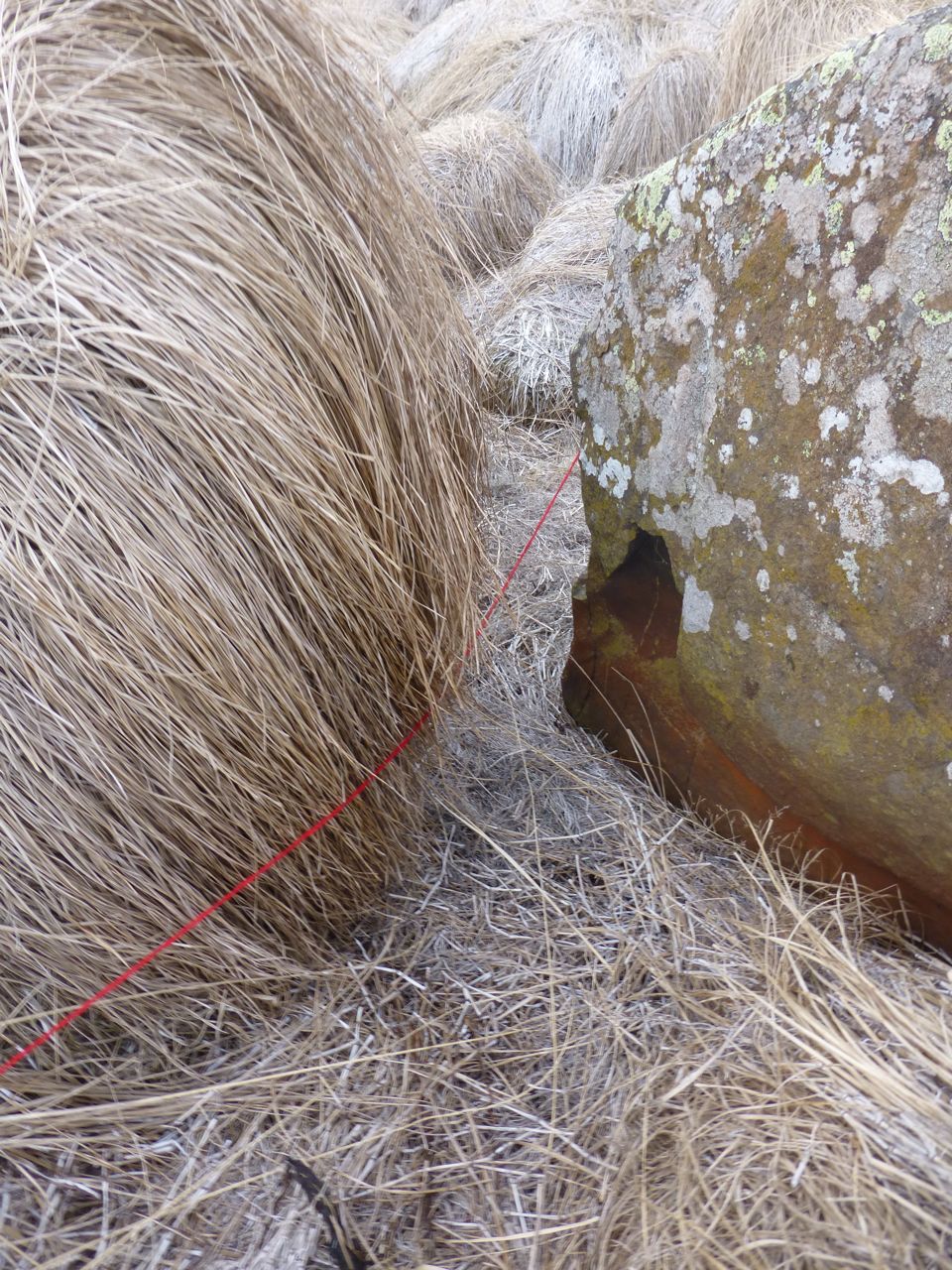
… and began to feel the line tug at me, as if I were a fish and the raven was reeling me in …

… and our fate was blowing in the wind, bound together by a living thread of will and fire …

… and yet free …
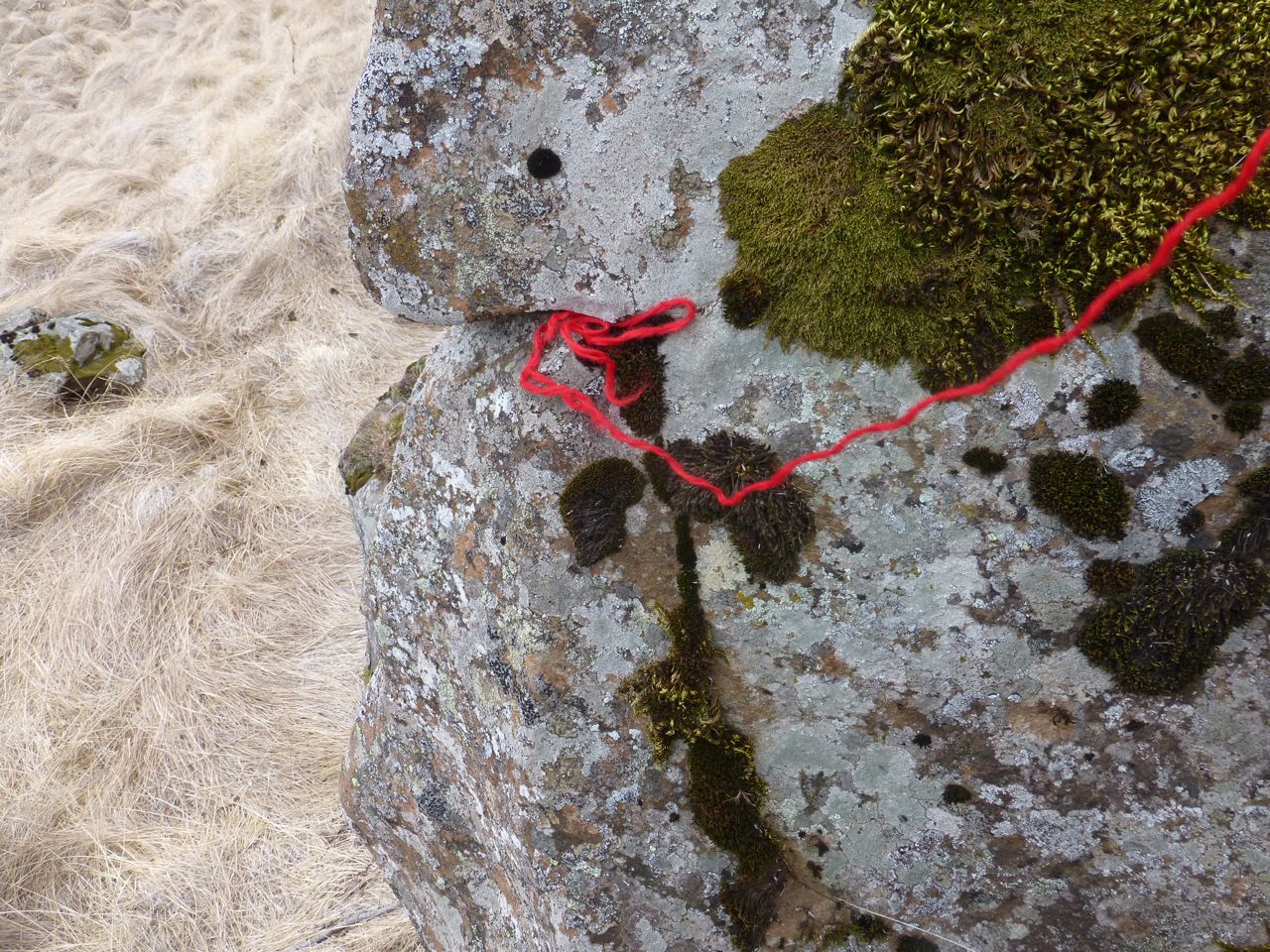 All the years were blowing in the wind. It wasn’t going anywhere. Like the birds in their flock, like the sheep in their meadow, like the elves in their stone, like the men in their church, like their prayers and the touch of their fingers to the natural crosses in the rock that wrote, I think, over time their story and now, it’s plain, writes them still…

… I enjoyed this moment of energy, and didn’t want to let it go, but all this must be set loose into their life, and so just as I went to pull my wool from the stone raven’s mouth, it broke…
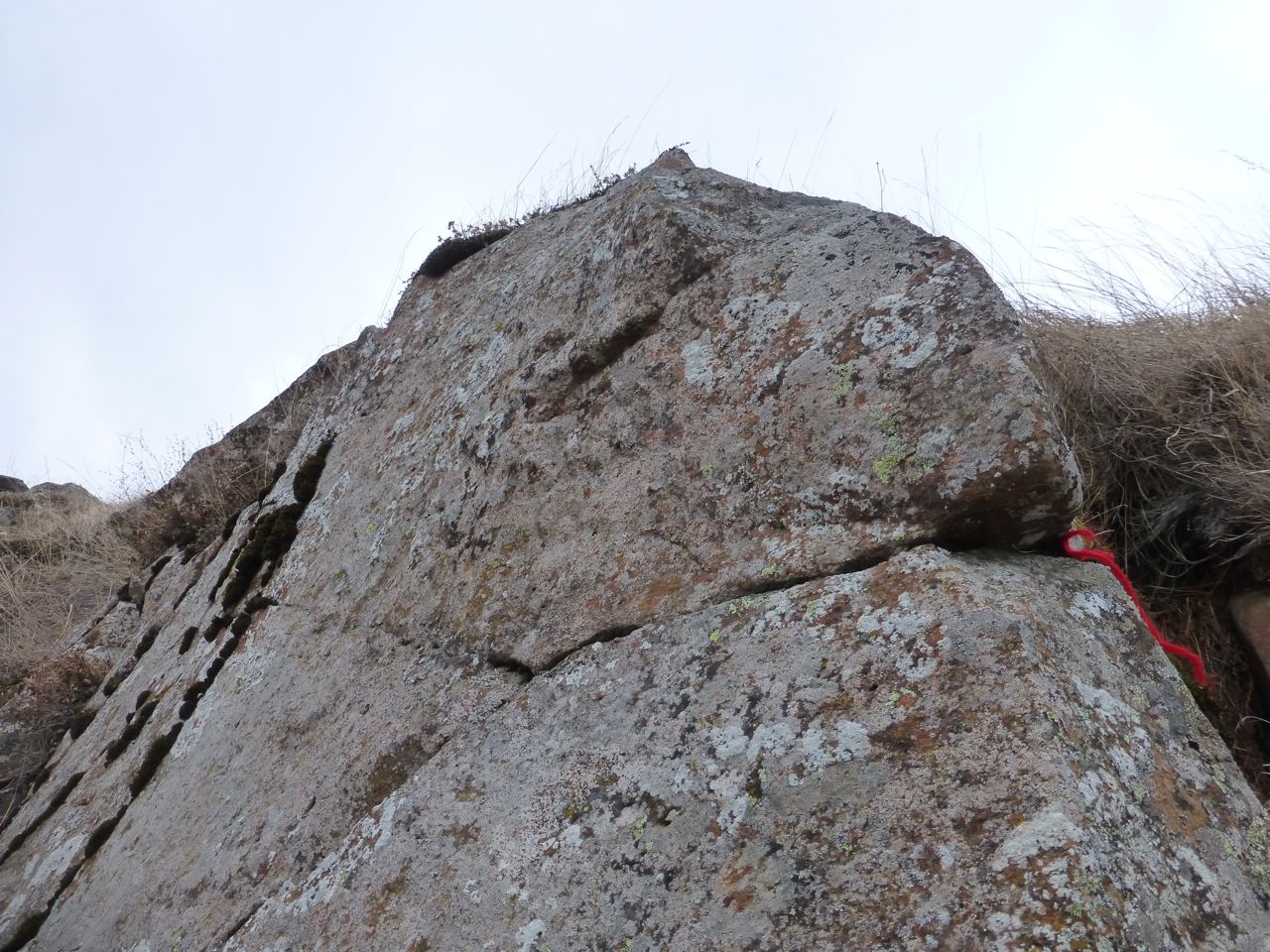 … and he flew off with the end of it …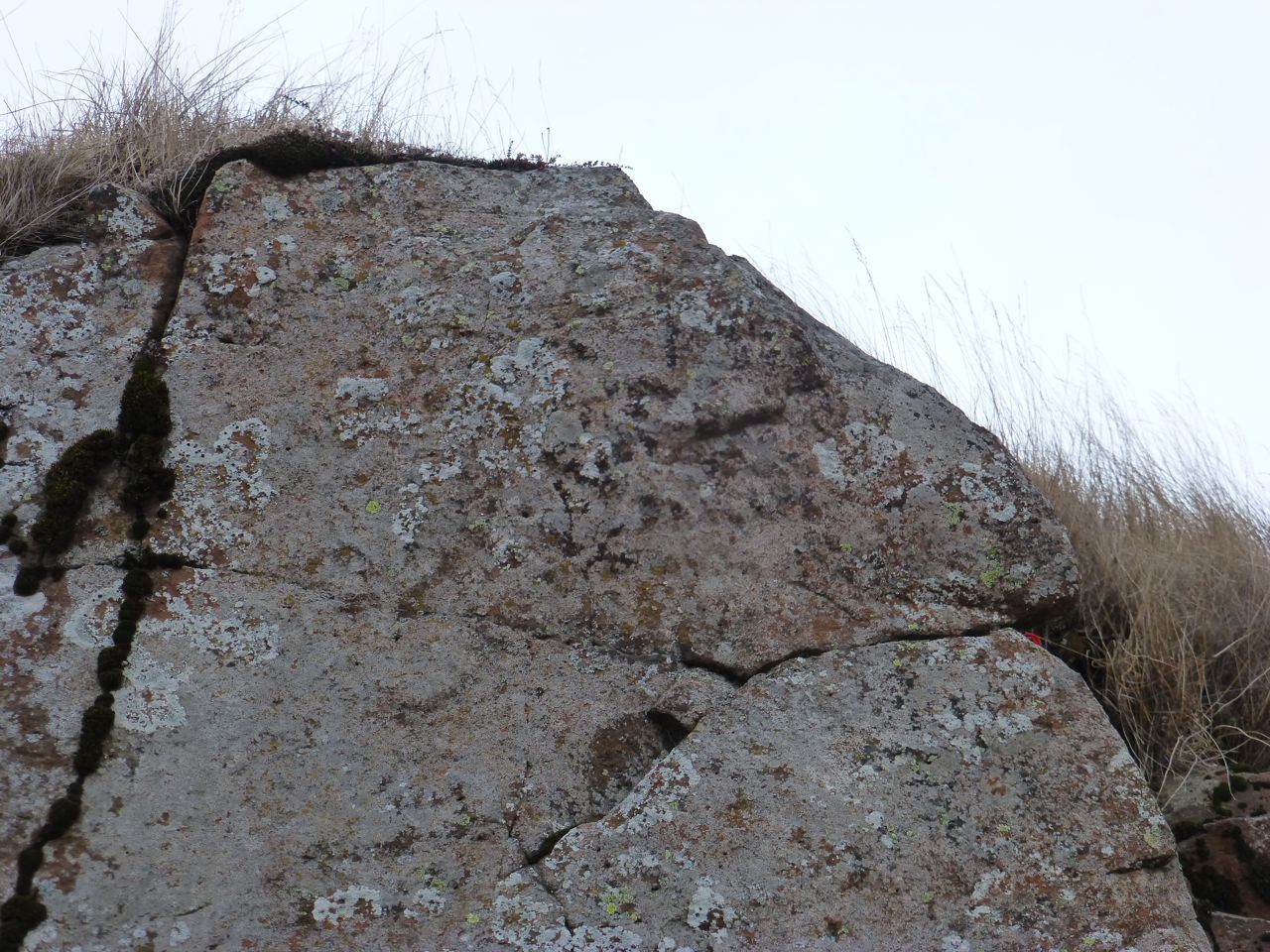
… or maybe its beginning. For four weeks now here, ravens have been following me and calling whenever they passed overhead, and I have called back in greeting, everytime. Here’s one, dealing a bit with the wind …

Sure, it’s all poetry. Yeah, it is. Tomorrow morning, I leave the Klaustur, and go to Reykjavik, where there are far more humans than ravens and poems. This afternoon, I’m going out for a word with the horses, but in my heart, well, let’s just say this, if you come here and leave the viewing platform, and walk for a month through the cloister and down through the birches and over the hill, and a horse comes out to share a word with you …

… it might be me. At any rate, enough sadness at leaving and enough joy at having been found, and think of this. When you go to those horses, and find they’ve come to you before you’ve arrived, remember, in your coming, you spoke, they heard, and in their coming, they answered.

There, a little poetry for you. I’ll be summing up in the next few days. Next, I want to show you how the sun and time and a human walking make a story out of stone. No, not one of Tolkein’s stories. Sorry. Those are written by reading books. Beautiful stories, and great for telling around a fire. Here I’ve found ones that I can walk through, and never stop walking. A fancy? There might be some fun in the telling, yes, but a fancy? No. I’ve stepped right out of the world, and into it. A riddle, that’s what, but a beautiful one. And windy.
Well, not trolls exactly. And not exactly a house. It’s a bit of a riddle, but poets love riddles. Why, you could even say that on the northern shores of the world, poetry developed out of riddles, or that skaldic poetry did, at any rate. Here’s a famous Icelandic skald:

Egil Skallagrímsson, Skald
Ready to do battle with, what’s that, a rusty sword? More like a cleaver, I think. I have used things like that to pick cabbages. Poet farmers unite! (17th Century Manuscript from the Árni Magnússon Institute).
A scaldic poem is a ceremonial poem, given as a gift by a poet (a skald) to his patron, written in praise (or at times rousing criticism — very scalding, very scolding criticism). Scaldic poetry was worked through in intricate design and was intended as a verbal form of the intertwined patterning on a shield — a kind of protective magic. (The contemporary equivalent might be depleted uranium.) At times, skaldic poems were even recited before battle. They were part of the battle. An important part, too, that preceded the bloodiness.

The Karlevi Stone, Vickleby, Sweden
Note the vertical columns of the scaldic poem above. As Gunnar Gunnarsson pointed out in Unser Land (the speech he read from during his 1940 literary tour of Germany), they are not much different than this:

Basalt Columns, Vík í Mýrdal
A tightly-linked protective shield poem against the encroaching sea, written in the land itself. (Note: studies from Hawaii have shown that black basalt beaches like this form in hours, not centuries.)
Isn’t that cool? A poem that is the land? That is the riddle Gunnarsson was speaking from: his house is Iceland; Iceland is his house. If that sounds a little unusual, do recall: he’s a poet; he’s not really thinking in metaphor. Mostly, metaphor is for people who are not poets. It’s a useful way, for sure, of describing the work of poets, but it does do so without really accepting the poem as the reality of the world, which is the poet’s way. In the case of Gunnarsson’s house and island, that work is performed in skaldic poetry, which makes his house a shield as well — and not just a shield, but an ornament, too, like this, maybe:

Viking Broach, Sweden
Men might have wanted shields, to protect their bodies in battle, but, perhaps, just perhaps, women wanted something to hold their garments together at the shoulder, something that was as protective as a shield, something with an island in the centre and the four points of the compass around them, something that would set them at the middle of the world. In Sweden’s case, that would have been North for the Trail to the North (Nor’way), South for Denmark and the trails down the Rhine, East for Finland, and West for the Orkneys — and if you just kept going, going, going, going (whew) … aha! In the middle of the ocean… Iceland.
Once people arrived in the middle of the North Atlantic, the compass shifted. Iceland was now at the centre of the world. The other points of the compass were adjusted accordingly, to reference it. Since all directions led to water, however, Iceland became the entire earth, floating in the universe (which was a big, cold sea). The country is still roughly divided into these quadrants.

Iceland, the Compass Version
The shield and compass pattern extends beyond maps. For example, if you really wanted to get into the whole magical side of things, and weren’t squeamish about a little darkness in your life, you could play around with something like the following (You could even write it in your own blood):

Vegvisir
An Icelandic magical stave. Staves come in many shapes and were drawn for many different purposes.This one is a compass written in magical symbols, and was used to find one’s way in bad weather.
For such a stave to work (if it did), such navigation would not be done by the physical properties of the land, but by spiritual ones — and we’re not talking Christian-spiritual. In the high days of the Christian Church in Iceland, the possession of such staves could have had you condemned as a witch and beheaded at Þingvellir. That might have been awfully un-Christian, too, but, still, even today, this kind of magic is not advisable. When the Germans tried this kind of thing in the 1930s, for one thing, they invented the 1940s, which turned out to be a really bad idea.

Dresden, February 1944
Among the 20,000 people killed in the Allied bombing of Dresden and the millions of German refugees who streamed through it shortly afterwards on their way south and west from the Baltic, were untold numbers of readers of Gunnar Gunnarsson’s books about Iceland.
The pattern of land-as-compass-as-shield continues further, into practical applications of gentler spiritual principles. This time, they are placed in the interests of nationalism, where it’s not black magicians in the West Fjords or Ancient Viking ancestors or ultra-Nationalist Germans trained in the killing fields of The Chemins des Dames who are leading the way to a nation, but young women, quietly fitting their minds to the old patterns, to create a little beauty and order out of the blank, snow-white flaxen cloth woven out of the country’s fields. Think of these as self portraits…
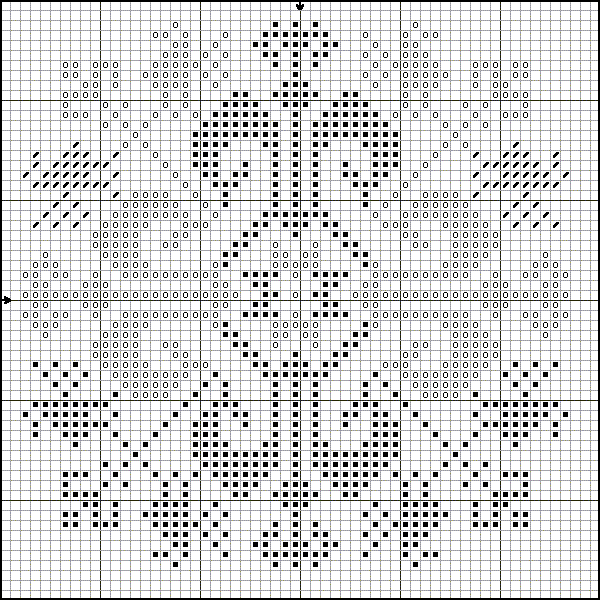
Icelandic Needlepoint Pattern
Flowers, yes, but also a hand-held mirror lifted from a dressing table, as well as the old compass, the old shield, the old broach, and the old skaldic poetry, too. Not to mention Gunnarsson’s house. Yes, the house. Such a pretty thing. Such devotion.
If you think I’m stretching this, consider that five centuries ago in the cloister below Gunnarsson’s house at Skriðuklaustur illiterate young women would have made embroidery of the flowers of the fields. It was a form of prayer, practiced between caring for the sick. Such devotion was the unique Icelandic contribution to prayerful attention and worship, in the way that the repetitive painting of icons of saints was an essential contribution to worship in Russia.

Christ Pantokrator
6th century encaustic icon from Saint Catherine’s Monastery, Mount Sinai. The power comes from about fifty coats of paint and the deliberately non-representational nature of the image. God, after all, can’t be reproduced in an image, so trying would be arrogance. Accordingly, such images aren’t representations of God. They are God’s presence, revealed when people devote themselves to old patterns.
The repetition and patterning were key. For example, just down the valley from Gunnarsson’s house at Skriðuklaustur, the old girls’ school at Hallormsstaður trained girls in Icelandic embroidery, as one part of a project to create a culture in Iceland independent from Danish influence. If the home was the heart of the country, and women were at the heart of the home, and the country was its children, then Icelandifying young women would, it seems, pay future dividends. Politification (My, aren’t I inventing words today) of national identity could follow at its own pace.

Icelandic Nationalist Embroidery, 1930s, Hallormsstaður.
The doors of the rooms in the school dormitory bear the names of trees, instead of numbers, and are set within a somewhat overgrown botanical garden. Such gardens were decorative in mainland Europe. In Iceland, they are a more practical magic.
The embroidery above is much like a map of Iceland. When you get down to ground level, after all, and experience the map that is Iceland on a human scale rather than an international or global one of contours, nation states, trade patterns, colonies, weather isobars and even corporate banking, Iceland does look like this:

Iceland at Ground Level, Neskaupstaður
The embroidery of summer!
This beautiful meadow, may I remind you, is still our shield and still our skaldic poem. It’s also Gunnarsson’s house, his novels, and the workings of his subconscious and conscious minds. Skaldic poems are full of doubling like that. We’re back to this:
His house is Iceland.
Iceland is his house.
Very skaldic, indeed. Of course, in physical terms, when this skaldic play comes to Gunnarsson’s house, the whole thing does look awfully German.

Skriðuklaustur
The German architect, the Icelandic stone, the grass roof…why, it’s an island itself. An island in itself. An island. Itself. German….German? That’s the riddle within the riddle.
The poems are our key. The first form of doubling in a skaldic poem is a kenning. Kennings are natural word forms inherent in Germanic languages (Frisian, Icelandic, Norse, English, Danish, and so on). Speakers of these languages use words like that all the time. Some English examples are: butternut, windowsill, firefly, and doublespeak. In kennings, this tendency is made artful. Each kenning is a miniature poem in itself. Take the land, for instance, such as that forming Iceland. Take a look at the series of kenning’s below. The earth is cleverly hidden with them, or perhaps cleverly revealed. The delight in recognition is part of the magic of the poem. Can you find the earth there, in its sea? (The translation [mine] is loose, to try to catch some of the music, but it’s not wildly off track, or at least not enough to hide the earth any more than it already is.)
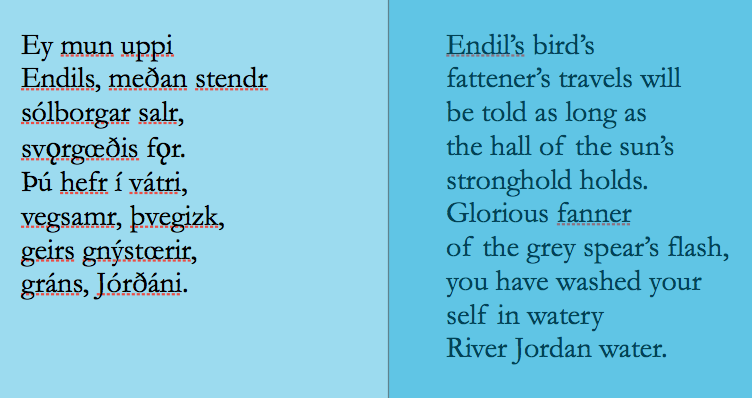
Skaldic Poem Made Out of Kennings
The earth is “The sun’s stronghold”. The others? Well, hey, it’s a riddle, right? Source.
So, that’s the first doubling: words are given multiple meanings by being joined together. In the example above, the earth is both rock and stone as well as “The sun’s stronghold” (as opposed, seemingly, to the darkness of death, underground, and the land of the salmon, or water). The other doubling comes about because the rhyme schemes of these poems were so intricate that the poem often had to be split in two columns, one representing each of its two speakers. Two speakers? Yes, that is another old Nordic style of poetry. Here’s what it looked like in its Finnish variant…

Finnish Folk Singers, Telling a Song Together
Each singer pulls the other towards himself to speak, then follows the other to listen, to pull again. It’s like rowing, or weaving.
Such poems looked like this, sometimes (the first line in each rhyming pair was given by one speaker; the second by the other… a pleasant game, for sure):

The Kalevala, Canto 27 (Opening)
Finnish is related to Pictish (and nothing else), the language of Scotland before the Vikings took the place for their own.
Here it is again, in English from the time of Gunnarsson’s youth. This time, the rhyming pairs are bound on single lines (to draw parallels with Homer, by the sounds of it):
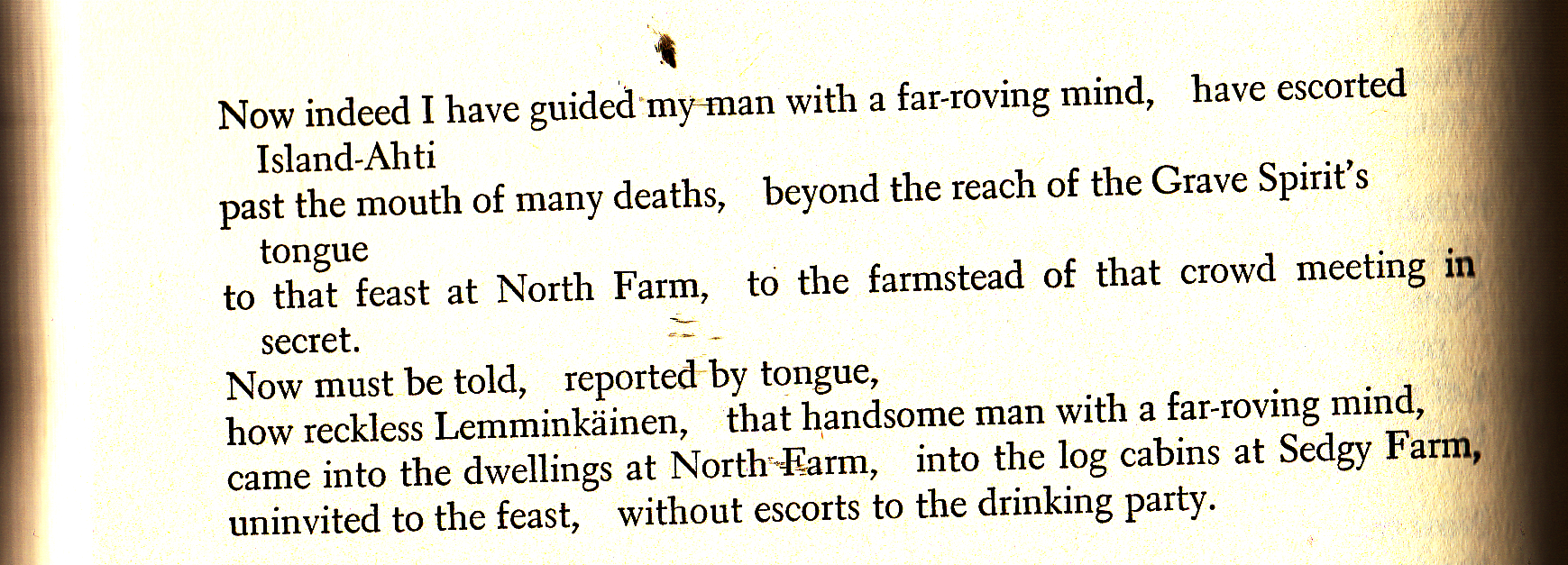 The Kalevala, Canto 27 (Opening)
Finnish folk poetry, compiled and massaged into a narrative by Elias Lönnrot. Translated by Frances Peabody Magoun, Jr. Homer was extensively read in literary circles at the time.
Two speakers. That’s the key here. But who are they? Ah, they are many things, many of which I have already hinted at here: Iceland and Germany, Gunnarsson and Denmark, Elves and the Church, earth and language, men and women, peace and war, individual and state, man and God. It looks like many things, but that’s just a linguistic convention. It’s really all part of the same conversation — if those words could be brought together into one tightly compressed thing, we would have Gunnarsson’s house. Let’s not forget that Gunnarsson was an Icelander. For a man like him, the word ‘thing’ has special significance, and looks like this:

þingvellir, the Thing Place
Iceland’s first thing, or speaking (In Icelandic, Alþingi. In Norman English parliament), took place here in the Mid-Atlantic Rift in 930. In 1000, the country chose Christianity here, for practical reasons to do with unity, self-determination and self defense.
Below the Icelandic flag above, there is a church, and a curious collection of houses…

þingvellir Church, 1850
The earliest church on this site dates from the early 11th century. The row of five houses to the right of the church represent the Icelandic state. Each time the constitution has been rebuilt from the ground up, a new house has been added to the row. The one house that is not represented here, is the one in Fljotsðalur to the North East. That’s right: Gunnarsson’s. Hey, no one said he was particularly modest. The volcano, Thor’s Shield, rises faintly in the background, from the earth’s core.
I was standing down by the church, looking up at the Alþingi site and wondering why it was placed here, of all places. Official documents point out that it was on a list of four possible sites, and was chosen because of the four it was the one situated conveniently on the country’s major trade routes (horse paths), and had sufficient pasture, water and wood (for fires) to sustain a large crowd. Makes sense. But why was it on the list in the first place? I wondered, then I got to daydreaming, as poets sometimes do, and thought about being a kid back then, attending the Thing with my family, and I looked up at the cliffs and they came into focus.
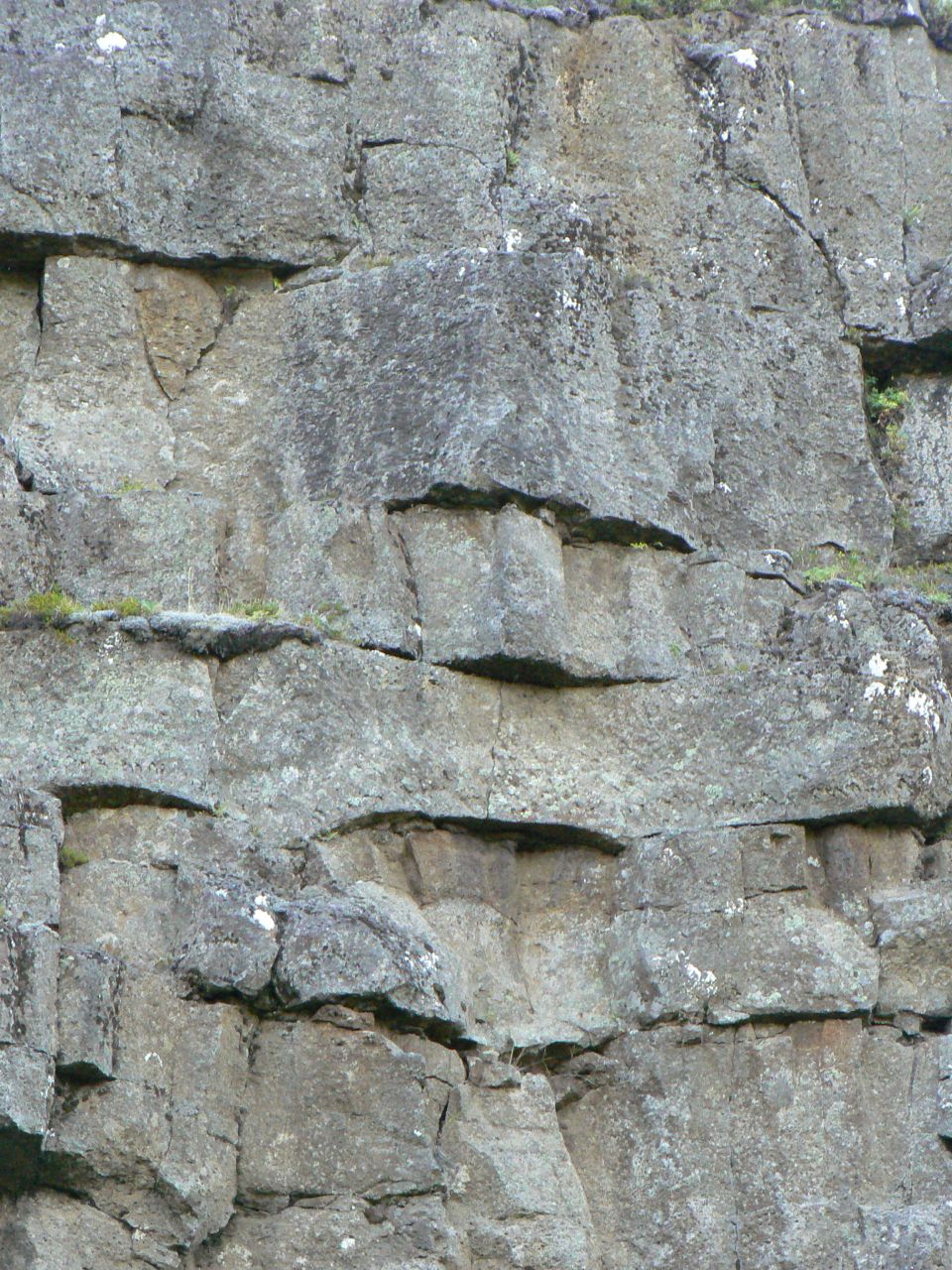
A troll!
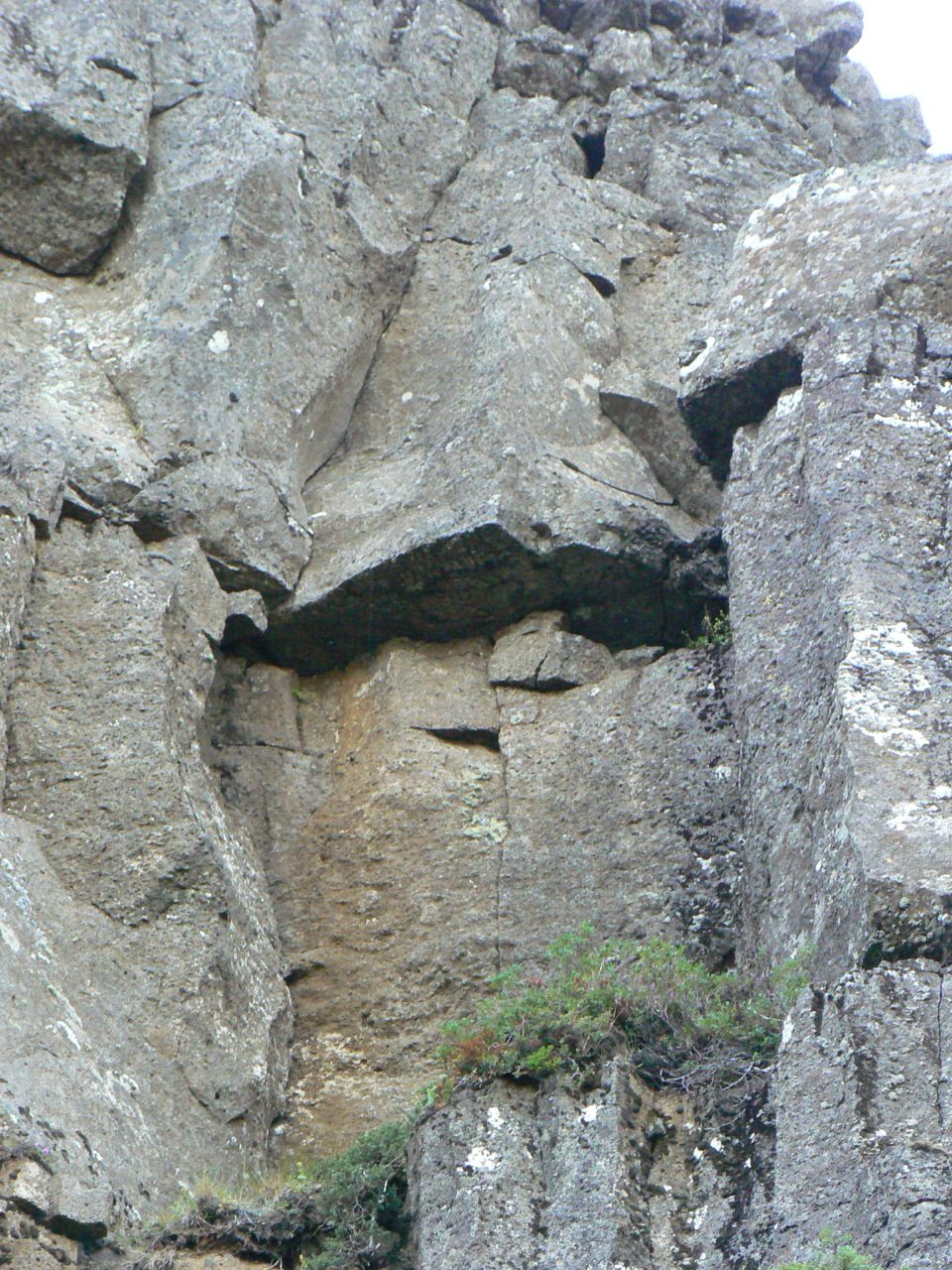 Another troll!
 Yet Another!
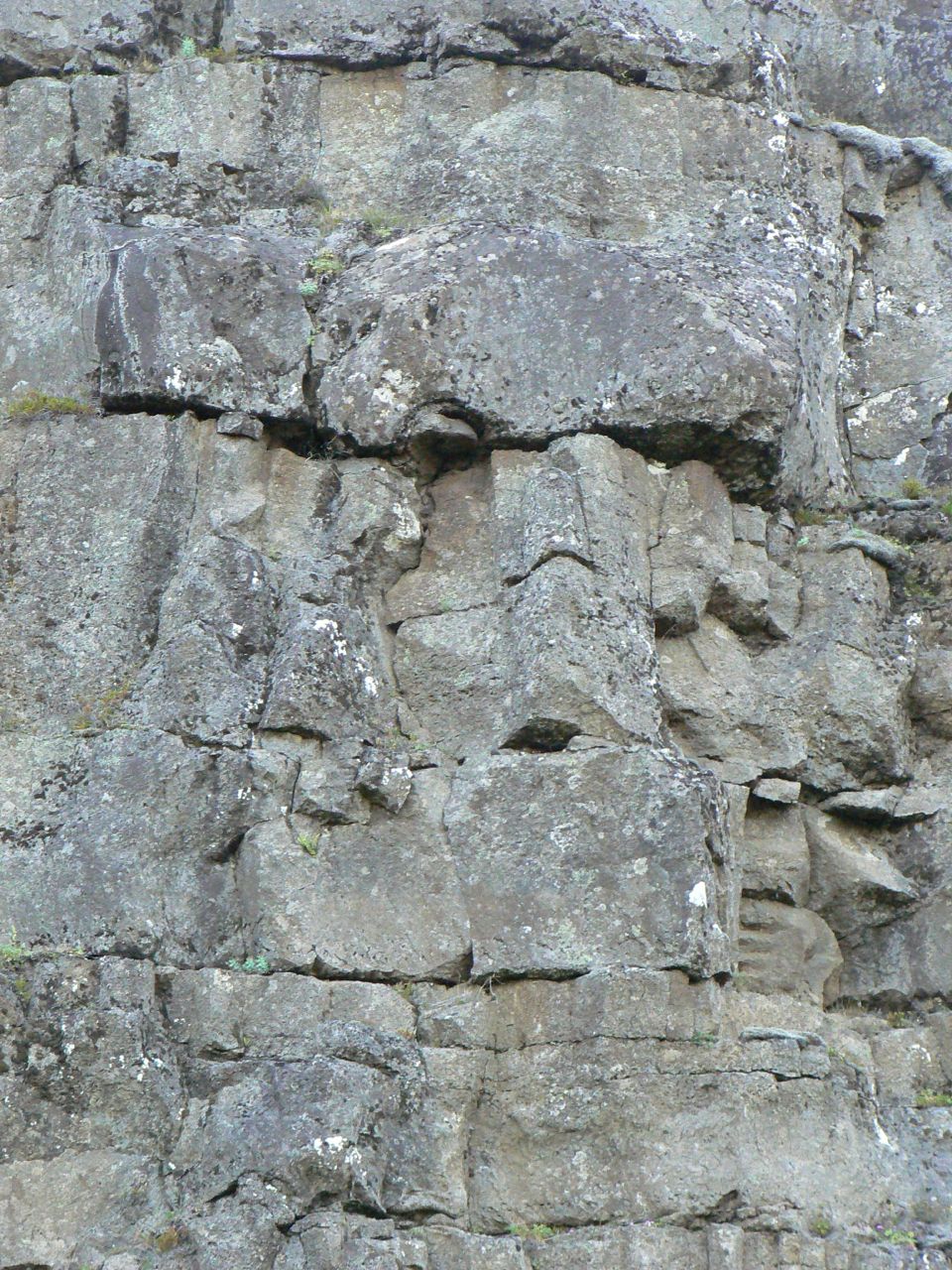
Trolls Everywhere!
And all of them are looking down over the people. You could say that the land is taking part in the discussion that is taking part in the Thing. You could say that now the past is watching the present, and looking down over the house that is Iceland, which is embedded in that past. Time and space are unique here. They are a language. Since that’s an unusual language, at least for the contemporary, novel-driven world, it’s useful to walk through its halls a bit, to see how they’re constructed and where they lead. I’ll do that in the next post. We’ll walk among elves and dwarves and trolls. They are not part of fairy tale. They are something completely different, and provide clues to the mind of Gunnar Gunnarsson in 1940. It’ll be fun. I hope you’ll come along.
 A Farm in Iceland