Colour and pattern enter the mind as one. The rest is an honouring.
 Grundarfjördur

Colour and pattern enter the mind as one. The rest is an honouring.
Grundarfjördur
In 1940 Gunnar Gunnarsson wrote that the long months of darkness were as treasured a part of Icelandic consciousness as the long months of light.
 Wise words! Look how the darkness of this un-named fall in the Whale Fjord radiates vision, stronger than the light.
Today, I praise the rowan tree. This is her season, as ice breaks to the season of water and birds.

Rowans with Elf Stone, Eyjafjörðursveit, Ísland
She’s a tree, yes, but look how she wants to lie on the ground. None of the towering heights for her.
Rowan, Skriðuklaustur, Ísland
And when the light comes, ah, then she is a torch.

Good Friday Rowan, Valpjofstaður, Ísland
The Rowan is sacred to Brigid, Saint of Holy Ireland, and to Bride (or Brigid), who came before her (and was no saint), and to Mary, Mother of Christ, and to Thor, god of lightning and thunder. The gender crossover is no big thing. Don’t give it a second’s thought. There was a time on earth when all things that signified the earth’s power most strongly were considered hermaphroditic, neither male nor female, and, after all, don’t humans, who come in several genders, tend to unite and make unions that are neither but are one?

Male and Female Fruit From a Hermaphroditic Pacific Mountain Ash
Wells, British Columbia
Unlike those sly sumacs and gingkos, a rowan has neither male nor female trees.She knows where she is. Look at her, earth tree, reaching up for the spring moon, with her feet planted firmly on the ground.

Skjaldarvik, Ísland
Wherever a rowan is found, it signifies the presence of her deities, who might have many names but are also one.

Thor, Brigid, Bride
For all of you who are of an empirical bent, don’t worry. Gods are just names for powers of the earth. The powers are present, even without the names, although perhaps not yet empirically defined. It’s just a kind of short hand. For those of you who follow the stories of the gods and goddesses, you know what I don’t have to say.

Rowan in the Birthplace of the Gods, Ásbyrgi, Ísland
Much of (nearly treeless) Iceland was one treed like this: a few rowans, and a lot of willows and birches. Then people got cold.
There’s more to the story of the rowan than is written down in history books, but not more than meets the eye. A lot of it has to do with environmental sustainability. A lot of it has to do with her name: in English, rowan, for red; in German, Eberasche, or red ash, or, more precisely, “red spear”. More on the spears in a sec. First, here she is, surprising us and all.

Pacific Mountain Ash, Quesnel Forks, British Columbia
Mountain Ash, Rowan, Eberesche, Bird Berry, Thrush Berry, Sorbier, well, you get the idea: a rose all dressed up.
She is glorious in summer, but look at her in her winter time, just last week…

Rowan has a profound story. Don’t look for it on Google, though. This is one you have to learn from the birds.

Yes, Today the Cedar Waxwings Have Come Back Home to the Rowans! Yay!
The story of rowans is a story of sacrifice, androgyny, magic, Christianity, nationalism, survival, life and hope — always hope. It is also one of the oldest stories of all. It begins with a Himalayan god of the air, Thor. He’s known today as a Nordic god, from Iceland, Sweden, Norway, Denmark and Germany at the north of the world, but he started out far to the east and south, and migrated with his believers across the continent. Thor has a hammer, that’s sometimes an axe, and, as you can see below, blood spatter, a phallic spear, and a weird right hand, and, yes, he’s been repainted with good old-fashioned wheelbarrow paint. 
Thor at Lilla Flyhov, Sweden (c. 1000 – 1500 BC) Source
That blood spatter? Well, look:

Rowan Berries in the Snow
They don’t call these bird berries for nothing!
That weird right hand? Here:

Rowan Berry Cluster After the Feast
And that axe? Well, Thor, remember, is a thunder god, from a time when thunder and lightning were the same thing. This is where he lives:

Dragon Tales in the Sky
People used to be able to read this language. It was a kind of writing not in words.
Thor used the axe to split that sky apart, so that out of its unity came lightning (on the one hand) and thunder (on the other). That is the moment in which consciousness is born. Into this air, that is all one (and out of which thunder and lightning come)…

… a spear …

Rowans Were Traditionally Used to Make Spear Shafts
… is thrust. It’s a curious kind of spear…

You wouldn’t want to thrust something like that at a wild boar or something. I mean, how pointless (literally). Sure, if you’re thinking of weapons being physical things, with pointy sharp bits, ya, but weapons are also extensions of the mind, and for Thor, and people who believe in him, this is mind, given body in the world…

You might want to have that magic and balance on your side when you go out to stick a wild pig that’s intent on sticking you (especially if you have the other kind of spear from the other, straighter, kind of ash (spear) tree. The darned things grow in thickets, ready made. You just need an axe to cut one from the ground and you have a weapon that extends your range and does your will at a safe distance from your body. A rowan spear, though? It’s both the thrust and the moment of reception, which is to say that it is a kind of symbolism or visioning, which practitioners call magic. Look how the boar’s blood and the spear are both present at once, and how the weight of the blood lowers the spear.

The tree is the embodiment of action. The mountain ash doesn’t make a great spear, but it certainly is a great way of focussing mind and body on the act of spearing.

There is, however, another angle to this story (as there always is in the world of indigenous thought and the language that speaks it best, poetry.) The red blood is the blood of a victim, the blood of a virgin, menstrual blood, and both life and death in one. Thor of Lilla Flyhov said it perhaps as simply as it needs to be said: the spear and a phallus are one. It thrusts upward, pierces the belly of the sky, and rains blood
Wells, British Columbia
Sacrifice and birth, male and female, action and reaction, in one representation: this is Thor’s presence, the concept of creating action out of stillness and seeing in stillness the potential for action. It is consciousness, for sure, but it’s also the body. Look again at that weird right hand. 
It’s a placenta. The tree has many of them. It bursts out into them all over.
  The rowan is drenched in the blood of life and death. It is Bride and Groom, or Thor, in one. He cleaves unity to bring it together in a different form. This is the ladder one climbs to the stars.
 I hope those of you reading this post for science aren’t scratching your heads at all this poetry and wondering when the science is coming. It’s coming. It’s just that this poetry thing, well, that was science once. I don’t mean bad science, full of childish explanations of the root of physical processes, the ones that science has done such an amazing job of parsing, or cutting part, after Thor. I mean, poetry’s way of finding correlations and moments of doubling, uniting seeming opposites or creating them out of thin air, applied to the world, is a powerful tool for understanding it and for manipulating it — not through manipulating its physical stuff, as contemporary applied science does, but through manipulating the minds of the people acting and living within it, and changing the earth through that energy. I know so many scientists with such deep concern for the earth, all looking for a way to bring their message across and effect meaningful change. Poetry, written out of the earth and with the language of the earth and human bodies, has always been able to do that. The other kind of poetry, the one written with words on a page, can do it among people highly trained to cast their selves within books and to bring back, so to speak, the fish of thought, but it’s not completely the same thing, and might just be the reaction to a passing technology. The thing about these sky gods, though, like Thor, is that they are embodiments of a central knot within hunting, butchering, and its ritual form, sacrifice: the act of killing in order to bring life. Thor’s not the only one. Christ stands in this tradition. The god Mithras, who also came from the East, and whose cult very nearly won Rome over in place of Christianity, was one. With his dagger, he slayed the sacred bull and created the universe. We are sprung from the drops of the bull’s blood.
 And, like Thor, he had an axe (and a dagger, which is kind of a short spear, but does the trick.)
 Mithras Killing and Creating
Relief from Heidelberg-Neuenheim, Germany, 2nd Century AD Source These placentas, though. That’s where Bride comes in, the Goddess. If the spear is androgynous, and holds in time both the fertilizing thrust of a phallus and the blood quickening in a placenta, then this is as much the goddess’s tree as the god’s. It has that power of transporting one from one state to another, like the Roman god Janus, who was a doorway, that went both ways equally and transported you from one state to another every time you passed through him (and who, dear scientists, wasn’t a god in a simplistic sense but a way of remembering that cognitive power, and focussing it, for what could come from its development), and, more than Janus, of being both states, male and female, killer and victim, at once.
  It is also, as you can see, drawn to the sky, and bowed down to the earth as a consequence of this grasping, which always ends in feminine fruitfulness. That is a good lesson. Another is how this tree’s lightning bolt shape …
 …ends in a flowing (quite the different thing), which is a hand, that has the capability of grasping.
What does it grasp? The easy answer would be that the early church, needing to gain converts from celtic practitioners (the Celts, too, came from the East), simply replaced Bride (or Brigid) the goddess with Brigid, the Saint of Kildare.

Brigid, Saint of Kildare Source
St. Non’s Chapel, St. Davids, Wales
The better answer would be that the Christian shepherd’s staff, and the rowan were recognized as one …


The crook is there, with Christ’s blood, at the intersection of Earth and Heaven, life and death, and Christ cleaves them with his presence and the axe of his love, so to speak. This is no distance at all. The movement to Christianity wasn’t a conversion but an enlightenment, like the scientific Enlightenment of the 17th and 18th centuries, a kind of purification, extension, or manifestation of what was already known.

For this reason as well, rowans were considered an effective charm against witches — not against practitioners of the old arts, but against practitioners who hadn’t moved over to the new understandings of them, finding flower and fruit in the Christian story.

Rowan, Hólar, Ísland
I’ve shown you all these images of Iceland for a reason here, beyond my love of rowans and the beauty of the place. In Iceland, where the trees were all eaten and grazed away, independence from centuries of exploitation and misery under a regime of Danish traders came about through poetry, and the replanting of lost birches and rowans in Iceland. The attempt was to make the country a poem again, to rebuild, so to speak, the first moment of settlement, and reclaim that creative potential and independence. It worked, or at least it helped. Today, Reykjavik is still rich with these nationalist trees …
 … that are kind of in the way, but no-one wants to cut down such magic.
They might try, but they just can’t go through with it. The trees have that much of a hold.

Reykjavik
The churchyards are rich with rowans, too. They signify not only the transfer of energy from pagan to Christian understandings of Thor’s axe and Christ’s Word …

Mårten Eskil Winge’s Thor (1872) Source
Note that cross that Thor is wielding there, the clever lad.
… but the balance struck between them …

Icelandic Stallion Grazing on an Elf Hill Under a Nationalist Agricultural School Churchyard Rowan (Laugar, Ísland)
In Iceland, you throw nothing away, because it is all alive in time. That is the balance, too.
The result is a way of being in balance in the world we live in and the world to come.
 The Rowans of the Reykjavik Graveyard
Graveyards aren’t for the dead. They’re for the living. They focus the mind and so change the world. Every rowan does that …

… not just to those who know its stories, but to all who know how to read its language in the wild. By bringing that into our social structures, we become the world. We become changed, and the world we imagine becomes changed in turn, and so it comes to pass by the action of our hands. The ancients knew this, and worked hard to protect these relationships. For young men, Thor’s axe might have been there to gain advantage by cutting through the wisdom of the world and recreating it as action, but there were large social structures to guide that strength into productive and ultimately feminine forms.
In historical terms, it means that in the lands of the rowan, the Christian staff can be a magical one at the same time, with no contradiction. The rowan’s staff, or bloody spear, has led to such concrete social acts as the creation of states, science, and female power.

I hope you will find a rowan on Brigid’s Day and find your balance by being in its presence —for personal development, if you need that, for spiritual purposes, certainly, and for social development and renewal of the principles embodied in this tree and in the powerful, earth-altering symbolic life to which it has been dedicated.
Today, I’d like to welcome Friederich Dürrenmatt (1921-1990), Swiss playwright and crime novelist, especially the former. He and Gunnar should have been friends. They were both energetic writers, both pioneers of criminal novels, and actively wrestled over a long period with ideas of ethics, morality, judgement and faith.
 Today Dürrenmatt’s old villa above Lac Neuchatel has been turned (on his bequest and with his financing) into a museum of … not his great twentieth century plays or his semi-autobiographical detective novels but his paintings, drawings, etchings and, well, look …

Could be cheerier, right? Well, his youth was spent in Switzerland during the Second World War, and just over the border things looked much like that, actually. Worse yet, when he was quite young, he was a member of the Frontier Club, a parallel movement to Nazism within Switzerland. He soon gave it up, but he carried the guilt forward for his whole life, and, as he put it, without a confessor but himself he had no way to expunge it. One of his most profound attempts was through the play The Minotaur. We know the story from Ancient Greece: a creature half-man and half-beast…

is imprisoned in a maze …

… the hero comes to slaughter him …
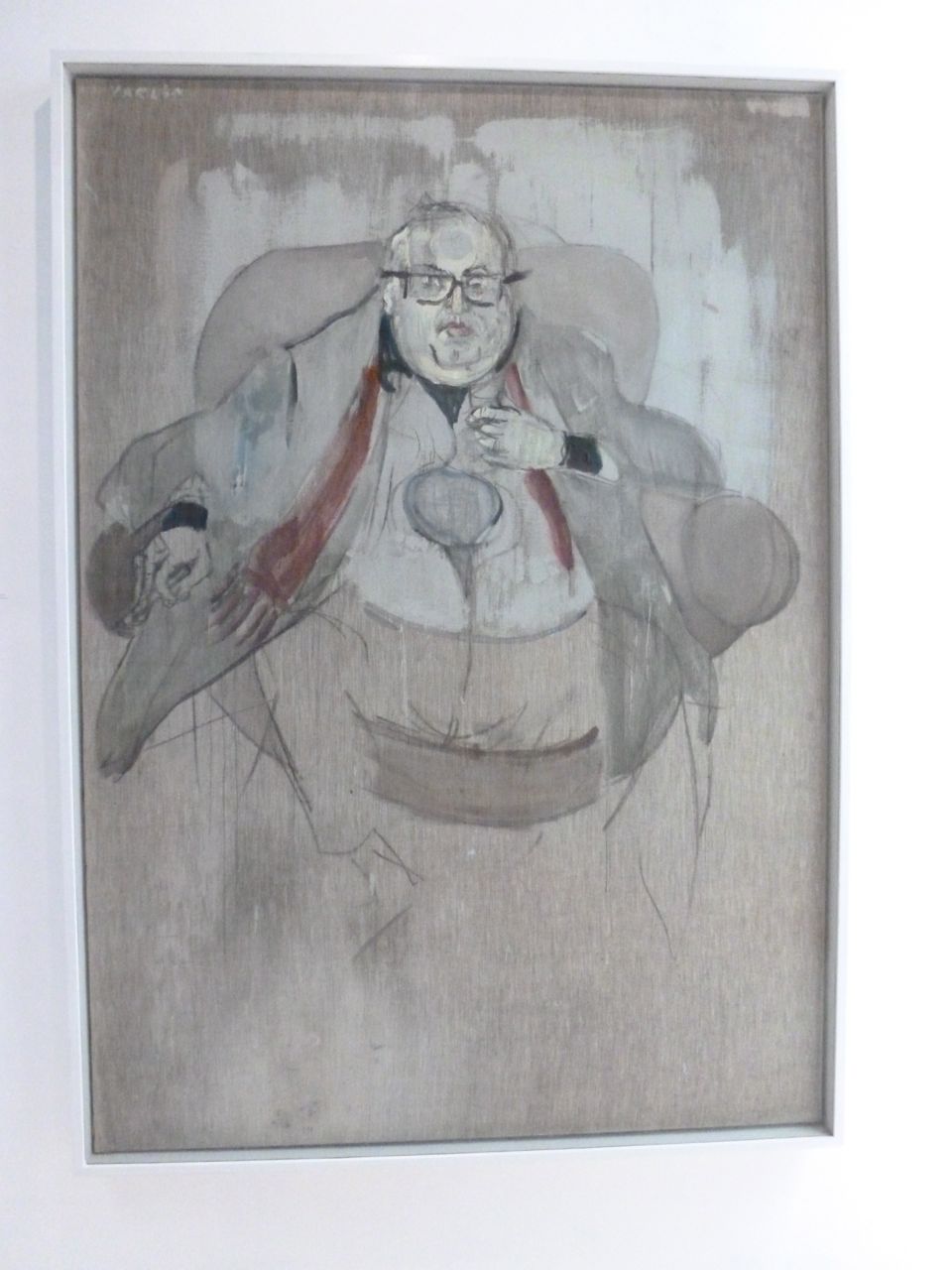
… which makes him into a beast …
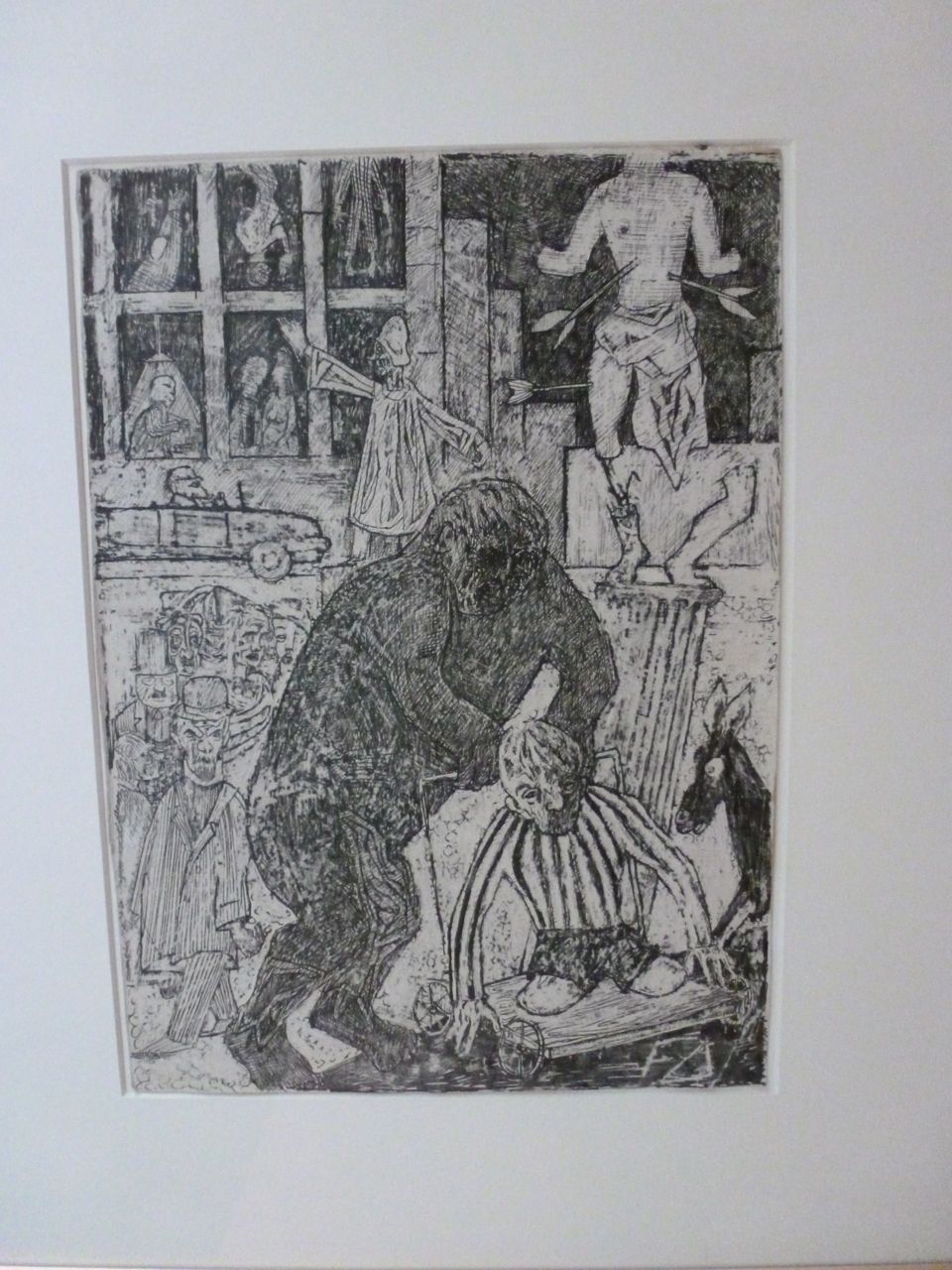
… and the beast into … well, Switzerland portrayed as a Roman Amphitheatre in which lions are eating Christians and the whole works. Either that or sunning on the riviera at Montreaux.

I made these images in 2010. When I was there in 2008, this amphitheatre was an image of the bankers of Zurich, being caught at a transaction they wanted to keep secret. The maze and amphitheatre was the frame of the image. In two short years, the curators came up with the improved version above. Here it is below (notice the maze of images that surround it. The whole building is the Minotaur’s lair.)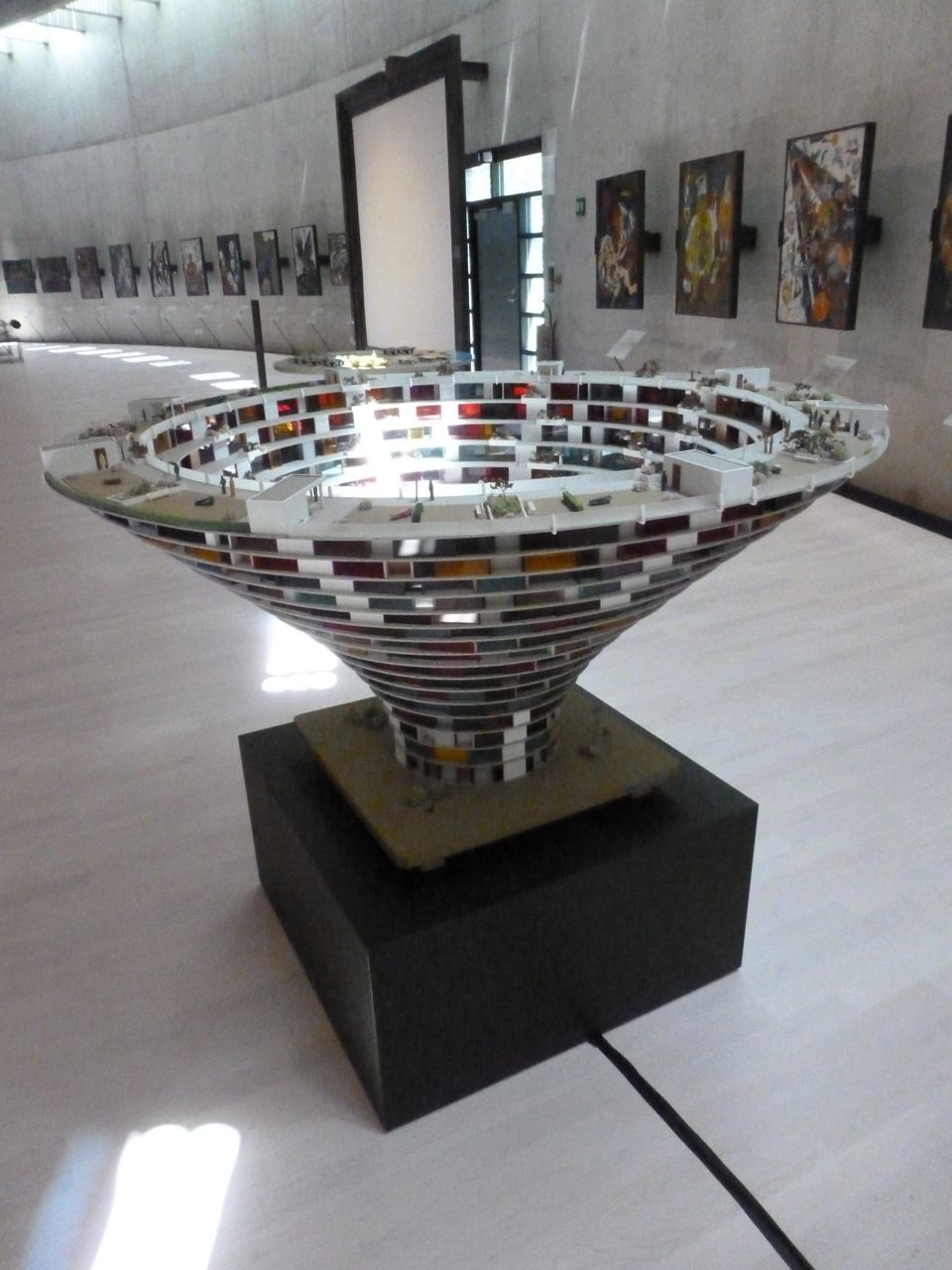
The thing about Dürrenmatt’s play is that he fills the stage with mirrors so that even the audience cannot tell which image before them is the minotaur and which is a reflection of it; one might want to slaughter it, but where does one strike? Perhaps the image slaughters the self. Dürrenmatt was concerned with issues like this. He took protestantism more seriously than protestantism. 
His radio play “The Accident” is perhaps most indicative of his method. In it, a travelling salesman suffers a car breakdown in a remote mountain village, on his first day on the job. He is directed to a villa, where a retired judge from Zürich (a foil for Dürrenmatt) and his friends are having dinner. The judge agrees to put the salesman up for the night, in return for his participation in a gentlemanly game. The salesman naively agrees. The game is an interrogation, in which the judges (retired) get to ply their trade by interviewing their guest (the salesman), on the principle that everyone is guilty of something; one only needs to find out what it is, and then absolve the person through sentencing. Well, I won’t give away the plot, but suffice it to say that the salesman’s secret is found, judgement is passed and then trifled with, and ultimately the audience leaves the stage under judgement itself, to argue the nuances away within society, in the bars and night cafés of Zurich. Every one of Dürrenmatt’s plays is a trial. It is the audience that is put on trial. There is no absolution. It is all quite shocking and, for a non Christian, exquisitely Christian, but you see, Neuchatel, where Dürrenmatt lived, actually is home to the minotaur. Sure, the guy is Dürrenmatt, but he is also this (well, androgynous) guy:

We are looking to what is perhaps an 8,000 year old Stele, carved several thousand years later by the Celts (who are the Swiss). This story of a beast becoming a man, which is the human story, takes place in Neuchatel without a break. For Dürrenmatt, a quintessential Swiss, civilization is a process of taming, which sometimes is a process of caging, and when you do it to yourself… what then? Why, you deflect it upon your audience, and send them home to wrestle with the mystery that cannot be resolved. That, I offer, is Gunnar’s story. All that’s different is that he has come to the story before the Second World War, and Dürrenmatt came to it during it, and Gunnar came to it from Nordic prehistory, while Dürrenmatt came to it from Swiss prehistory. For both of them, protestantism was larger than the church. It was kind of defiance in and of itself — and not necessarily of a negative kind.
Next: Gunnar’s Bind
When I left Skriðuklaustur a little less than a year ago, a fox ran beside me as I turned away from the lake towards Egilsstaðir and a glorious, sunny flight (with Air Iceland chocolate) to Reykjavik. I took it as a good omen. On my hard drive, I had the notes towards a book written during four weeks of becoming so immersed in Gunnar Gunnarsson’s work that it was written in the death-dance style of his novel Vikivaki. It is now finished and ready to find its way into the world. It begins like this:
A DICTIONARY OF ATLANTIS, by Harold Johanesson
An introduction to Gunnar Gunnarsson’s books of literary spy craft Islands in a Giant Sea, The Shore of Life, The Black Cliffs, Vikivaki, The Gray Man, and The Good Shepherd by Gunnar Gunnarsson, in the form of Vikivaki and in the light cast upon them by the essay, Our Land, which Gunnarsson presented to Hitler and Goebbels in the wartime spring of 1940.
Atlantis? Yes, Gunnar took a cruise there with his mistress and a group of Danish and German intellectuals and literary figures dabbling in racial theory, in June of 1928. The trip changed his life and set him on a twelve-year-long program as a secret spy working entirely on his own, without confiding in anyone, to change the course of the foreign and military policy of the Third Reich. Here’s the image that haunts me, of the day in the spring of 1940, just after he hoped to stand triumphantly before Hitler. Quite the opposite was the case.
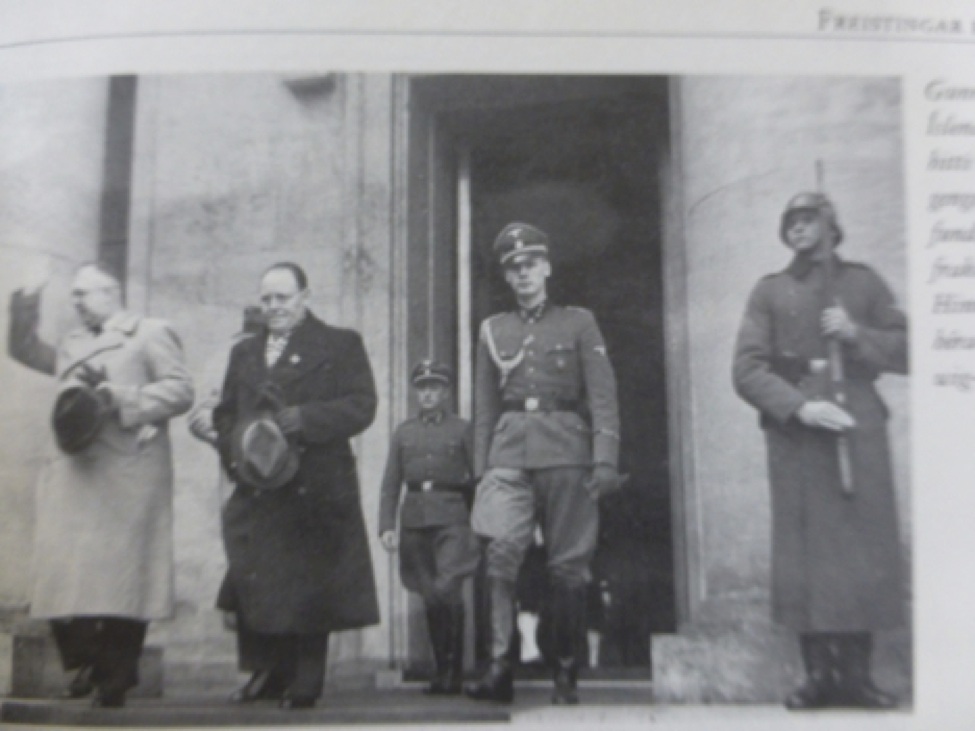
Secret Agent Gunnar (in the black coat).
Note the fencing thrust of the right leg of the SS Officer next to him. That’s Otto Baum, who would soon capture Norway for Hitler.
My book shows both what Gunnar had in mind and how his use of literature to further his cause created a genre both ancient and 75 years ahead of his time. My next tasks are to find a publisher for this book, to write a play about Gunnar’s meeting with Hitler, and to open the book up into a series of literary essays about Gunnar’s works, their form and their context. 20th Century literature has lost one of its central stories. By sheer good fortune I have found it. There is much exciting work to be done.
So, what happens to best-selling author Gunnar Gunnarsson’s public after his archetypal stories of Icelanders living in a raw, Nordic landscape …

… fall out of fashion in the new, post-war Germany that is partly an American colony and partly a Soviet one …
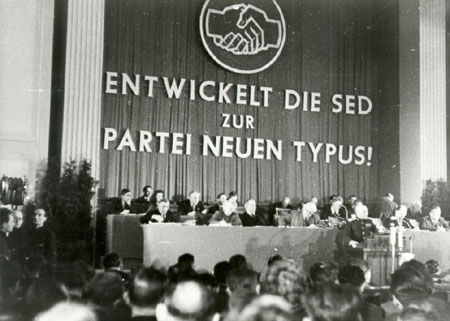
The Social Unity Party of Germany Grows into a New Kind of Party
Well, that’s what they thought back in the 1950s.
… looking to the future because the past is probably a pile of bricks out in the street?

Downtown Berlin in the Early 1950s: a Cold War Battleground
With Baltic Gemany lost, there’s not really much interest in looking to the North anymore.
This is the era of re-imagining Germany on a European cultural, rather than a nordic cultural foundation (Well, in the West, at any rate,) and especially not on the military or racial foundation of the 1930s and 1940s.
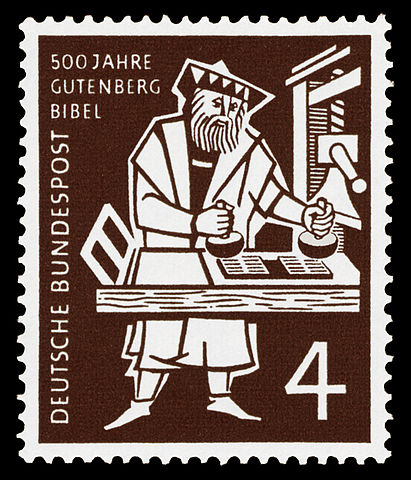
500 Years of the Gutenberg Bible
Stamp from the New Post-War State of the German Communities (West Germany)
This is the era of sausage stands springing up in the ruins.
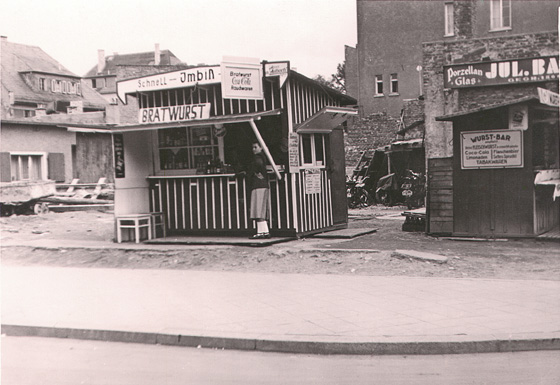
Bratwürst Stand, 1952
Women start to take charge of things, after the men messed up big time.
This is the era of the canoe on top of the Volkswagen and the first communist cardboard car.
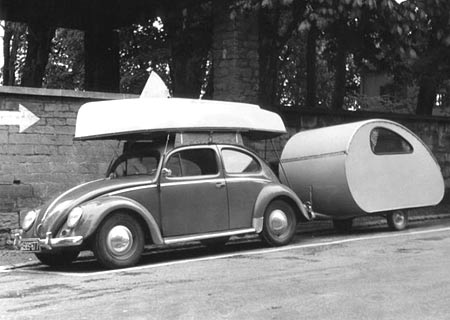
The Height of Modernity
What you get for reading too many Westerns. Especially after trying to drive to Smolensk in much the same get-up (The Volkswagens of the early 1940s were kitted out as amphibious assault vehicles … i.e. jeeps!)
This is the 1950s. Here’s what Gunnar’s readers are snapping up at kiosks little different from that sausage stand above.
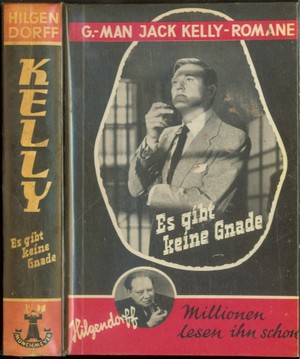 FBI Agent Jack Kelly: There is No Mercy
Hilgendorff: Millions Have Already Read Him
Herman Hilgendorff (Actually, H.C. Müller or Kurt Müller) wrote nearly 1000 books (!!!): most of them Westerns, FBI crime novels and British spy novels. (Long before the World War II Agent Ian Fleming spoofed the genre with his James Bond pulp novels.) Müller was one of the few crime novelists not banned by the Third Reich. And what is in these books that drew the Germans to them, and away from Gunnar’s more thoughtful, physical and eternal visions? This alternate book title (a cheap 60 cent edition) ought to show you …
 Jack Kelly, FBI Agent, at the Controls of the Robot that is Trying to Shoot Him
Does the robot look like a man? 100% Only Jack Kelly can tell the difference.
And who has constructed these robots? Why, a so-called Mr. Carefree, who promises to remove pain and suffering from people’s lives, for cash, in a process which usually involves underhanded death and destruction to someone else, a man who remains hidden and unknown, because he fronts even himself as a robot. And who is he? A hateful man. A theatrical agent from the 1930s. Yeah, this guy, you got it:

Joseph Goebbels, Third Reich Propaganda Minister
Any film made in the Third Reich was cleared by him.
Any book published in the Third Reich was published by Goebbels. Here’s one of those books:
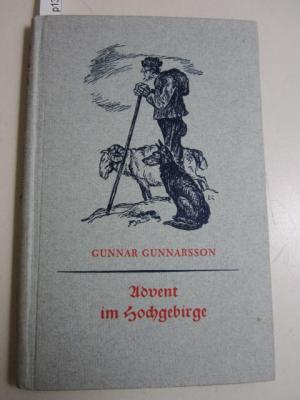
Advent in the Highlands, by Gunnar Gunnarsson
This is the edition approved by Joseph Goebbels.
Here is “Mr. Carefree” with with one of his robots.

Ah, But Which is the Robot and Which is the Real Mr. Carefree?
And then there’s the artist who sculpted the robots. Is he the German everyman? Is he a resurrected Jew, freed from the camps? Is he this man?
 No, that’s just Gunnar, living on in a Europe that had left its own images for ones from Asia and America. Meanwhile, HIlgendorff continued to rewrite the Nazi period in his pulp novels, under the concealment of the popular images of a new, non-European age. It’s fascinating to watch modern Europe birthing itself in the darned things. Oh, and who is Jack Kelly, really? Aha, look again:
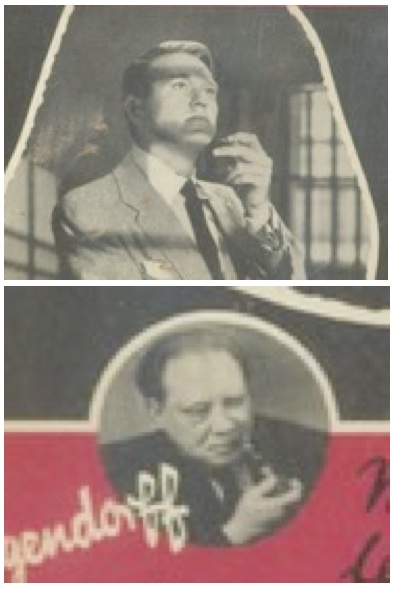
I bet he loved sausages.
Today I’m walking through the social ecology of Iceland, by way of the popular artist Kjarval. Here’s a hint of what’s coming later in the post…

Beautiful Human Monster, Kjarvalstaðir
Recycled, too. With teeth!
In Iceland things are what they are. For the earth, this is a pretty standard state of affairs. Luckily for all humans, it can be pretty beautiful, too. Like this:

4×4 Jeep at Church, Hallgrímskirkja, Reykjavik
Great matching colours at Reykjavik’s showpiece church! I think this approach might clash at the Vatican if you tried it there, though.
In Iceland, things are usually a little different than they first look. That red vehicle above, for instance, is not a 4×4 in the sense that its Japanese designers intended it. It’s more like a cross between an American military runabout and an Icelandic horse…

Pre World War II 4×4 Vehicle Putting a Fence to Good Use
These specifically Icelandic rules of social sculpture are largely unvoiced. I find them liberating — as another creature awkwardly domesticated by a colonial legacy: a Canadian.

Second Hand Furniture Emporium with Droopy Flag, Vernon, Canada
In Canada as well as in Iceland, the remnants of past economies provide fertile ecological niches for new economies. The land (often talked about but always distant) is not the point.
The kind of social sculpture in the above image is found wherever humans settle down, of course. What makes it different in former colonies (such as Iceland and Canada) is that the technologies are all foreign. That might sound a bit obvious, but consider it this way: at installations like this …
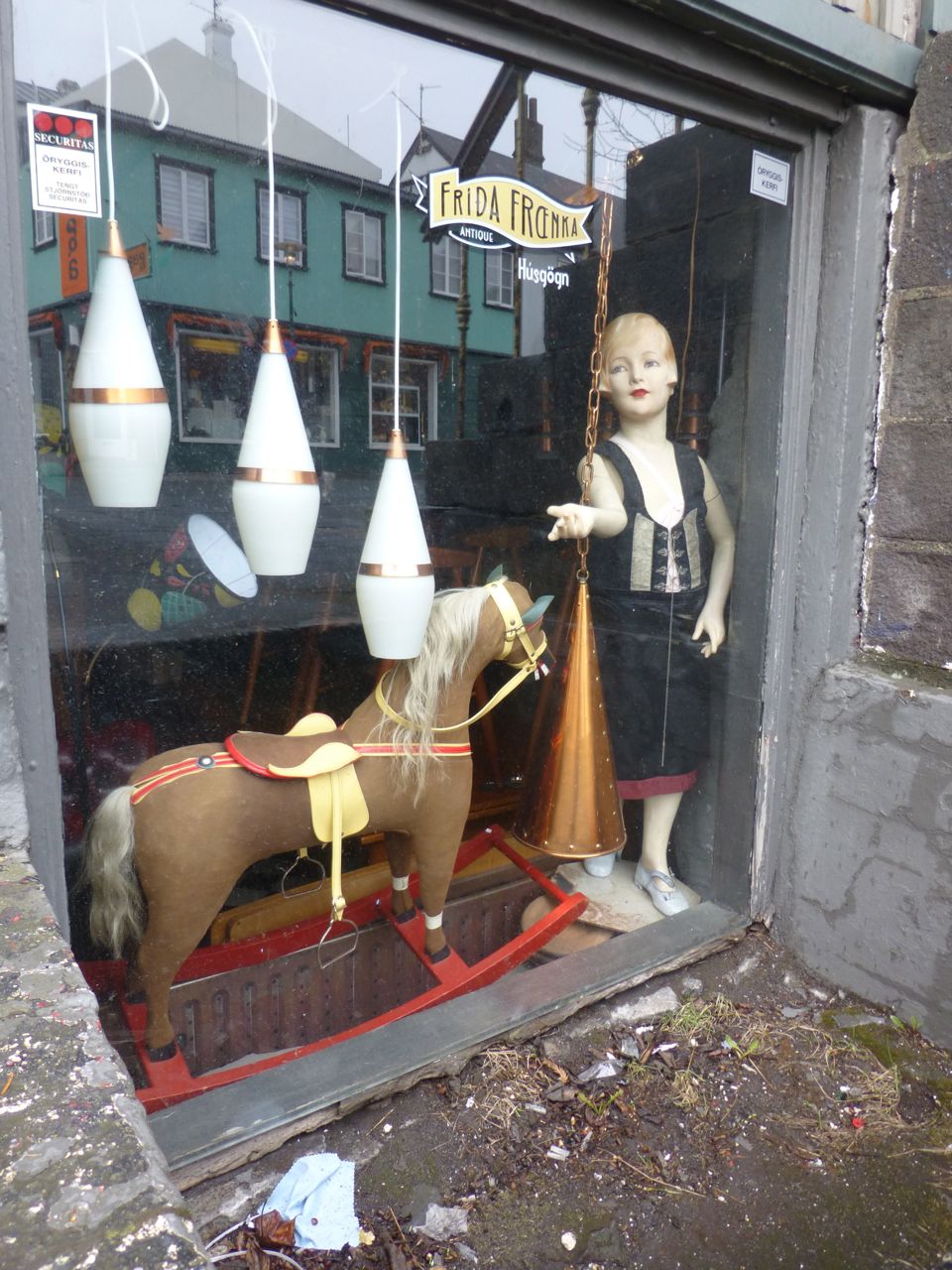
Antique Store Window, Vesturgata
Selling the world’s junk back to the world.
…in France, French people get to largely root around in their own heads. In Iceland or Canada, people are largely rooting around in someone else’s head. Not the same thing.

Store Window, Reykjavik
Lures for humans looking for a new image for their bodies. Important note if you want to try this at home: the realization that the human is the body is not part of this aesthetic. You can only do that with impunity in colonial centres, not at their peripheries.
Canada has its own approaches to power and to its colonial legacy (Largely, Canada is a social rather than a geographical location. It has replaced social and economic growth in “geographical place” by luring immigrants from other former world colonies, whose comfort with living in dis-placed lines of force is more attractive to Canada’s elites than is the costly rootedness of former immigrants). Iceland, too…
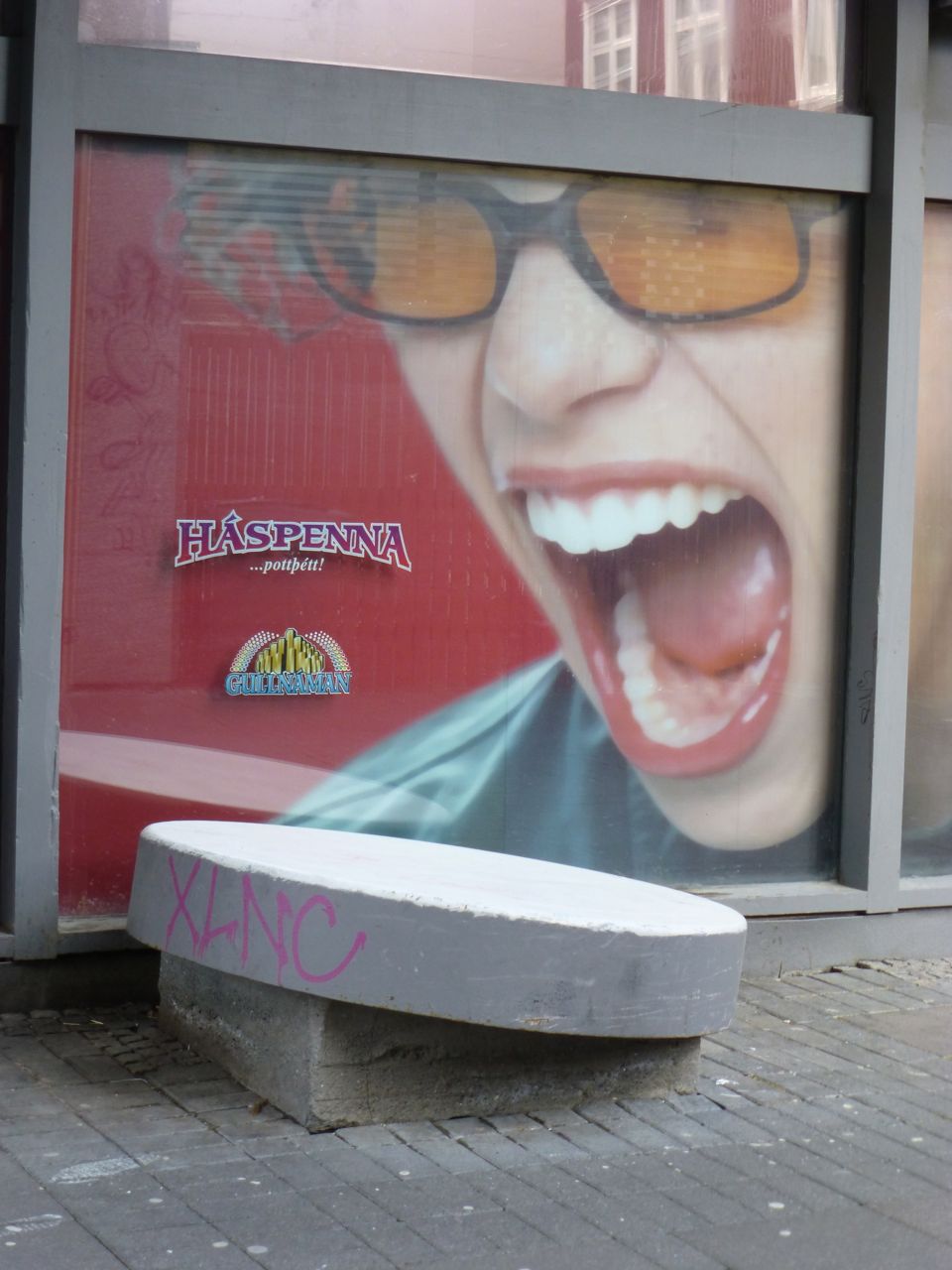
Slot Machine Casino Window Advertisement, Reykjavik
Giant drugs? Concrete money? A clever nordic pun for “real money”, I’d say, and presented in a colourful larger-than-life artifice, too. Top marks for this dynamically-energized street art-political installation and its recycling of images of contemporary global colonialism. Note the pink paint — a kind of dog-like territorial marking made by humans partially resistant to the human entrapment technology called “advertising” and its tried-and-true sexual lures. Imagine: wild humans, among us, even now in 2013. One hardly dare breathe, lest one scare them away!
Just as in Canada, human political elites (the A-type power personalities that usually dominate human relationships) really like this kind of stuff. It supports their power structures well. There are variations on this model, though. In Canada, as I mentioned, they experiment with mass immigration as a means of forestalling change. In Iceland, however, they lure people foreign to the culture for temporary visits (tours), during which they are offered images of their own culture, such as this street-side bar offering English drinks for English visitors (seen here through its window) …
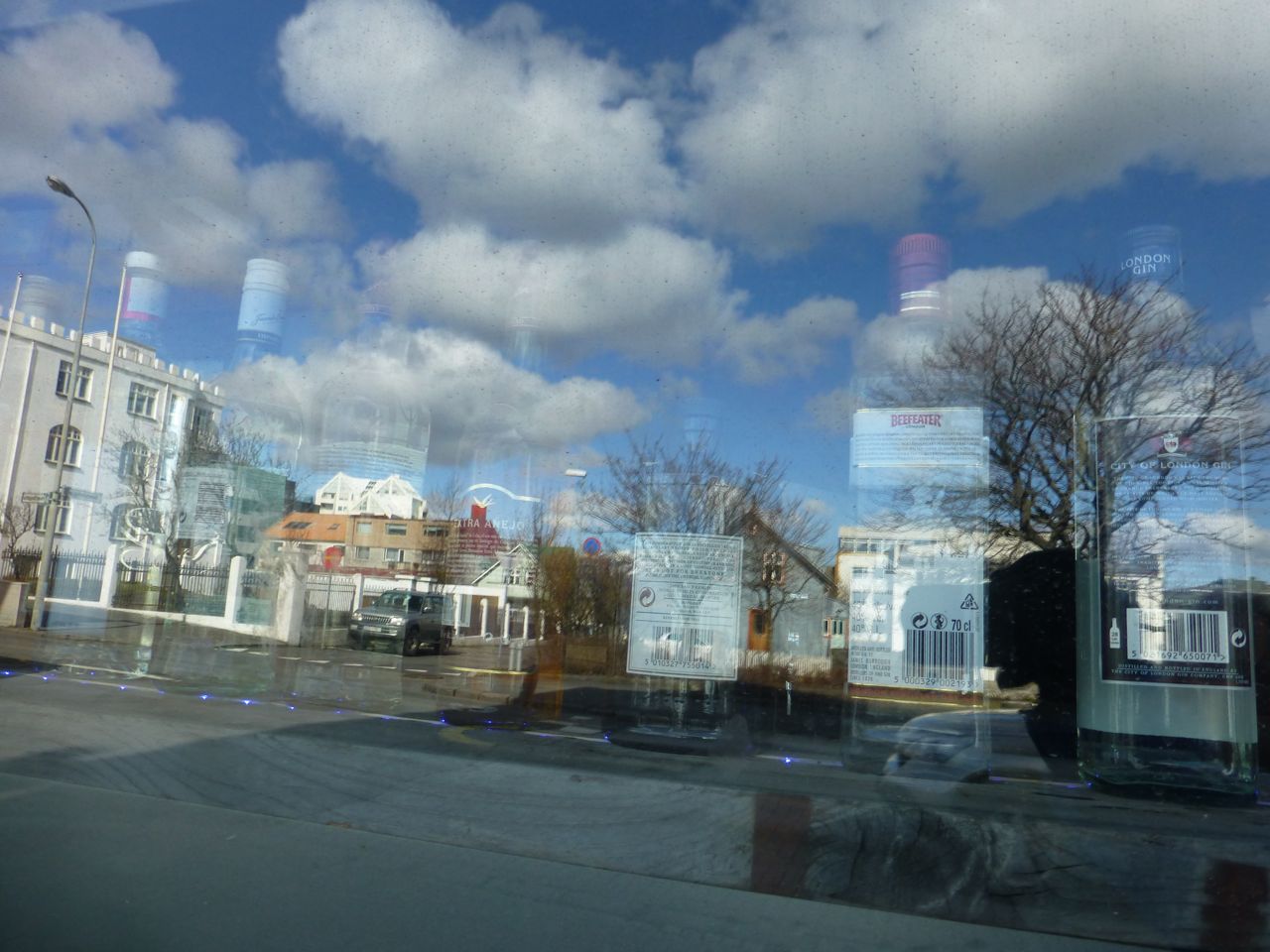
… and, still on the English theme, this other bar, up the street and down the hill towards the water…

England, Denmark, and the United States in One!, Reykjavik
(American beer slogan graffiti, English musical icons, and Danish Carlsberg beer.)
The key to colonial societies is the almost random recombination of multiple foreign influences, none of which are home-grown. It leads to exquisite and exciting (and beautiful) temporary art exhibits like this…
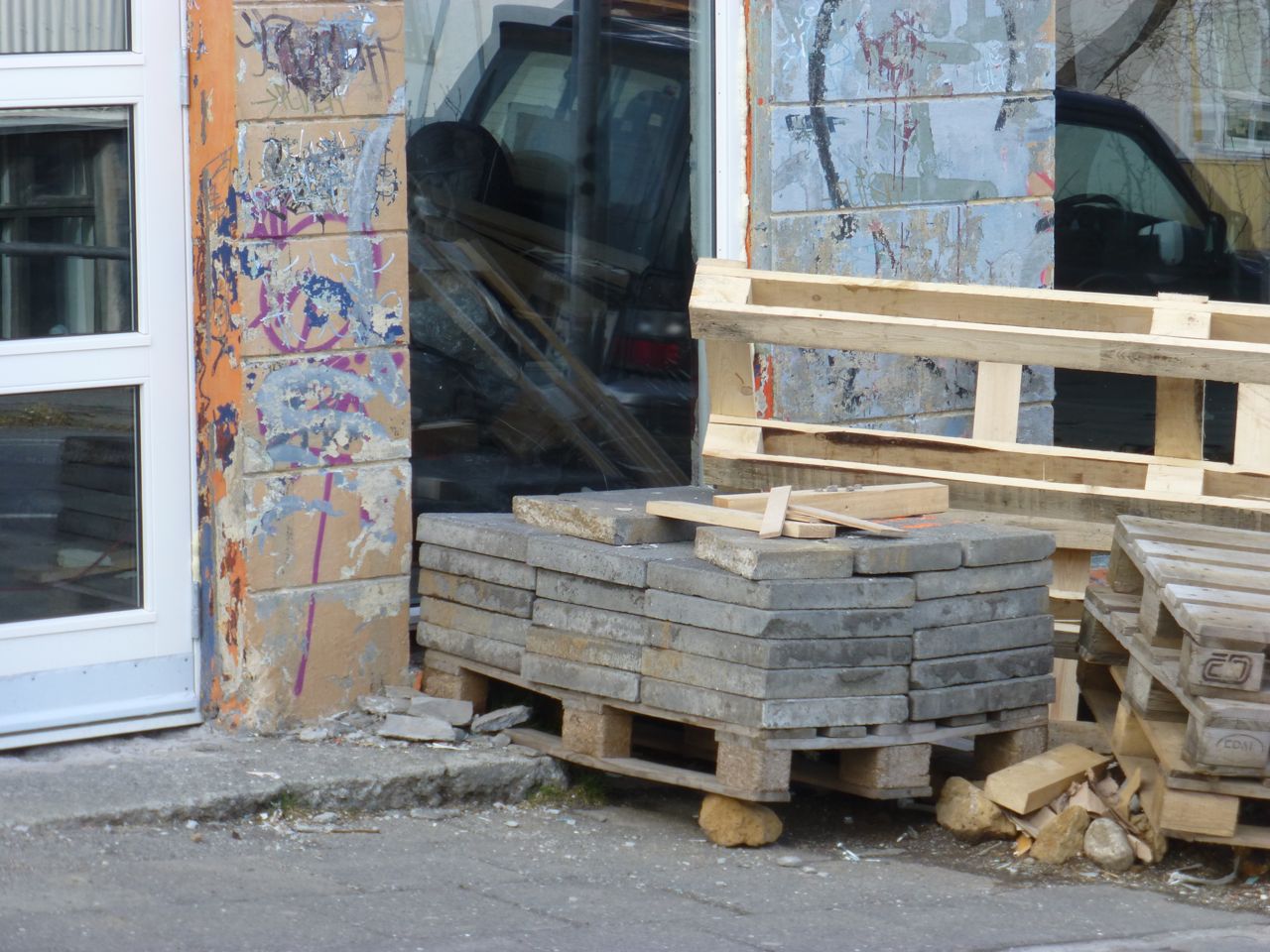
Construction Site, Reykjavik
Although only the most powerful of these sculptural objects is Icelandic (the rock holding up the corner of the palette), the combination of elements is pure Icelandic (in the sense of Iceland as a social space.) One learns to navigate one’s own colonization. One makes a home in it, so to speak.
This, the wisdom of urban people worldwide, finds its perfection in colonialism (including its new face, migration.) Intriguingly, in this art form mechanized reproduction is not an infringement on individuality. You can repeat the same Háspenna advertisement on all sides of the same building (and probably, if Coca Cola is any example, around the world) with impunity.
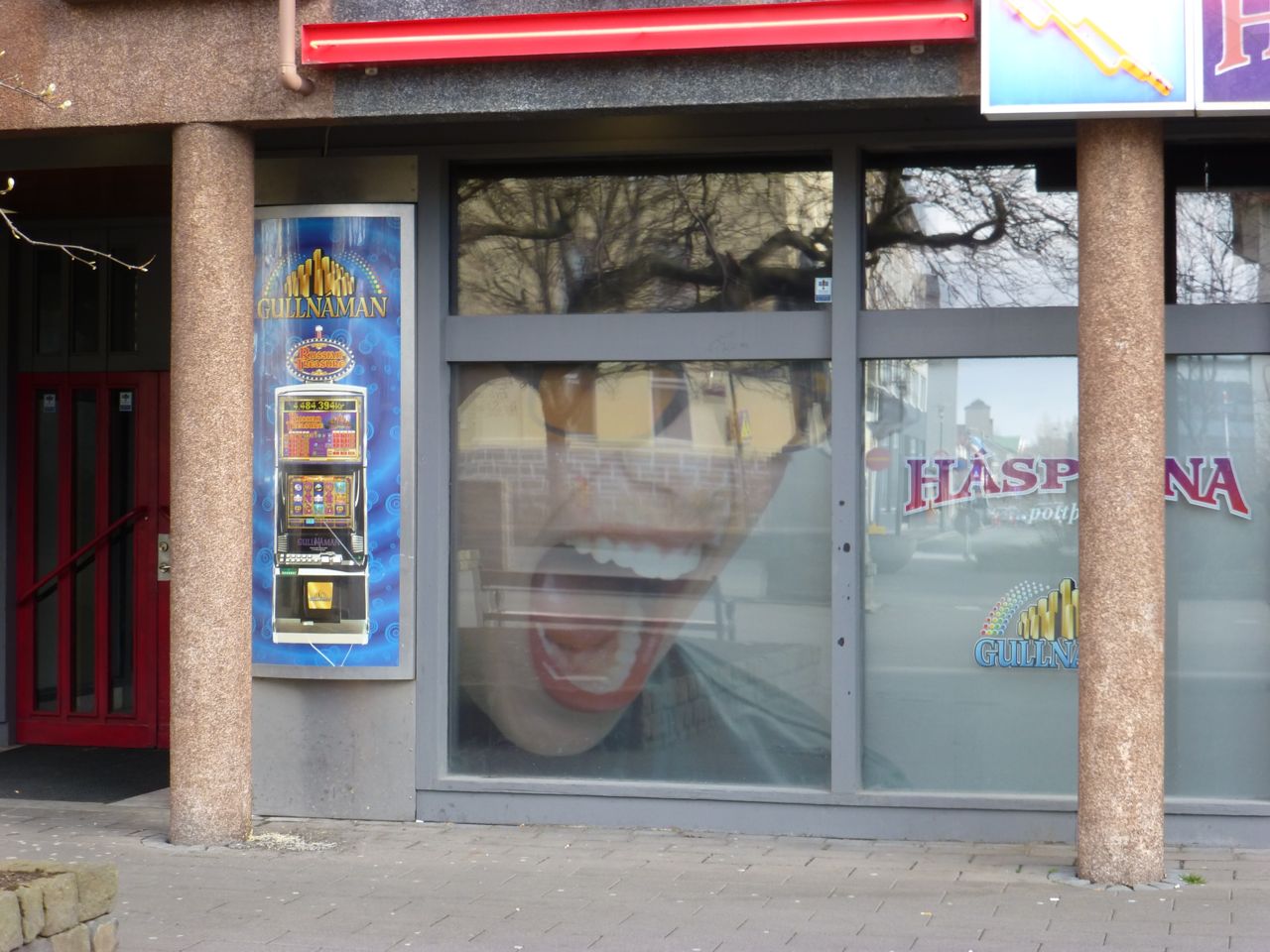
Aren’t you glad, though, you can’t hear the screaming?
As a part of global culture, this casino (and its copy writers) is relying on the concept that an individual human is a moment of emotional and biological energy — a wordless animal that delights in colour and scripts that it can move into, inhabit and ‘flesh out’. It is up to dominant social humans to write those scripts in such a way that when biological humans enter them, their accompanying social humans believe they have written them themselves. It is best to maintain such illusions of individual identity. Humans are a little touchy when it comes to identity issues.
To recap, I’ll try to simplify that into an image. It shows a couple biological humans in a piece of performance art directed on the fly by the social humans who fill them like spiritual water. Here it is:

Humans are Mightily Attracted to Work, Laugarvegur
Excellent colour work here, especially the inner hallway carpet’s lush mauve, pulled out to protect the concrete from paint spills. The bubble gum that already has used it as an abstract expressionist canvas shouldn’t be spoiled carelessly, should it. No, it should not. That’s deep respect, that’s what that is.
Now I’ll try to return that to words: because human identities are crafted by contemporary political elites to appear as attractive homes for social and biological humans alike, such art as the Háspenna advertisement above is a form of sculpture or building. If you think “stable”, you’re pretty much on the mark. Here is its physical corollary:
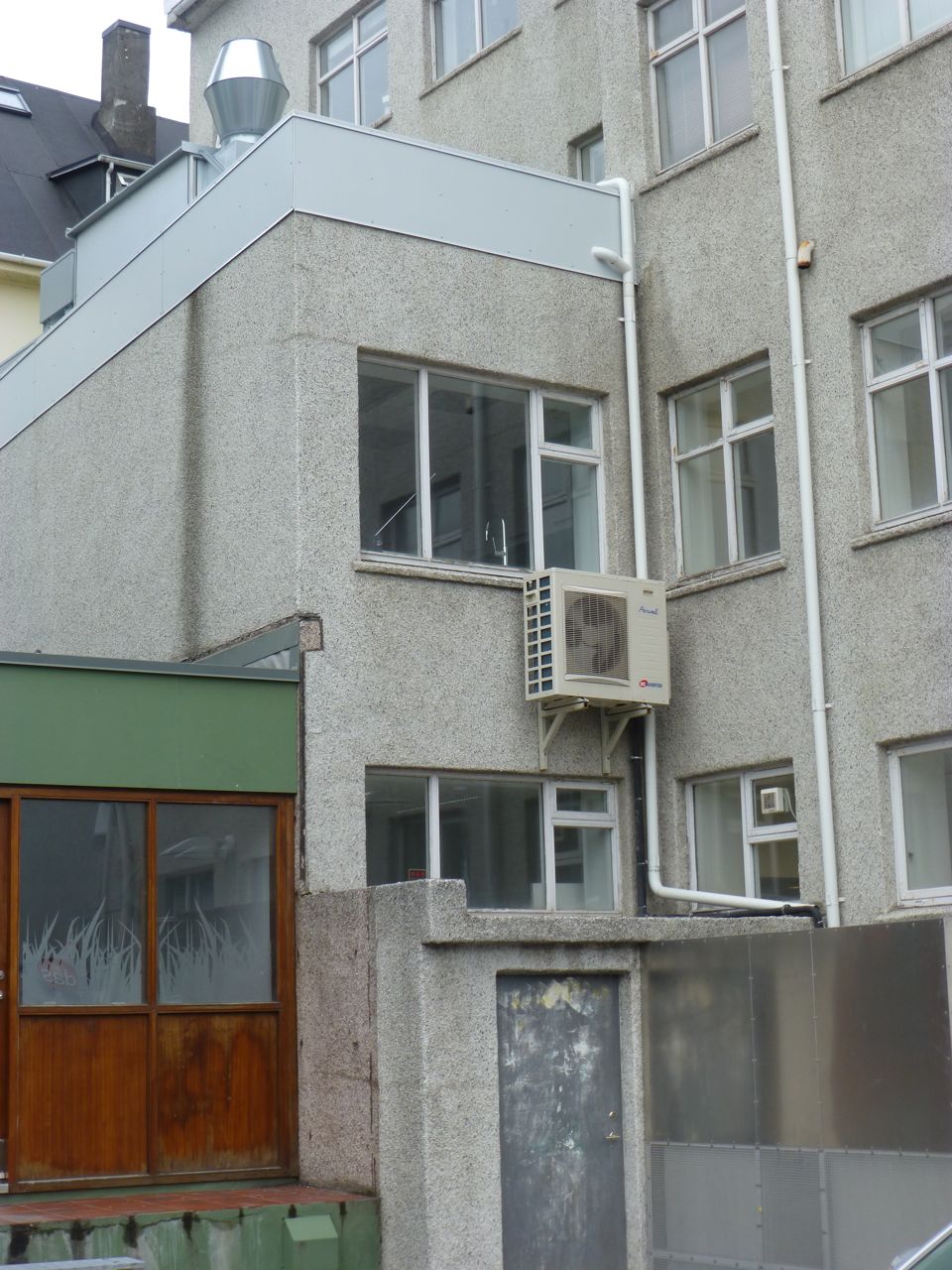
Biological Care Facility (Apartment or Stable), Reykjavik
Complete with climate control. No price is too great. After all, no social life forms are possible without the biological humans they carry around with them. Such complicated art works! So delightful!
Simply, you just can’t have social power, or a national state and the benefits of security it brings, without socialized (domesticated) humans. Wild ones are just trouble.

Wild Humans Causing Trouble in a Bankrupt Construction Site, Reykjavik
They missed the socialization that was supposed to teach them that domestication and culture are the same thing. Poor things.
For the purposes of nationalizing humans, art is absolutely essential. It is a kind of engineering much akin to the construction of bridge girders. Here, for example, are some temporary Icelandic residents (tourists) training themselves in this technology …

Skógafoss (Forest Falls), Iceland
This beautiful waterfall is in the process of successfully luring these humans to its lair. Don’t let the lack of a forest spoil your experience with that exquisite retro-art form, “nature”. There was a forest once. People got cold. They burnt it. Wouldn’t you do the same for your body? I know I would.
I’d like to introduce a term which describes this effect. It is this: Photographic Acclimatization. You use it in a sentence like this:
The people in the above image are training themselves in the contemporary art technique of Photographic Acclimatization.
Here are some more humans hard at work at just that …
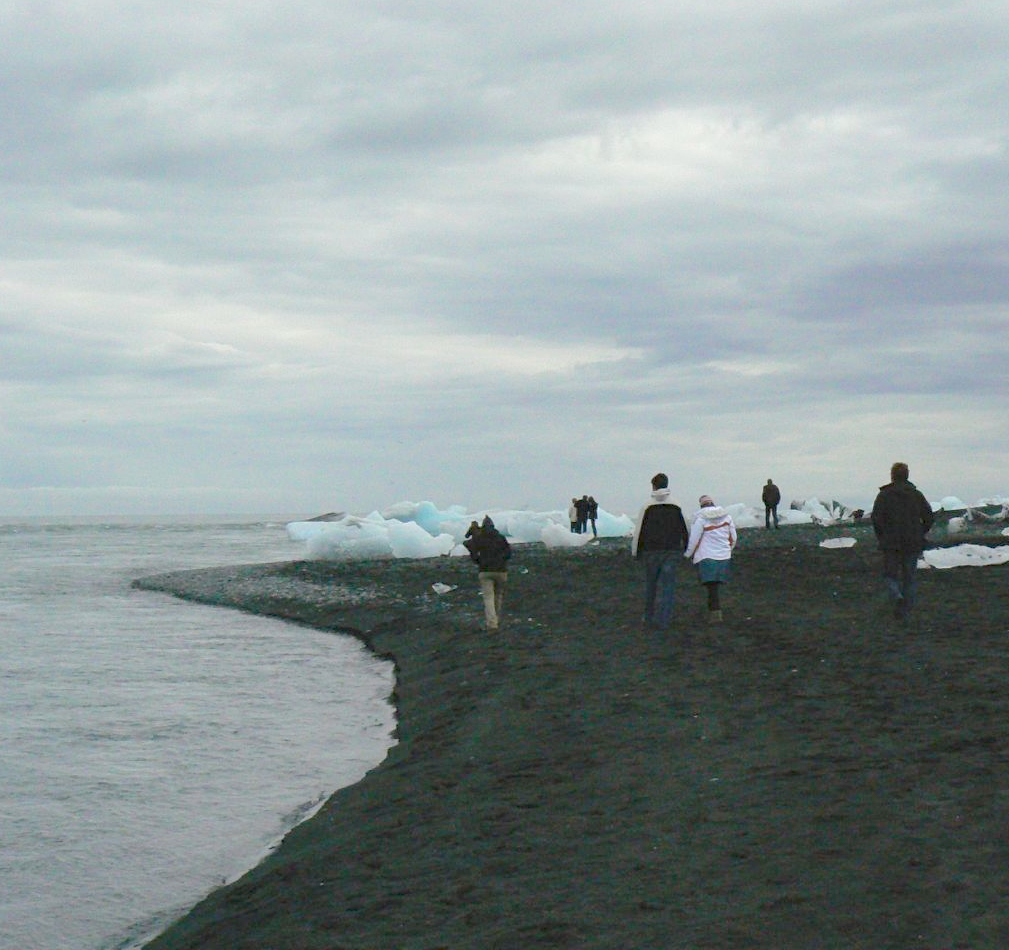
World Humans Meet the Earth
And then stand there, far, far past where language can lead them, staring. Sometimes they meet their biological selves for the first time in this way. Being generous and merciful, Icelandic tour bus drivers bring them here by the busload. If you drive real fast, you can make it from Reykjavik to here and back in a day, which is, frankly, wayyyyyy too far and hard on the bus drivers, but, as I say, they are generous and merciful.
The popular art form of photographic acclimatization is an updated version of the 19th century science of butterfly collecting, something which I’ve been trying to make into a new science of late, although without a net.
 Western Swallowtail in Some Feral Alfalfa
This turkish forage plant was left behind in the faeces of some cattle, back when this part of Oregon Territory was an updated version of the Wild West. The alfalfa decided to stay. In the 19th century, I would have had to catch this beauty with a net and pin it on a card. It would then be usable by modern human art-makers, as an image of past human-earth interfaces. As a wild butterfly, it is relatively invisible, as is the undocumented weed ecosystem it now inhabits. It is like a brand new earth out there!
Photographic Acclimitization is based on the principle of traveling the country (or the world) to capture images of things that you have seen before in advertising material. It is absolutely essential to modern society. It allows socialization processes to ‘gel’ into the complex social sculptures without which the society could not exist in a stable form.
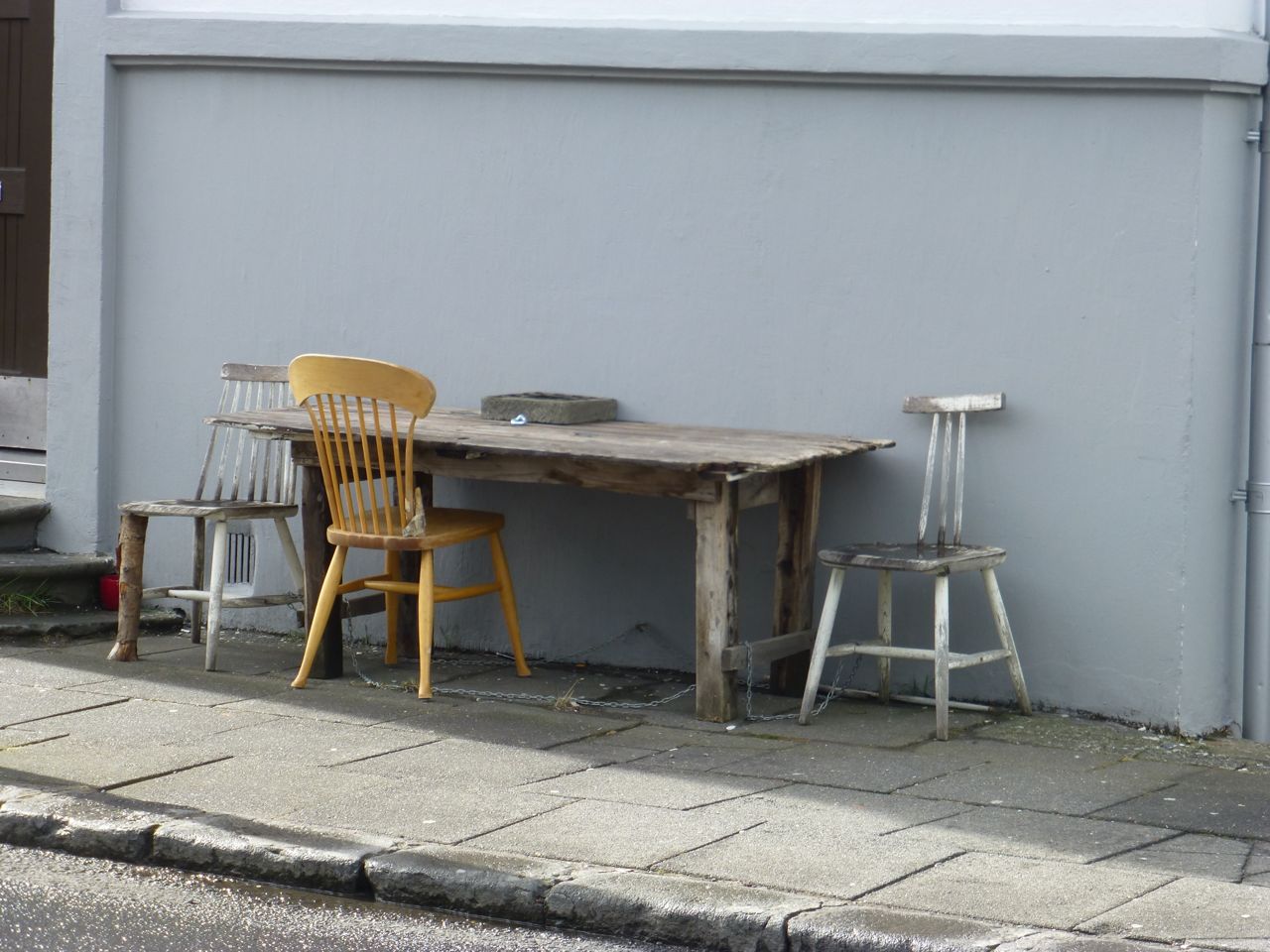 What Happens When Photography and Other Furniture Are Used for Asocial Purposes: Rogue Art!
Look at how these poor beasts are chained up night and day. Poor things.
Plato, the Greek philosopher who pointed out that each chair is a projection of a perfect chair in Heaven, would turn over in his grave. This approach will not lead to nationalism. The following is a more appropriate photographic subject:
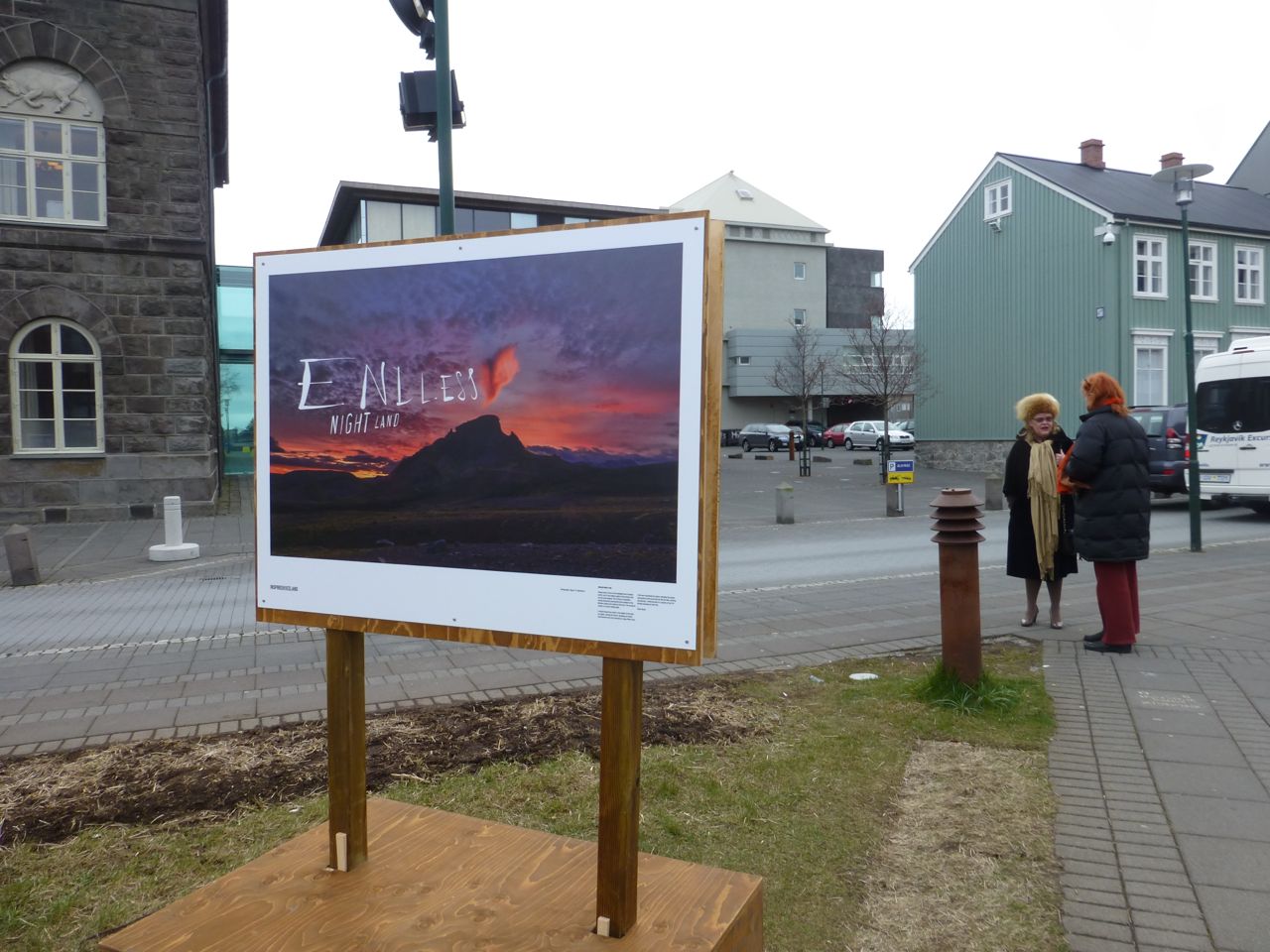
Icelandic Tourism Display: Endless Night Land
This will lead to nationalism. A year ago, tourists from around the world were asked to submit their photographs of Iceland and to coin a new term for the country which expressed their experience. The ones in keeping with the promotional goals of Iceland’s copywriters were chosen, lavishly photographed, and turned into a “new” (or at least re-cycled) promotional package. It’s the casino all over again!
After all, it’s not just horses, sheep and cattle who are domesticated in the process of creating a society out of farmers.
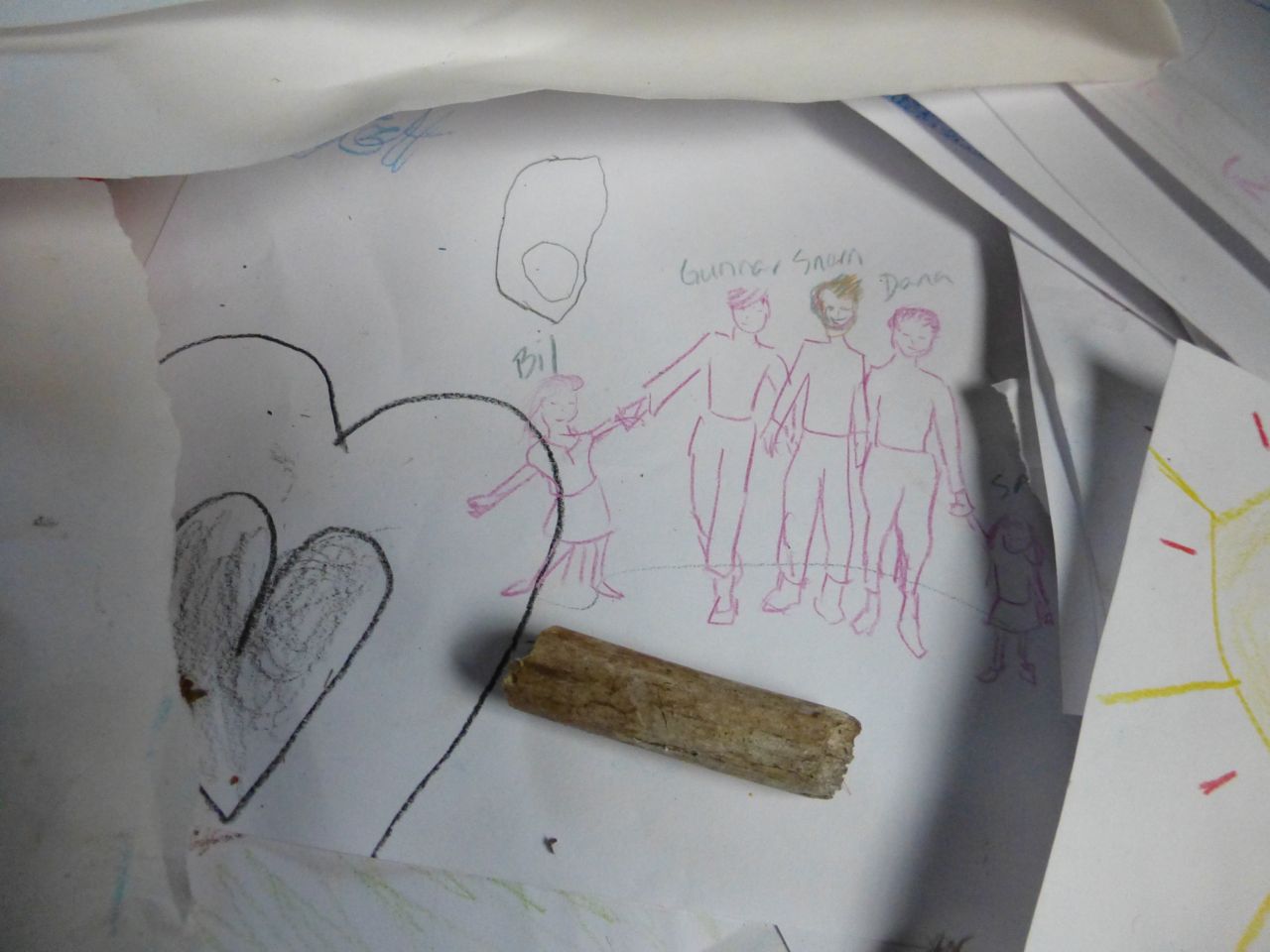
Teenage Art, Hallórmstadur
Tasked with the job of leading young children to exploration of art in a wooden hut in Iceland’s national forest, teenagers practice the social art instructions of their Walt Disney-style drawing pad.
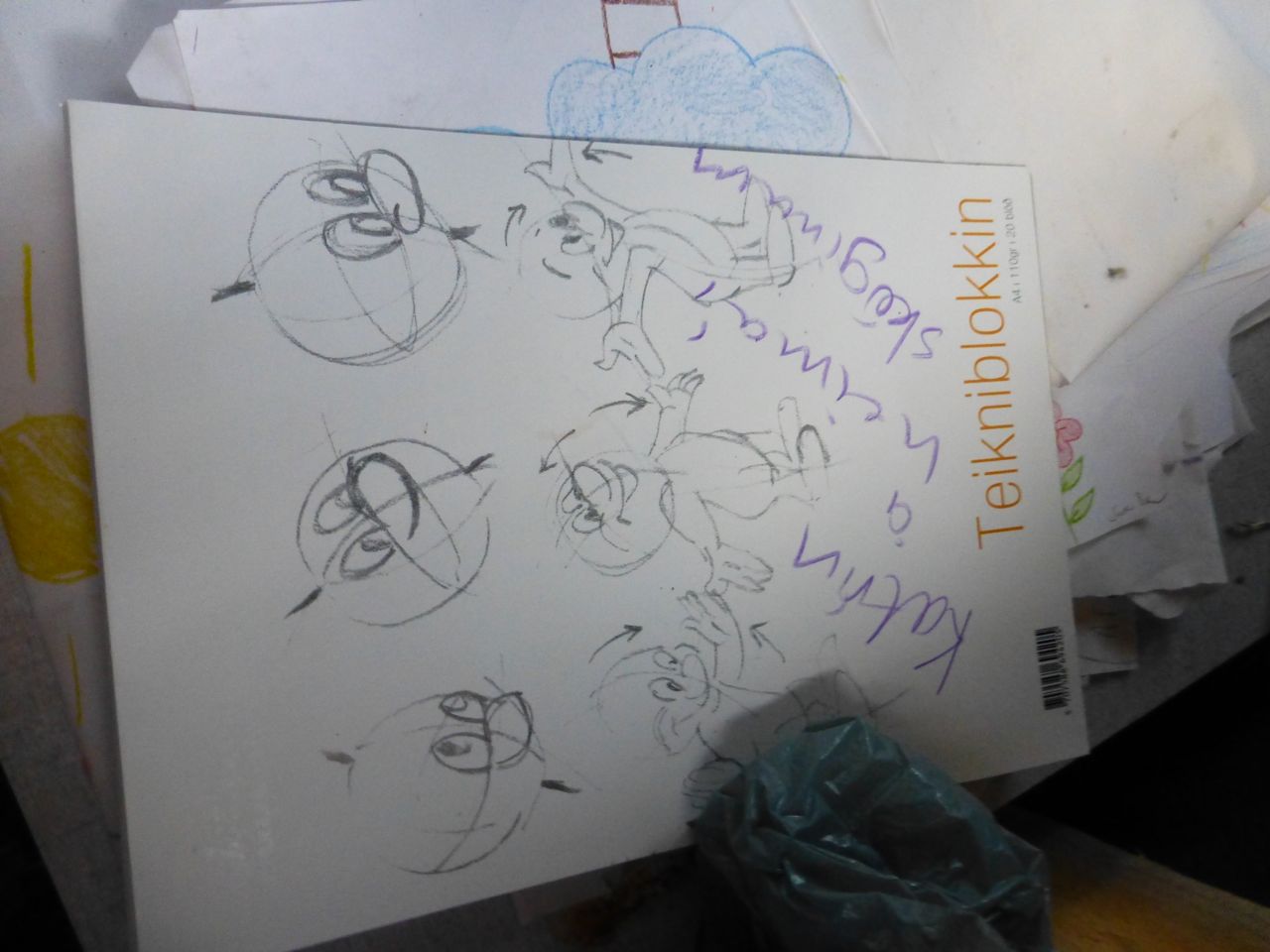
Note the Arrows
They aid in the process of refining the complexity of the human body into simple, infinitely reproducible lines.
The goal is the sculpting of readily portable masks, called identities …
 Identity Creation Materials Skólavörðustigur
… which can be worn as display objects in public.

Checking for Traffic. Vesturgata
Individually sited, using a mass-produced stencil. Now that’s about as good a definition of colonialism and migration as I’ve ever heard.
Identity masks for human bodies come in many types, all attractive to social humans. They include clothing, hair styles, facial expressions, language, apartment furnishings, art and, of course, footwear. You don’t want your favourite human to wander the streets unshod. He or she might step on a nail, right? And, besides, they’d have a hard time getting into restaurants to be wined and dined, and then where would you, a social human, be with a cranky, hungry animal tethered to you?
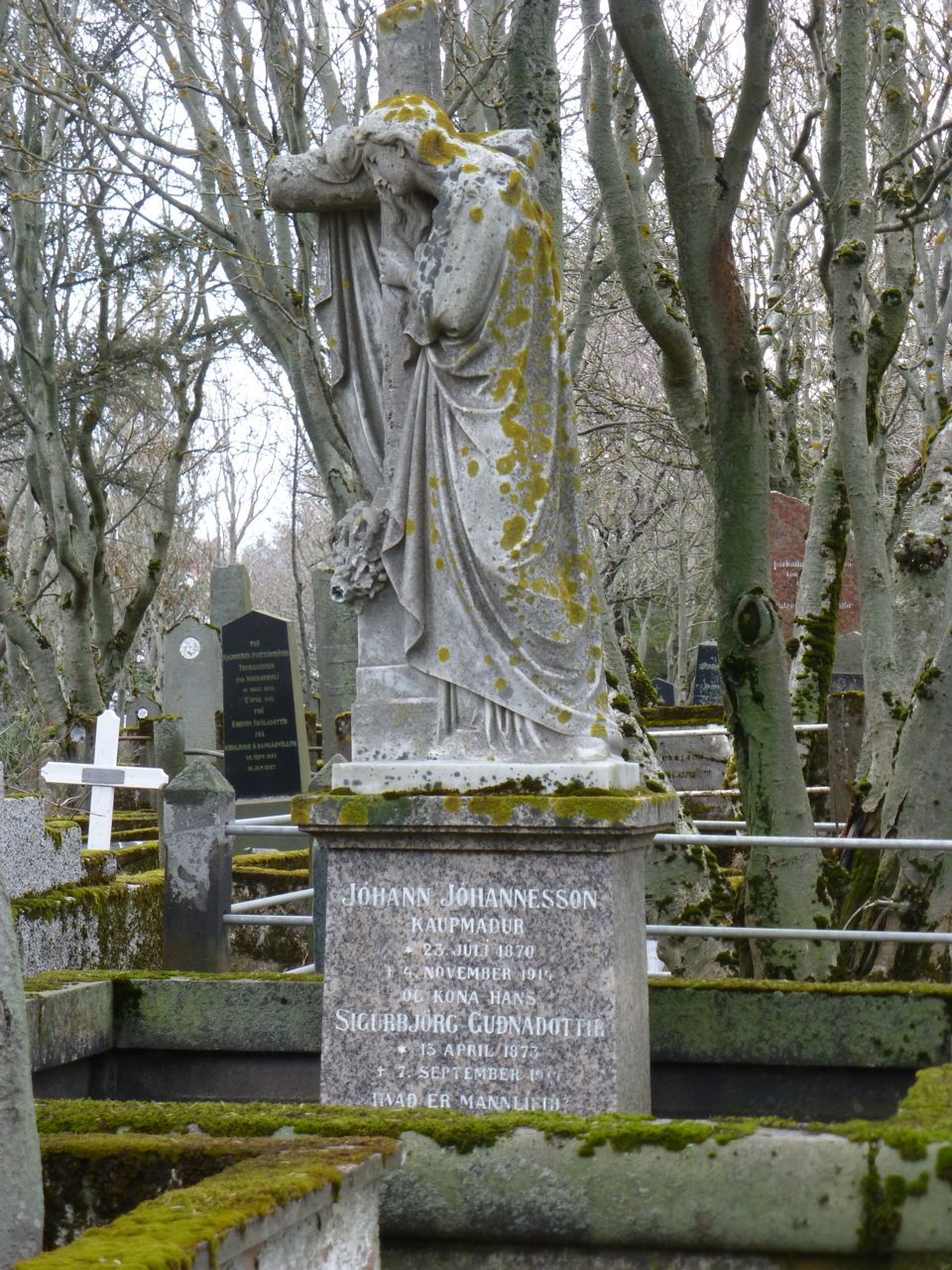
Reykjavik Graveyard
A reason to keep your body shod.
The image above looks like the mass-produced, flippy-flappy Swedish flat-packed style shoe racks that can be found in houses, apartments and closets worldwide. It’s not. It’s Icelandic art.

Icelandic Shoe Choosing Rack for Two
A pair for each identity mask.
No doubt, the other millions of shoe racks worldwide are also completed with a sterling collection of globally-sourced, mass-produced shoes, but that’s not the point. The point is, of course, the flare, or gesture, with which one installs it. For example, construction sites are also part of artistic display worldwide …
 Reykjavik Harbour Art Installation
This is a form of process art. It is, after all, called a “building”, not a “built.” In such subtle ways, a language directs the humans that it occupies.
… but turning them into playgrounds for children, complete with turf, tires, and repurposed fish boat tubs, well, now that takes flare. Lots of flare.
 Imitation Elf Village, Reykjavik Harbour
This Icelandic art form incorporates such a keen eye for the beauty of artistic line and colour that it makes the fantasy character creation materials window (art supplies store) above seem a lot like a visit to the dentist. I mean, don’t just gawk at all this beauty … walk around in it!
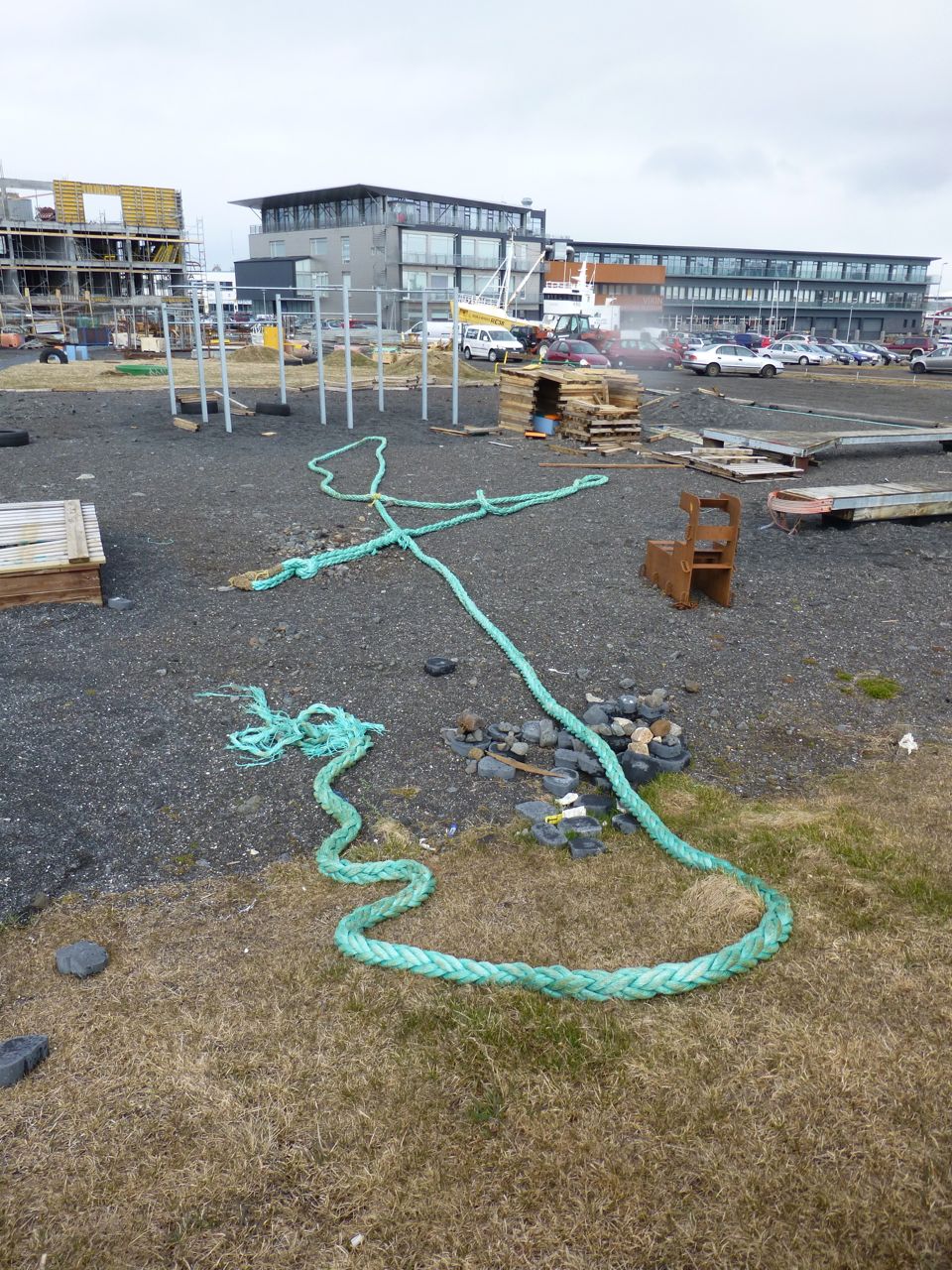
Reykjavik Harbour Construction Site
Children encouraged. Look at the magical rope boat anchor cross angel talisman, eh! Such an exquisite turquoise. There’s no way you could squeeze colour like that out of a tube.
If you walk around long enough, you might find the materials to build a sculptural representation of your body, like a ghost from long ago, and even move into it and sleep and dream…

A Good Place to Go on a Rainy Day
The children, however, are all in school. Poor things.

Neighbourhood School and Canadian-Style Child Socialization Device, Seljavegur
Like many play places in Iceland, the playground and its accompanying school (socialization device) are situated on a plot of land set aside for “the other people”. In most cases, this means elves. In this particular case, dwarves.
It is socially acceptable in Iceland to allow children to play and learn among the other people. This is a primary rule in Iceland, and why not. After 1100 years of crippling poverty, the Viking settlers of Iceland lost so much — almost everything, in fact. What remains are a few sturdy humans, horses, dogs, sheep and the other people. All are granted almost unbridled respect as the spiritual creatures that they are. Accordingly, a village of the other people is also a good place to build a church …

Elf Houses Among the Crocusses in front of Hallgrímskirkja, Reykjavik
That’s a statue of Leif the Lucky, donated by “The People of the United States of America” after World War II. Excellent playground! Sadly, the dutch crocuses and the elves, which have both gone native here, don’t get a plague.
… but you can never build a house on elf rock …
 Alf House and Human Housing, Reykjavik
It’s tricky to decide who has the better deal.
A popular saying in Iceland is “You never know.” It’s used to describe the Icelandic love of slapdash construction and the lack of interest in cleaning up old junk. The reason for it is “you never know” whether elves exist or not, or even God, so you keep churches and elves around because it might prove useful some day. You also “never know” when the economy is going to collapse or a volcano is going to blow its top, so there’s no point in settling down too comfortably, either. One’s home is Iceland, not some particular private property within it, because “you never know.” Actually, you do…

Farm on the Snæfells Peninsula
Once very nearly wiped out by a) a lava flow, b) a cinder cone, and c) the ash that came along with them. In Iceland, this kind of thing happens all too often. Icelanders know this.
As a result, in Iceland one’s home is not in a ‘place’ but in a community. In the past, displacement was so rampant in Iceland that most people were less than indentured servants, continually on the move from one side of the country to the other, looking for some point of entrance into secure social structures (Hint: there were none.) Icelanders tell themselves (and the world) that they created their country for themselves by throwing off the yoke of Danish colonization. As the above examples of contemporary colonization should demonstrate, it wasn’t the Danes (or any other country) that was the real yoke. The yoke was separateness. It was broken when Icelanders gained enough perspective on their situation to realize that to be properly socialized they would have to participate in their own socialization, so they took to it with great enthusiasm and earnestness.

One Manager (Labouring) and Two Workers (Supervising) Spend Two Hours Fixing a Door to Nowhere Reykjavik Skate Park
One Canadian is most enchanted. No skaters, mind you. Lots of Italian graffiti art, though.
This basic rule of human socialization applies as much to individual as to group humans (families, communities, corporations and other social identities, not all of them friendly.) In capitalist societies, it takes the form of “economy”, a kind of language that attempts to profit from exchange and, indeed, makes an entire artistic language out of it, all the way from the Icelandic banking industry (a form of gambling) to the Icelandic gambling industry (a form of banking).
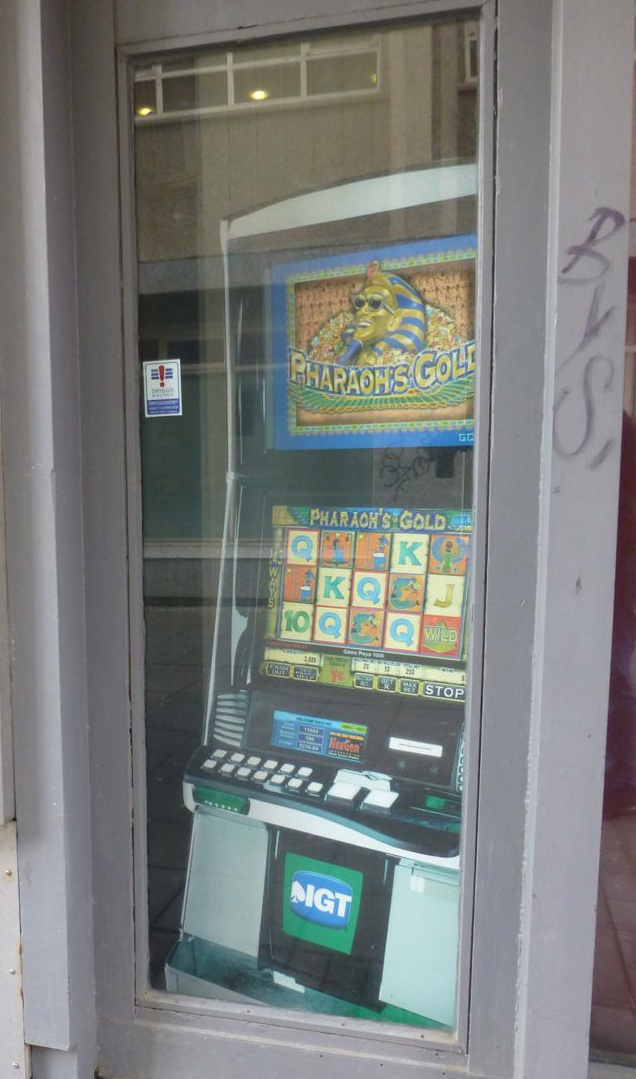
I Bet You Were Wondering Where That Gold Got To!
This would be tricky for iguanas, but fortunately it’s dead simple for humans. As you (a social sculpture) and your biological human (‘your’ body) explore this art form, do keep in mind that self sculpture is often built around sculpture designed to shape you, and if you’re anything like normal you’ll chafe a bit at that.

Abandoned Farmhouse, Suðurdalur
“What? Me stay poor in the middle of nowhere, while everyone else in Reykjavik has television and Wienerbrød (a Danish, colonial pastry)? No way, Jóni!
And what do half wild humans do in Reykjavik? They learn the ropes. And the half-wild children of domesticated humans, what do they do? Most of them live in places like this …
 The Hamburger Factory Cow…
… and her people going to work. Later they’ll come back for some hamburgers with the family, while she, in her lovely Icelandic sweater, looks bovinely on.
… and then get restless, which looks like this …
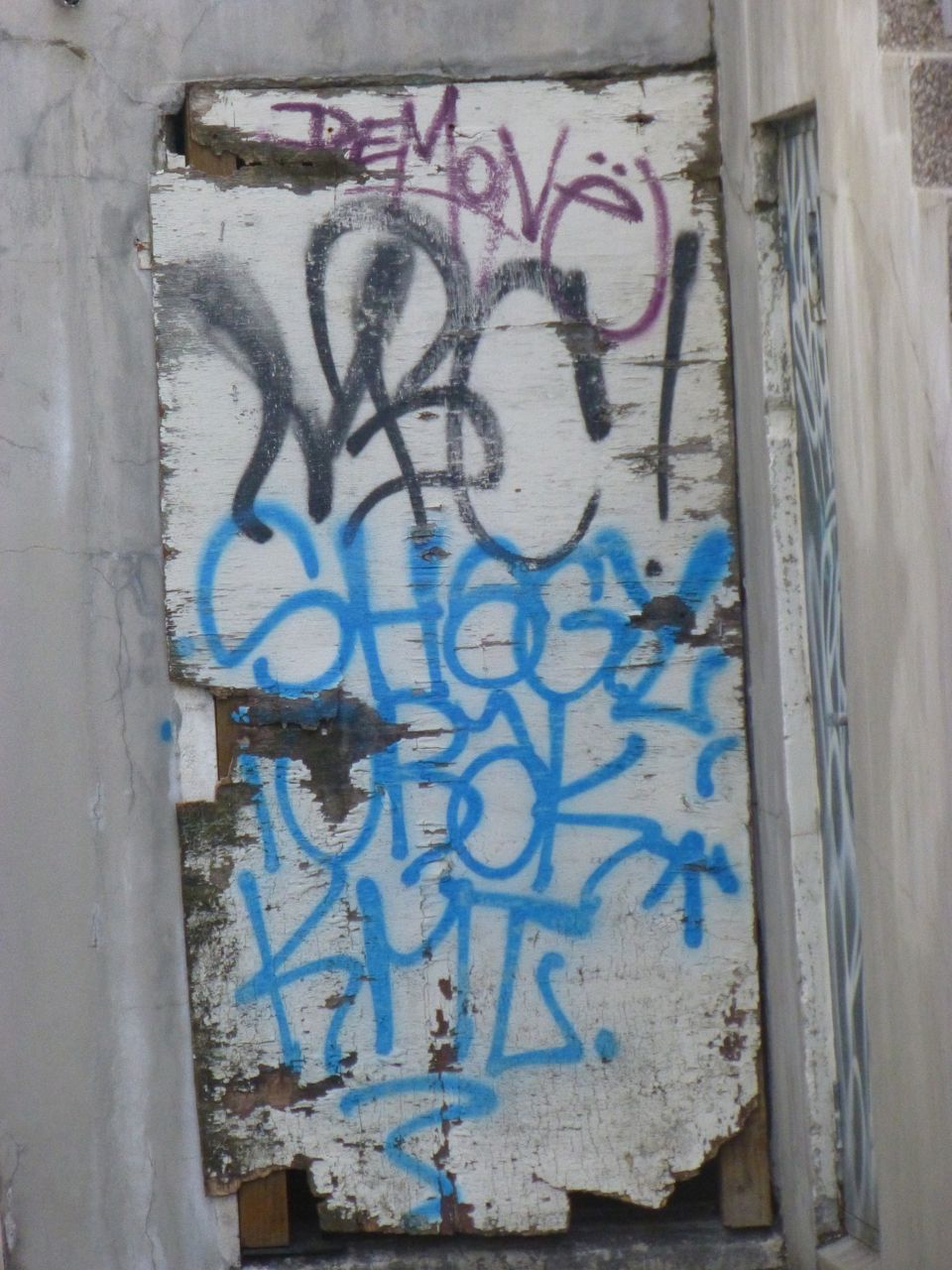
Art, Open Air Gallery, Frakkastigur
These restless humans are intent on adding a touch of wildness to the contemporary city, using the very elements (imported technologies, concepts and rituals) which they appear to be rejecting. Such is the paradox of people whose cultures have grown in colonial situations.
 Tractor Hiding Behind a Fence, Ingólfstræti, Reykjavik
Like the troll under the bridge in The Three Billy Goats Gruff. Note the excellent use of colour and the rather fraught respect given to the rowan trees — once a potent symbol of nationalism and now a no-less-potent symbol of ‘home’ and ‘place’.
For most Icelanders, the tension between the 19th century romantic story (the imported concepts of wild nature, wildflowers, waterfalls, beauty, landscapes, nationalism, and all that fine stuff, which enabled Icelanders to see their country as something larger than a net of social relationships, and which eventually led to the kind of post-colonial independence it has today) …

Strutsfoss, Suðurdalur
The invention of the colour blue. Pure 19th Century! Yes, it is possible to travel in time in Iceland. Wear sturdy shoes. A walking stick helps. Watch out for snow drifts (5 feet deep).
… is easily enough merged with newer imported technologies and old forms of social integration, into their communal village, contemporary Reykjavik…
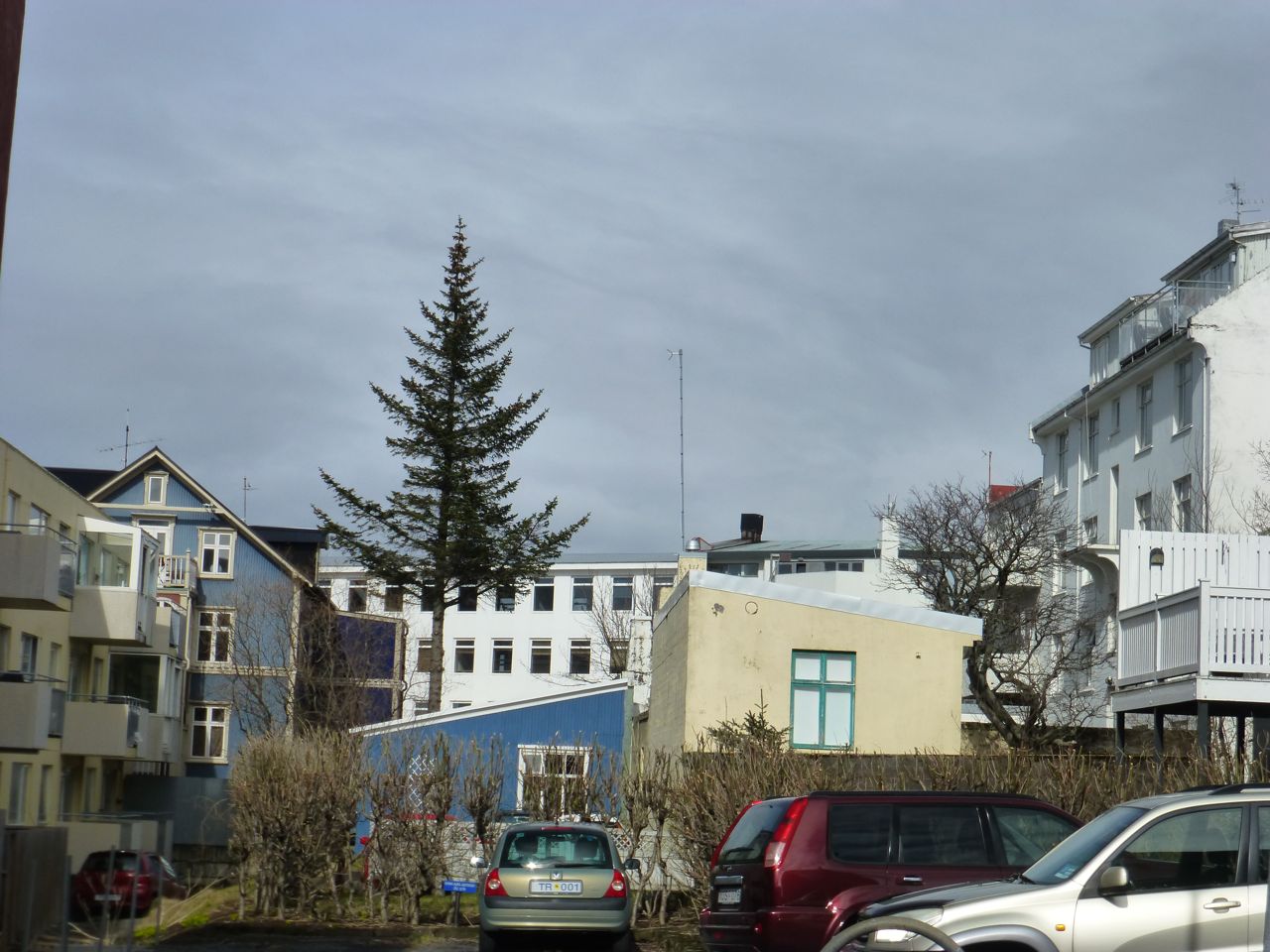
Reykjavik, Old Town
A typical neighbourhood view. This is what time (1945-2013) looks like when viewed all at once.
Culture creates a form of time that doesn’t move. Instead, it sculpts it into a complex dynamic. In the Icelandic case, this dynamic is a series of modernized replacements for turf houses for biological humans.

Two Kinds of Modernized Turf House, Reykjavik
The social decisions of humans over time and the ways in which they choose to animate space with their bodies and minds, including what they retain and what they discard, is a form of art.
In this case, the genre might be called: Stairways to Heaven. Or even, Jacob’s Ladder:
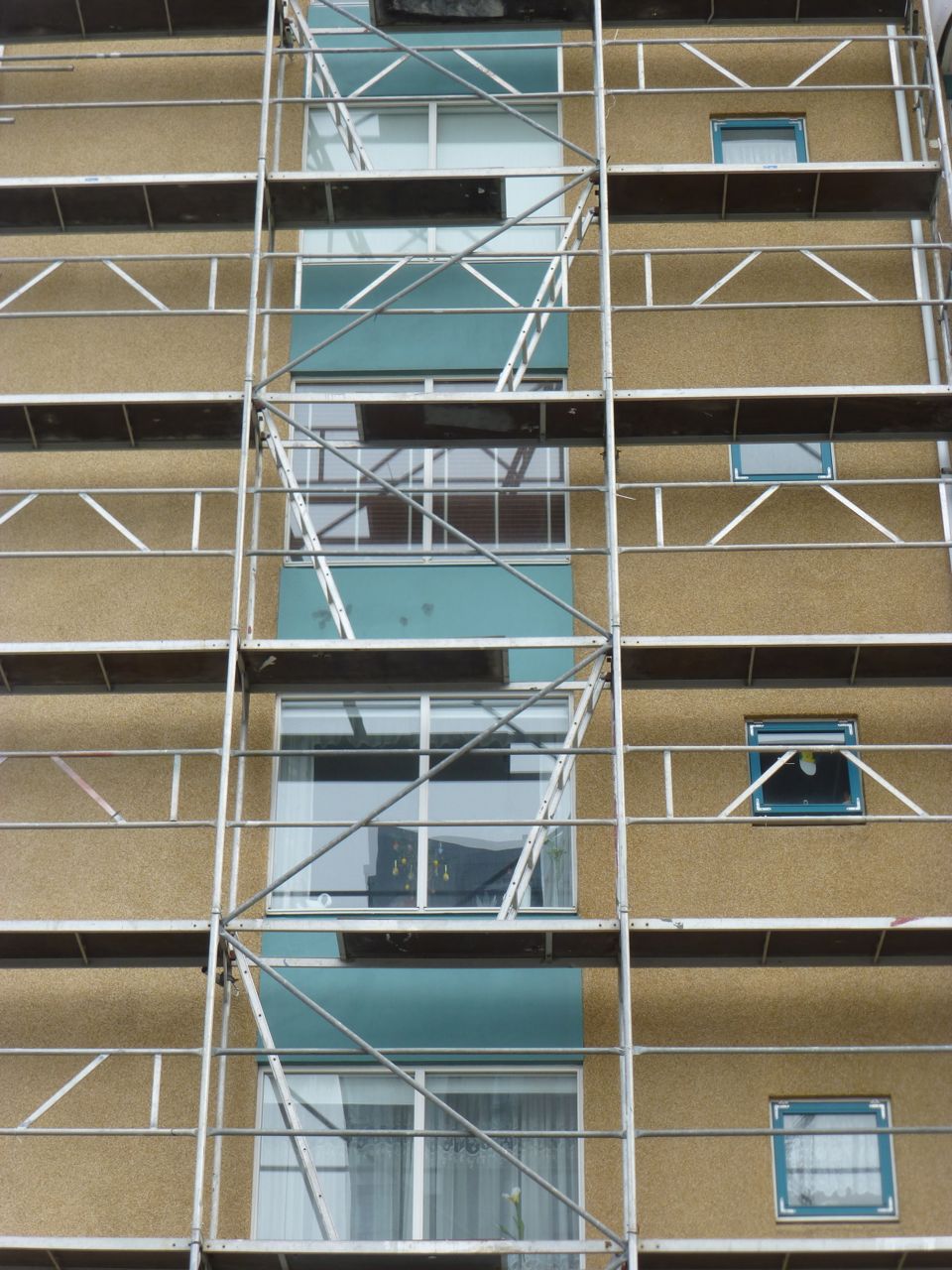
New Edition of the Holy Bible, from the Period Before the Banking Collapse, Skúlagata
There’s so much to learn and celebrate, but, as I said, it’s not always what it seems. Take this older art form, for instance:
 Litlafoss, Hengifossá
Nice waterfall, for sure. The raw power of nature. Pure beauty. Etcetera. We all know this romantic, 19th century story, and it’s worth telling and walking into. But there’s another story. About a century ago, there were five poles to North European culture: Nordic, Anglo-American, Middle European (including German and Jewish), Eastern European and French. Today, there is largely just a rump of the Anglo-American and a sliver of French. War will do that. In the forgotten Nordic version, though, the earth of men, or Middle Earth, was a point of balance between an earth of fire and an earth of ice. The waterfall above is just this balance. So is the one below: Detail of Waterforms by Kjarval
His friend, the writer Gunnar Gunnarsson, was also deeply attentive to Middle Earth.
Another way of looking at Middle Earth is to describe it as The Middle Way. For example, Iceland chooses to support certain of its artists, musicians and writers for life, as they are considered important parts of the national fabric, as essential for the support of the people as roads and electrical transmission lines and law courts.

Icelandic Artists Pointing the Way to to the Aluminum Plant
Make no mistake: this too is nature.
To support the arts in Iceland, sometimes you build an art gallery for a popular artist, such as Kjarval, which includes living quarters for both the man and his paintings. Such museums are scattered around Reykjavik. With the passing of the artist, they become full-fledged galleries … based around the achievements of an individual who serves as a model for citizens of the national state. If you were a poet, though, you’re more likely to get this:

Memorial to Jónas Hallgrímmson, Öxnadal
Long before Gunnar Gunnarsson, Jónas went to Denmark for an education. He came back with the idea of planting trees — an important contribution to Icelandic independence, as it helped Icelanders start to create their landscape, rather than just experience it. As a reward, Jónas has been planted among the trees. That’s his bust on the rock, there, within sight of the turf house of his childhood, high on the mountain in behind.
Artists have been a bit luckier. In the case of Kjarval, he got a museum. It is even called Kjarvalstaðir, or Kjarval City. In it, you will find this (waterless) waterfall…

Detail of Kjarval’s Technique
You get the idea: oil paint on canvas, brush strokes, and all the markings of modern art. Except, it’s not what it seems. It’s not really modern art at all. It’s folk painting that looks like modern art.
Now, before you read why I think this is an example of an old Nordic tradition living on into the present global art installation, let’s pull back a bit and look at the waterfall in its context.
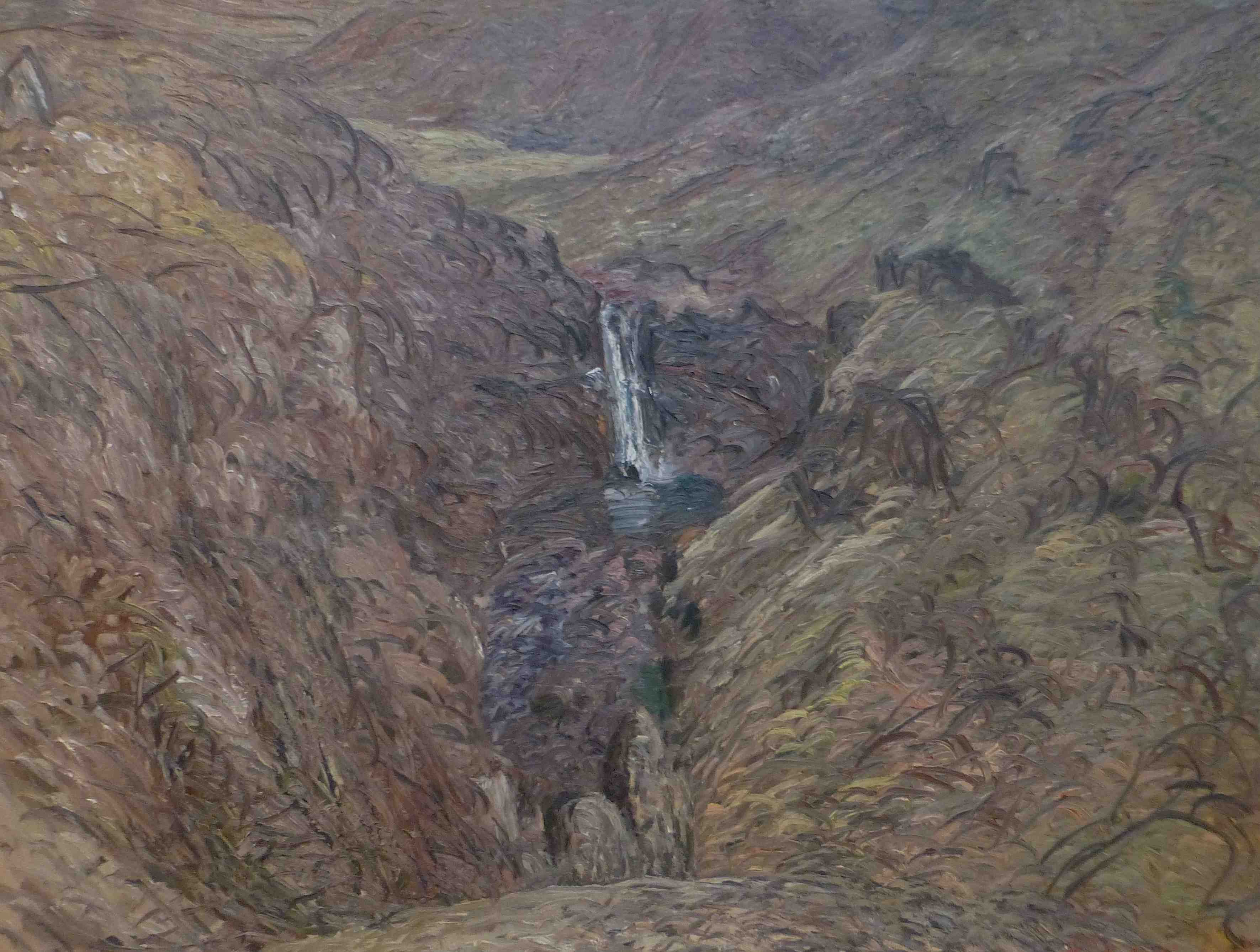 Kjarval’s Waterfall
Pardon my camera’s wonky understanding of light and colour. Luckily it’s the lines that are intriguing here. Look at them all. All kinds of squiggly this and that, eh.
Critically, Kjarval is an enigma. From the point of view of modern art, he was obviously a skilled practitioner (although it’s usually mentioned that he was self-taught — which is code-word for “Hunh? Whah? Why?”).
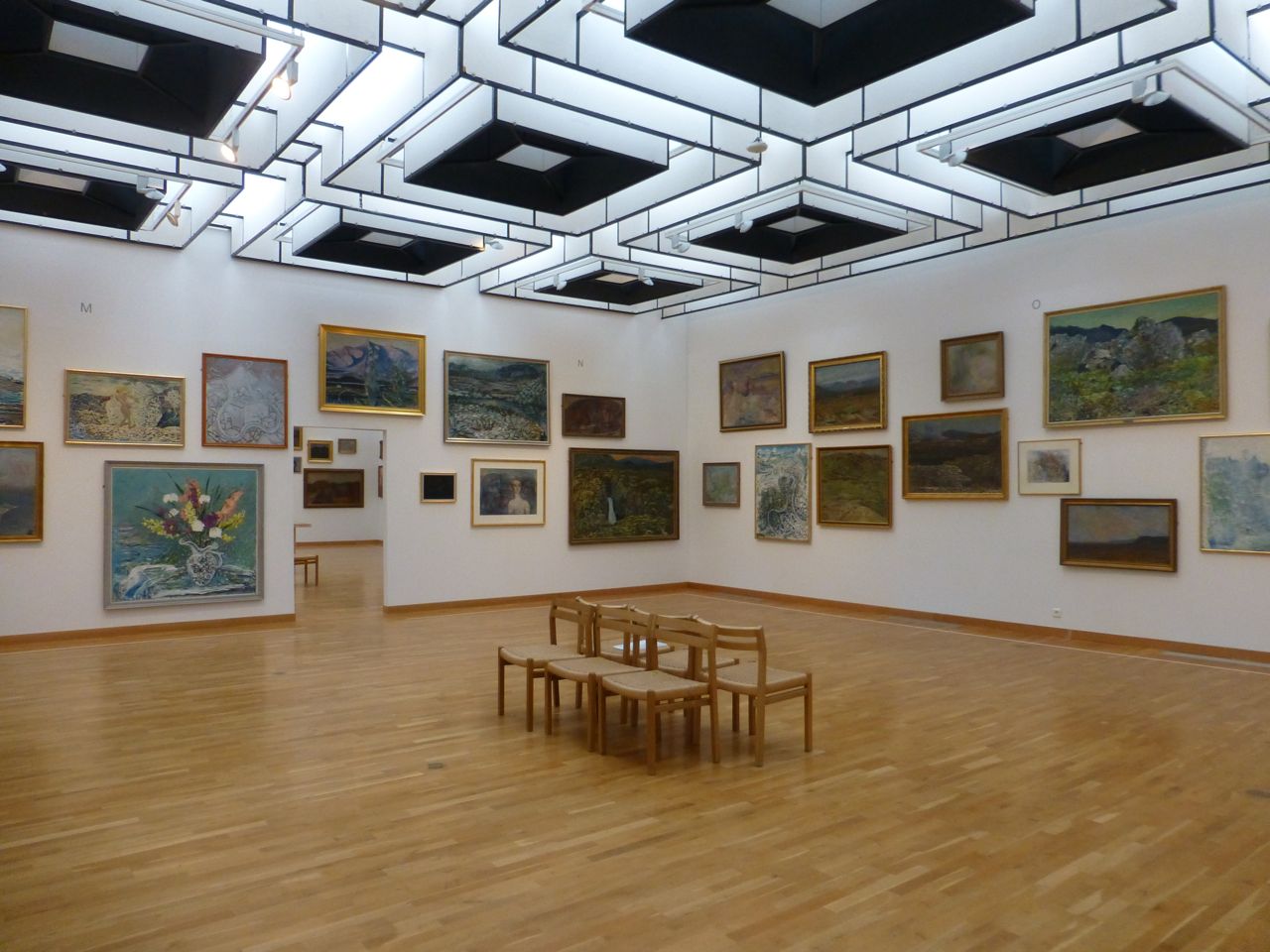
Church Bazaar Art Elevated to World Gallery Status
That’s Kjarvalstaðir for you! If you think this is a criticism, think again. It is, among other things, a form of deep respect. For another thing, there is no Platonic law that states that a work of art by an individual can’t find its fullest expression socially (such as in the social frame of an art gallery.)
Kjarval is also frequently described in the art world as an oddity, because he never settled on a personal style, nor developed all of his skilful interpretations of world art traditions and techniques into a language of his own, which is de rigeur for a modern-art-scientist-individual type, like, say, Klee or Picasso. Kjarval remained colonial to the end, as in this energy diagram resulting from a cross between Gaugin and a German woodcut (Without wood, the medium of choice became paint imitating wood’s recording of solar and water energy — very clever.)
 … or this incomplete pencil crayon fun, lovingly framed by the gallery’s architecture and lighting …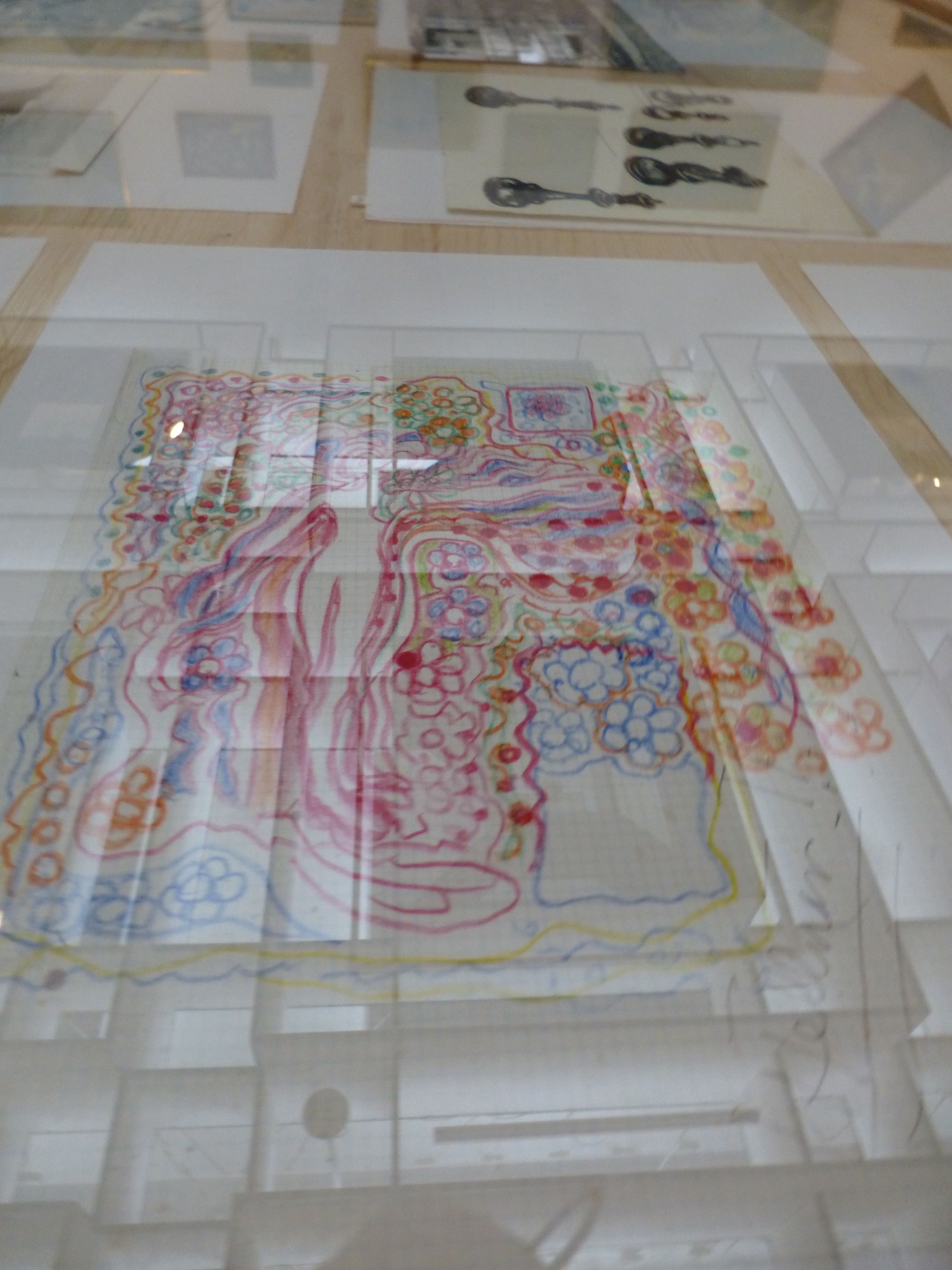
In terms of the art world, these deviations from an elaborate intellectual language are the signs of an amateur, even a child or even, gasp, a non-artist. Now, that just can’t be. How are you going to have a national artist, when there’s no art? It does certainly leave the Icelanders with a bit of a problem: not only is Kjarval the most popular of all Icelandic artists, bar none, but there’s a whole architecturally beautiful museum plunked down in Reykjavik devoted largely to his work, and in a display as sophisticated as any small town display of amateur works by a local painting club, too…
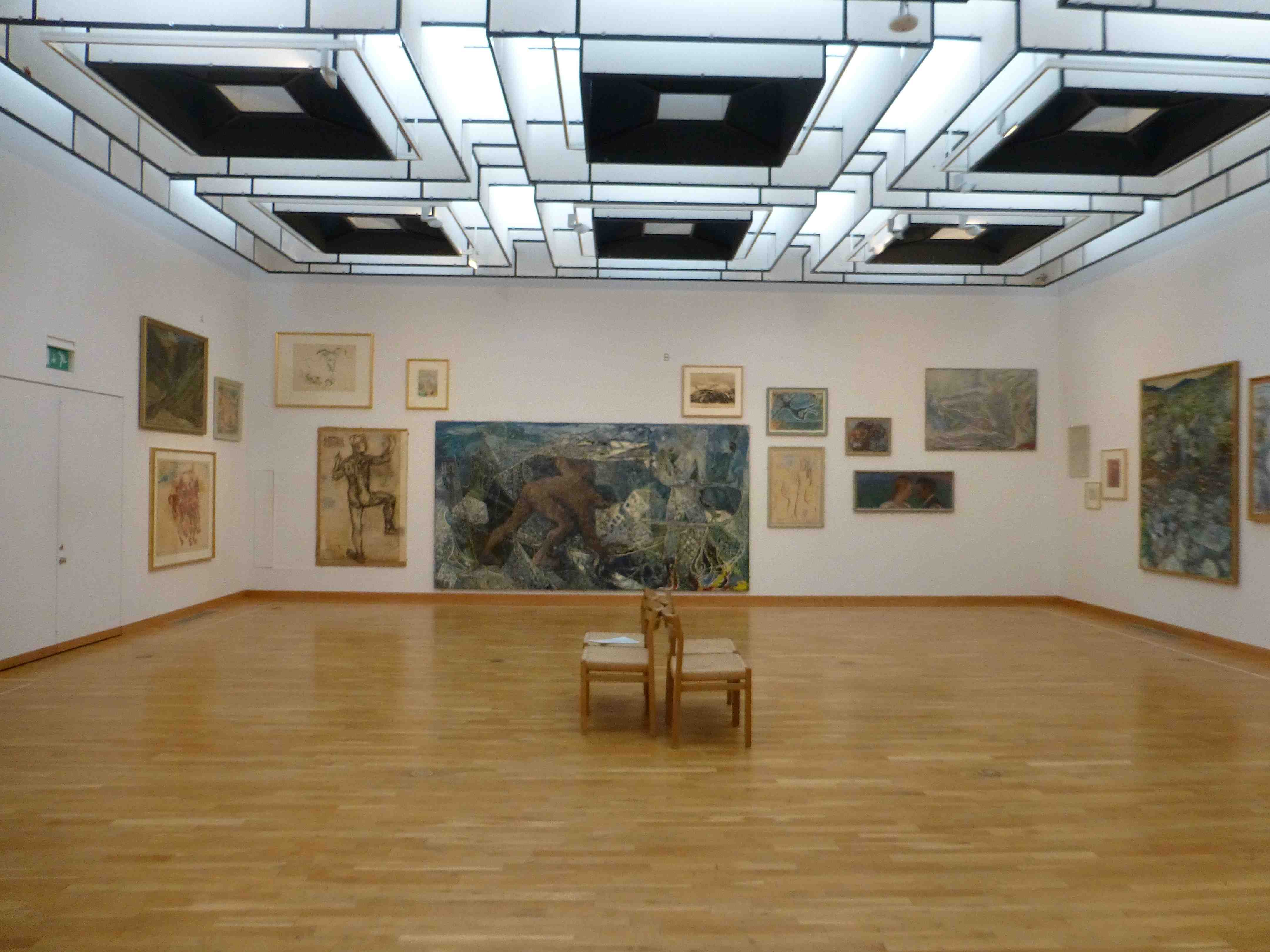
Bit of an embarrassment, really. Ah, but it’s not what it seems. For one thing, you can serve food. That works. Keep the bodies fed and magic may follow. You never know! Actually, you do…
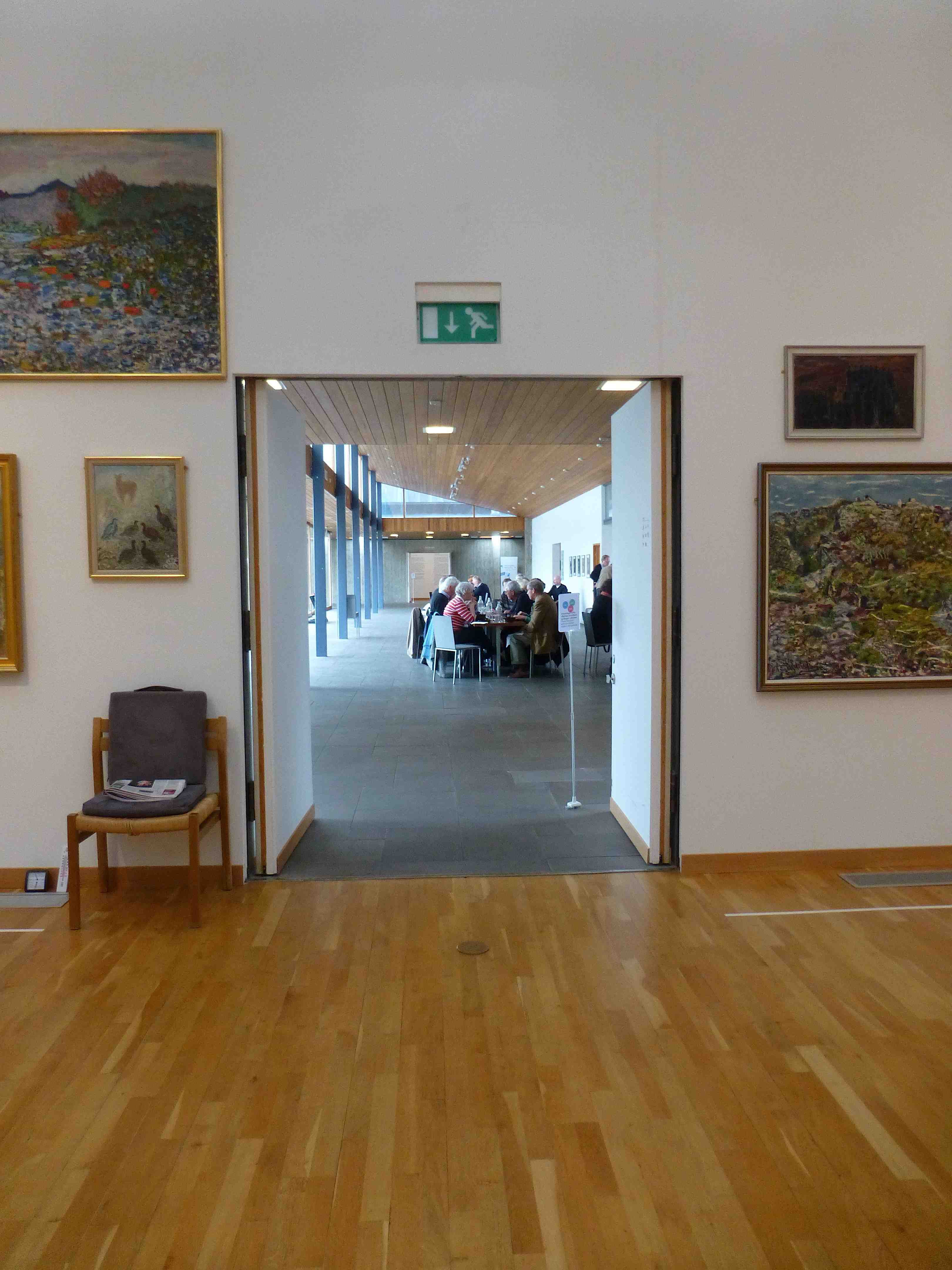
Viewing the Art is Not the Point.
Living with it, and within its display, is. Why, one can be as easily framed by the gallery as is the art. That is, actually, a pretty profound experience. Icelanders know this.
For another thing, take a look at some of those marks below and to the right of that waterfall I showed you above…
 Kjarval’s Paint Gouging
It’s like he set his cat onto it, with claws. Or let his pet raven wander over it, scritchy-scratching, or started playing x’s and o’s with his subconscious. I wonder who won.
Now we’re getting somewhere. In the world of individualistic, über-scientific modern art, child of the Enlightenment, god daughter of the intelligentsia, brush strokes, scratches, gouges, lines and other marks are part of a sophisticated texture … which somehow doesn’t include these. These look rather formless. They’re not, but the impression holds, nonetheless. That’s because, they’re really this:
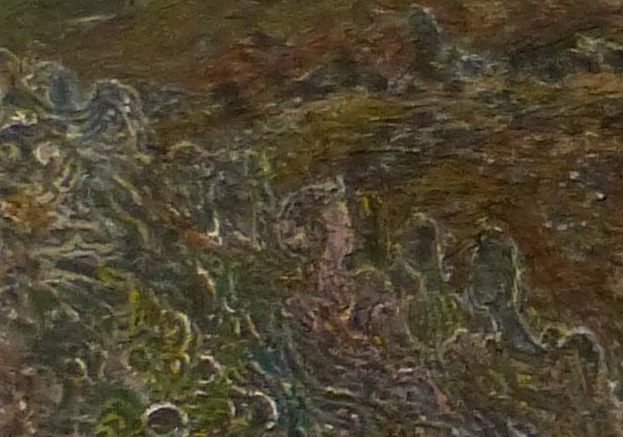 Kjarval’s Elves
…and this…
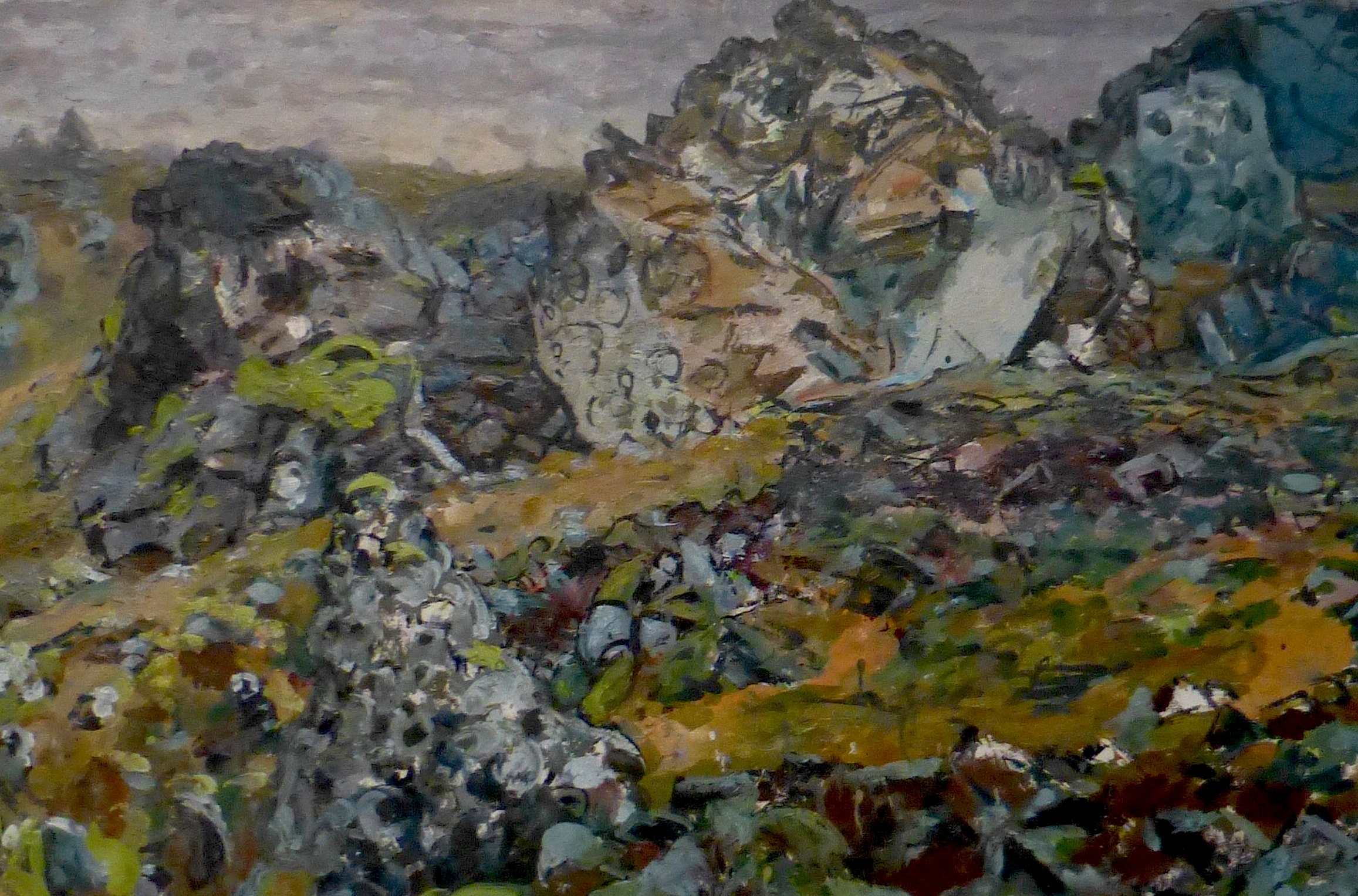
Kjarval’s Trolls !
Poor art critics! The Icelandic people love looking for the faces within Kjarval’s paintings. The art critics just scratched their heads at the childishness of it all.
Well, one can forgive the art critics. For one thing, they didn’t go to school in an elf village, did they. For another, no one built them a playground in the harbour. For another, they might not have seen this:

Trolls, þingvællir
Looking down over the World’s first parliament (965 AD).
So, let’s recap: a country that retains its folk animals and its folk beliefs because the land is unstable and “you never know” (although they do), does not build houses on fairyland but raises and educates and plays with its children on it instead — and not because they’re children; because they’re equally valued and are socialized by exposure to non-human energy. The country’s favourite artist interprets world artistic mark-making within this context and replaces sophisticated intellectual mark with sophisticated folk marks, in which the non-visible energies of the other people are everpresent and revealed …
 … as if they were a language (a spiritual language, which is one step up the ladder from a. physical, b. individual, and c. social). The country responds by completing the art work in a social context and then proceeds to do a most amazing thing. It brings its children here, a place now as sacred and powerful as the elf houses themselves, and proceeds to educate them into sophisticated artistic responses. Method includes a room for parents and their children to make art together and post it into frames on the wall after viewing the galleries, in a process as capable of social completion and change as Miro, say, or Klee, within their non-colonial contexts (and which would function as colonizers here, if not released from that role by this truly Icelandic process, with its roots in the Middle Way of ancient Nordic culture) …
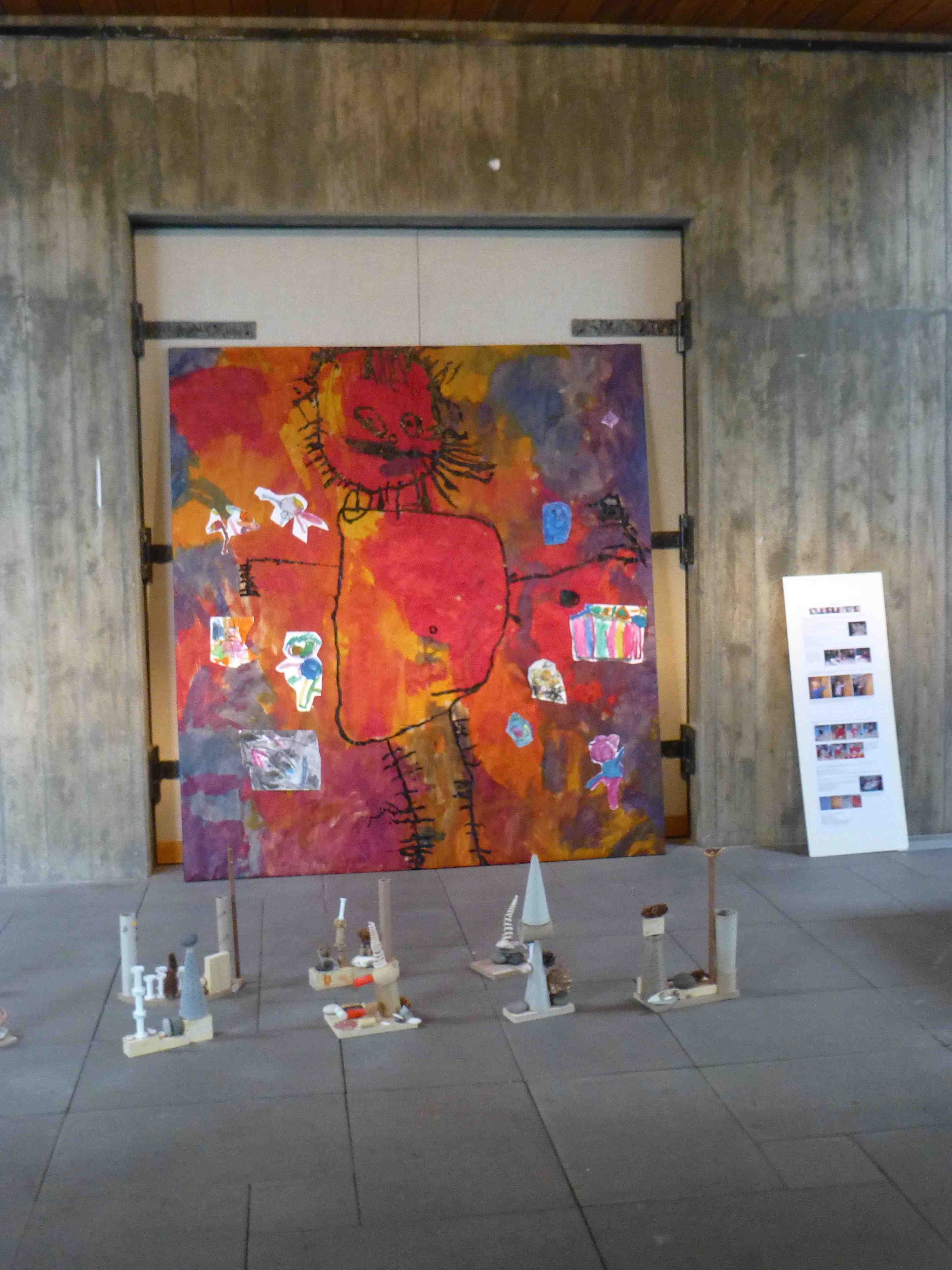
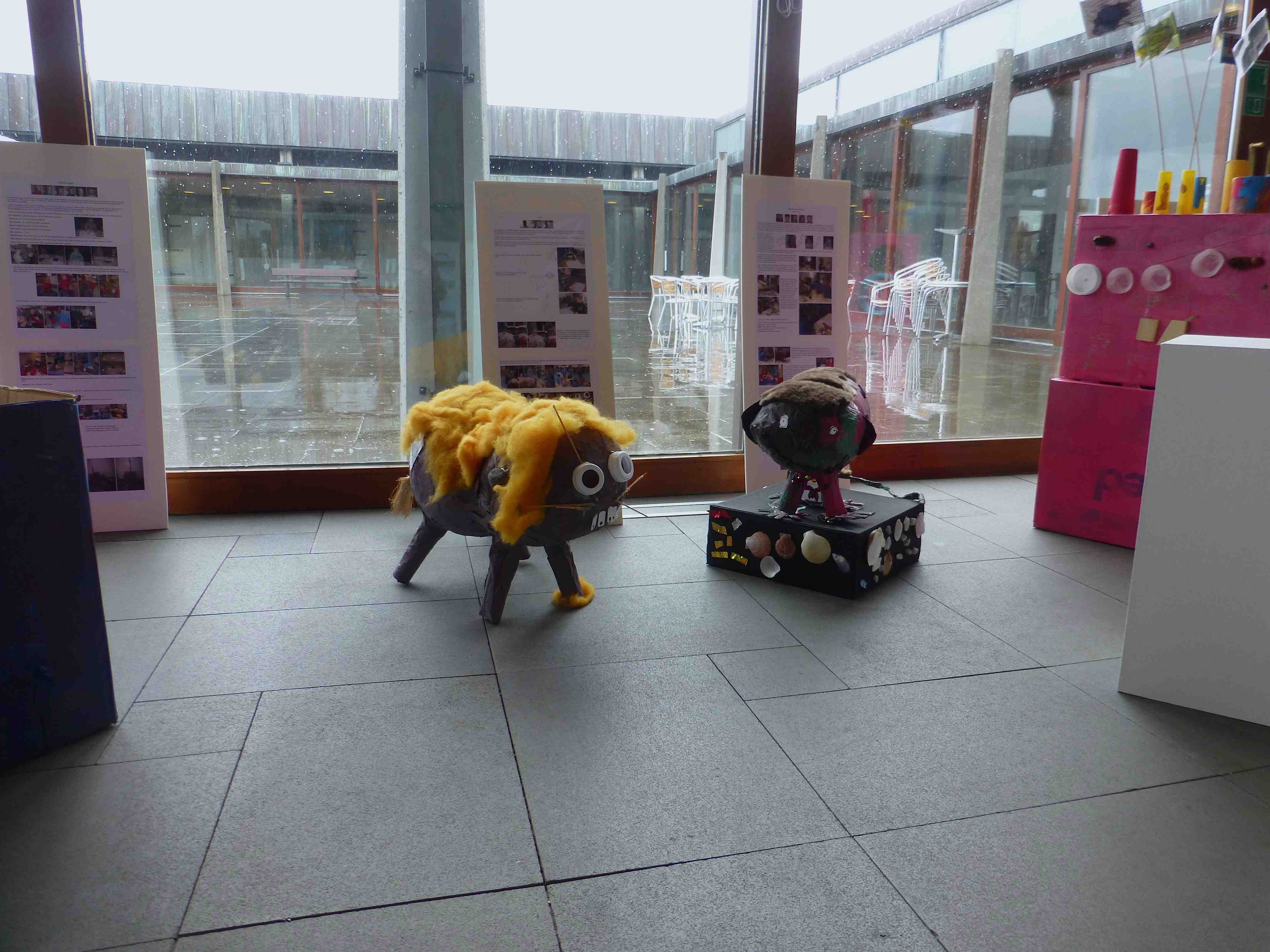
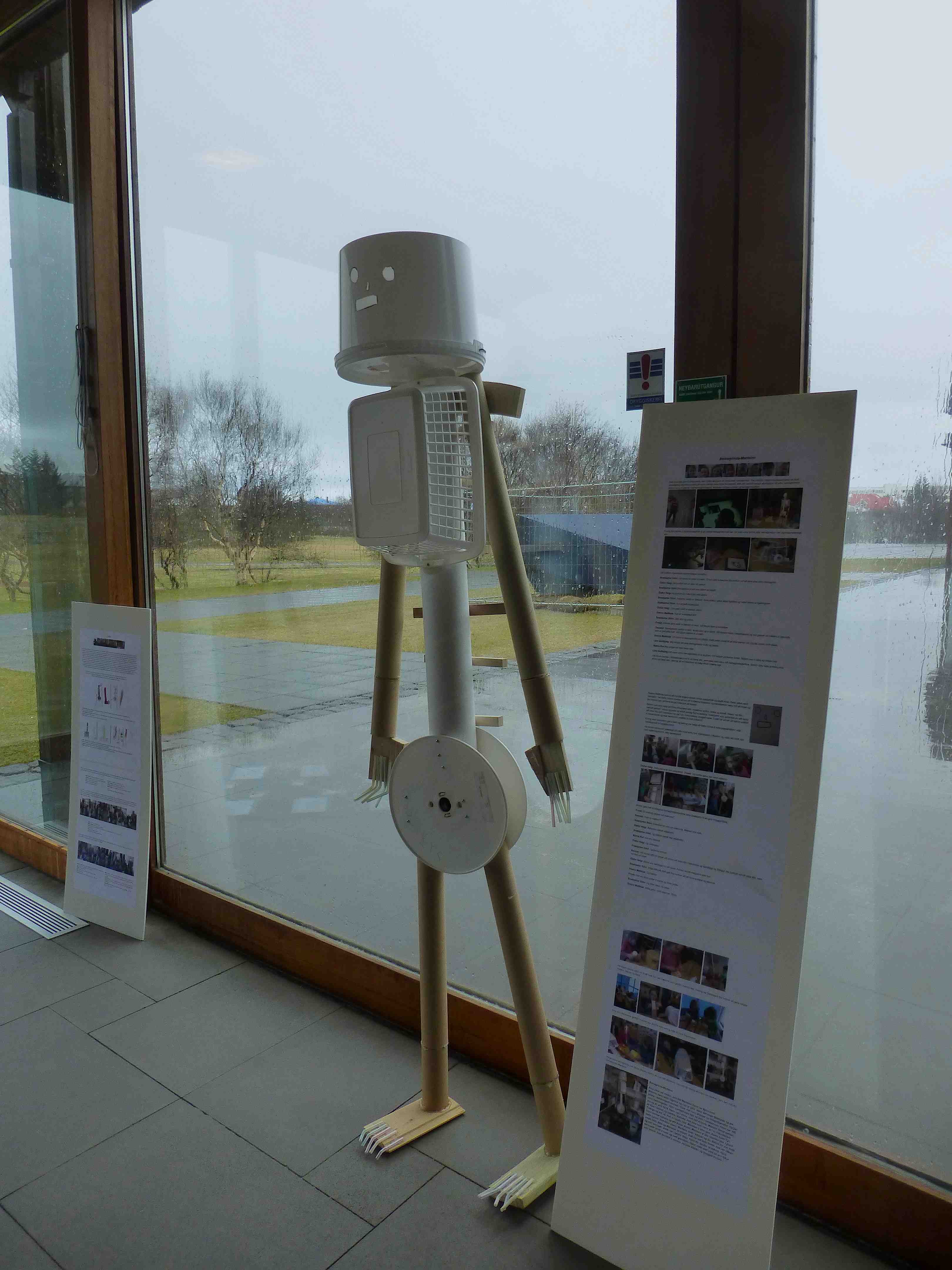
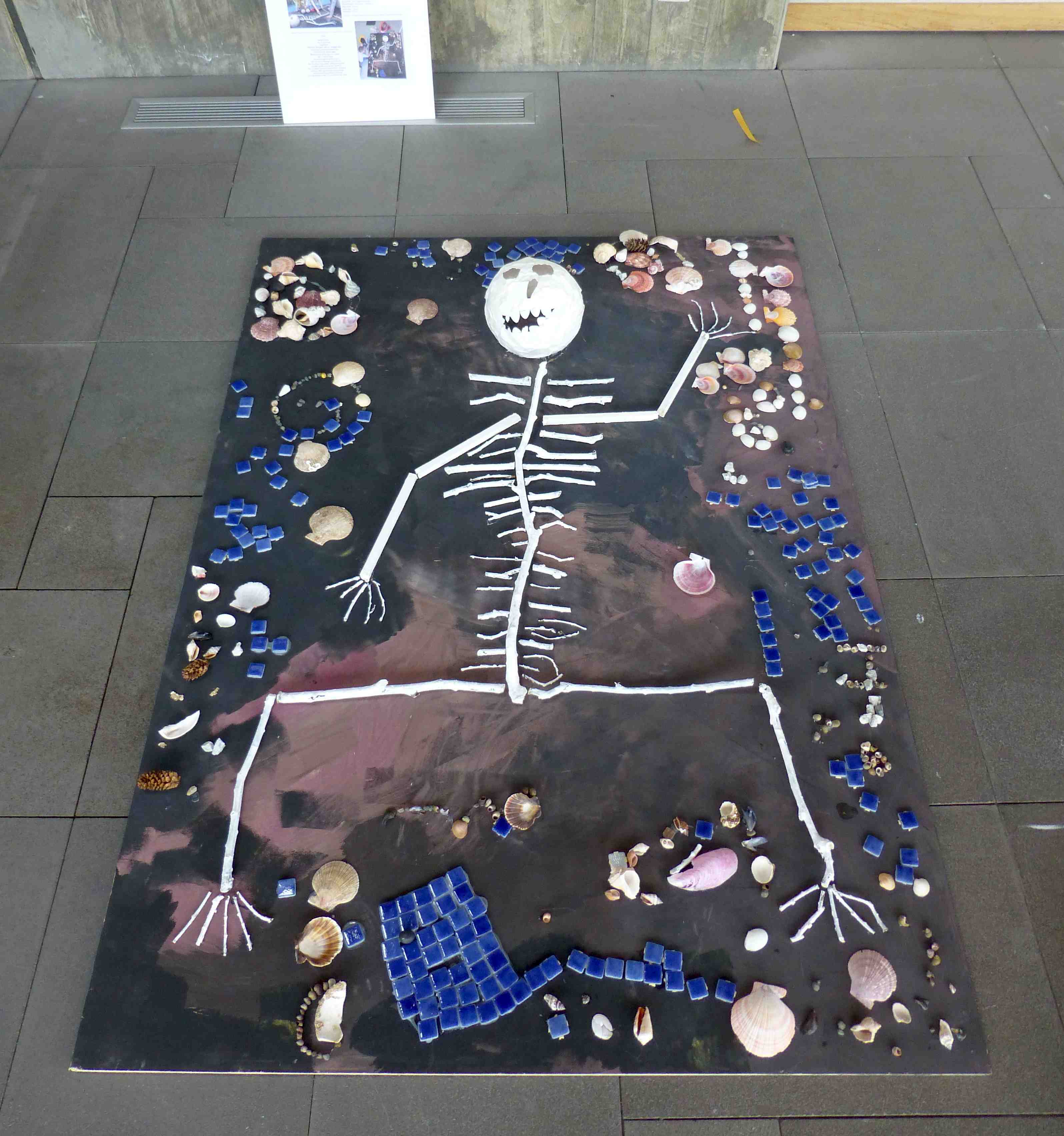
 … and a project in making art out of recycled materials, which includes small people less than three years old, whose innate art-making has not been otherwise rewritten by elite codes …
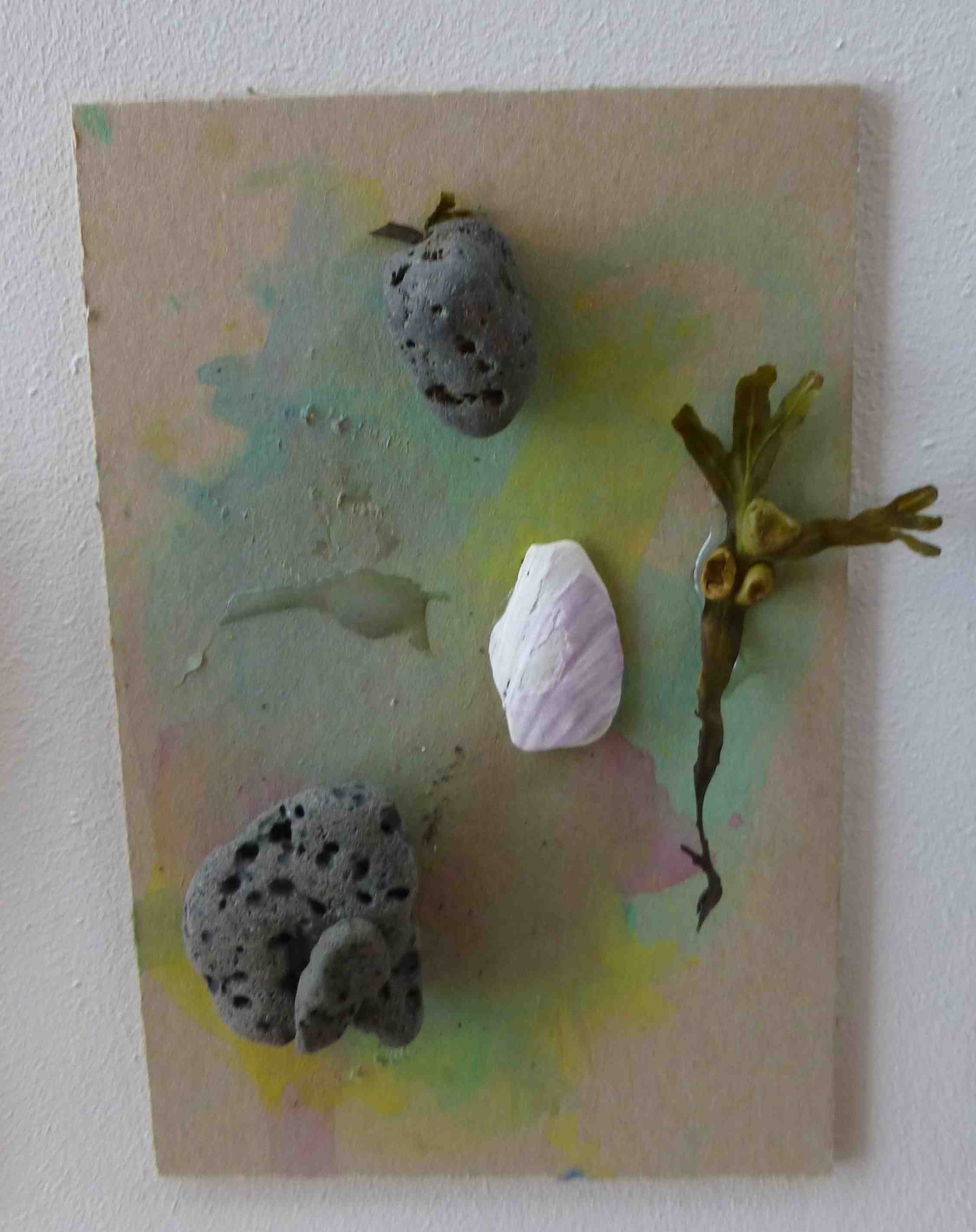
Icelandic Artist’s Collage
(Name with-held for privacy. Available on request.) Age 2 yrs, 11 months.
… sophisticated portraits …
… elaborate portraits of dwarves …

… a Coast Guard Ship …
 … the family cat …
… Diaper Day Mom …
… Enough ribs to make ribs fun again …
… and an elaborate, high-art contribution by parents and teachers, helping to stage the show …

Beautiful! It Almost Upstages the Kids…
… but not quite.
This is what the Canadian approach to a colonial past misses: a past before the colonial past that it can reach into and transform the colonial experience into merely a passing fancy. In Canada, cultures are continually replaced. In Iceland, children are brought to make art in the country’s national galleries, and the art they are asked to view there is of exactly the same kind of material, intent, and subject matter as what they produce in response to it. And so the cultural loop is closed — partly because “children” are viewed as equals to adults, if not superior to them, which is definitely not the Canadian way. In Canada, they are educated to be adults. In Iceland, they are already adults, just very special ones. Is Kjarval’s art “world class”. No, not in the way that is meant. But does “world class” art find fulfillment in the following image? (Hint: no, it does not. It might look like modernist Dutch art, but it is not.)
 Typical Reykjavik Housing
1000 years of clustering together in the Bath Hall (the only heated space) in their houses have made Icelanders eager to live very closely together. It also helps to keep out Nature, which is great retro stuff for attracting money from tourists who grew up within its 19th and 20th century images …
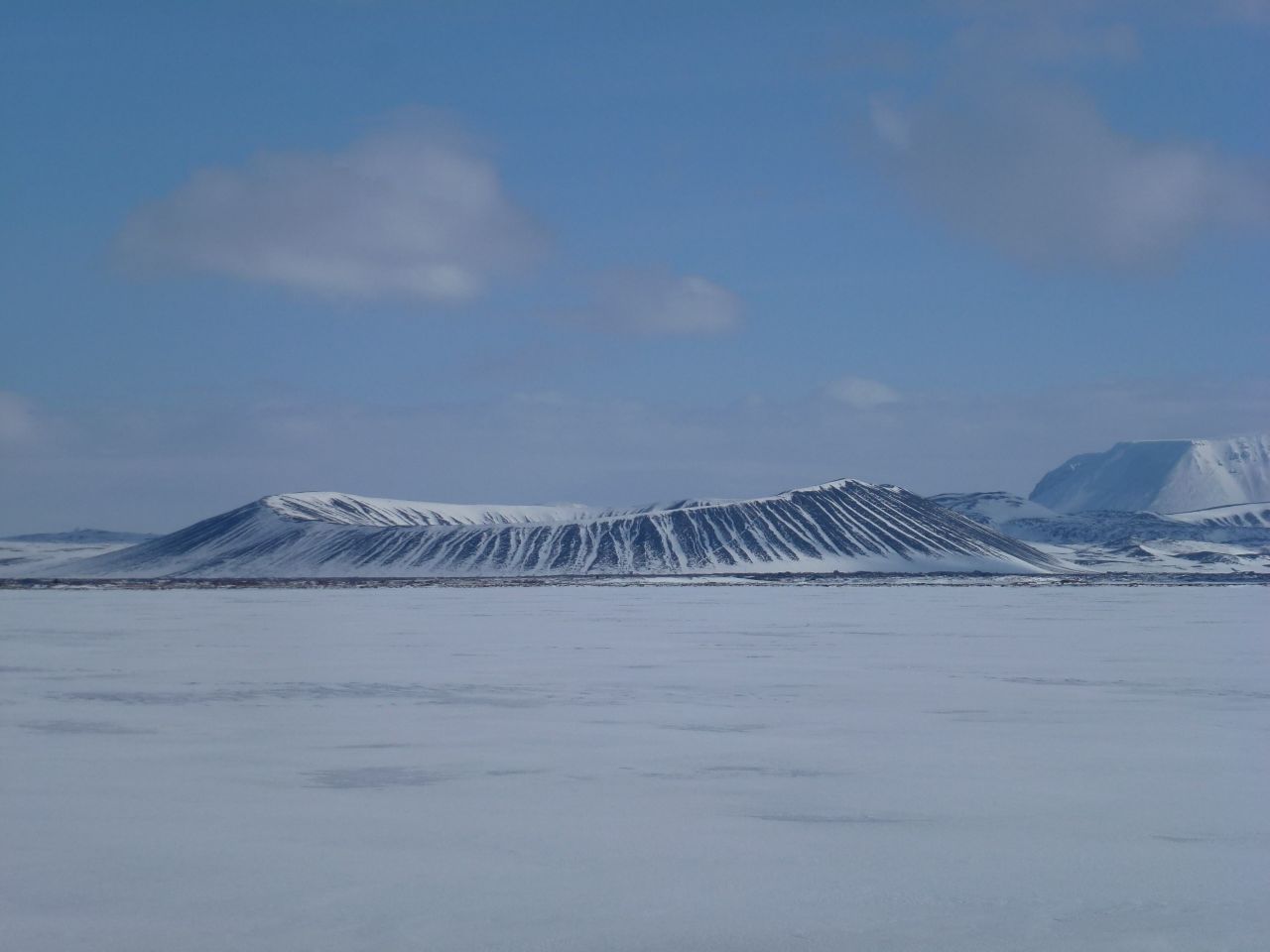 Hverfjall
… but it can kill you. It is best to make something out of it.

Turf Barn, Landshús, Norðurdalur
So, Icelandic art and literature can sometimes appear childish and a bit awkward (Gunnar’s sure does, at times, and the contemporary situation is no different), but they work within a very specific social context, that is still in touch with the Nordic roots of contemporary Western life, roots which most of the literary and art worlds have completely lost. Next, I’ll explore those roots a little, but for now, thank you for spending some quality time with me among the elves.
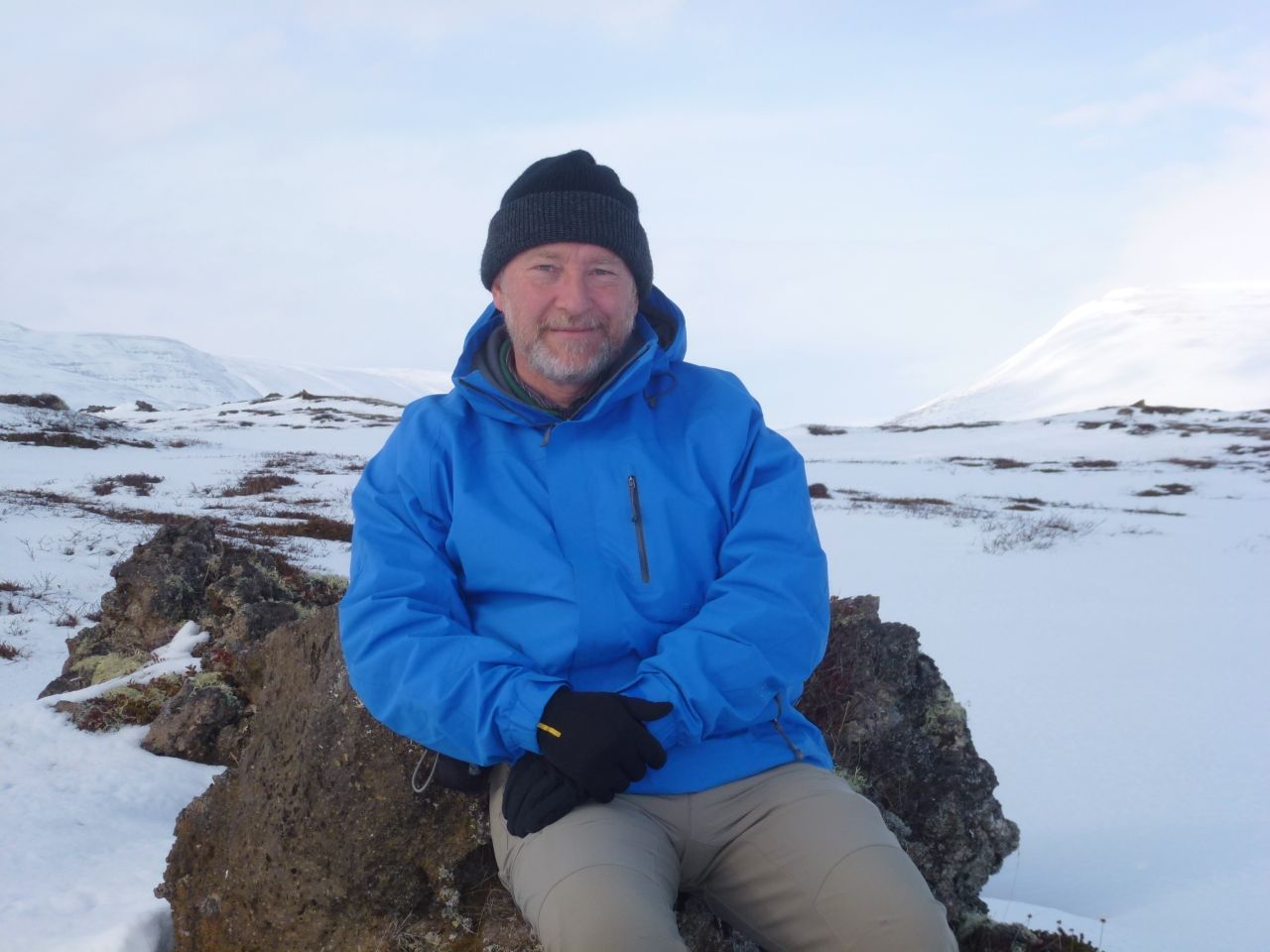
Harold Among the Elves
Goðafoss
For the last month, I have devoted almost my entire time to completing my Iceland project about Gunnar in World War II. The whole effort is like fitting together a puzzle, or the way in which on my last day in Reykjavik, I witnessed some Icelanders attempting to build a forest in the middle of the city …
A Forest in Process
Sometimes words just won’t do.
Canada is not a country in which art is so closely combined with public and private life, and that’s too bad for Canada. It speaks to the kind of wealth that comes from a colonial history of buying things, rather than building them. Iceland has a good dose of the same colonial disease, but, the outcome of the election this project was designed to influence aside, has a better chance, I think, of coming out the other side into the earth and greater human richness than does Canada.
 Danish Post-Colonial Dining Room Furniture Taken Outside for Some Fresh Air
Over time, this forest construction effort brought many thoughtful and happy onlookers. The whole process filled people with delight. And why not. Look at how trees and scrap wood are brought together to make a model (a kind of 3D map) of Iceland itself, right in the middle of the city…
 Look as well how the effort requires fashionista colour coordination between man and tool, and the union of hiking footwear with workman’s gloves. Reykjavik mornings can be like that in the spring time! In fact, isn’t that an image of the Icelandic economy as a whole?
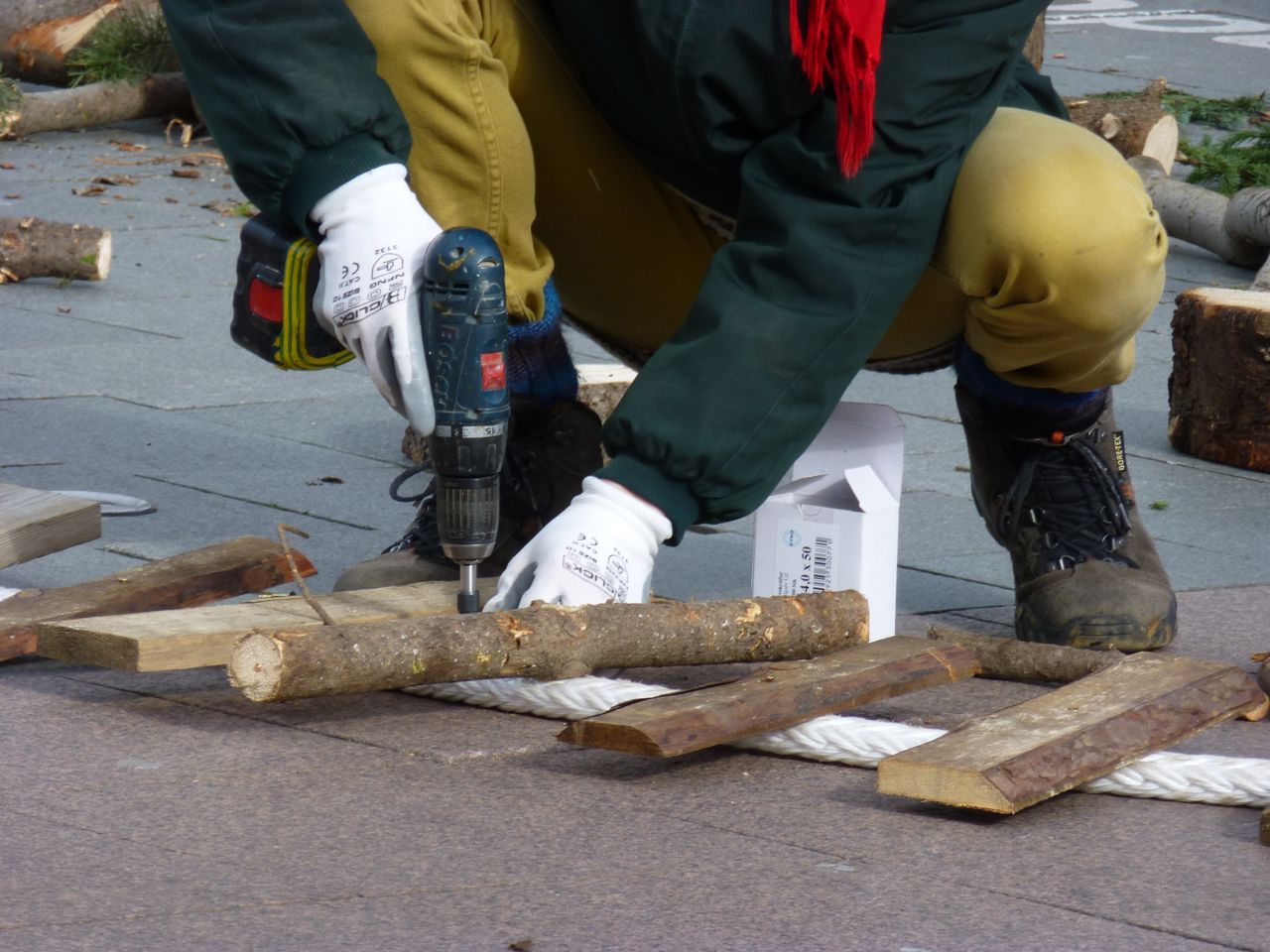 It is also the work of a community, of which there appeared to me to be no leader. It was as if the sculpture itself, the new forest, was directing the humans…
 I had to get on a plane and leave, but these are the images I took away with me, and which I continue to expand in the work. I believe that the images show something uniquely Icelandic. It is a kind of creative energy, with very specific roots deep in Nordic culture, on the one hand, and in the Icelandic settlement experience on the other, which is ongoing, and not historical. “History” is just a word. This is a living thing. In the next few weeks, I plan to show some other examples of this energy at work in modern Iceland, and by then I think it’ll be time to show you how I have been fitting them together, like a delightful jigsaw puzzle, into my story about Gunnar. Bless bless!
The ideal woman of Reykjavik, c. 1400…

Mary of the Hallgrímmskirja
Note that she is on life support with an artificial power source.
… and in the modernist period …
 Woman at the Picnic Site
Still with a child. The houses in behind look like Nordhausen. Statues like this show up in Germany at nationalist sites, such as the Dornbürger Schlösser north of Jena. There, though, she has no child.
… and today …
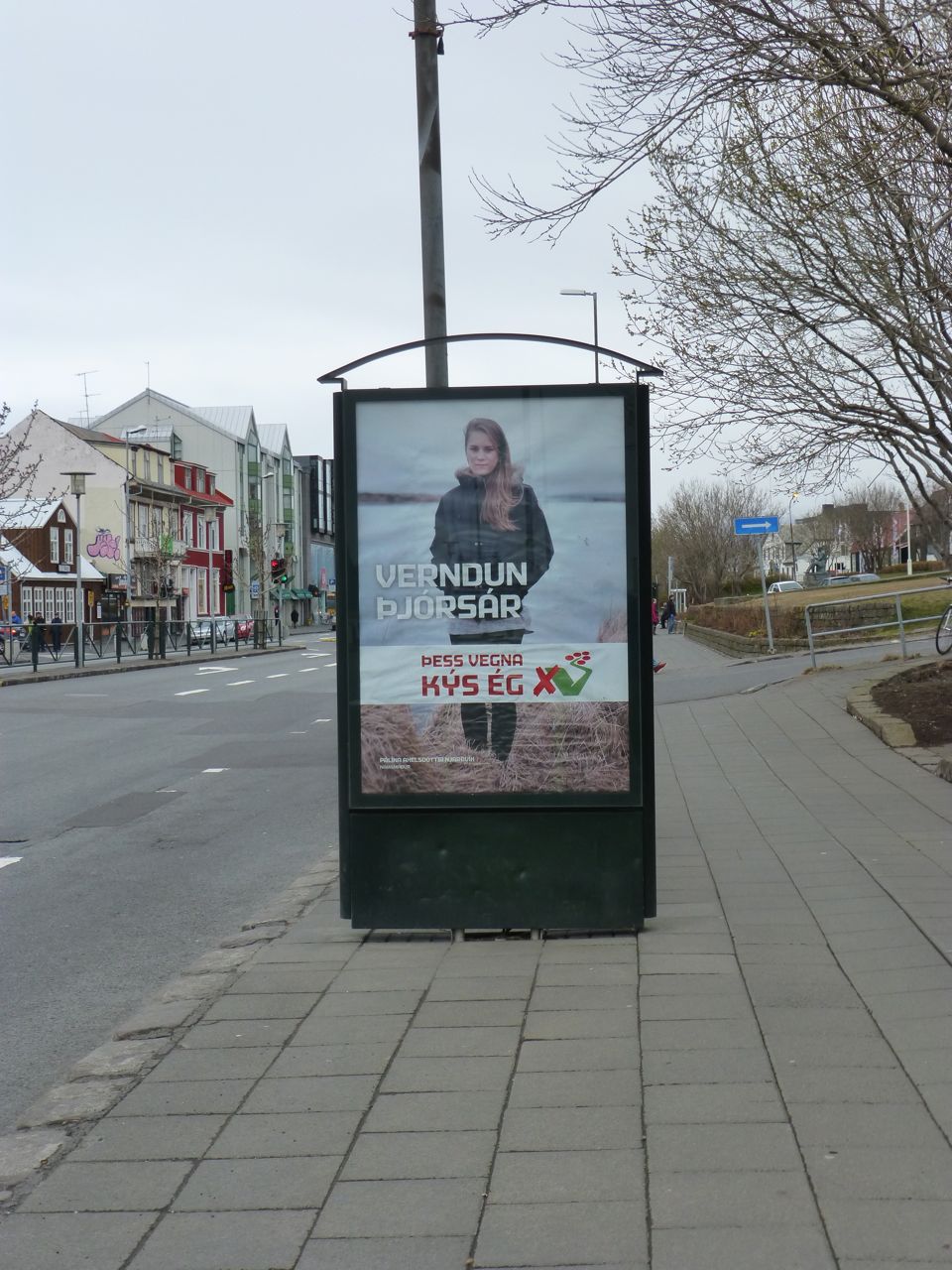
Green Party Election Candidate on a Bus Shelter
What a journey! There’s more …
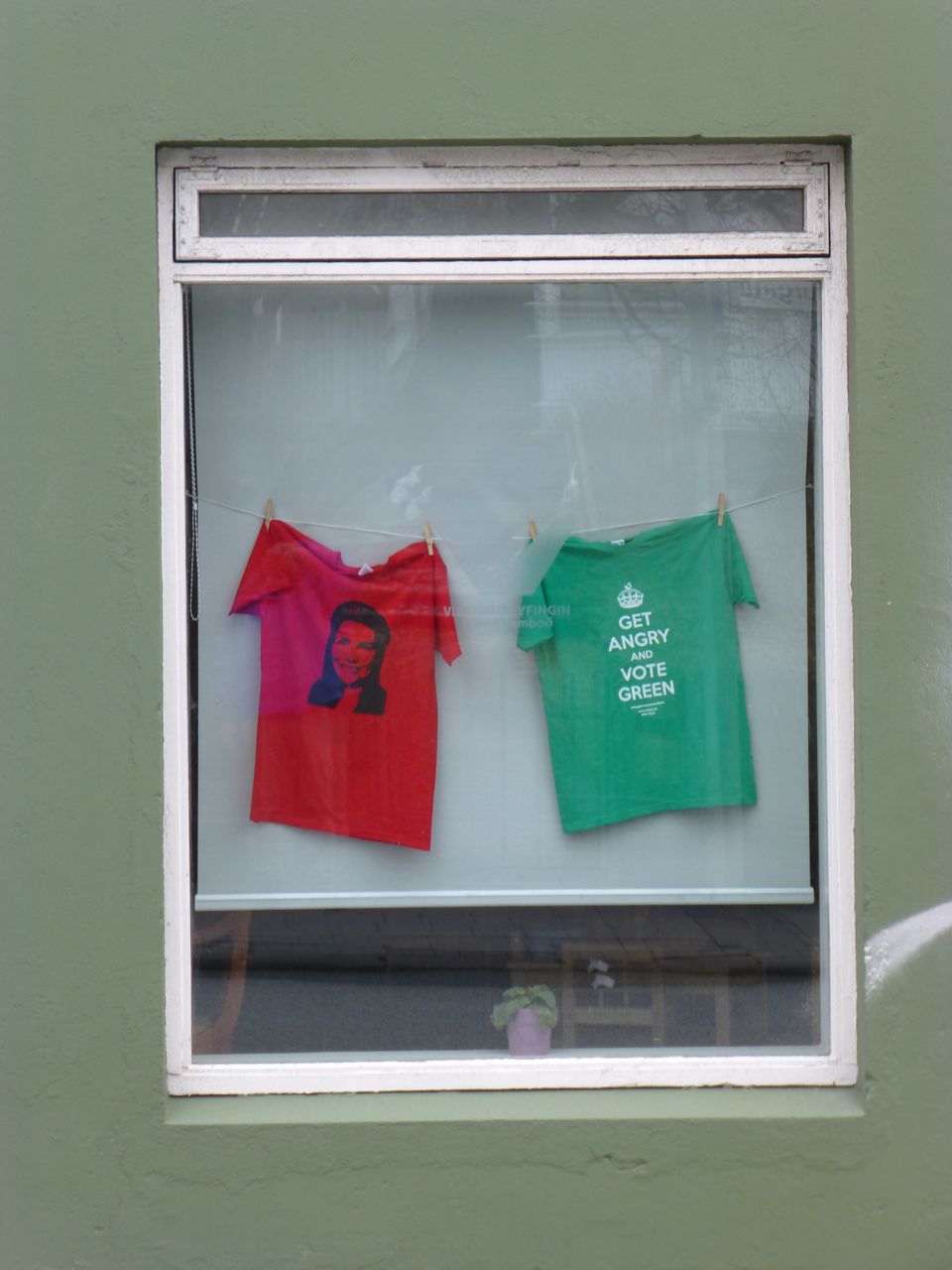 Green Party Window, Reykjavik
This an unfolding story. The oldest telling of it and the newest are still alive together at the same time. Look …
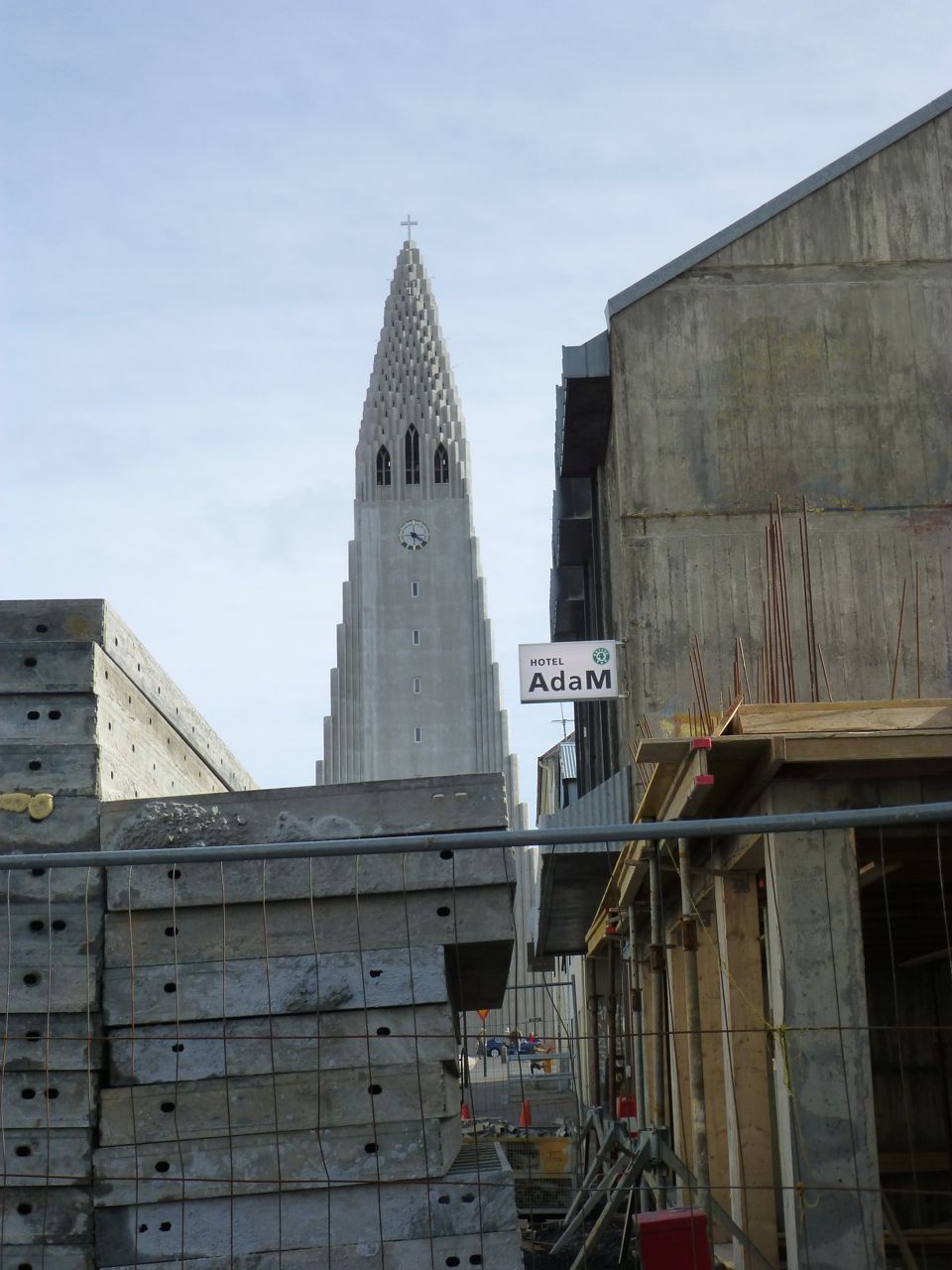 Adam’s Hotel for Travellers
Right by the Hallgrímmskirja, too.
At first, it looks like a clever pun, in the old Icelandic tradition, but look, right next door, in a passageway, amidst the tagging …
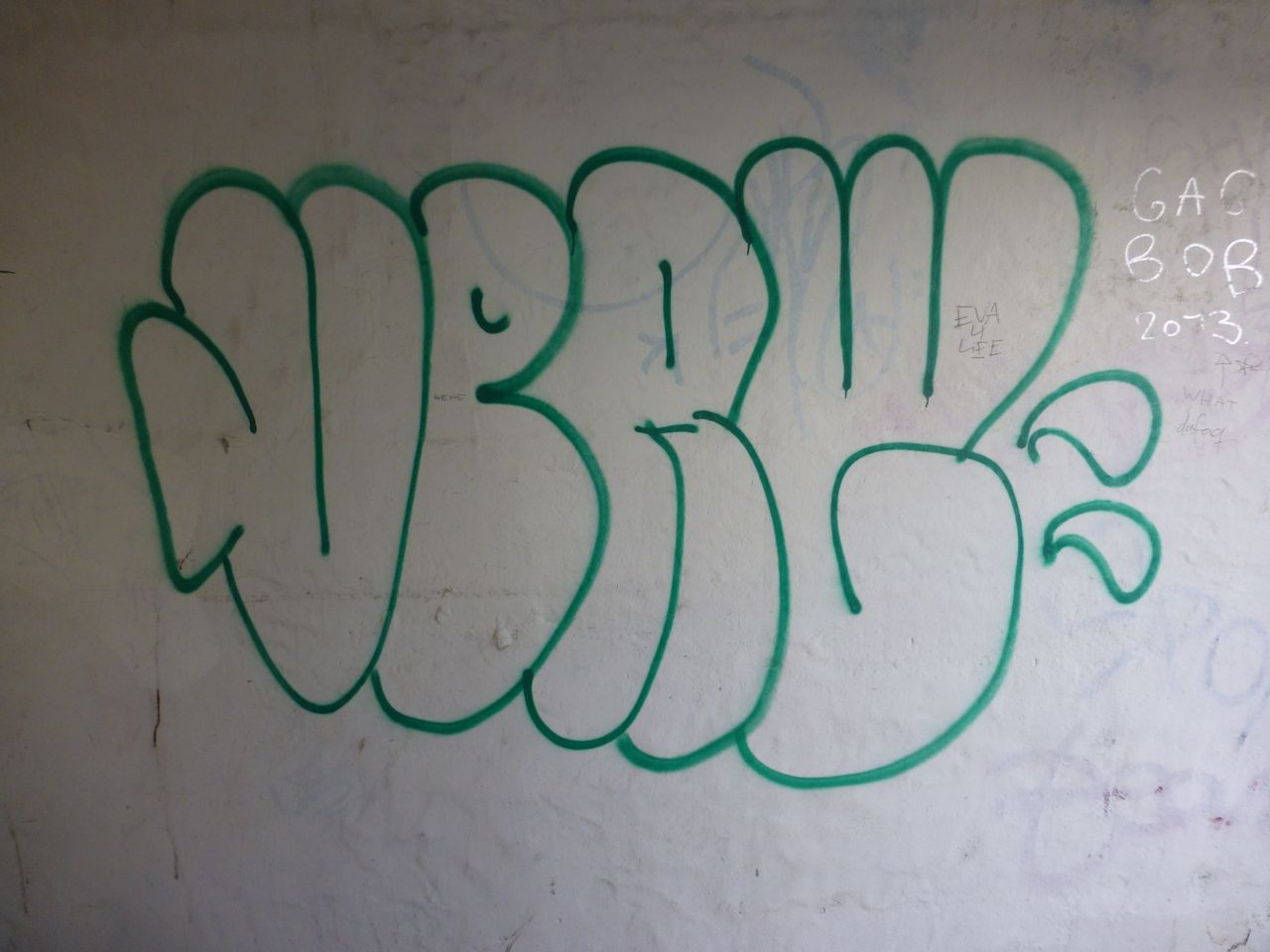 Green’s a great colour, but it’s the details that matter. Look inside that tag …

Adam, we blush. In this context …

See What I Mean about Nordhausen, that DDR ruin?
Maybe not. You had to be there in that DDR mining town abandoned by reunification, I guess.
Still, her beau is here…
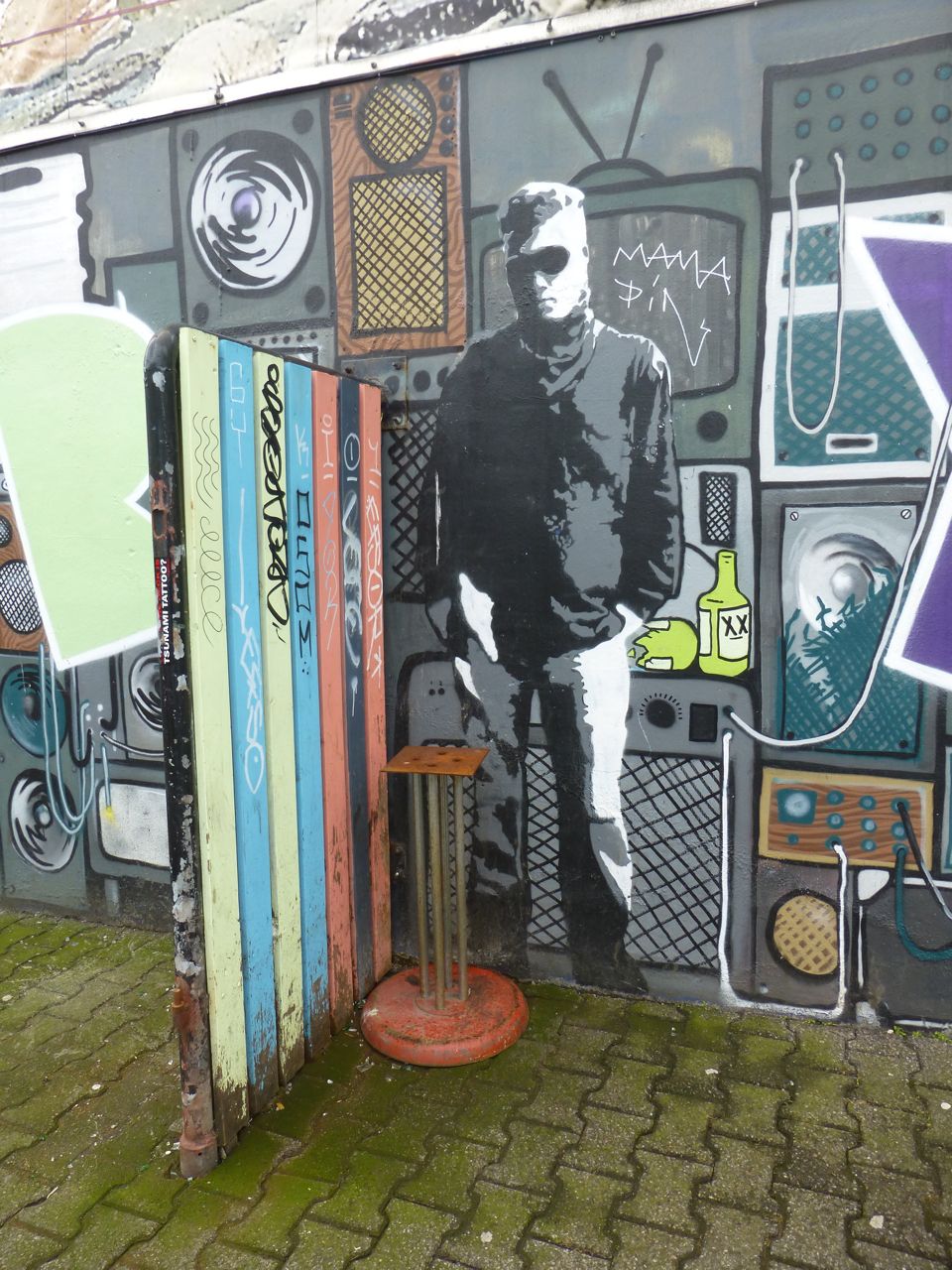
Adam? Is that You, Bro?
I wish the lovers well.
In 1940, the writer Gunnarsson went to Germany on a book tour, for which, among other things, he has been called a Nazi. I’ve been giving you photography that will be the heart of the book I’m writing about him, but there is a point at which his story as a man of the land clashes with the affairs of the world, and it was here, in the moment just before this photograph was taken …
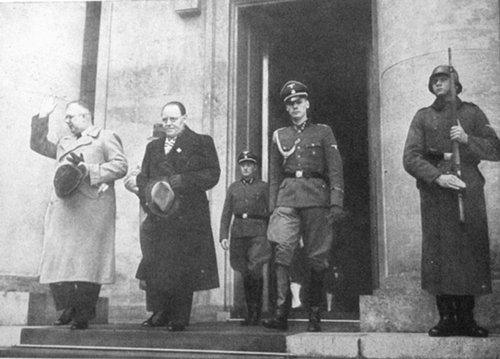
Iceland-Danish Author Gunnar Leaving his March 1940 Meeting with Hitler 3 Weeks Before the Invasion of Denmark and Norway Source: http://fornleifur.blog.is/blog/fornleifur/entry/1257968/
From left, Hinrich Lohse, Gauleiter of Schleswig-Holstein, Head of the Nazified Nordic League Literary and Film Club of Lübeck, of which Gunnar was a member and under whose auspices he was on this tour (Lohse was soon to become Kommissar of the Baltic States as well), a hidden man in civilian clothes, Gunnar, two SS Officers (likely Werner Best, later the Nazi administrator of Denmark, and Otto Baum, later head of the Das Reich Division of the Waffen SS), and an SS guard.
What was said inside that building that could make Gunnar so upset? I have been working on this for a few days now. Here’s my theory: in 1928, Gunnar went on a cruise to Atlantis (Ireland, Madeira, Teneriffe, Lisbon, Morocco, Seville, Mallorcca) along with, I believe, this soon-to-be-prominent Nazi-era photographer and photographic pioneer …
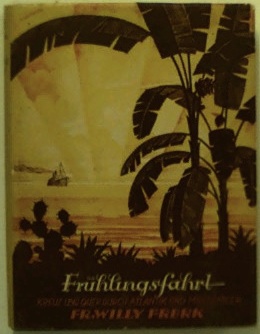
Frerk’s 1928 Book About a Cruise to Madeira, Tenerife, Lisbon, Morocco, Seville, Mallorcca…
There’s a big story about the Atlantis idea, but let’s just say that it was a huge fad at the time in many circles, including Nazi ones, that the continent of Atlantis (and its ‘advanced spiritual civilization’) had sunk into the mid-Atlantic in a volcanic explosion, leaving only the islands and cities mentioned above, plus Iceland. This isn’t that story. It is, however, the story of Gunnar’s decision to become a spy, without mentioning it to anyone, and to do so by writing cables back to Denmark that used literary language that could easily double as criticisms of the Third Reich’s racial policy. I believe that Herman Wirth, one of the architects of that policy, may have been on the cruise, and I believe it was that voyage that the “non-existent” Luftwaffe installed and tested a prototype ship-launched fighter plane, disguised as a mail-delivery plane. At any rate, read Gunnar:
“It’s good for one’s health to get off the ship. From the cool of the ship and the shadows of the quay, one rises on smooth, wave-beaten steps of stone into the deafening sunshine. The humming of the sun and the murmuring of the sea boil together in one’s head; one becomes dizzy. Out of the boiling light, a pair of heavy palms suddenly cut themselves; there they stand, with their blank green, sharply drawn against a blinding white wall.”
Gunnar, Islands in a Great Big Sea, 1936 (originally published in Copenhagen’s Politikken, 1928)
Sure, it could just be the words of a man on a romantic cruise with a woman who was not his wife, enchanted with the landscape, in love, and catching a glimpse of exotic green trees in a stunning landscape, not the need to escape from the odd, racist environment of the ship’s dining room conversation, or the security personnel in plain clothes (or not). Still, the book doesn’t really read like that, and his next books, Vikivaki (1932) and “The Good Shepherd” (1936) read as parables, which can be read anyway you want, depending on your prejudices. “The Good Shepherd” certainly was. It was used as propaganda by the Germans, the British and the Americans, and then at the close of the war was among the books that suddenly read as secret condemnations of the Nazis, published from within the Nazi Propaganda Ministry. At any rate, more on that story later. There is a third text, even less widely distributed, and that’s the speech Gunnar gave in 44 Third Reich Cities before meeting Hitler, whose support of Gunnar’s books [albeit as propaganda material for a Scandinavian annexation] had made Gunnar very rich. I believe this speech, called “Our Land”, was a correction to the message in “The Good Shepherd”, and was intended to correct the propaganda aims to which that book had been put despite Gunnar’s efforts to keep it as a message of peace extended to all men, regardless of their politics. A passage from this text is just below. When you read it, remember that Gunnar’s friend from the pre-Nazi Nordic League, Fritz Höger, who had wanted to be the Reich’s leading architect and redesign its buildings along North German (ie Danish) lines, had lost out to Albert Speer, who was responsible for the monumental, kitschy architecture that came to represent the Reich (including the building in the image above). Here goes:
“What is necessary is to open the eyes of Icelandic youth to Icelandic nature and its beauty. Not as if they don’t see it; but do they know what they see? Have our youth been lead to understand clearly for themselves, what goes well within our Icelandic landscape and what less so? At the very least one sees no sign of it in the newest of Icelandic buildings and the way people carry on through the country and even, at times, in the villages themselves. It pains one to see the way the land is mishandled and alienated through tastelessness, through kitsch, which will lead only to a a weight on the people themselves and bring disrepute to our land and our people. It is far better to view the inner life of people in the way it views itself, without outside direction, than to do so with words and discipline. To see the right path from these roots is more important than one might think from a distance. And, at any rate, one sacrifices little if one holds to taste and good manners. And if it ever should be time to talk of sacrifice, our land has already earned it completely, and our joy at its beauty will never be complete, so long as these things are not put into an order that no longer give any cause for rebuke.”
I believe that Hitler heard that exactly as he was meant to, behind his tiny desk in its huge room like a concert hall in the Chancery in Berlin, where he usually greeted heads of state. He would have heard this…
“What is necessary is to open the eyes of German youth to German nature and its beauty. Not as if they don’t see it; but do they know what they see? Have your youth been lead to understand clearly for themselves, what goes well within their German landscape and what less so? At the very least one sees no sign of it in the newest of German buildings, built by that idiot Speer, with his head in Italian clouds, and the way people carry on through the country and even, at times, in the villages themselves. It pains one to see the way the land is mishandled and alienated through tastelessness, through kitsch, which will lead only to a weight on the people themselves and bring disrepute to our land and your people. It is far better to view the inner life of people in the way it views itself, without outside direction, than to do so with words and discipline. To see the right path from these roots is more important than one might think from a distance. And, at any rate, one sacrifices little if one holds to taste and good manners. And if it ever should be time to talk of sacrifice, your land has already earned it completely, and Höger’s and my joy at its beauty will never be complete, so long as these things are not put into an order that no longer give any cause for rebuke.”
After all, both Gunnar and Hitler shared a believe in the identity of Iceland and Germany as Nordic states united in brotherhood — they just understood that differently. Here’s Gunnar a little later in the speech (Remember, at this time the British and the Americans hadn’t invaded Iceland and there were no appreciable building projects of any kind, but there were in Germany)…
Few lands that can call themselves populated are so little touched by the traces of time. Here it’s not, as it is in richer territories, buildings and the works of man that make a land appear all-powerful. On the contrary. In the past, the houses stood so simply and artlessly in the land that they were hardly to be reckoned as houses, and human habitation snuggled into the landscape and passed well with it. In recent times, a massive change has stepped in to this relationship, and sadly not for the best. It is sad to see how foreign so many of the new houses appear above their home meadows and how ugly and gauche they clash with the Icelandic valleys, among its rivers and against the strata of its mountains. Regrettably, out of tastelessness, which they are also anchored within, springs only decline and bad fortune.
Again, neither of these two men were stupid (That Hitler was evil is another matter), they shared a symbolic language, and I believe that what Hitler heard went much like this:
Few lands that can call themselves populated are so little touched by the traces of time as Germany. Here it’s not, as it is in France and Italy, buildings and the works of men [the Nazi Party] that make a land appear all-powerful. On the contrary. In the past, the houses stood so simply and artlessly in the land that they were hardly to be reckoned as houses, and human habitation snuggled into the landscape and passed well with it. In recent times, a massive change has stepped in to this relationship, and sadly not for the best. It is sad to see how foreign so many of Speer’s Greek palaces and your new Autobahn bridges appear above their home meadows and how ugly and gauche they clash with the German valleys, among its rivers and against the strata of its mountains. Regrettably, out of tastelessness, which they are also anchored within, springs only decline and complete and utter defeat and destruction.
In both of these speeches, a tiny change, well within the compass of the title “Our Land” and Gunnar’s relationship with the audience to which he was speaking, bring out an amazing subtext. Gunnar’s 1930 novel “The Black Cliffs” demonstrate that he had the depth of writing skill and the depth of psychological understanding to attempt to pull this off. Can any of this be proven? No, hardly. It does, however, make absolute sense. If it is in any way true, however, Gunnar’s reputation as a early-to-mid-twentieth century writer needs to be reassessed. If this is what Hitler got out of those speeches, the conversation inside that building, of which Gunnar never mentioned a word, would not have gone well. Any other writer who had tried to use his authority as a writer (and none were more famous or sold better or were more beloved than Gunnar) to trump Hitler’s had wound up in Buchenwald, even Ernst Wiechert, whose Baltic folktale novels were very similar to Gunnar’s nordic ones. If such a half-veiled threat had been made, and was accepted bluntly and openly rather than as the psychological suggestion I think it was intended as, Gunnar’s expression would have been understandable, especially given the company he has on those steps. Here is that photo again:
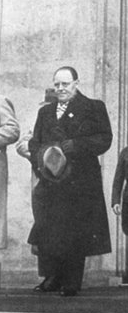 Gunnar Gunnarsson: A Man Trying to Broker Peace?
 A Farm in Iceland


