Tag Archives: Iceland

Easter on Middle Earth

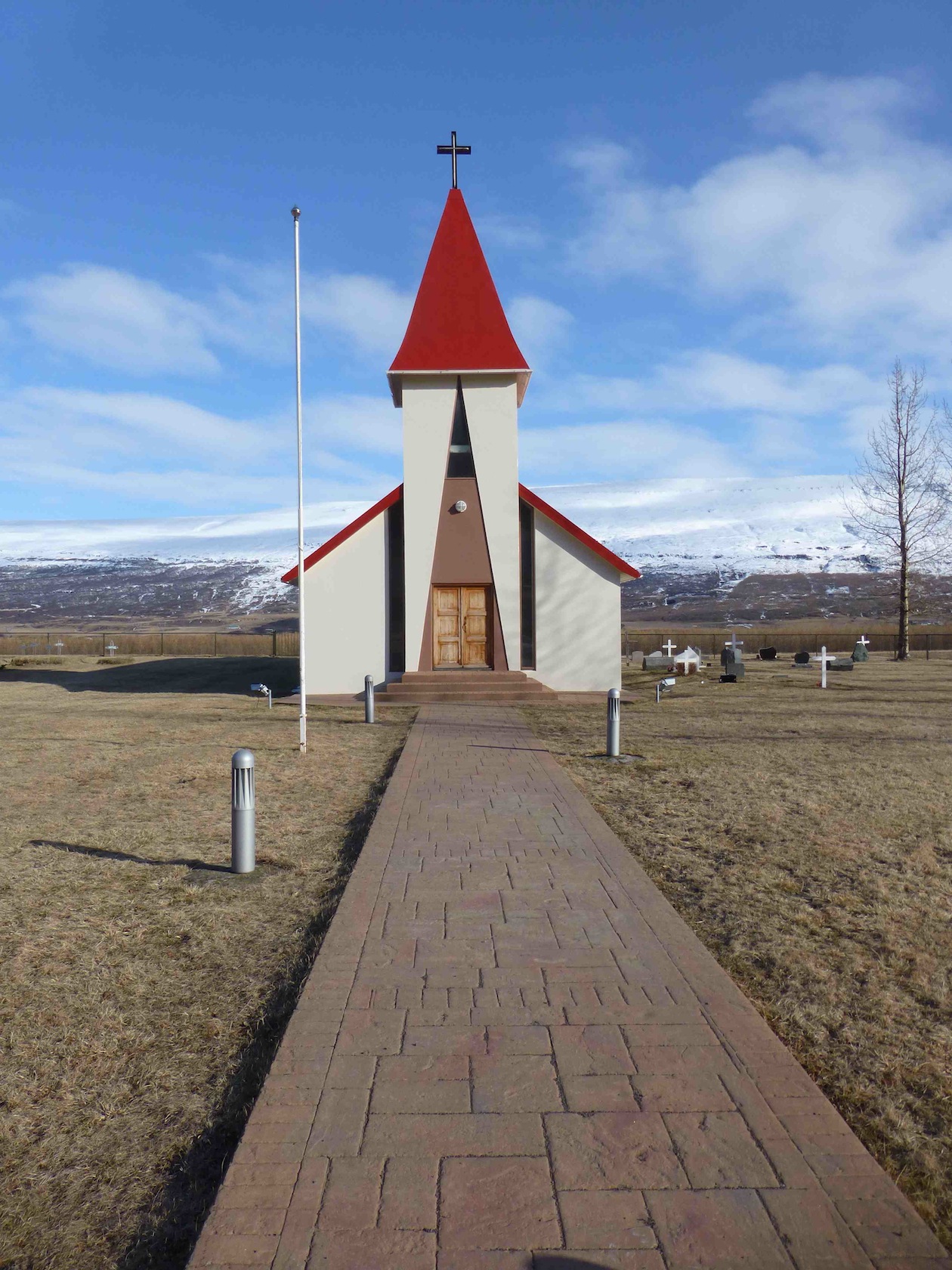
Christ has arisen. This isn’t just a bit of a ghost story with a happy ending. If your imagination is rooted in the earth, or even in books, should that be your fate, it is mathematics and geometry.  Here’s the middle view of Christ’s ascension, in this stopping house, this alms house, this shelter from storm, this cloister between worlds:
churchforfarm

ValÞjofsstadur Church, Fljótsdalur

Note the mathematical precision of its construction. Note as well the Father, the Son and the Holy Ghost of the entrance, and how one enters through the Middle Way, Christ, the Son. That’s not an accident.

The Church makes eternal order out of temporary beauty. That’s kind of its point. It is a form of intellectual activity.
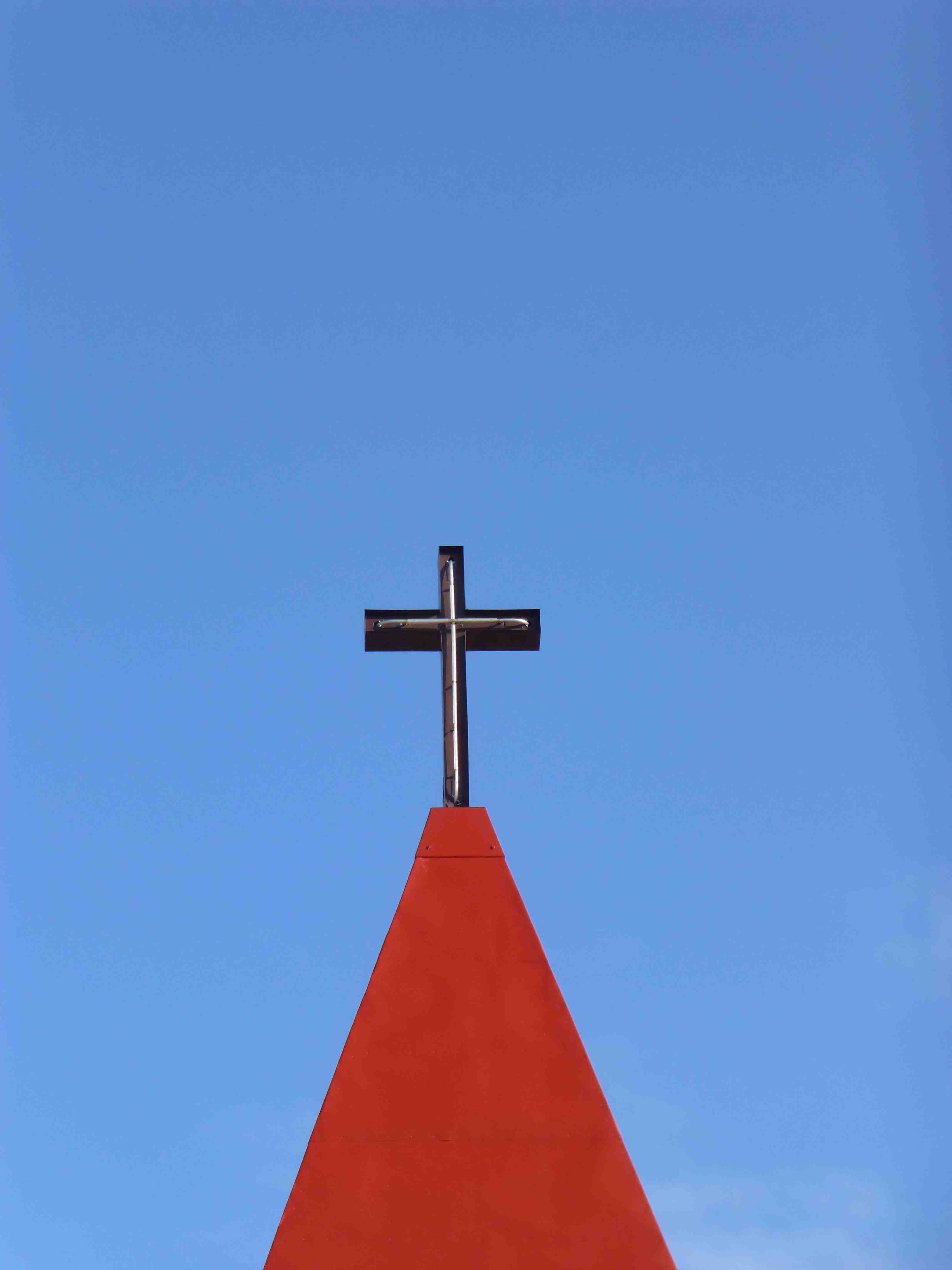
crossforfarm

The Point

It’s not just a cross. It’s an entire intellectual tradition. All Western peoples today stand within it. It’s inescapable. Nor should it be escaped from. It is.

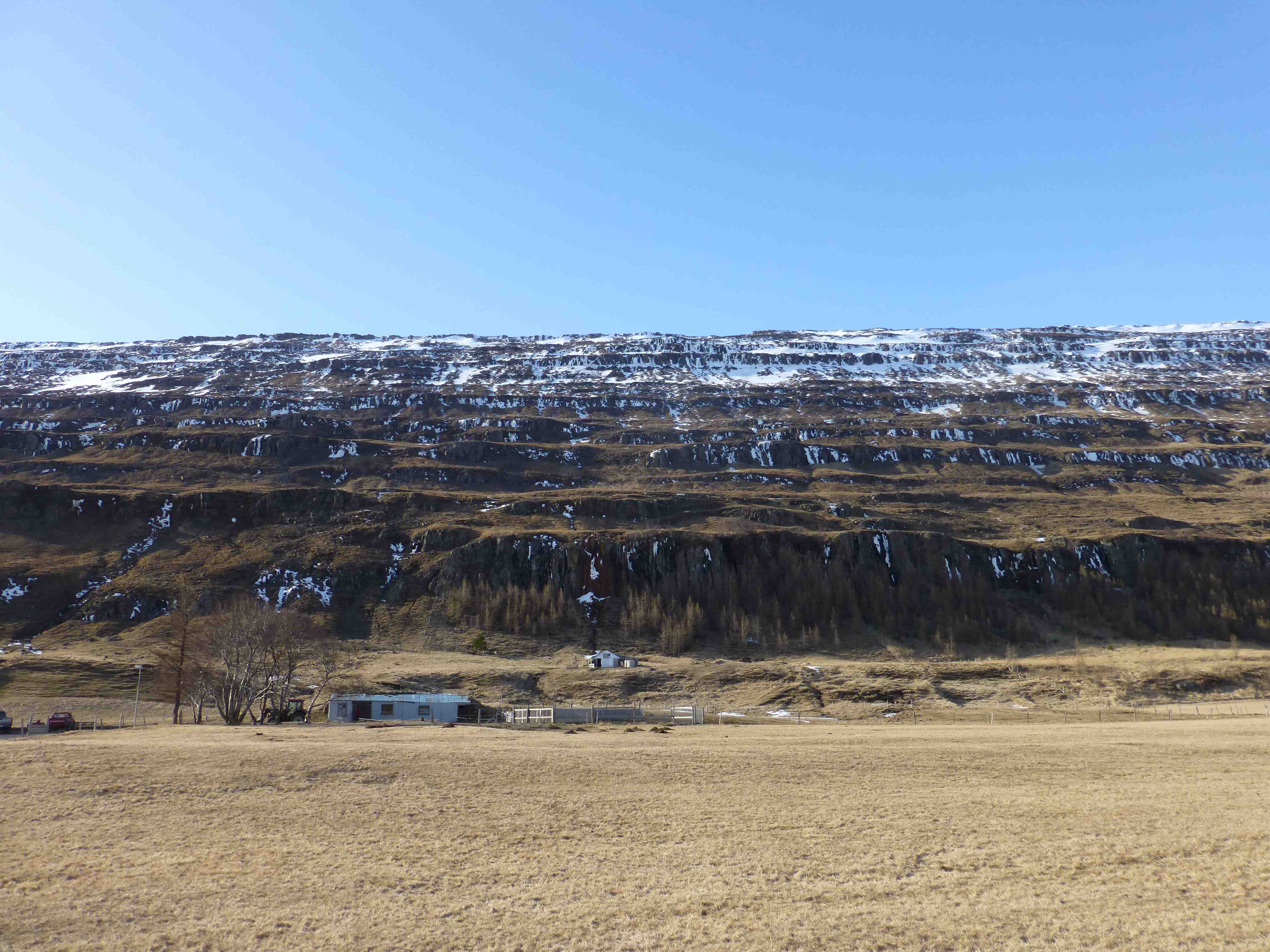
Gunnar Gunnarsson’s childhood farm, that guided much of his writing, faced out over the graveyard where the church now stands. Here’s how it looks today, with the old turf houses gone but the old trees remaining.
valpjofsstadur

ValÞjofsstadur

This is the week that the farmer brings the manure out by the wheelbarrow load and dumps it in his field. You can see some of it there in the centre of the image, just in front of the buildings. Sweet springtime!

Easter is a celebration of rebirth and renewal from the dead (and the stink of closed winter barns full of way too many animals). Another way of putting that is to say that the dead don’t leave the living, nor do the living leave the dead, but that they’re all travelling together on one road that leads out into the fields and the light after a long, cold winter. Here, then, is the real church, in its wild state …
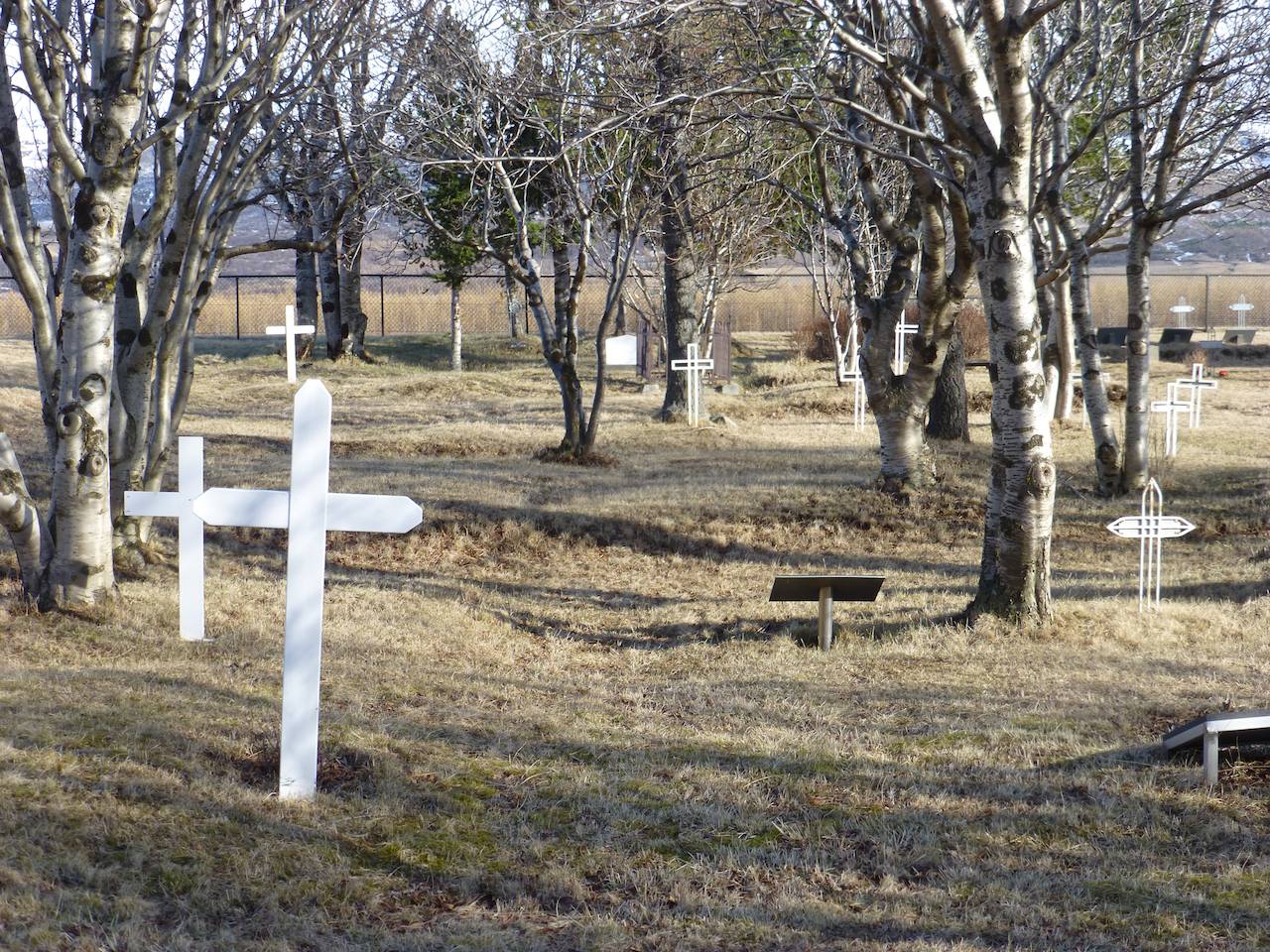
ahnenValÞjofsstadur Graveyard

The ancestors lie quietly in their pews, most with a form of mathematical perfection rising from their souls. It is a joyous place, a sanctuary from the work of the world, a kind of retirement, shall we say, a waiting.

I have been writing poems about Easter, so forgive my mind for wandering like this through the trunks of these trees, but look, both churches are standing together in communion, the church among the ancient trees, the ancestral church, and the new one rising from the mind …

twochurchesChurch, Ancestors, and the Ancient Trees, ValÞjofsstadur

All travelling together into the sky, all tied to the earth, on the middle way.

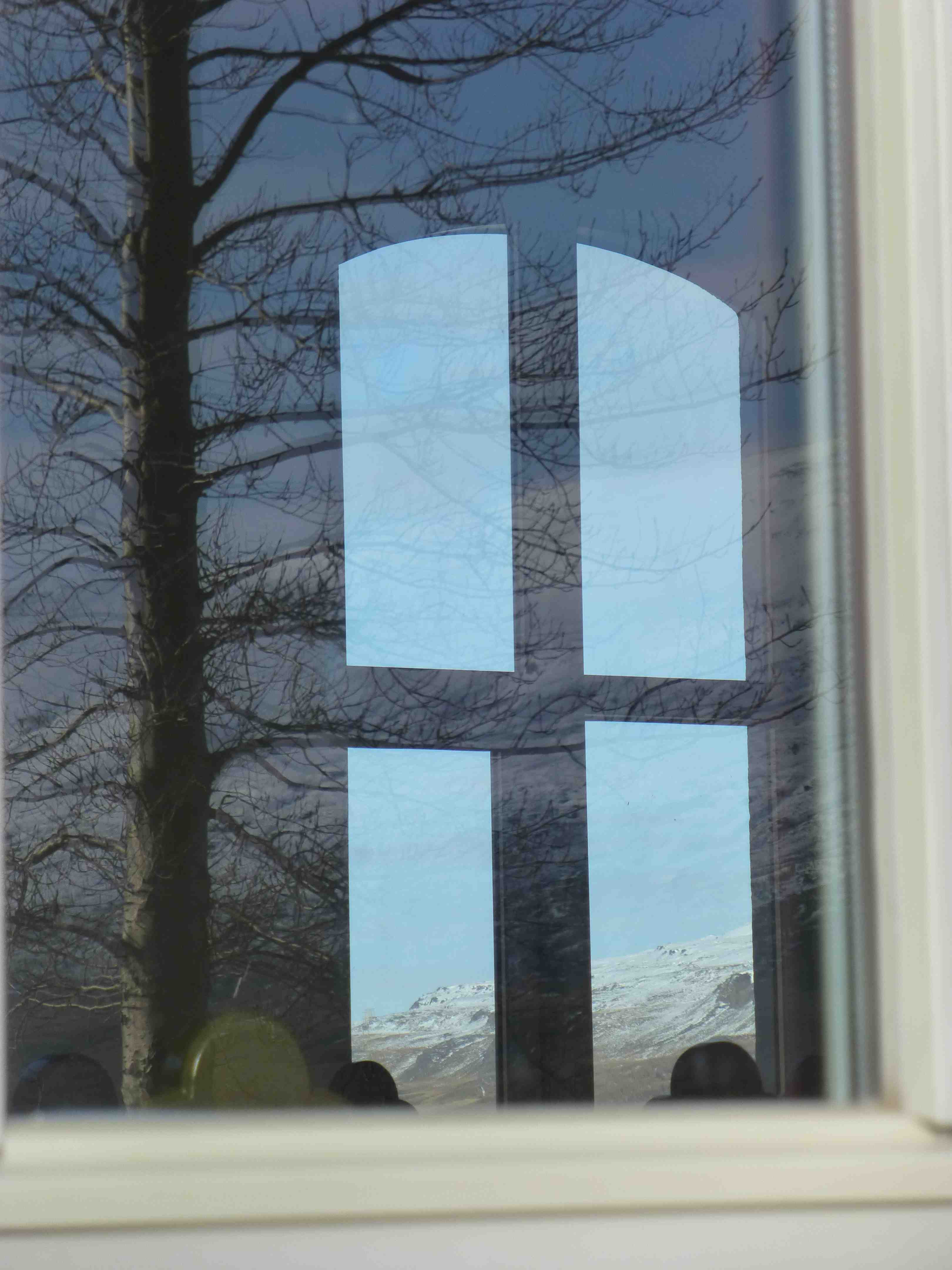
When the earth and its peoples are stood with organically, as Gunnar stood with them and that farmer with his manure still does, rather than under-stood, or standing under, as a priest might put it (especially in the past), looking down from his or her pulpit and speaking the Words of God to his or her “flock”, its patterns flow like water and light and know no bounds. A boy, or a man, such as Gunnar, perhaps, could learn to write books just by walking in the world with his eyes open.
treewindow

The Church, the Cross, Chairs like Tombstones, the Mountains and the Ancient, Sacred Trees

Are all woven from light, from the inside and the outside, from reflection and what is seen through.

A window, now that’s an ancient word. Consider this, every river in Iceland has the same name. It’s an á, pronounced ‘ow’. In German, that would be an “au”, a meadow, a place of particular fruitfulness, naturally fed by wetland water — and usually the place at which Irish monks set up their missionary churches in the 9th century. That’s not far from Iceland, really, where the early farms were set up along river bottoms, which could produce the abundance of grass necessary for 10th century Norse farming practices, and these rivers were all variations on an á. One just down the road from Skriðuklaustur, for example, is the Hengifossá …

hengifossaHengifossá Mouth

And the river of the wind? Ah, here it is …

windowquadrants

The Four Cardinal Directions

Notice how the Wind’s Á, its meadow, opens from inside, so the outside can come in. First, though, one has to go inside.

The tradition of the church and its remarkable magical buildings constructed to ancient conceptions of mathematical balance and beauty go very deep, with roots in the world. Here’s the pulpit …
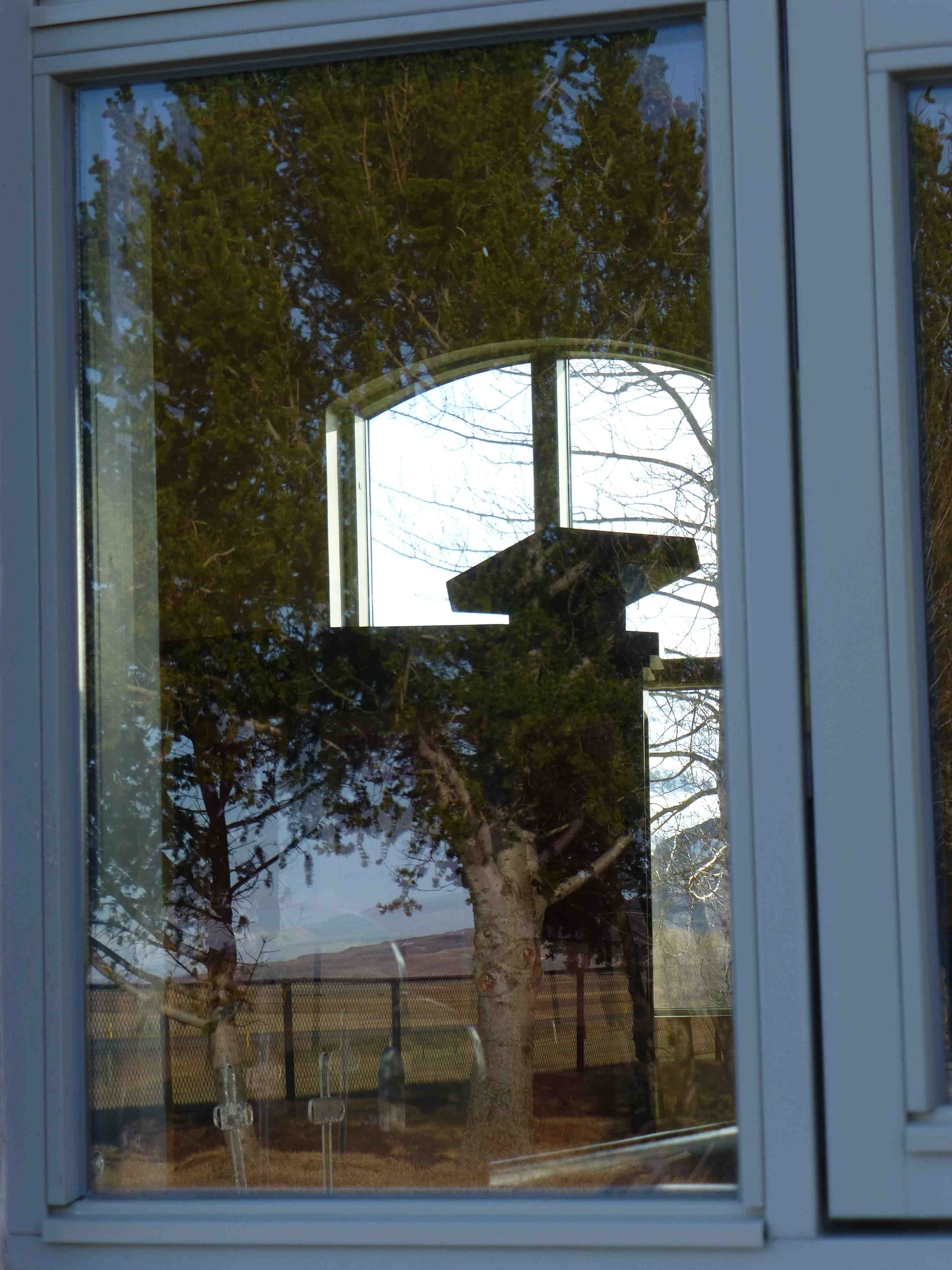
pulpitThis is a Book

But not just a paper one. The world is part of the spiritual picture. It is through it that one finds the light. And the Word. And the word.

By “world” here, I don’t mean the usual thing. I don’t mean “the community of men and women and their children” and the national and international relationships they build up between themselves, as the word is often understood, but the world as stood with, which is often called the earth. There’s an old book in Nordic tradition, called Volvens Spådom (The Prophecy”, which in one of its opening passages goes like this…

volvensThe Middle Way from Volvens Spådom

Without a world, the sun and stars have no anchor. That is to say, no tether, no home, which is to say that they are not at-home, or, to use the old word, they are not haunting. In the middle way, on Middle Earth, things haunt.

Things haunt like the reflections in the windows above, like the trees growing from hallowed ground, and like this image that has been made from them, purified in the manner of making wine (in this case, making wine from light and the world) …

eyewindow2

The Eye of God and the Mountains of ValÞjofsstadur…

…seen through the wind’s oh, its á, its au, its river of ValÞjofsstadur Church. The mind streams in with it. That’s the kind of spiritual place this world is, witnessing the mathematical beauty that streams through it, because, after all, a window opens two ways. It is, in fact, not a mouth or an eye, but a passage, a path, a way.

I took those images yesterday. Today, I went out to witness the sun rise, and I discovered that on this holy morning, before the first planes started flying to Keflavik from Europe, the Middle Earth was clear for all to see who were awake and walking. In the West …

P1370820

The Moon, Setting

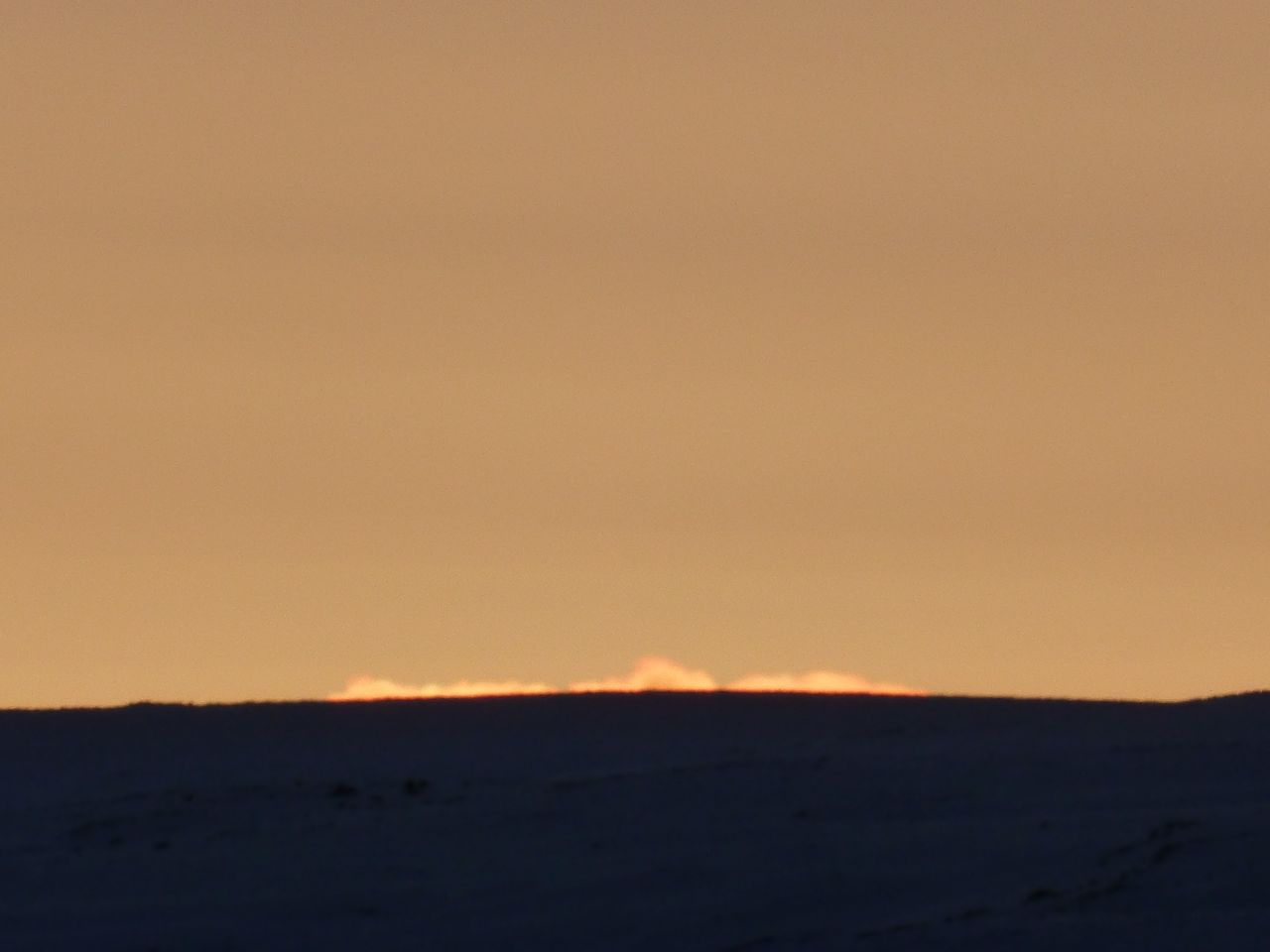
… and in the East, across the sky …

P1370776

The Sun, Rising

… and in between …

P1370850The Horses of the World

The horses are spiritual creatures. Here they are in the words of the scottish poet Edwin Muir, best known for translating Kafka into English. This is written after the devastating war that Gunnar had hoped to prevent by uniting all Nordic peoples on the Middle Way. Ironically, it ws Muir, who endured more directly the anguish and fear of that conflict who found, in the horses of the world, the horses of God’s Grace, his Eden, his au…

(Dear Readers, it’s a longish poem, but not a difficult one, and it is one of the best in all of human tradition. If reading poetry is not your thing, why not scroll down to the images or listen to my reading of it here. The link will take you to a new page. When done, please press the back button to continue …

The Horses.

I hope you’ll listen and read and look at the images. That would be like being together on this day.)

Here’s am image to set the scene …
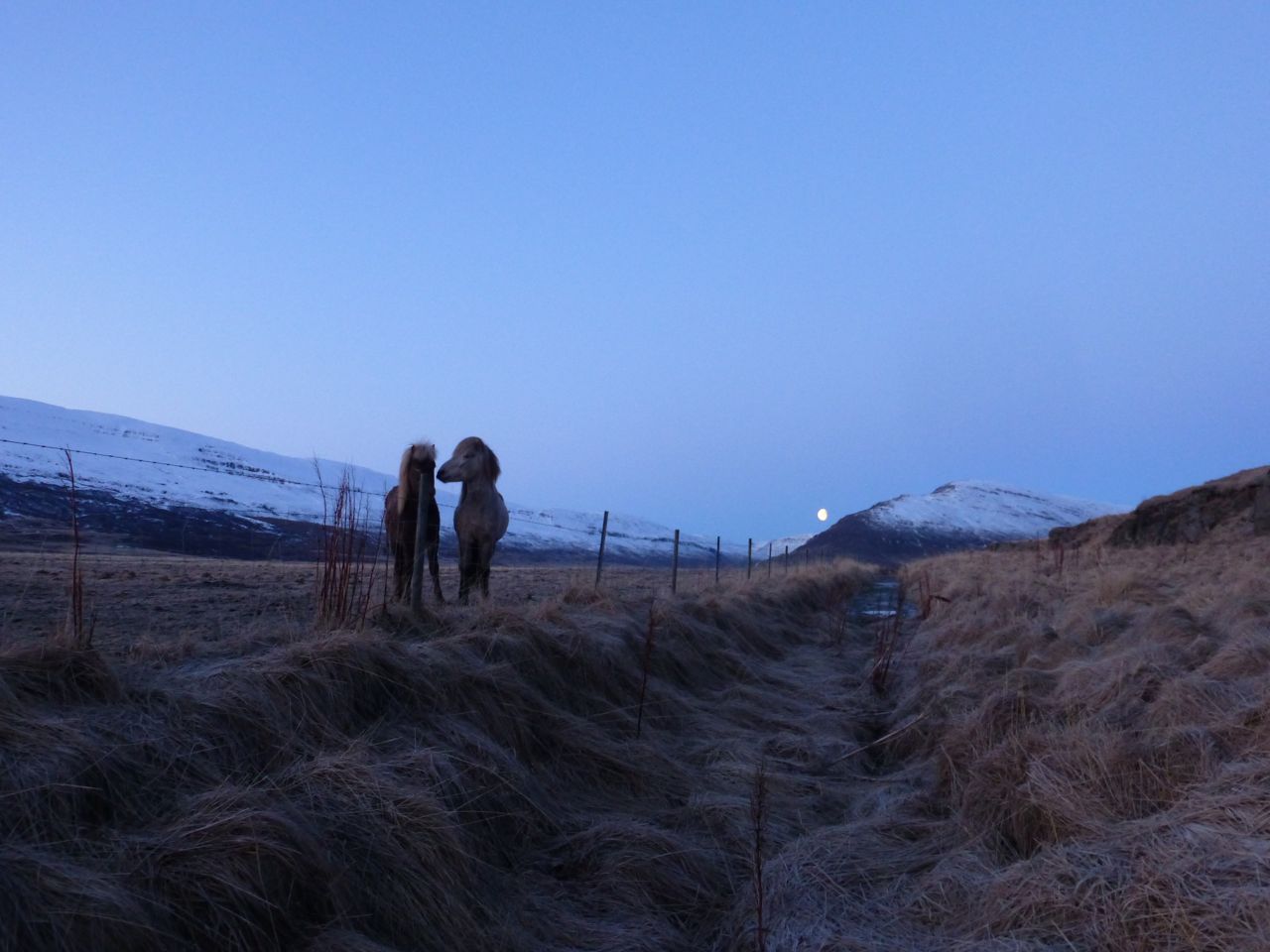
P1370886

The Horses

Barely a twelvemonth after
The seven days war that put the world to sleep,
Late in the evening the strange horses came.
By then we had made our covenant with silence,
But in the first few days it was so still
We listened to our breathing and were afraid.
On the second day
The radios failed; we turned the knobs; no answer.
On the third day a warship passed us, heading north,
Dead bodies piled on the deck. On the sixth day
A plane plunged over us into the sea. Thereafter
Nothing. The radios dumb;
And still they stand in corners of our kitchens,
And stand, perhaps, turned on, in a million rooms
All over the world. But now if they should speak,
If on a sudden they should speak again,
If on the stroke of noon a voice should speak,
We would not listen, we would not let it bring
That old bad world that swallowed its children quick
At one great gulp. We would not have it again.
Sometimes we think of the nations lying asleep,
Curled blindly in impenetrable sorrow,
And then the thought confounds us with its strangeness.
The tractors lie about our fields; at evening
They look like dank sea-monsters couched and waiting.
We leave them where they are and let them rust:
‘They’ll molder away and be like other loam.’
We make our oxen drag our rusty plows,
Long laid aside. We have gone back
Far past our fathers’ land.
And then, that evening
Late in the summer the strange horses came.
We heard a distant tapping on the road,
A deepening drumming; it stopped, went on again
And at the corner changed to hollow thunder.
We saw the heads
Like a wild wave charging and were afraid.
We had sold our horses in our fathers’ time
To buy new tractors. Now they were strange to us
As fabulous steeds set on an ancient shield.
Or illustrations in a book of knights.
We did not dare go near them. Yet they waited,
Stubborn and shy, as if they had been sent
By an old command to find our whereabouts
And that long-lost archaic companionship.
In the first moment we had never a thought
That they were creatures to be owned and used.
Among them were some half a dozen colts
Dropped in some wilderness of the broken world,
Yet new as if they had come from their own Eden.
Since then they have pulled our plows and borne our loads
But that free servitude still can pierce our hearts.
Our life is changed; their coming our beginning.

Edwin Muir
P1370898An Icelandic Blue in the Skriðuklaustur Pasture
Middle Earth contains not just humans and horses on their spirit paths, but, of course, our trees …
P1370752
Poplar on Easter Morning
… elves (more on that, soon) …
P1370763Easter Sunrise Through Frosted Glass
… sacred space …
P1370767The Cloister at First Light
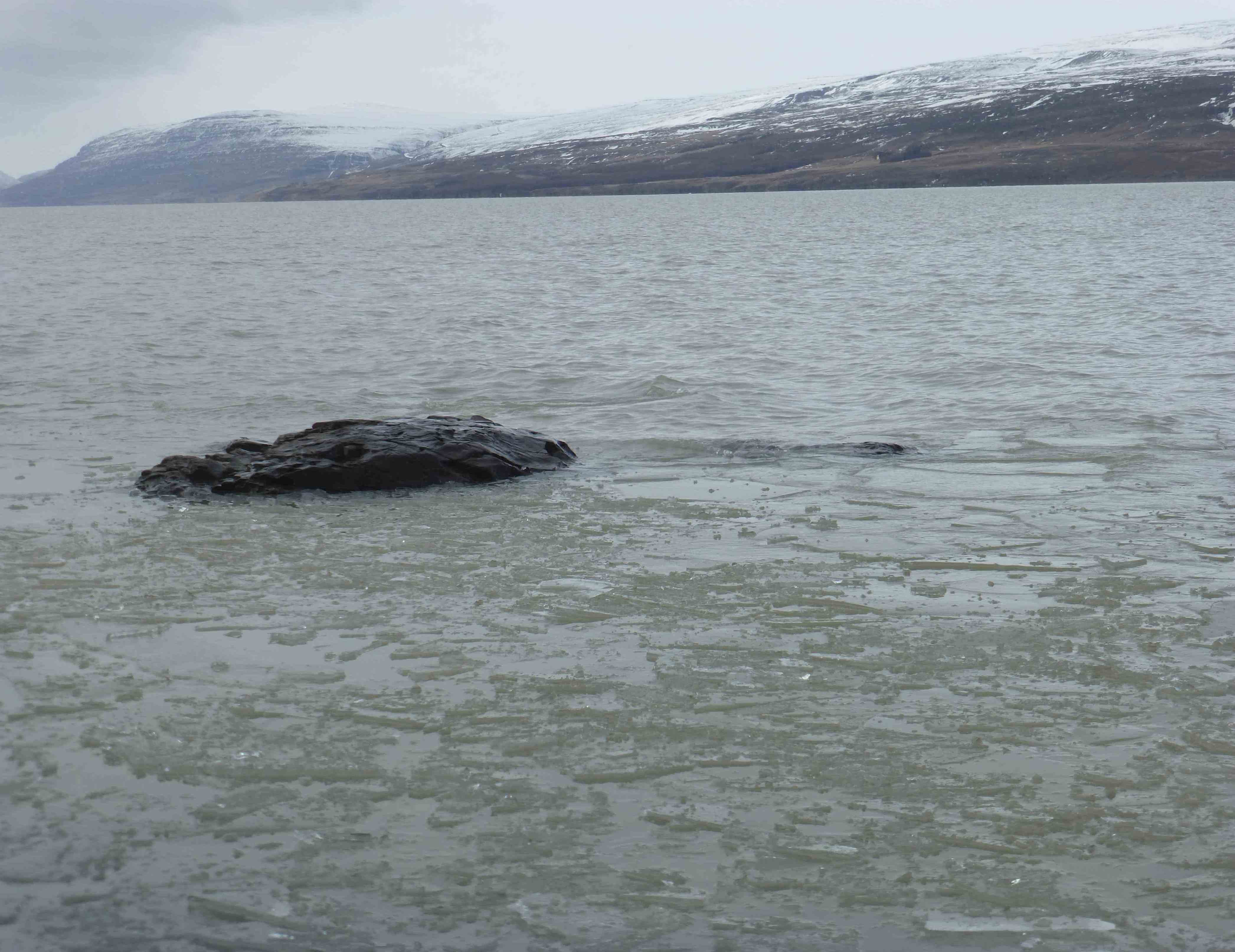
… trolls, charmed …
P1380048
… the dead, of all kinds …
P1370860
Giant’s Skull in a Cave in the Skriðuklaustur Cliff
Turned to stone, I may point out by the rising sun … which, on this day, is Christ ascending. Accident? Coincidence? No. It is part of the sacred order of things viewed as things. After all, a “Thing” is a meeting place, in the old languages, a parliament, a place of talking and coming together, of all the people … including, I presume, the sheep which shelter in this cave in summer.
… because even though it is a Christian world, it is built upon the bones of an older one, and does not dishonour them and is not dishonoured by their presence. How could it be? If it were so, God would be made by men. It is to this world that Gunnar returned when he left Denmark in 1939. All during his time on Mainland Europe, he was walking the Middle Path, living between worlds, trying to be a broker between them, trying to be a writer, which in the pre-modern Icelandic tradition of his birth and youth meant to be a pastor, to write sacred texts and to present them to the people, to stand among them but slightly apart, and to look both ways, like a wind’s á. This is the character we meet in his 1932 novel Vivivaki, a reclusive writer in the Icelandic highlands, to whom the Dead awake on New Year’s Eve, to the sound of the Danish National Hymn on the radio, and who look to this rebirth as the Resurrection and look to him as God. Next, I’ll unravel the rest of Gunnar’s life as a Secret Agent, but first, the blessings of this day of rebirth and ascension and grace, from the blind earth …
P1370782
… to the light of the sky …
P1380096
Blessings, all, from Skriðuklaustur.

Sighting The Wyrm in Lagarfljót

The lake that runs to the sea from this old monastery site in East Iceland is called the Lagarfljót. It is a long and beautiful thing that catches the light from the mountains and the sky and softens them — not that they are harsh to start with. It also has a wyrm, like the monster of Loch Ness or the “Ogopogo” of Okanagan Lake of the North America’s Pacific Northwest. Cryptozoology is good for tourism. Here in the sacred birch forests of East Iceland …

P1370240

… with the elves catching the mid-day sun …

lichen

Lichen on Birch

(I hope to have the elvish connection to lichen ready for you in a couple days.)

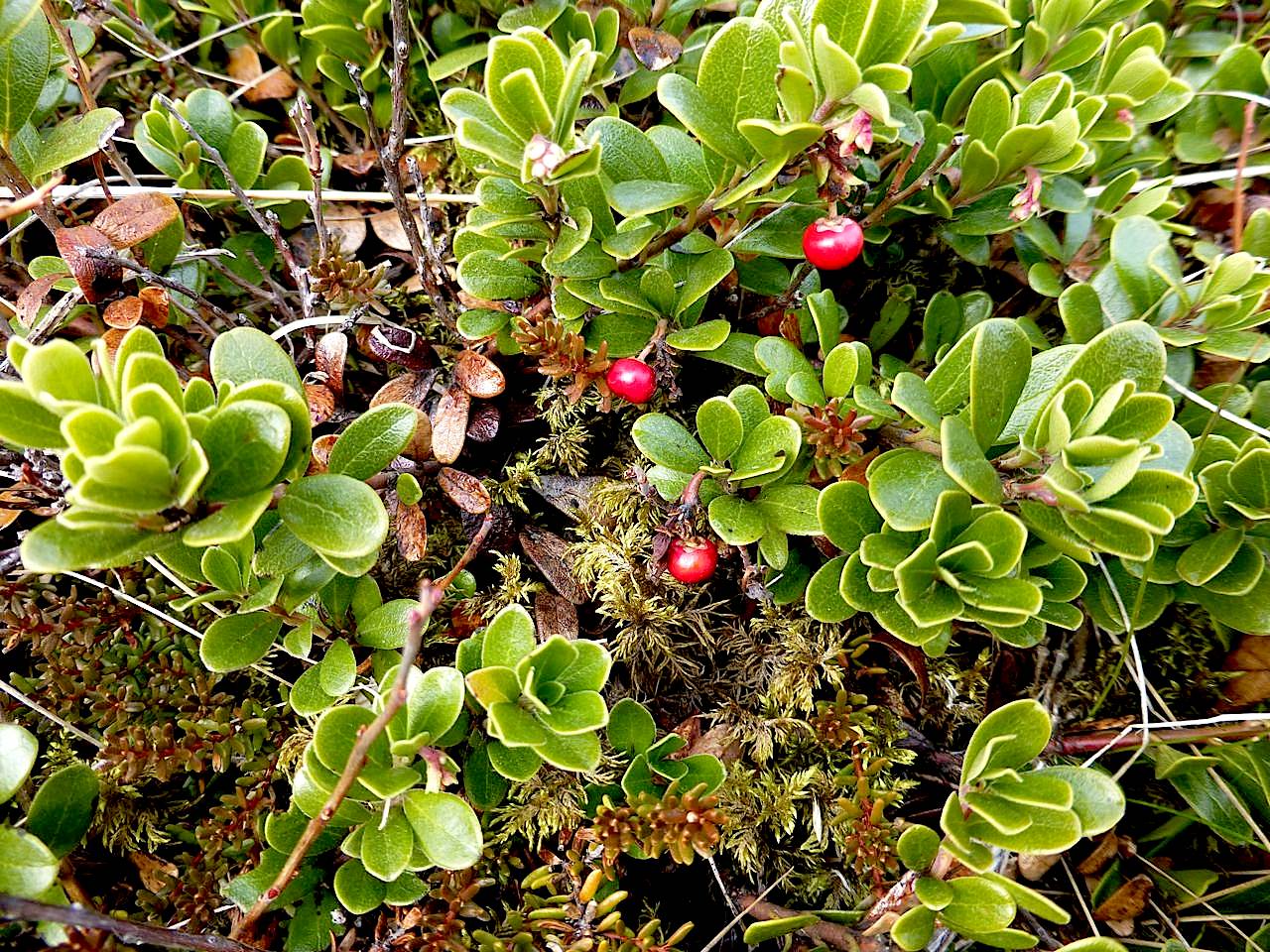
… and a moment to enjoy the red berries that the birds missed in the winter …

berries

… because I’m a poet and poets are easily distracted by pretty things (so are wyrms, whose stories are similar enough to the serpents of the Rhine and the Celtic Moselle and the Ring of the Nibelungs to raise a poet’s eyebrow or two), but finally things were looking up. The government was there first, helpful as Icelanders are …

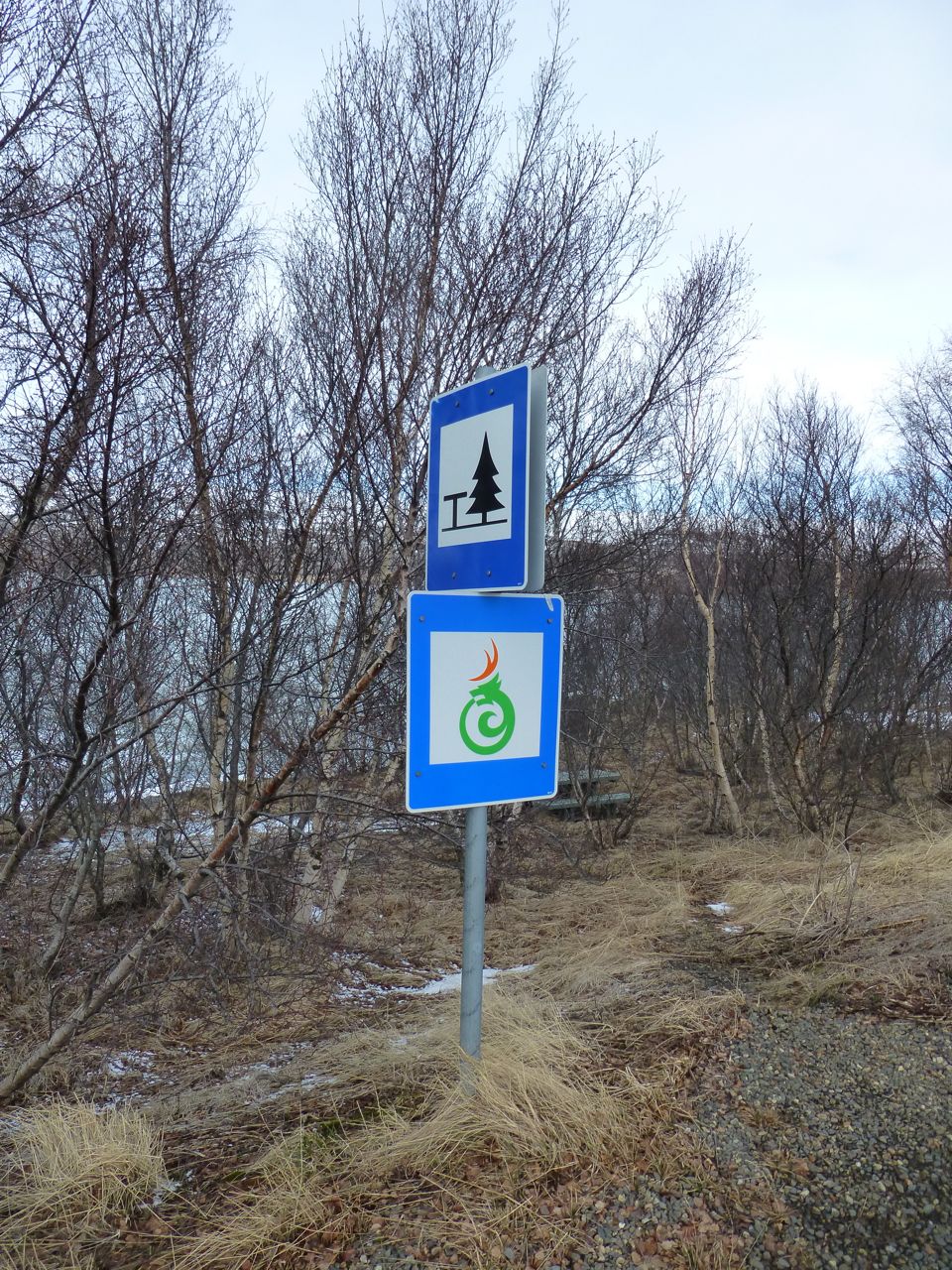
P1370118 A Good Place to See The Wyrm

Shall we? Down the trail through the old, slightly mouldering but still charming early-Nationalist picnic site, and, hey, look, already we see signs of an apex predator eating the locals…

P1370116

We Must be On the Right Track

And then I lost my doubt, because I heard the birds singing…

P1370166

See the Birds?

No, I don’t either.

There weren’t any birds, that’s why. It was the lake that was singing, like a choir of angels. That was actually better than birds.

P1370184

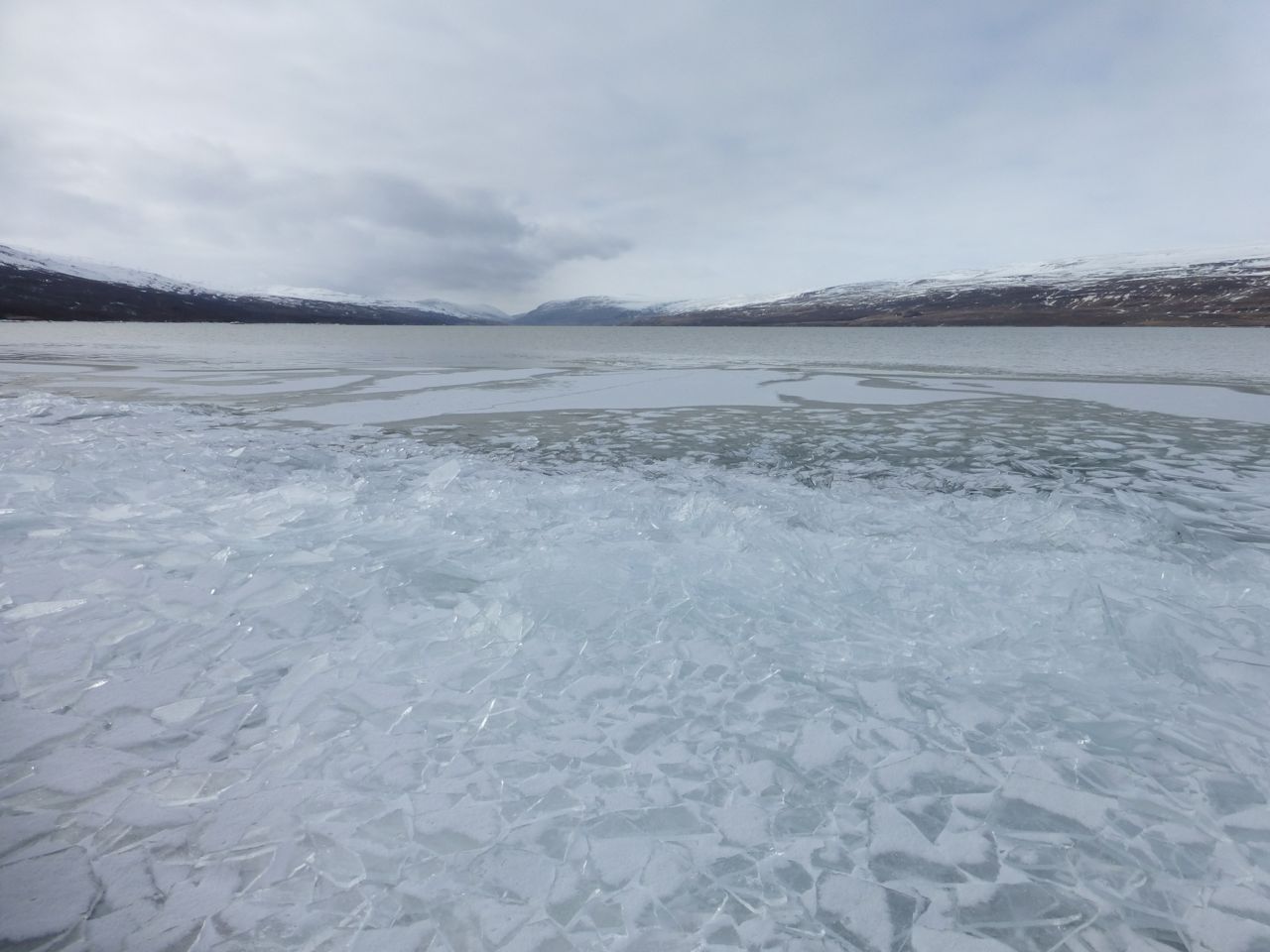
All Winter Long the Ice Has Been Singing As the Waves Break it Up and Knock it Around

Then they do it in the spring. It is haunting. What a magical lake.

And that’s when I first saw the wyrm (well, after a few more steps) …

P1360998

Wyrm

Being a Canadian and a bit biased towards polar bears, that’s what I thought it was at first. Here’s its head, so you can have a closer look …

P1370001

Wyrm Head

Note the nice ribbing. Even the Worm in Dune has that. (Look to my upcoming posting on elves and lichen for an explanation of how forms like this are cast up by stone.)

Then I turned and saw this wyrm…

wormhead3

A Dead Ringer to Tolkein’s Smaug…

… or a crocodile. Note the hump, too.

Now, to set things straight, here’s the story of the Wyrm in Lagarfljót: Read it Here. And here’s a video that played on Icelandic TV a year ago … View it Here. And here’s my warning on reading mythic imaginations literally, with photographs of the dreamtime stone that is Canada’s “Ogopogo” — or would be if there were greater general understanding of how pre-industrial people thought. Read it here. This is important stuff. A little respect for the truth of ancient story, and how it was laid down and how it was not, goes a long way towards rebuilding human relationships to the earth. To tell those stories, I am here at Skriðuklaustur.  It has been a beautiful day. Tomorrow, images of Easter in East Iceland, and if things go well the second part of my series on Gunnar Gunnarsson, Secret Agent.

Gunnar Gunnarsson, Double Agent: Part 1

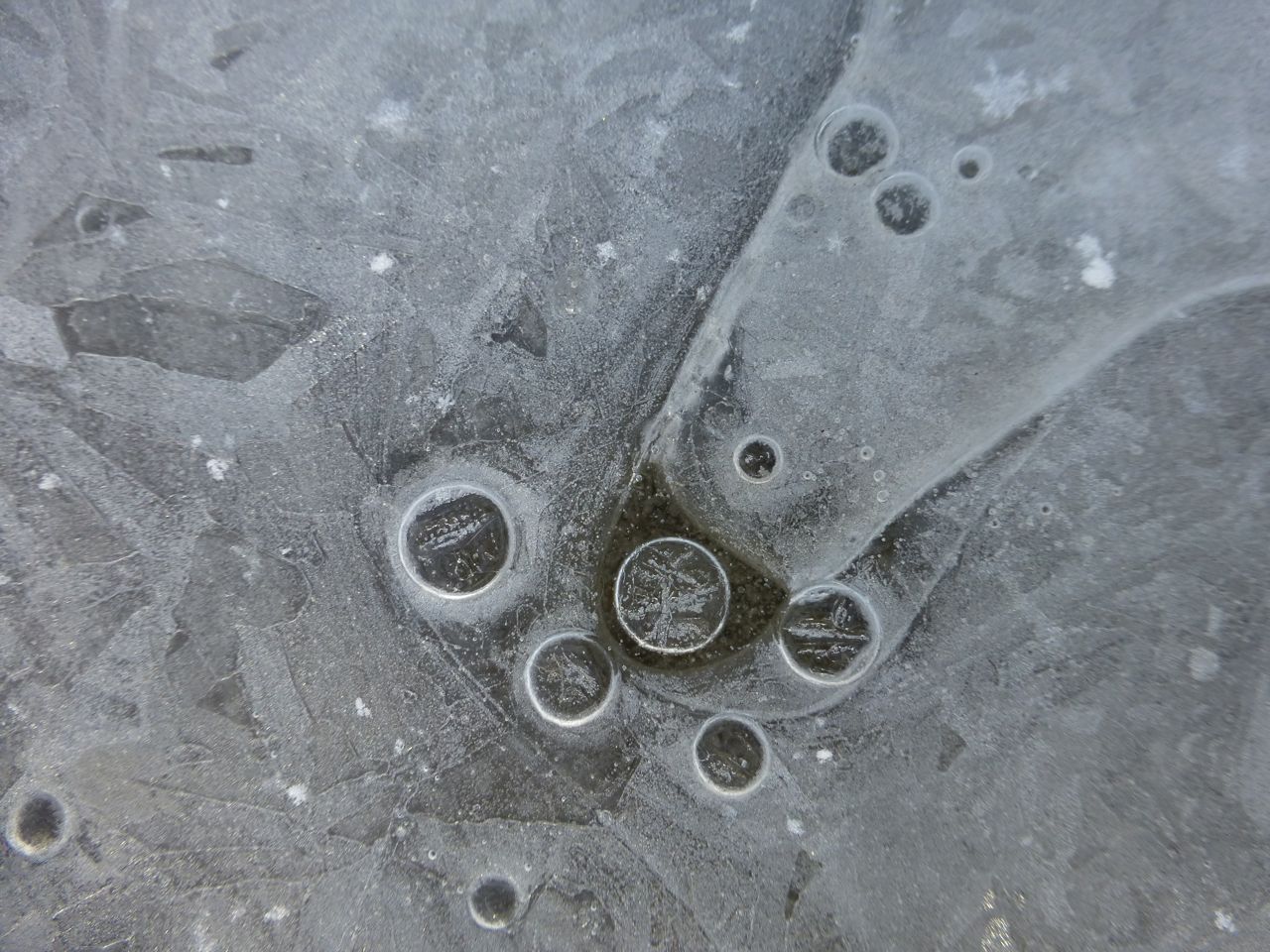
Yesterday I mused on the origins of story in lines that cut across pools of presence. Part of the story was the human response to them, that brought them together into art. (If you missed it, you can track through it right here.) Today I’d like to talk about Gunnar Gunnarsson, and how some of those lines are circles, and that they too have a story. Now, circles are very special lines. They have no beginning or end, no directionality and can can extend from every point into every conceivable shape, as long as it has no beginning and end. Circles are eternal. Their boundaries separate into inner and outer representations of … what exactly? Ah, that’s Gunnar’s game. Here’s a circle:

grassline21 Air Caught Within a Seasonal Icelandic Pond

Intersection of Highways 848 and 87

And here’s another:

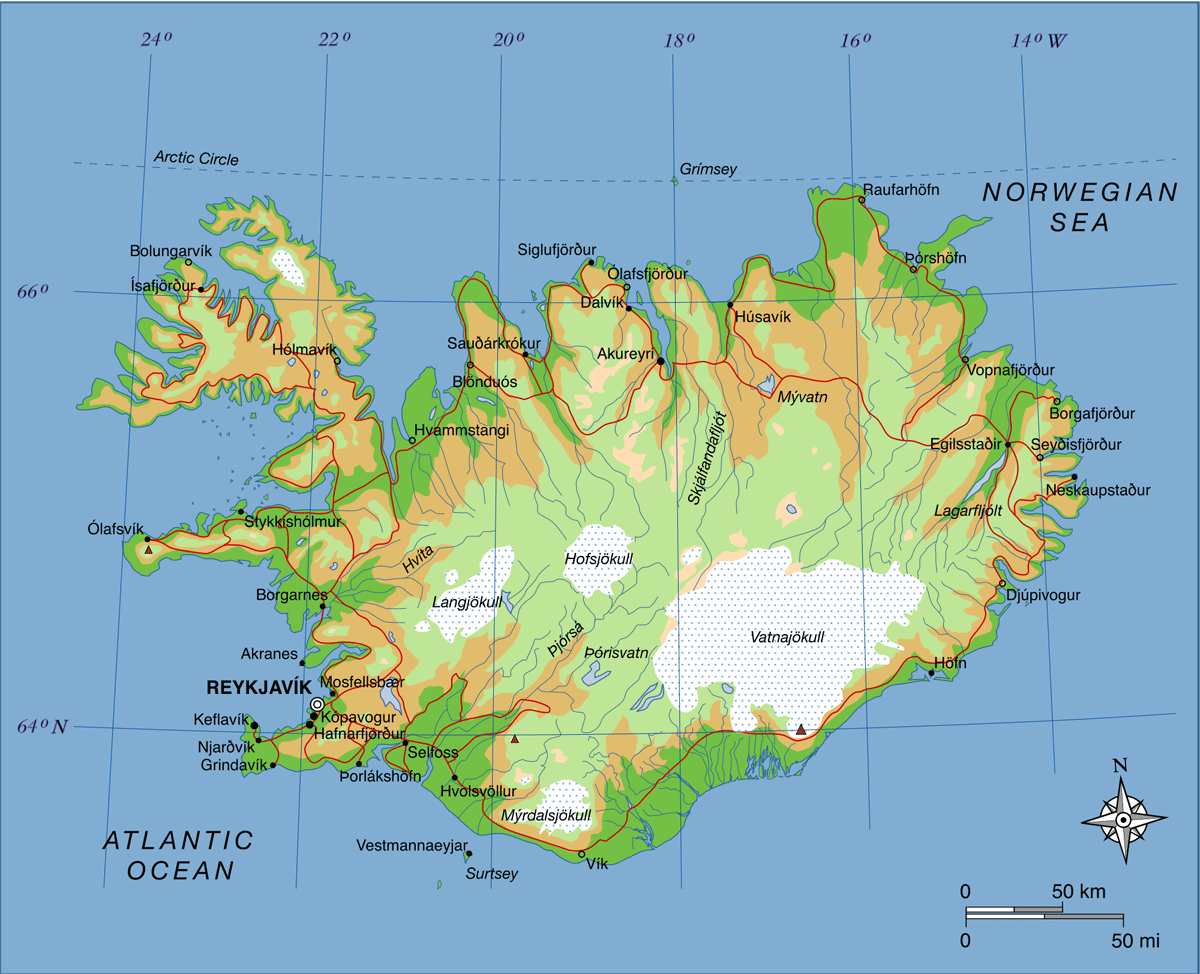
iceland-physical-map

Iceland (Source)

Well, almost a circle. Sort of. If you took off the scrunchy bits. It has a circle-like edge, at any rate. Here, this might be closer:

2maps

Three Maps of Iceland

Two for tourists and one in words to keep tourists away.

That’s a copy of the text “Unser Land” or “Our Land” that Gunnar read on his spring 1940 tour of 50 cities in Germany, immediately after the sod was laid on the roof of his house and just before the German invasion of Denmark and Norway. Here’s how Gunnar starts off:

It rises majestically out of the sea when approached from the water. It grips the heart like a heroic song, touched with eternity, sown with destiny. There is nothing small about its appearance.  Even though its face varies from place to place, it remains integral — a pure vision.

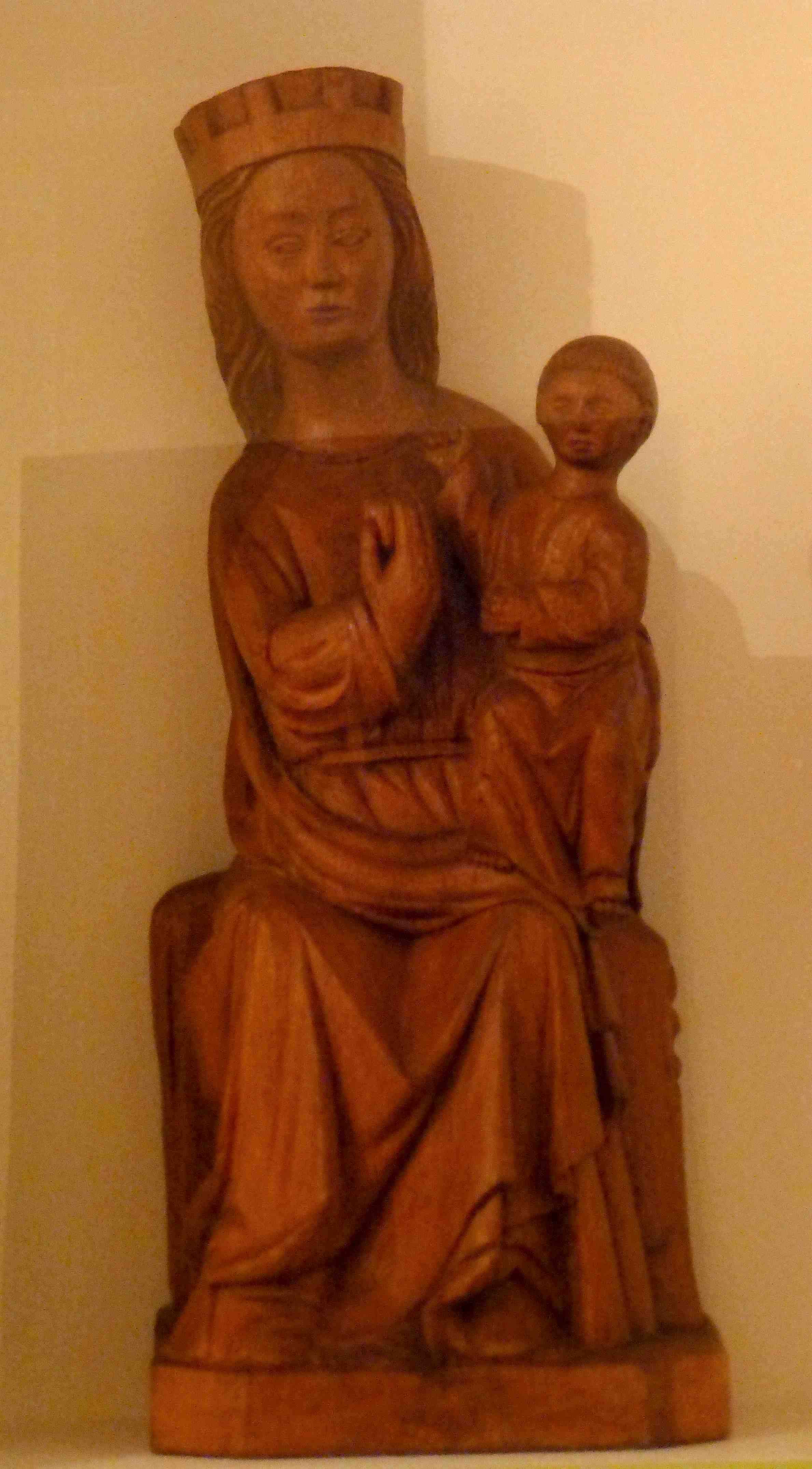
A pure (or untrammelled) vision? It’s like a shaman’s spirit stone or a statue of Mary with the Christ Child. Speaking of which, here’s one:

madonna2

The Skriðusklaustur Madonna…

… in her glass box, with reflected light, and looking very Icelandic indeed (replica).

By “pure vision” Gunnar had many things in mind, including nature in its rawest, least adapted, least, shall we say, artistically crafted, farmed, developed, urbanized or written version and the Madonna. Now, even if we accept that Gunnar idealized his mother and lost her at the age of eight, and then bought the farm next door some 45 years later and set up his writing desk where he could look up the valley and see that childhood, which he called the purest image of eternity, and even if we accept that Iceland, the land, is alive and represents human consciousness just as the consciousness of Icelanders represents the land (which, indeed, Gunnar argues in the latter part of his speech), and even if the madonna above comes from his farm in East Iceland, the Madonna and Iceland — or even Gunnar’s farm — just aren’t exactly the same thing. In his text, though, they are. The title gives us a clue as to what he means by that: “Our Land”. Whose land? Apart from raw, physical and spiritual nature, like this …

ice28here are some of the many possibilities:

ourlandThe Our Land Game

In playing this game, it’s good to remember that Gunnar was a showman and a businessman speaking to his main audience: the Germans, who had swarmed (to take a word from the German) to his books for decades. Indeed, they had done so to a whole genre of Nordic romances from Sweden, Norway and Iceland, that was fed, ultimately, into the German war machine. In other words, Gunnar was speaking to two audiences at the same time: Icelanders (himself, most specifically) and Germans who had a longing to get out of Middle Europe and to create a new centre of balance around the Baltic (somewhat removed from them by the Treaty of Versailles). If I’m right, he intended his text to be a cipher, read differently by both groups. The madonna was intended for the Germans. The pure nature for the romantics. The way of looking both ways at once, for himself. Himself, Gunnar was a boy from the fjords of East Iceland, a farm kid, from a long line of farmers. He remained so to the end. In the context of 1940, with German and Russian invasion of Poland a fait accompli and Germany reassertive along the south shore of the Baltic, “Our Land” meant several further things, which I will speak to over the following few days in this Easter season of death and rebirth, grace and forgiveness. One of them was “land to live upon,” a concept which was one of the cornerstones of Germany’s violent foreign policy, by which Germany sought to fulfill what it (or at least Hitler) saw as its “destiny” — another word that Gunnar carefully sows at the beginning of his speech. His audience would have been all ears. In my next post I will discuss the bearing this concept had on Jews and their culture and the horrific story of the Holocaust, but let’s be kind to ourselves. These things are hard and need their time and space to unfold. Until then, look at the world of Gunnar’s nature, islands of air, always different, always the same, and frozen into one picture of pure spiritual vision. Applying this boyhood observation of paradise to the divisive and self-devouring complexities of German political life in the 1930s might have been unwise on Gunnar’s part, but the boyhood observation is a thing of beauty…

iceandlines51


The question is: what does one, as a man, make out of that? And that cross we will carry tomorrow.

Elves and Men in Iceland

In his Book Livet’s Strand (The Shore of Life), written in 1915 during the height of the Great War that destroyed Western Civilization and left us all trying to make sense of the ruins, Gunnar Gunnarsson explored the idea (to heartbreaking length) that the earth is a shore on which life crashes again and again and again. On this shore, life is rescued and lost, celebrated and lost again, and in the end only endured. Today, 98 years later, I’d like to rescue that earth from this apocalyptic image — without denying its truth and the very real anguish which gave birth to it. To set the scene, two posts ago I gave this image of the living sea in the Skaga Fjord, in which I suggested that the sea was life itself and all other life is only a replication of it …

aliveThe Greenland Sea

Very much alive in Skagafjörður

Today I’d like to modify Gunnar’s rather black and white statement with the observation that the land has its own life. For evidence of it, a journey to Skudustaðir on Myvatn (The Lake of the Midges), is well advised. There is life within the stone there — life intimately connected with human consciousness, too. Here, for example …

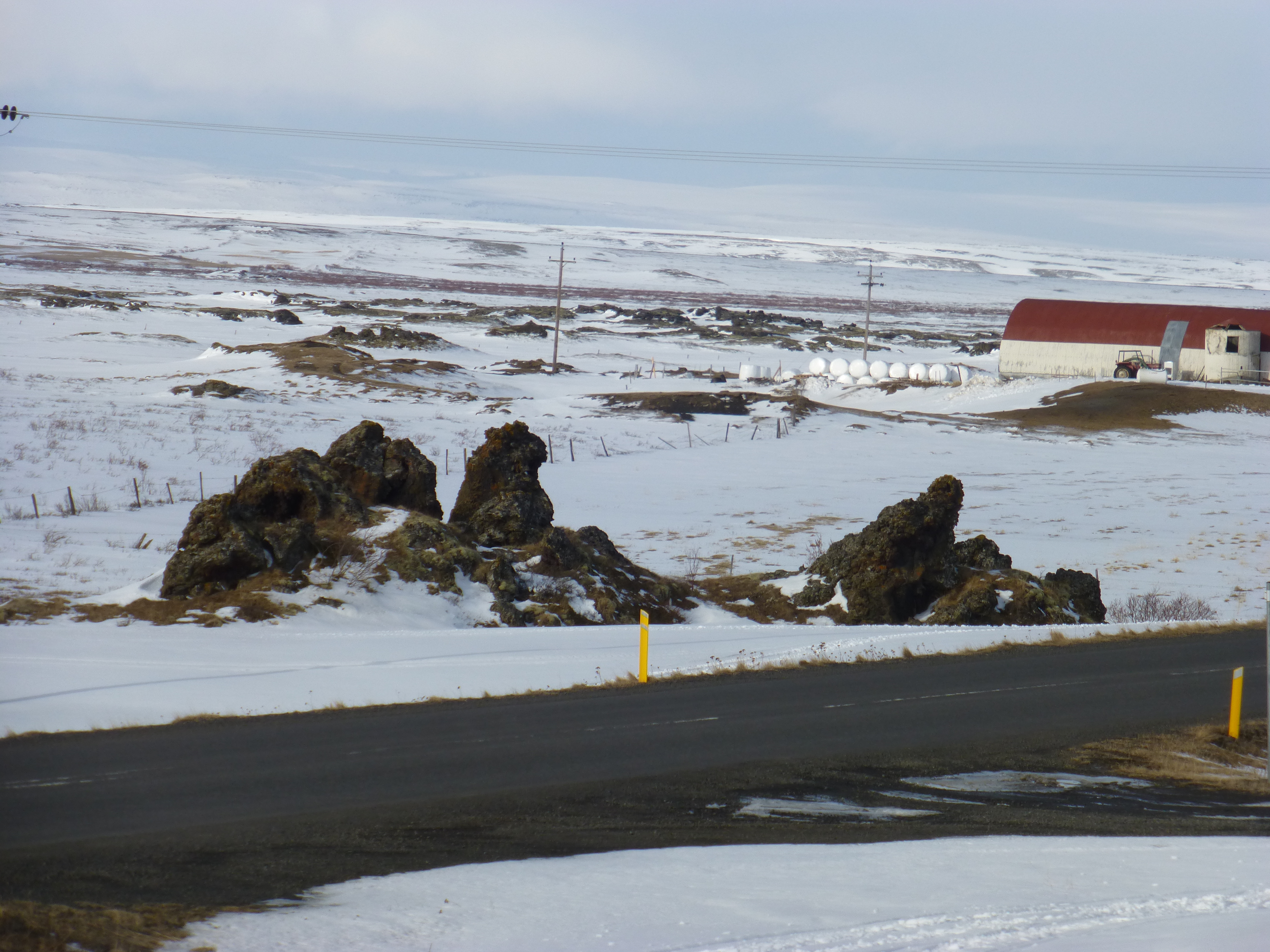
P1320873House and Barn

That’s Elf House and Human Barn, actually, and the road going north and south. Folk wisdom holds that elves are more beautiful than people and reveal themselves only when they wish. No argument there.

Sure, Tolkein dreamed of his elves and so did the Victorian fabulists, but these are not those elves. Those ones are social and linguistic constructs and physical animations rising from the literalism of Christian civilization. I have deep respect for Christian tradition, but would like to show that in the North it has a very specific and illuminating context. These “elves” or “other people” are bodily perceptions that humans brought here from older continental traditions stretching back into the deep stone age. Here’s some charmed rock …

innerelves

The Other World

Or, to give life to an old phrase that now is a name for bedrock: the living rock. It is not a metaphor, but neither is it one of Tolkein’s stories.

There is, for one thing, a world within the rock, with faces frozen into stone. Now, I will be following up on those faces in the next few days, but today I’m laying down words about the rock as the sculpture that it is …

elfin5

Rock Entrails in Skutustaðir

Open up a human body and you get much the same thing.

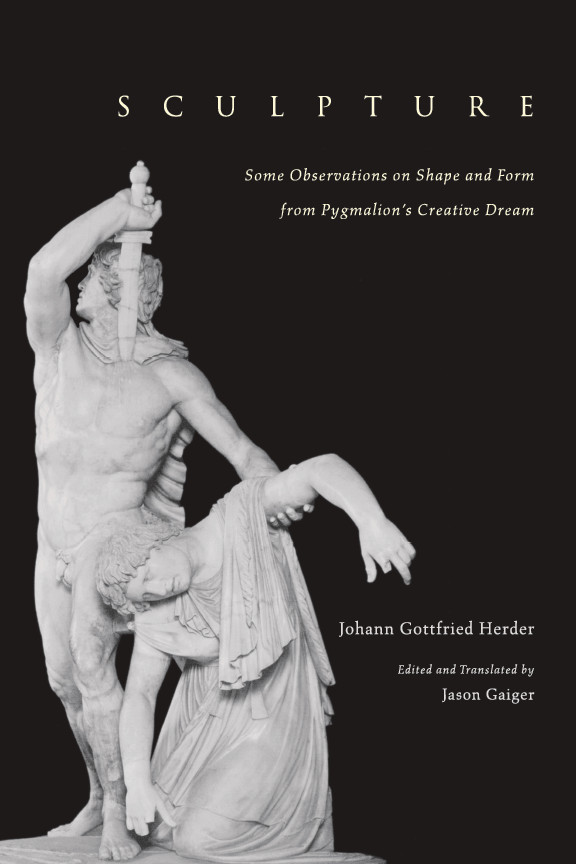
In the 18th Century, the German philosopher Johann Gottfried Herder wrote a vital book on aesthetics that shows light on this kind of art. It has been impeccably translated in a new edition from the University of Chicago.

978-0-226-32755-6-frontcover

The Publisher’s Page on this Book is Here.

In this book, Herder argues that sculpture is a representation of the human body, seen at the intersection of time and space — that three-dimensionality is just this intersection. Intriguingly, to observe this form of mirror, a human must walk around the sculpture, to see it unfold in time. It is a way of movement that anyone knows who has gone walking in the hills and seen their story unfold with each footstep, and sensed them moving behind one’s back. And what does a human see when his or her body is glimpsed within the earth, rather than within the sea, or on Gunnar’s shore?

elfin4Elves in the Their Kingdom

One also sees their sheep…

elfinElvin Ram

These effects are not just observable in the intestines of the stone, mind you. Even the surface stone, it’s skin, the shape it takes on exposure to the sun and human sight, is alive …

elfin6Elvin Sheep Skull with A Halo of LIchen

What do I mean by “alive” in this context? I mean that the stone has the power to cast forth shapes within the observing mind. It is a kind of template. The mind I’m talking about is a point of intersection between humans, earth …

lakeelves1 Lake Elf in the Spring Sun

Skutustaðir, Iceland

 … and with other wanderers from the sea, like these lichens …

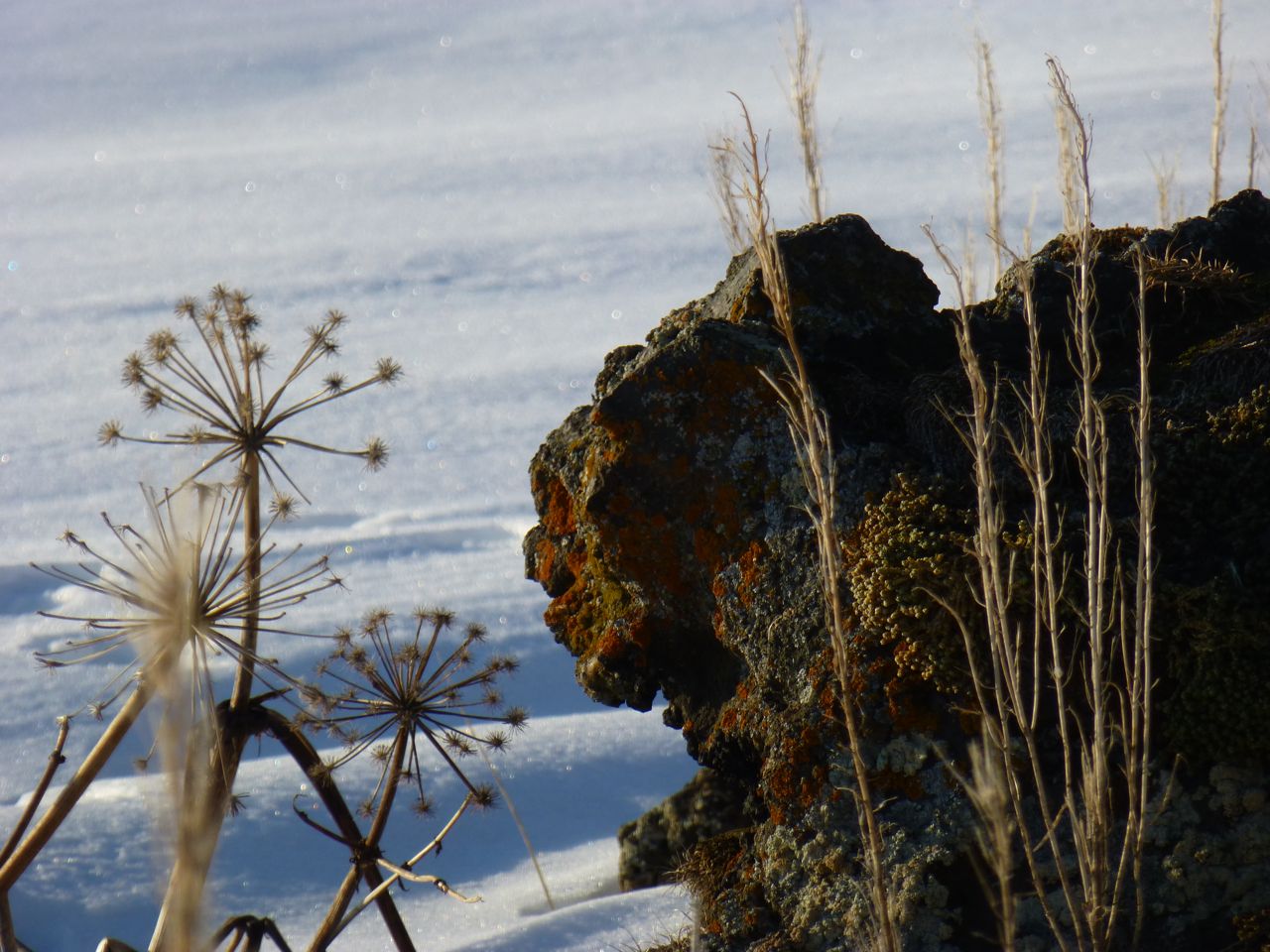
head2Lake Elf with Jewels of Lichen

The orange lichen blooms in the faeces of birds. Cool!

Even more dramatically …

elfsnow2Lake Elf Replicated in Lichen

Sometimes the patterns laid down by the stone allow for these type of human readings to rise directly from the lichens themselves, as the stone is read in time …

elflichen3Lichen Elf

Skutustaðir, Iceland

This is the way the human mind reads the earth. In contemporary terms, ‘reading’ refers to decoding marks on paper, which spell out words, which encapsulate ideas and signify the things of the world, all coloured by human “spells”, traditions, conventions, and cognitive biases. Reading the earth operates on the same principle, with the difference that it came long before spells and words, and is a way of “reading” or participating in the earth with the body, rather than with the mind. Gunnar’s anguish during the Great War was that the link to God had been lost, and that God cared nothing for his people, and was remorseless — as remorseless as nature. That is, in itself, a very modern reading, but in no way does it negate the physical context in which it stands, in which humans stand upon and within the earth, bring forth children upon it, and tell this most ancient story, not of earth as a shore of death on which life, or God, shall we say, crashes and breaks again and again like waves of untrained and disastrously led soldiers marching into the machine guns of the Somme, but is alive. Who are the other people? The question is absurd. They are our selves, built upon the forms of the earth, continually springing to life, indominatable, and enduring.

elfsnow

Tomorrow I will continue this discussion by extending it into the forms of human sight, the line, and the basics of art. Now, I’m going out to walk among the horses of Iceland. Bless bless!

The Sea is A Living Thing

aliveMeeting Life Itself, Skagafjörður

All the rest? The trees, the horses, the humans, the cod, the arctic terns, the chickens? They are all carrying a replica of life within them, but the sea is life itself. Instead of saying “life”, we could just say “sea”. And the land? Ah, now, now that is a story of humans and other people. I’ll tell it tomorrow. Here’s a hint to haunt your dreams while the night falls and the sun rises again …

e1Elf Stone, Goðafoss


The Architecture of Souls

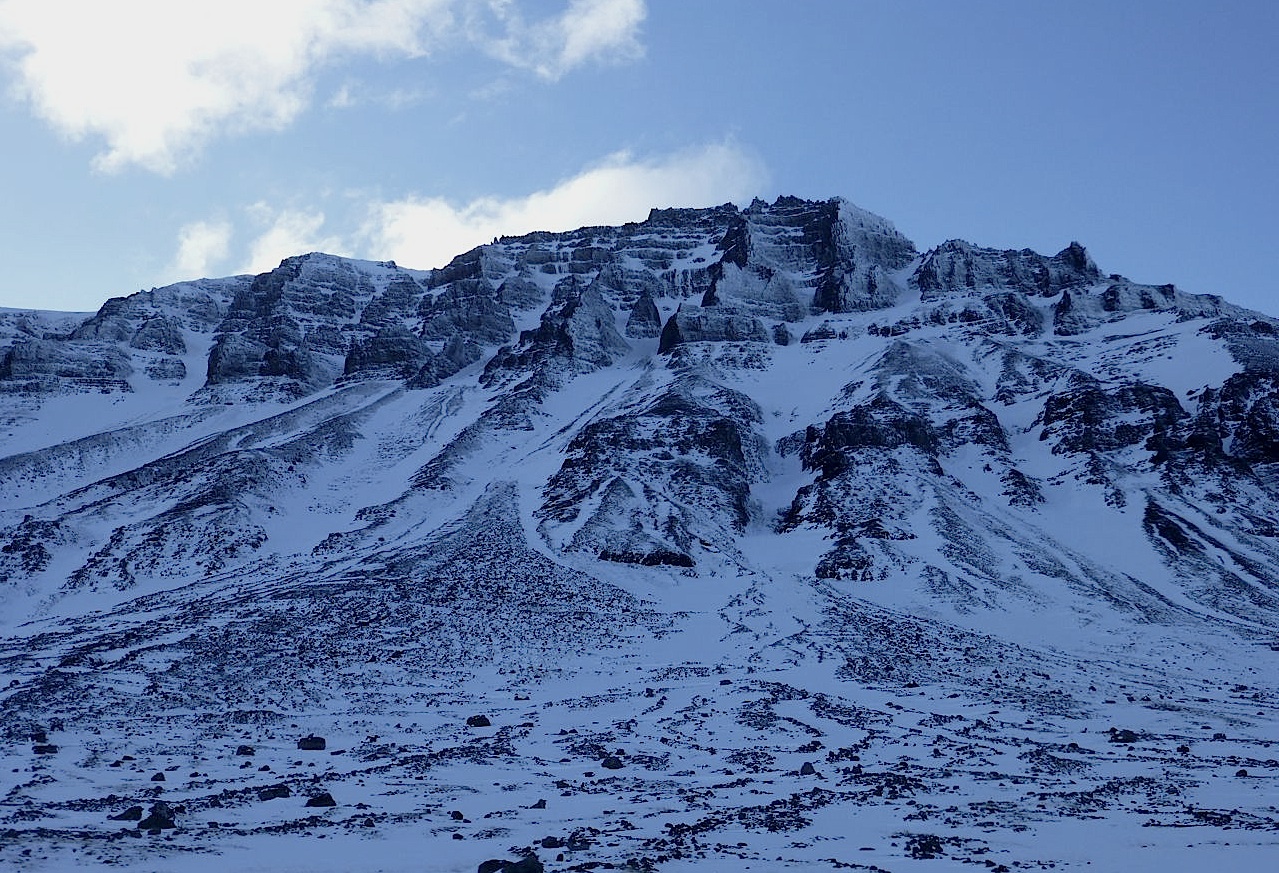
If you look at mountains on a human scale, they have presence.

blue22Volcanic Glass, Skjaldsvik, Iceland

If you look at mountains on the scale of a mountain, they have presence.

mtn2

Mountain in Late Afternoon, Skagafjörður, Iceland

If you look at mountains from a cultural point of view (in this case, Nordic mythology), they have presence…

sunset

Spring Sunset, Skagafjörður

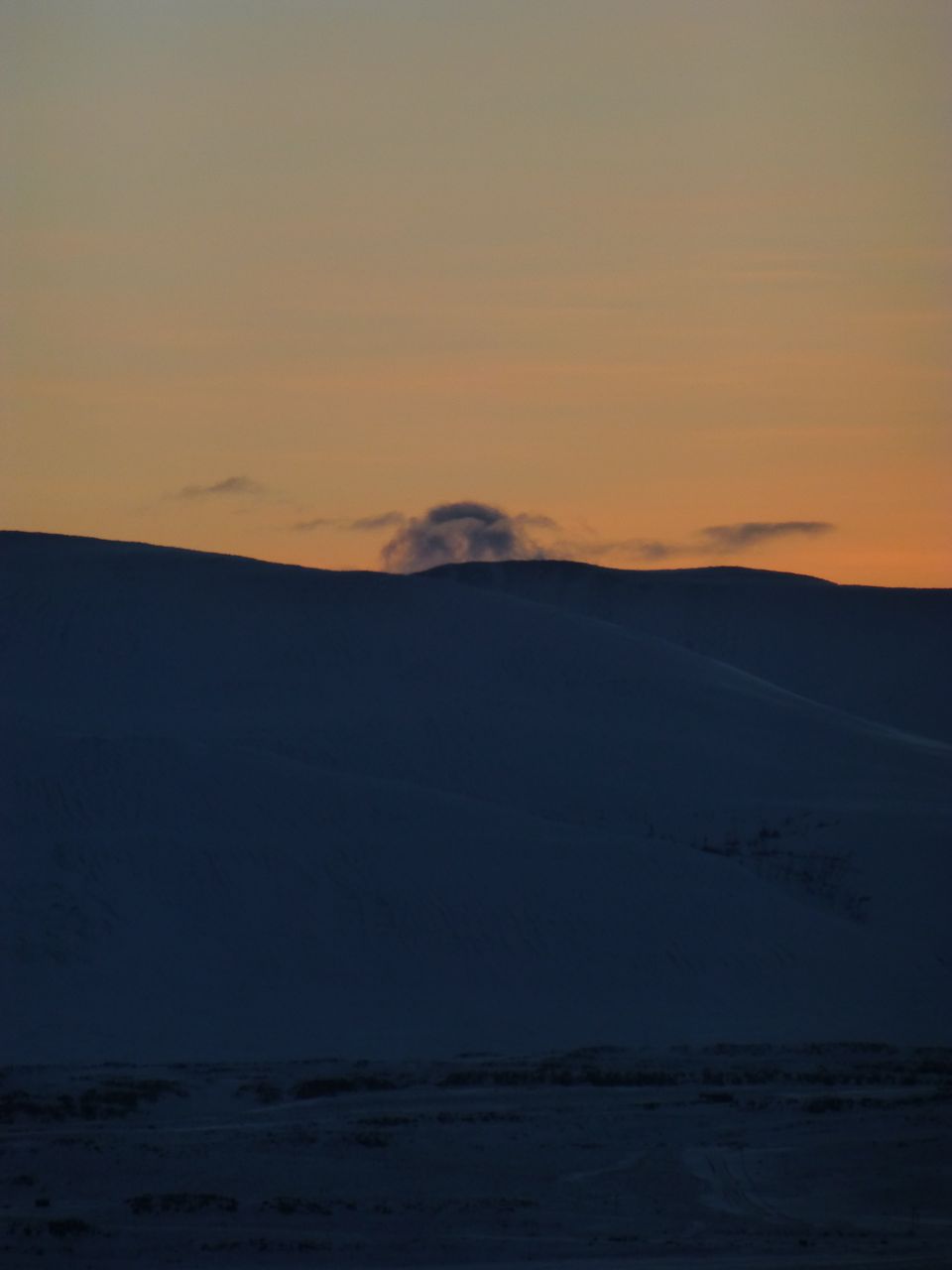
In this case, story unfolds in time, as the earth turns from the sun, which is just below the ridgeline. Here is the same mountain a couple minutes later …sunset2

Spring Sunset, Skagafjörður

And a half hour later, when the sun is behind the shoulder of the Arctic Ocean?

sunset4

Spring Sunset, Skagafjörður

The story continues through the northern lights at night, and on into the next day. Light is writing on stone and ice. If the mountains are viewed through Christian eyes, perhaps this is the spot for the centre of Christian life in Iceland.
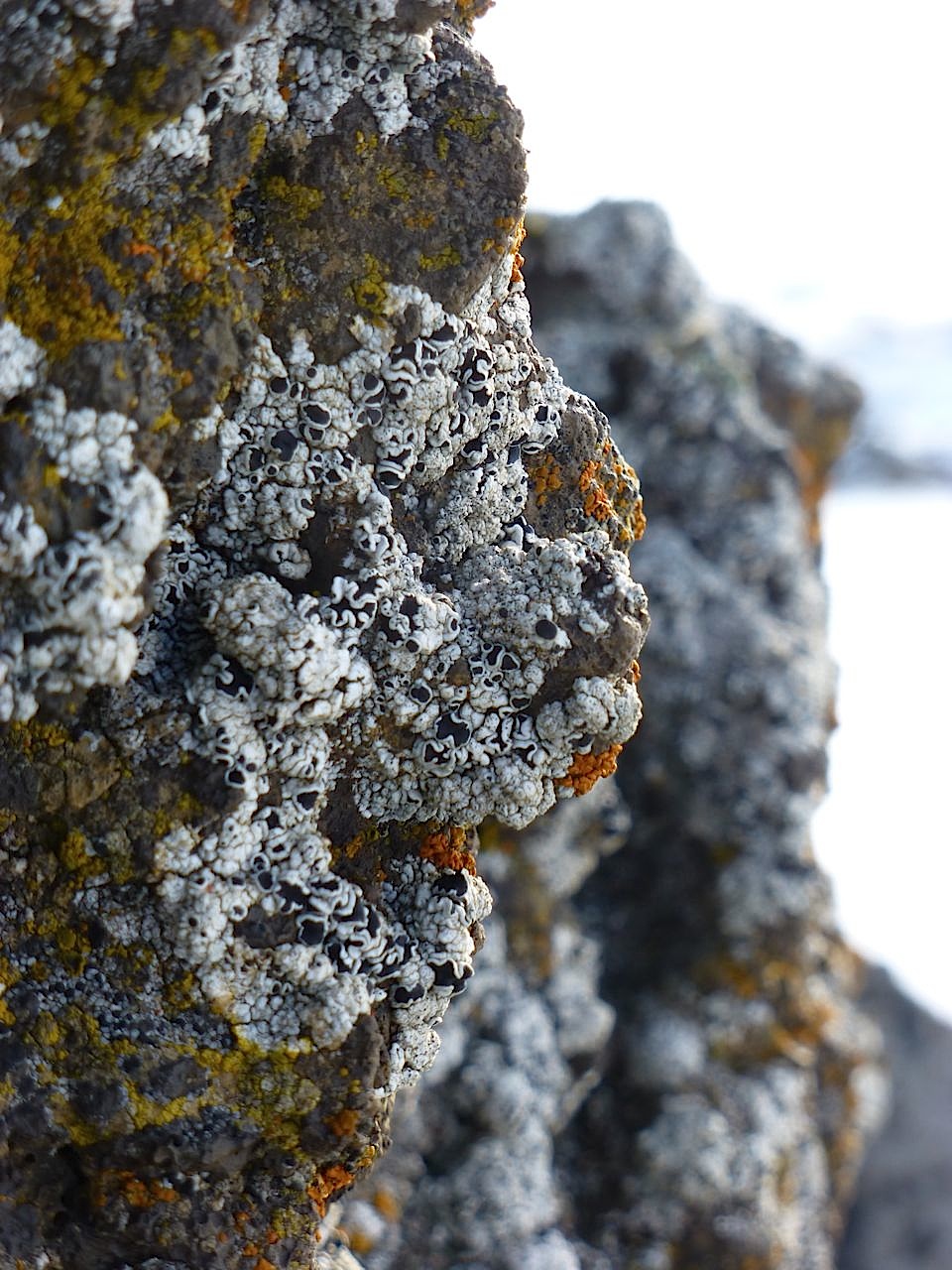
holar2Holar in the Distance

The Heart of Christian Iceland, Skagafjörður

If you’re thinking of print making or writing, you might as well think big. When your technology is the earth itself, it’s easy to think of the architecture of souls.
Gunnar’s Warning to the Germans

Look at the riddle Gunnar Gunnarsson told the Germans in 1940, just a few weeks before the invasion of Denmark and Norway and the resulting invasion of Iceland by the British and then the Americans:

It is far better for a man to recognize true inner human nature without touching it than through the words and behaviours people dress it in. Such a view into truth is far more vital than casual thought would have it. And certainly it’s no great sacrifice to hold to good taste and respect in all things. And since the talk is about sacrifice, our land has at least fully earned that, and our joy at its beauty will never be complete until these issues are ordered in such a way that gives no more ground for reprimand.
The text it is from a speech called “Our Land.” It can be read many ways. Here’s one:

fold

Turf Sheepfold, Reyðarfjörður

Here’s another, referencing each sentence of the passage quoted above to the argument Gunnar built up in the pages preceding it:

1. It is far better for a man to recognize true inner human nature without touching it than through the words and behaviours people dress it in.

Translation: Iceland has no history, except nature. Elsewhere (Germany included), nature is interpreted through the habits and clothing of people — in other words, through the changeability of time. In Iceland, however, nature is naked, and so are people: they are dressed in nothing, except each other. They do not exist in time — only in place. When one builds a bridge in Iceland (it is an example that Gunnar uses), one has to build it out of Iceland and not out of imported ideas, which sit within foreign customs and gardens rather than within nature itself, no matter how successful they were in other places. In Iceland, they won’t work. The land is not forgiving of any departure from its forms.

P1190151

Workers’ Housing, Aluminum Smelter, Reyðarfjörður

Gunnar would not have liked this.

2.  Such a view into truth is far more vital than such casual thought would have it.

Translation: Truth is untouched nature. It can be approached (and dismissed) casually, but it is not in itself dismissable. Nature is not the contemporary idea of “all things green”, nor the idea of “landscape art”, nor the notion of a goddess of nature called Natura. It is God: wordless, idea-less, unrepresentable and uncontainable. God is Iceland is Nature — or they would be, except God and Iceland and Nature have no names, and no words or ideas can be given to them, only drawn from them.

P1010427Streambed Near Njardhvik

3. And certainly it’s no great sacrifice to hold to good taste and respect in all things.

Translation: Just as with the sacrifice of Christ, good taste and respect (based on an underlying devotion to God) are not sacrifices but a practical good in their own right. Life flows in patterns. On earth (that is to say on “Our Land”), one lives within them. Land is this shore of life, which other people call a planet, and which yet others call countries. “Our Land” is a changeable idea. It really means, “Who we are.” That’s not a modern idea.

stream2

Ryolite Streambed Near Njardhvik

4. And since the talk is about sacrifice, our land has at least fully earned that, and our joy at its beauty will never be complete until these issues are ordered in such a way that gives no more ground for reprimand.

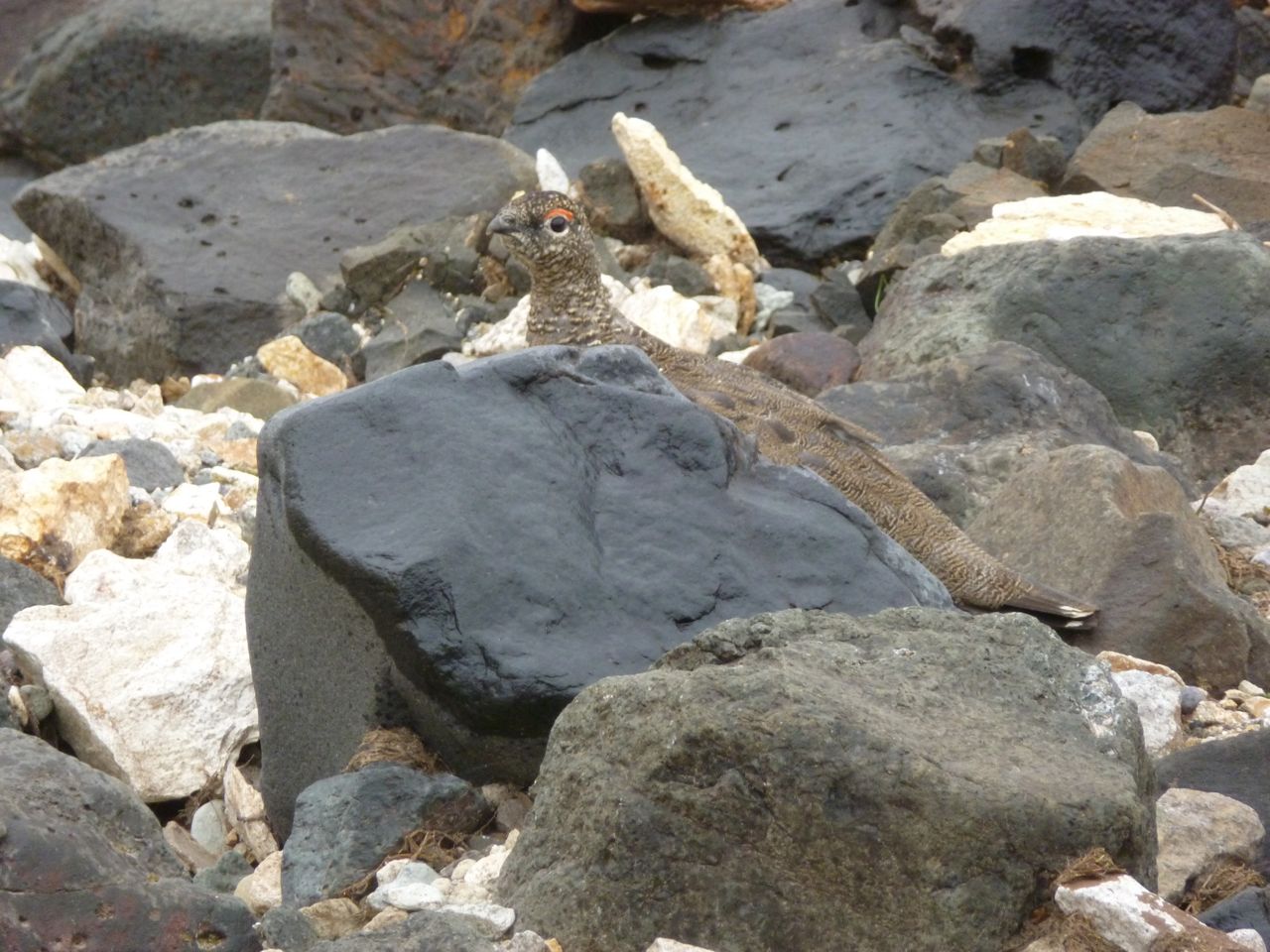
Translation: Iceland has earned the sacrifice of human desire to its eternal forms; all those wishing to speak of sacrifice must learn to do so in a way consistent with the forms of the shore, in the way water finds its path through the grasses yet still moves with great power. Societies can be repurposed. Land cannot. Any attempts to do so will destroy the society of humans on earth. The joy of Icelanders at the beauty of those forms will not be complete until human temporal constructions are ordered in a way no longer out of touch with the streambeds of nature. The bonds between humans and God — a bond called “Our Land” — must be respected, not with words or ideas or customs, but with bodies and with rock. Only the people of a place can build there. All else will fail.bird

Ptarmigan Waiting for Me to Go Away

It’s a remarkable thing to say, especially to a country in the throes of praise for the sacrifice of thousands of its young men in capturing Poland to provide, in the language of the times, land for nordic people, especially when Finland is falling and talk of Scandinavia’s strategic importance is in the air. Invasion plans have already been drawn up, by both the British and the Germans. It’s an especially remarkable thing from a man like Gunnar, who spent decades advocating for a pan-Scandinavian state and who earned his income writing Scandinavian books for a German audience enamoured with the idea of becoming Scandinavian rather than Mediterranean. It’s an especially pointed statement to a Germany that has just united with Italy, on the Mediterranean, especially when Italy, Norway and Iceland are the three poles of the world given in Gunnar’s speech. Did I say ‘speech’? I meant sermon.

christ

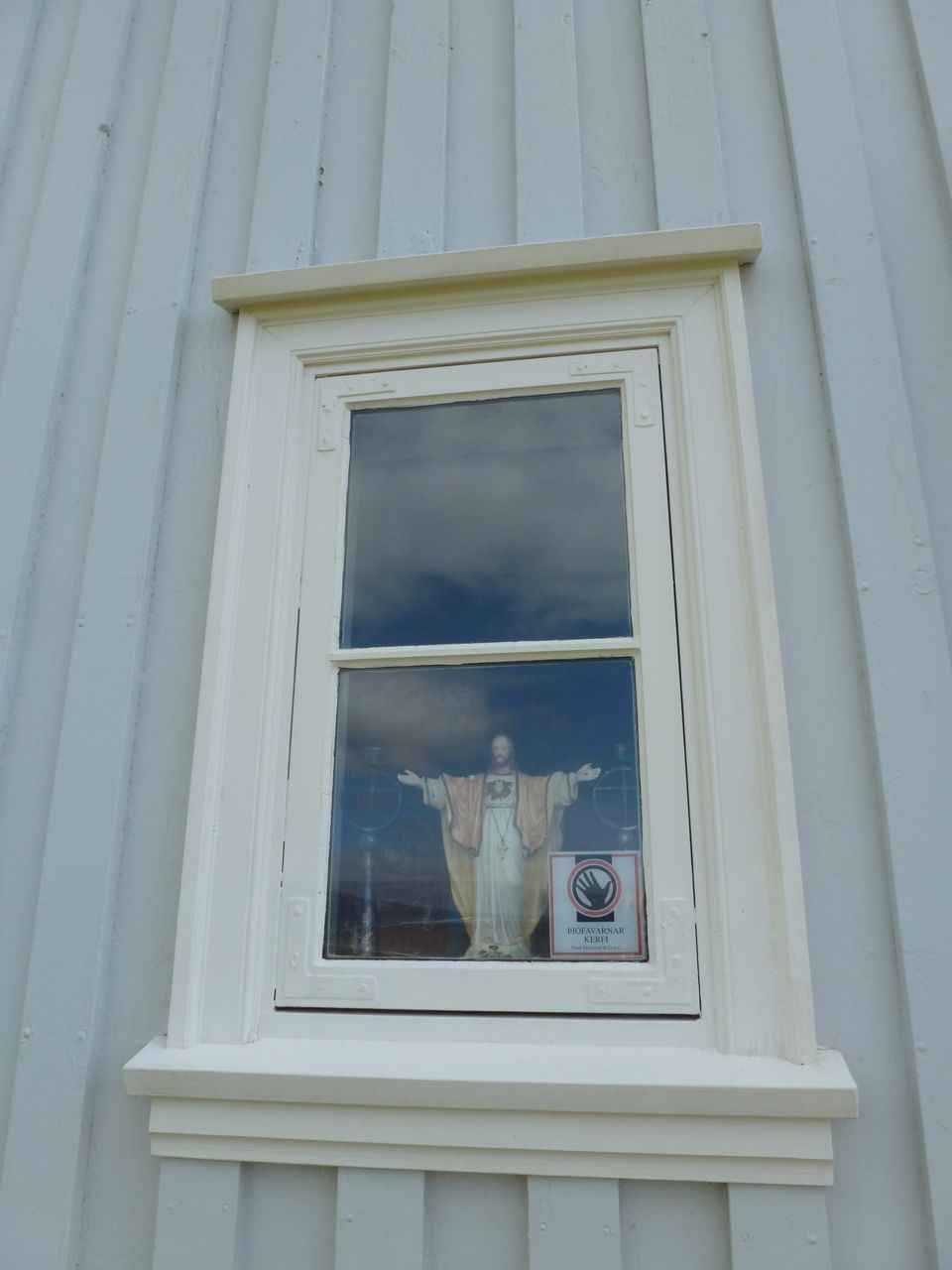
Two Security Systems Hard at Work and Ready to Embrace You. Strandakirkja

Choose the one that works for you.

Next: Gunnarsson as a Lutheran.

Trolls and House Building: A Field Guide

Well, not trolls exactly. And not exactly a house. It’s a bit of a riddle, but poets love riddles. Why, you could even say that on the northern shores of the world, poetry developed out of riddles, or that skaldic poetry did, at any rate. Here’s a famous Icelandic skald:

Egil Skallagrímsson, Skald

Ready to do battle with, what’s that, a rusty sword? More like a cleaver, I think. I have used things like that to pick cabbages. Poet farmers unite! (17th Century Manuscript from the Árni Magnússon Institute).

A scaldic poem is a ceremonial poem, given as a gift by a poet (a skald) to his patron, written in praise (or at times rousing criticism — very scalding, very scolding criticism). Scaldic poetry was worked through in intricate design and was intended as a verbal form of the intertwined patterning on a shield — a kind of protective magic. (The contemporary equivalent might be depleted uranium.) At times, skaldic poems were even recited before battle. They were part of the battle. An important part, too, that preceded the bloodiness.

374px-Öl1,_karlevi

The Karlevi Stone, Vickleby, Sweden

Photo by Berig.

Note the vertical columns of the scaldic poem above. As Gunnar Gunnarsson pointed out in Unser Land (the speech he read from during his 1940 literary tour of Germany), they are not much different than this:

pillars1

Basalt Columns, Vík í Mýrdal

A tightly-linked protective shield poem against the encroaching sea, written in the land itself. (Note: studies from Hawaii have shown that black basalt beaches like this form in hours, not centuries.)

Isn’t that cool? A poem that is the land? That is the riddle Gunnarsson was speaking from: his house is Iceland; Iceland is his house. If that sounds a little unusual, do recall: he’s a poet; he’s not really thinking in metaphor. Mostly, metaphor is for people who are not poets. It’s a useful way, for sure, of describing the work of poets, but it does do so without really accepting the poem as the reality of the world, which is the poet’s way. In the case of Gunnarsson’s house and island, that work is performed in skaldic poetry, which makes his house a shield as well — and not just a shield, but an ornament, too, like this, maybe:

h2_1992.59.1

Viking Broach, Sweden

Men might have wanted shields, to protect their bodies in battle, but, perhaps, just perhaps, women wanted something to hold their garments together at the shoulder, something that was as protective as a shield, something with an island in the centre and the four points of the compass around them, something that would set them at the middle of the world. In Sweden’s case, that would have been North for the Trail to the North (Nor’way), South for Denmark and the trails down the Rhine, East for Finland, and West for the Orkneys — and if you just kept going, going, going, going (whew) … aha! In the middle of the ocean… Iceland.

Once people arrived in the middle of the North Atlantic, the compass shifted. Iceland was now at the centre of the world. The other points of the compass were adjusted accordingly, to reference it. Since all directions led to water, however, Iceland became the entire earth, floating in the universe  (which was a big, cold sea). The country is still roughly divided into these quadrants.

icerecoloured

Iceland, the Compass Version

The shield and compass pattern extends beyond maps. For example, if you really wanted to get into the whole magical side of things, and weren’t squeamish about a little darkness in your life, you could play around with something like the following (You could even write it in your own blood):

2000px-Vegvisir.svg

Vegvisir

An Icelandic magical stave. Staves come in many shapes and were drawn for many different purposes.This one is a compass written in magical symbols, and was used to find one’s way in bad weather.

For such a stave to work (if it did), such navigation would not be done by the physical properties of the land, but by spiritual ones — and we’re not talking Christian-spiritual. In the high days of the Christian Church in Iceland, the possession of such staves could have had you condemned as a witch and beheaded at Þingvellir. That might have been awfully un-Christian, too, but, still, even today, this kind of magic is not advisable. When the Germans tried this kind of thing in the 1930s, for one thing, they invented the 1940s, which turned out to be a really bad idea.

6a00d83452a98069e200e54f76d8928833-640wi

Dresden, February 1944

Among the 20,000 people killed in the Allied bombing of Dresden and the millions of German refugees who streamed through it shortly afterwards on their way south and west from the Baltic, were untold numbers of readers of Gunnar Gunnarsson’s books about Iceland.

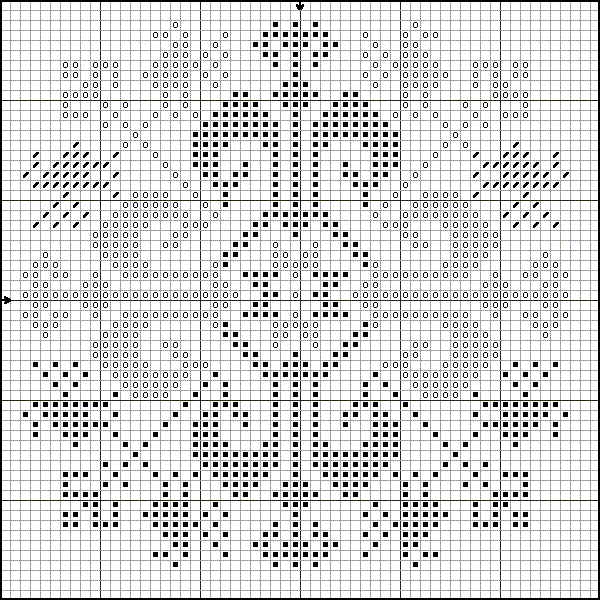
The pattern of land-as-compass-as-shield continues further, into practical applications of gentler spiritual principles. This time, they are placed in the interests of nationalism, where it’s not black magicians in the West Fjords or Ancient Viking ancestors or ultra-Nationalist Germans trained in the killing fields of The Chemins des Dames who are leading the way to a nation, but young women, quietly fitting their minds to the old patterns, to create a little beauty and order out of the blank, snow-white flaxen cloth woven out of the country’s fields. Think of these as self portraits…

icesymbl

Icelandic Needlepoint Pattern

Flowers, yes, but also a hand-held mirror lifted from a dressing table, as well as the old compass, the old shield, the old broach, and the old skaldic poetry, too. Not to mention Gunnarsson’s house. Yes, the house.  Such a pretty thing. Such devotion.

If you think I’m stretching this, consider that five centuries ago in the cloister below Gunnarsson’s house at Skriðuklaustur illiterate young women would have made embroidery of the flowers of the fields. It was a form of prayer, practiced between caring for the sick. Such devotion was the unique Icelandic contribution to prayerful attention and worship, in the way that the repetitive painting of icons of saints was an essential contribution to worship in Russia.

christ-icon-cc-phool-4-XC

Christ Pantokrator

6th century encaustic icon from Saint Catherine’s Monastery, Mount Sinai. The power comes from about fifty coats of paint and the deliberately non-representational nature of the image. God, after all, can’t be reproduced in an image, so trying would be arrogance. Accordingly, such images aren’t representations of God. They are God’s presence, revealed when people devote themselves to old patterns.

The repetition and patterning were key. For example, just down the valley from Gunnarsson’s house at Skriðuklaustur, the old girls’ school at Hallormsstaður trained girls in Icelandic embroidery, as one part of a project to create a culture in Iceland independent from Danish influence. If the home was the heart of the country, and women were at the heart of the home, and the country was its children, then Icelandifying young women would, it seems, pay future dividends. Politification (My, aren’t I inventing words today) of national identity could follow at its own pace.

hallormsstadur

Icelandic Nationalist Embroidery, 1930s, Hallormsstaður.

The doors of the rooms in the school dormitory bear the names of trees, instead of numbers, and are set within a somewhat overgrown botanical garden. Such gardens were decorative in mainland Europe. In Iceland, they are a more practical magic. 

The embroidery above is much like a map of Iceland. When you get down to ground level, after all, and experience the map that is Iceland on a human scale rather than an international or global one of contours, nation states, trade patterns, colonies, weather isobars and even corporate banking, Iceland does look like this:

p1190188

Iceland at Ground Level, Neskaupstaður

The embroidery of summer!

This beautiful meadow, may I remind you, is still our shield and still our skaldic poem. It’s also Gunnarsson’s house, his novels, and the workings of his subconscious and conscious minds. Skaldic poems are full of doubling like that. We’re back to this:

His house is Iceland.

Iceland is his house.

Very skaldic, indeed. Of course, in physical terms, when this skaldic play comes to Gunnarsson’s house, the whole thing does look awfully German.

P1020160

Skriðuklaustur

The German architect, the Icelandic stone, the grass roof…why, it’s an island itself. An island in itself. An island. Itself. German….German? That’s the riddle within the riddle. 

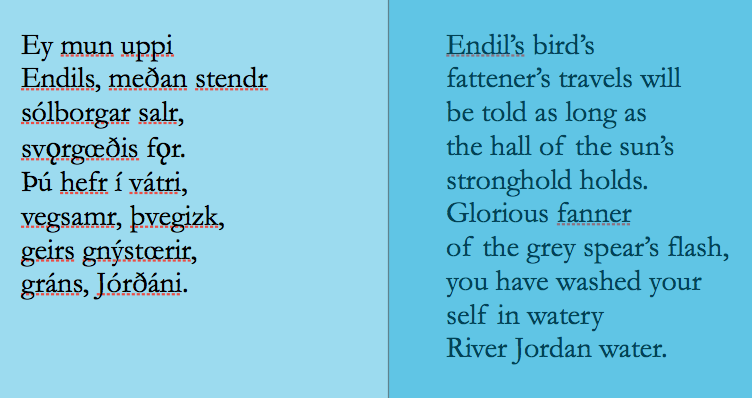
The poems are our key. The first form of doubling in a skaldic poem is a kenning. Kennings are natural word forms inherent in Germanic languages (Frisian, Icelandic, Norse, English, Danish, and so on). Speakers of these languages use words like that all the time. Some English examples are: butternut, windowsill, firefly, and doublespeak. In kennings, this tendency is made artful. Each kenning is a miniature poem in itself. Take the land, for instance, such as that forming Iceland. Take a look at the series of kenning’s below. The earth is cleverly hidden with them, or perhaps cleverly revealed. The delight in recognition is part of the magic of the poem. Can you find the earth there, in its sea? (The translation [mine] is loose, to try to catch some of the music, but it’s not wildly off track, or at least not enough to hide the earth any more than it already is.)

endil2

Skaldic Poem Made Out of Kennings

The earth is “The sun’s stronghold”. The others? Well, hey, it’s a riddle, right? Source.

So, that’s the first doubling: words are given multiple meanings by being joined together. In the example above, the earth is both rock and stone as well as “The sun’s stronghold” (as opposed, seemingly, to the darkness of death, underground, and the land of the salmon, or water).  The other doubling comes about because the rhyme schemes of these poems were so intricate that the poem often had to be split in two columns, one representing each of its two speakers. Two speakers? Yes, that is another old Nordic style of poetry. Here’s what it looked like in its Finnish variant…

These two Finns are singing the Kalevala, the national epic of Finland

Finnish Folk Singers, Telling a Song Together

Each singer pulls the other towards himself to speak, then follows the other to listen, to pull again. It’s like rowing, or weaving.

Such poems looked like this, sometimes (the first line in each rhyming pair was given by one speaker; the second by the other… a pleasant game, for sure):

kalevala1

The Kalevala, Canto 27 (Opening)

Finnish is related to Pictish (and nothing else), the language of Scotland before the Vikings took the place for their own.

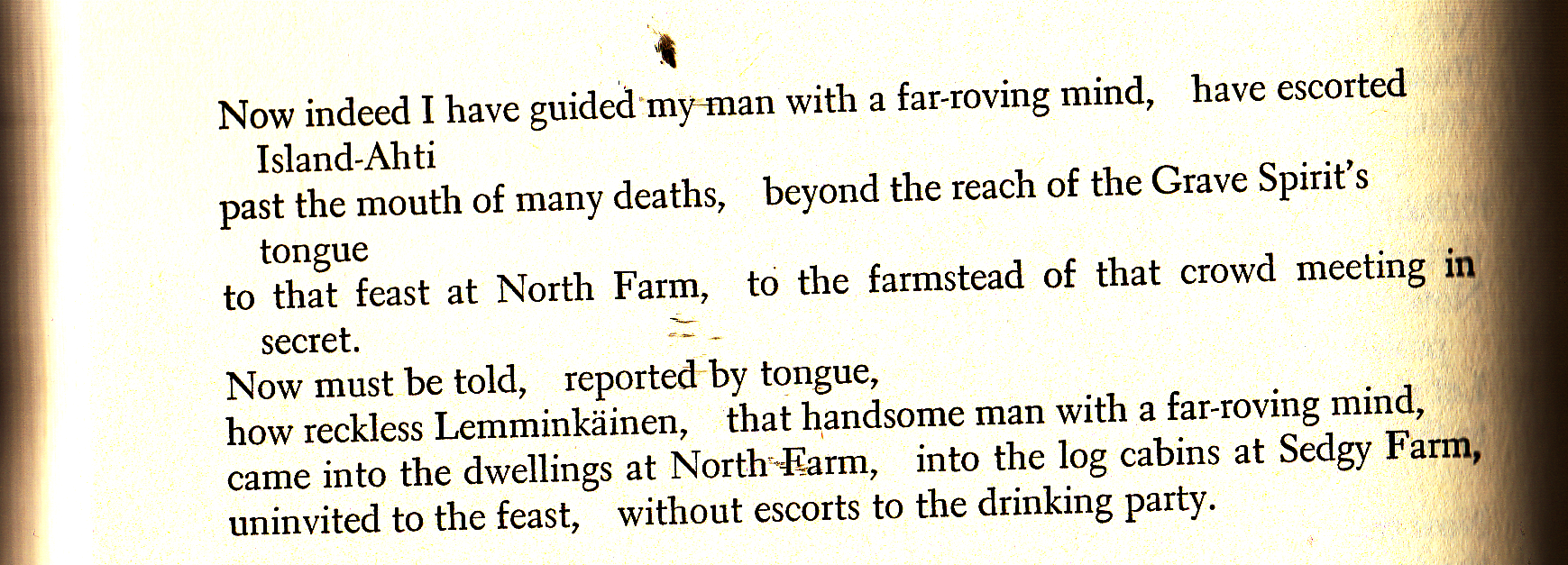
Here it is again, in English from the time of Gunnarsson’s youth. This time, the rhyming pairs are bound on single lines (to draw parallels with Homer, by the sounds of it):

27The Kalevala, Canto 27 (Opening)

Finnish folk poetry, compiled and massaged into a narrative by Elias Lönnrot. Translated by Frances Peabody Magoun, Jr. Homer was extensively read in literary circles at the time.

Two speakers. That’s the key here. But who are they? Ah, they are many things, many of which I have already hinted at here: Iceland and Germany, Gunnarsson and Denmark, Elves and the Church, earth and language, men and women, peace and war, individual and state, man and God. It looks like many things, but that’s just a linguistic convention. It’s really all part of the same conversation — if those words could be brought together into one tightly compressed thing, we would have Gunnarsson’s house. Let’s not forget that Gunnarsson was an Icelander. For a man like him, the word ‘thing’ has special significance, and looks like this:

P1190592

þingvellir, the Thing Place

Iceland’s first thing, or speaking (In Icelandic, Alþingi. In Norman English parliament), took place here in the Mid-Atlantic Rift in 930. In 1000, the country chose Christianity here, for practical reasons to do with unity, self-determination and self defense.

Below the Icelandic flag above, there is a church, and a curious collection of houses…

P1190582

þingvellir Church, 1850

The earliest church on this site dates from the early 11th century. The row of five houses to the right of the church represent the Icelandic state. Each time the constitution has been rebuilt from the ground up, a new house has been added to the row. The one house that is not represented here, is the one in Fljotsðalur to the North East. That’s right: Gunnarsson’s. Hey, no one said he was particularly modest. The volcano, Thor’s Shield, rises faintly in the background, from the earth’s core.

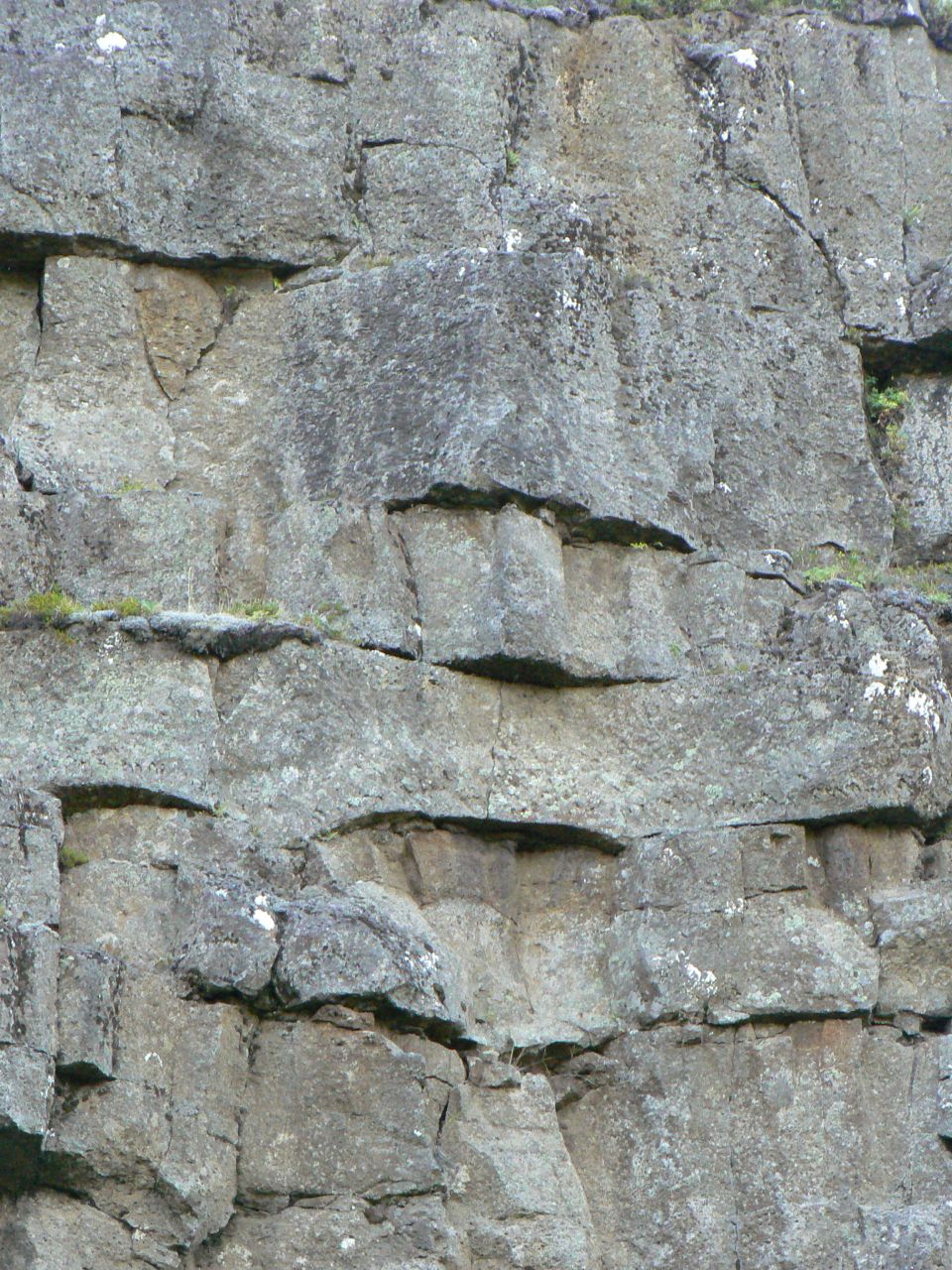
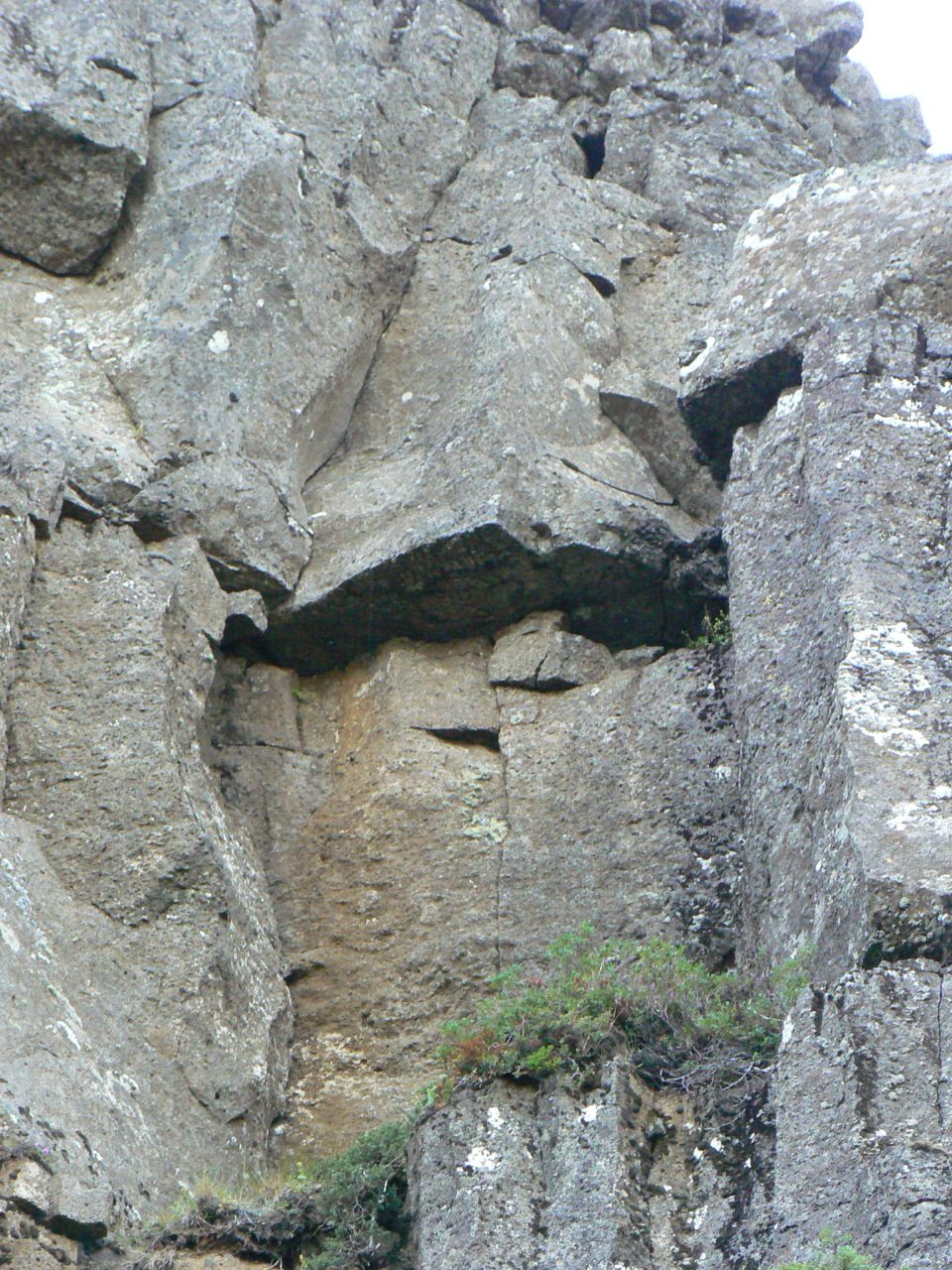
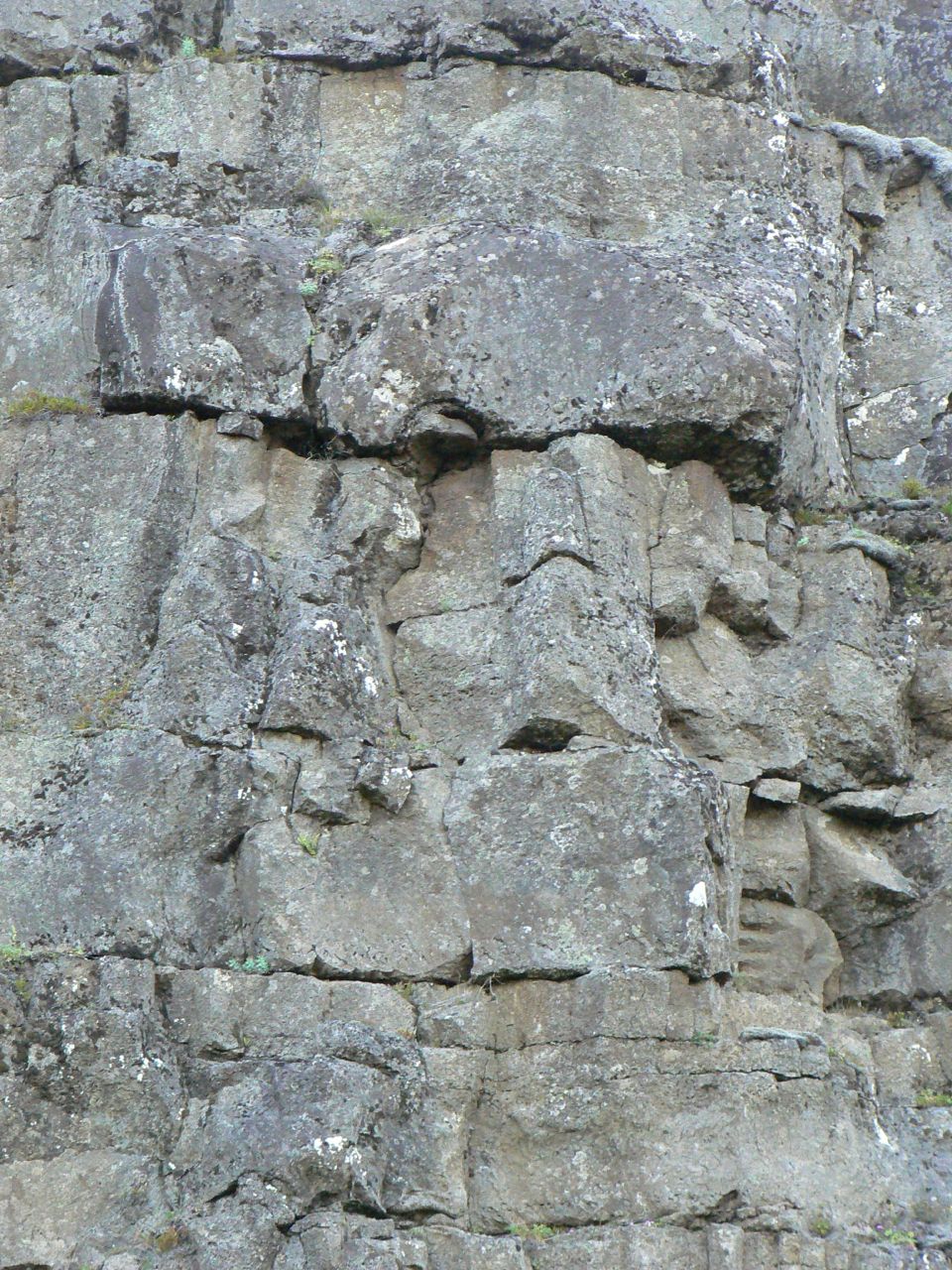
I was standing down by the church, looking up at the Alþingi site and wondering why it was placed here, of all places. Official documents point out that it was on a list of four possible sites, and was chosen because of the four it was the one situated conveniently on the country’s major trade routes (horse paths), and had sufficient pasture, water and wood (for fires) to sustain a large crowd. Makes sense. But why was it on the list in the first place? I wondered, then I got to daydreaming, as poets sometimes do, and thought about being a kid back then, attending the Thing with my family, and I looked up at the cliffs and they came into focus.

P1190629_2

A troll!

P1190612_2 Another troll!

P1190621Yet Another!
P1190625

Trolls Everywhere!

And all of them are looking down over the people. You could say that the land is taking part in the discussion that is taking part in the Thing. You could say that now the past is watching the present, and looking down over the house that is Iceland, which is embedded in that past. Time and space are unique here. They are a language. Since that’s an unusual language, at least for the contemporary, novel-driven world, it’s useful to walk through its halls a bit, to see how they’re constructed and where they lead. I’ll do that in the next post. We’ll walk among elves and dwarves and trolls. They are not part of fairy tale. They are something completely different, and provide clues to the mind of Gunnar Gunnarsson in 1940. It’ll be fun. I hope you’ll come along.